Rudolf Steiner, Dornach, Switzerland
August 14, 1921
We have now put together a number of building blocks that should be suitable for erecting a kind of building to penetrate deeper into the essence of the human being through this building of contemplation. In order to proceed from the discussions we had yesterday and the day before yesterday, it is necessary that we expand our considerations today to areas that we have touched on, in such a way that we consider the soul-spiritual, which of course works in man, and the bodily-material, which also works in him, in connection. In the scientific development of modern times, it has become difficult to combine this view of the interaction of the spiritual-soul and the physical-material in the human being in a fruitful way, because modern man actually only knows a duality in this area. He is familiar with the material world and its effects and configurations, and then he also looks at this material world in the human being. He looks at it in the human being by studying physiology, chemistry and biology. Certain views then arise from these studies and are absorbed into popular consciousness. People cling to them with a certain tenacity, and it must be emphasized again and again that even those who, in their Sunday best, still live in old traditional religious ideas, fully recognize as authority what popular science says about the physical body of the human being, perhaps even more so. On the other hand, certain people do have ideas about the spiritual and mental. But these ideas about the spiritual and soul are so abstract, sometimes they are actually just empty words about something that was once known more precisely, but the knowledge of which has been lost, so that not much can be done with them. People today do talk about thinking, feeling, and willing; they talk about imagining. But they do not really have any experiences of these things. One might say that words have been handed down and humanity clings to these words without associating much meaning with them. One also sees that his game is introduced into the literary works on psychology and the like that appear today, where thinking, feeling and willing are nothing but empty abstractions.
Then people realize that on have the material view on the one hand, which they cannot deny because they have eyes, hands with which the material can be grasped and seen, because they have scales with which it can be weighed, because they can measure and the like. Thus, the material is recognized as such from direct inspection, from sensory perception.
On the other hand, people do speak of a spiritual soul, but in the way I have just discussed. And then they cannot somehow find a relationship between this spiritual soul and the bodily physical, the material physical. All kinds of theories have been proposed as to how the spiritual-mental is supposed to interact with the physical-material. But all these theories are just figments of the imagination. Before gaining insights into these things, it is absolutely necessary to be able to look at the whole person. In the whole human being, it is ultimately the case that no expression of soul or spirit occurs between birth and death that is not accompanied by a physical manifestation. And when we speak of the physical and the spiritual as opposites, we are talking in abstractions, for it is the same thing seen from different sides. But this is not realized, that it is one and the same thing, and one sees only the difficulties in constructing a theory of how the two interact. But only what we grasp in a truly heightened, trained observation is what helps in this field. And for this it is necessary to draw attention to the things that arise in such an observation. It is natural that a certain schooling in the sense I have described in “How to Know Higher Worlds” must precede exact observation in this field. But if one has the goal in mind, if one knows what has been observed there, one can indeed make use of one's common sense, if one really wants to, if one is willing to follow the ideas that are then brought to light through spiritual scientific observation, in their content properly to pursue.
These ideas are of course always such that, if you apply to them what is familiar to you from ordinary science, then you will not keep up. You have to get involved with the ideas that are given. But you can always get involved with ideas using common sense. Ideas could come from the most unknown worlds; if they are there, one can engage with them. If only the experiences from the corresponding worlds are really brought into such comprehensible ideas, then one can engage with them. But one must rise to that, for which one does not need occult training: to grasping ideas.
Of course, most people today are unable to do this, and least of all today's scientists. They are accustomed to having ideas only when these ideas are borrowed from the external sense world. And they are willing to engage in mathematics at most, but otherwise they do not engage at all in grasping ideas, which are then pursued from within, just as mathematical structures are pursued from within. Everything that the humanities scholar brings can be followed if one develops the will to engage with such ideas, and in fact one can verify everything conceptually. But one must want to. To do this, one does not need occult training, but one does need to overcome what one takes on board as recognized scientific methods of thought, which do not coincide with common sense, because they have produced the habit of thinking that only what has a correlate in the sensory world is valid. Today we have to develop a number of ideas that can lead us further in the considerations we have gained. When our imaginative life takes place, when we imagine, something is going on in us. And what is going on there is not the abstract process that is often described today, but it is a process in which something that is called material processes is also alive. One does not become a materialist by pursuing the spiritual into its material effects, one only becomes a materialist by rejecting the spiritual out of prejudice.
As soon as one becomes fully aware what actually takes place in the soul when one thinks, when one visualizes, then one will gradually be able to arrive at an inner grasp of the soul-physical process that is taking place, even without occult training. And this soul-physical process of thinking, of imagining, is one that, even in its soul characteristics, shows that it is the opposite of another process. Just try to find, in the realm of ordinary consciousness, what the opposite process of thinking is. It is the process in which our thoughts fade away, where we become incapable of pursuing thoughts in a bright, clear way, where, in other words, what we call consciousness in ordinary life ends, at least where our control over what we call consciousness in ordinary life ends. Now you can see how this counter-image of thinking has a physical correlate: Wherever the actual growth process, the process of becoming in us, the process of nourishing and growing, is particularly strong, the thought element, the element of imagination, recedes. You only need to look intelligently at the lively organic growth activity in the first years of childhood. This growth activity is particularly vivid then. But thinking is only present in the germ, at least the power of the human being over thinking. Or follow disease processes through which, as in feverish phenomena, the organic activity becomes particularly vehement, where it becomes intensified, there the conscious control over the life of imagination fades away.
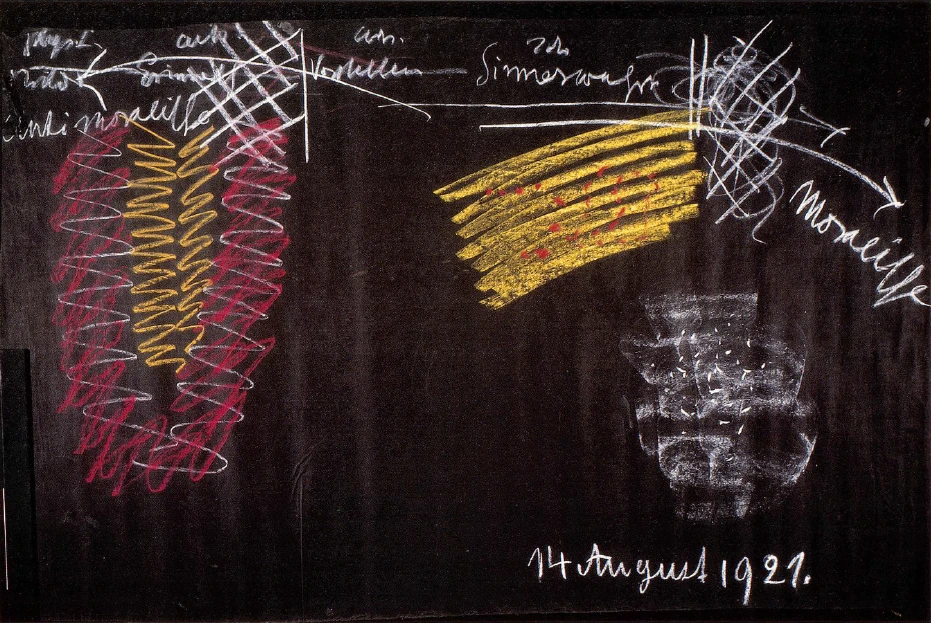
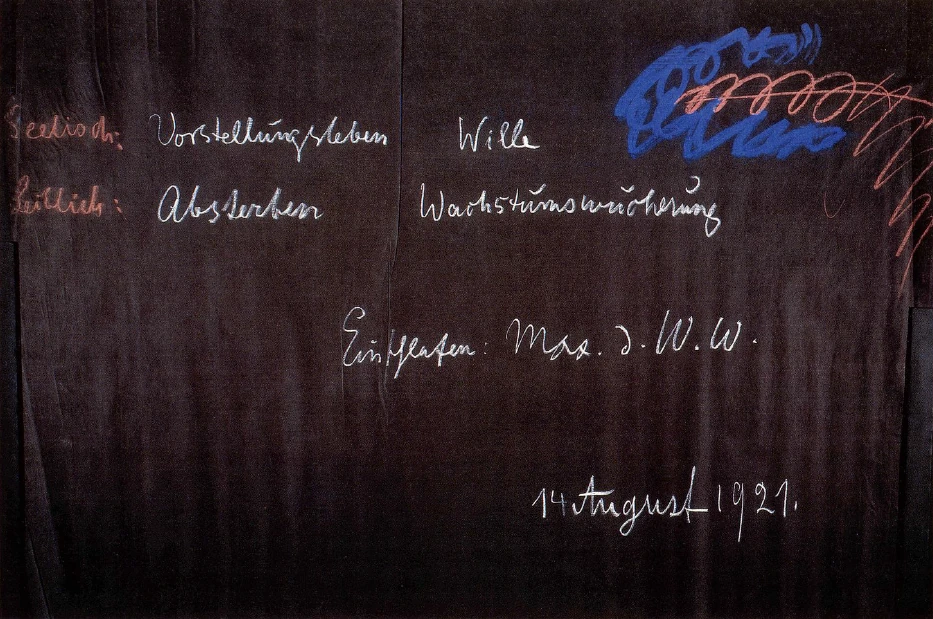
We can see a contrast that we could describe in more and more detail, but I would like to point out only the main lines. One is the life of the imagination; we understand this primarily in its spiritual aspect. The other is the life of growth. In order to point out more clearly what is actually involved, I will write “growth proliferation”, since the contrast is now more physically grasped.
But try to go further from this starting point. Remember that I have often pointed out how man, in his ordinary consciousness, only has this bright, clear day-consciousness, which he carries from waking to falling asleep, through his life of ideas, while what goes on in us when we develop the will plunges into a darkness like the life between falling asleep and waking up. We sleep, as I have often said, not only completely from the time we fall asleep until we wake up, but we also sleep partially for our will activity when we are awake. Everything in us that lives as a volitional activity is actually shrouded in a state of sleep. We are aware of our intentions, our volitional motives, when we want to raise our hand, but we relate to what is actually going on inside us by actually raising our hand, that is, by unfolding our will, just as we relate to ourselves when we are asleep. What is actually happening? What is actually going on?
What is going on is this: What underlies the will in us organically is to be found below, in the growth processes that remain unconscious to us. The will has plunged down into the growth processes. Everything that proliferates as growth in us is at the same time akin to the will, is a growth process when viewed externally in the body, and will when viewed internally in the soul. So we can already see how the growth proliferation, like everything that lies within the currents of strength that express themselves in growth, in nourishment, in life itself, is akin to the will. If we look at it from the soul, we can say that it is connected to the will.
Now, if we look at the human being between birth and death, we see that what we call our will is an abstraction in every single activity. This will does not run separately by itself. There is always a metabolic process within us, a process of growth, a process of nutrition or a process of malnutrition, in which the will unfolds. In a lesser degree, the same thing is present that, let us say, extinguishes consciousness in a particularly heightened growth or life process. That is why our consciousness is also extinguished in the actual region of the will. This region of will is where the growth proliferation is; therefore it is in the unconscious. We must therefore distinguish in ourselves as human beings an area - I am drawing it schematically, of course - where the growth proliferation is, and in this growth proliferation, which does not fall within the scope of ordinary consciousness, the will is rooted. But this is actually one thing in the concrete human being. Only in thinking do we separate the will from this growth proliferation.
Another area that we have initially only considered in terms of the soul is that which encompasses our thinking. This thinking, this imagining, develops either in connection with external ideas or through the process of remembrance being transformed into imagining when experiences are remembered.
Now, in our soul we can basically see very clearly that this life of imagining is the opposite pole of the life of will and also the opposite pole of the life of growth, of the life in the organism in general. This thinking life, this life of imagination, is precisely where we are fully in control of ourselves, where we string together our ideas, where we analyze and synthesize within the life of imagination. We can contrast thinking with the will. The will, in its essence, is completely unconscious to us. We now know that we are unconscious of it because the will is rooted in growth, in the processes of life, in the processes of metabolism. Thinking stands opposed to the will. We have it under control.
However, in the moment when the spiritual researcher advances to imagination, it immediately becomes clear to him what is actually present in thinking. For just imagine this process that the human being undergoes, who advances from ordinary thinking to imagination.
Ordinary thinking is abstract. Man, in thinking, is conscious only of the life of thought (yellow). When, through the methods I have described in “How to Know Higher Worlds,” this thinking condenses into imaginative life, then the images of imaginative life arise. But it is understandable that nothing that takes place in the soul, that is, is experienced, does not also have some kind of physical correlate in ordinary life between birth and death. One perceives something in oneself when one ascends to the imagination. And what one perceives is precisely the process that takes place in thinking in general, because this imaginative cognition is only a further development of thinking. I have already said that the facts about a person do not change when one ascends to higher, supersensible cognition. One only learns to recognize what is always present in a person. What one learns to recognize always happens, but one does not know it with the ordinary consciousness. If one now has the images in the advanced consciousness, then one knows that certain figural deposits, correct material deposits (red), correspond to these images in the human organization. These correct material deposits are always present in man; they are just not noticed. For what one experiences in the imagination are not new deposits, but the imagination only enables one to see the ever-present deposits. One would not be able to have imaginations if one did not see in a certain way - one can hardly call it 'seeing' - if one did not become aware of these deposits, because the imaginations are reflected in these deposits. One then notices that these deposits are present even in ordinary thinking. They are connected with the delicate organization of our nervous system and with that which belongs to the nervous system. They constitute the nervous system. The life of our nervous system depends on these deposits. As I said, they remain unknown to ordinary consciousness. They are recognized by imaginative consciousness.
This concludes a series of considerations that can be undertaken as follows: the life of imagination is opposed to the will. But the will is bound – as can be experienced through such considerations as I have presented to you – to growth proliferation. Now we can consider: So the life of imagination is bound to the opposite of growth proliferation, to dying away. And indeed, what takes place in us and what is, as it were, inwardly perceived in imaginative knowledge, is the falling out of the material as organic matter from the process of growth proliferation.
Soul: Life of Imagination
Will: Death of Growth and Growth
It is indeed the case that we have within us the process of growth and proliferation, that is, the process of metabolism, and dying matter is constantly falling out. We are continually being filled with such dying matter by thinking. We perceive this dying of matter when we ascend to the imagination. And our thinking, our imagination is bound to this dying matter.
It is really the case that we human beings carry the metabolic process within us, the dissolution and composition of the substances and so on, that the life of the will lives in it, and that matter continually dies within itself, that is, that it excretes parts that are no longer included within its organizing forces. Inorganic matter is constantly being eliminated from the organic, and the life of imagination is connected with this falling away. If the growth process, the metabolic process, becomes overgrown, our imaginative life fades. If this dying process predominates, then our ideas become increasingly rigid and pedantic. It cannot be expected that a person without occult training can easily arrive at such self-insight; but he could arrive at it, he can come to a self-insight through which it becomes clear to him: just as when his consciousness fades away in any way, even if only when falling asleep, there is a victory of the growth and metabolic forces over those forces that underlie this inner activity and dominate the thoughts. But one can also perceive, if one is only unbiased enough to acquire such inner self-insight, how an inner fatigue, a lowering of matter takes place within, in that thoughts are developed, in that one lives more and more consciously and consciously in one's imaginative life.
We do indeed carry birth and death within us continually. And what is at the beginning of life as birth, where the forces of growth are still most active, where consciousness has yet to arise, that lives with us continually until death and is basically the bearer of our will, our unconscious will, which only becomes conscious when the light of thought is thrown into it. But what is rampant is permeated by continual processes of dissolution, by a continual, continuous fulfillment of that which is then compressed into one at the moment of death, by a process of dying. And just as the growth and proliferation process reveals the element of will to the outside world, so the inward process of dying reveals the element of thought and imagination. If we cultivate this insight within us, we come to the conclusion that we are actually born and die continually, and that the single birth at the beginning of an earthly life is nothing more than a summation of what runs through our whole life until death in miniature.
For mathematicians, one could say that the real birth is an integral of all the birth differentials that are effective throughout life. But the death differentials are also effective, and real death is only the integral of this. This means that if we are continually dying inwardly, so that dying is constantly being suspended, so that it is already suspended at the moment of its arising, then this is the material basis of the life of imagination. When dying occurs, when what is constantly active in us simply becomes more intense in an unlimited way, then the moment of death is there, just as in real birth that which is constantly a process of growth in us is more intense in us in an immeasurable way. Thus one sees the spiritual-soul process and the physical-material process as one. And without this, one cannot really arrive at spiritual knowledge at all.
Now, at a certain moment in our lives, we are always very close to the point where we make a transition between thinking, which, after all, must fill our healthy consciousness from the moment we wake up until we fall asleep, and between what is proliferating and what thinking constantly seeks to extinguish. That is the moment of falling asleep. We can say that we arrive at a maximum proliferation of growth that life must initially reckon with. Those who advance to imaginative knowledge get to know it very well. For at the moment when imaginative knowledge arises, he is also able to have such experiences that are overslept in ordinary consciousness, where ordinary consciousness extinguishes itself because it is overgrown by the development of the will-growth.
These are such states into which ordinary consciousness must not enter. If the ordinary consciousness enters, then, so to speak, the growth proliferation takes hold of that which lies in the dying life of the imagination; it drives up - I must now express myself in images, but one also speaks in the imagination or out of the imagination - the growth proliferation that which lies in the dying life of the imagination. It, so to speak, does not allow the dying life of the imagination to reach its higher development.
This is the process that occurs in hallucinatory life and, to a certain extent, in life in illusions, in visions. Visions are pathological formations, hallucinations are also pathological formations. One understands them, I would say, in a soul-physical sense, when one sees the will in a certain harmony with the growth proliferation, which then takes hold and, as it were, tears apart what should consolidate in the dying process of thinking. In a sense, the continuous inward mortification is suspended. Something is torn out of the person and proliferates that should die in him if he were healthy. These are bloated masses of thoughts, and we only understand them as bloated masses of thoughts if we see what is physical and material in harmony with what is spiritual and soul-like. Something of the growth processes in man always proliferates when he has hallucinations or visions. You will recognize certain preparatory training sessions for the imaginative; if these preparatory training sessions are done in the appropriate way, then the person is able to consciously immerse themselves in what is constantly taking place in the change of life, namely, that we really live into the complete state of sleep through the dream images. In this state, where ordinary consciousness is taken from us, one learns to live by advancing into the imagination. One thus arrives where the dying process is in a certain way really overcome. It is overcome in everyday life in a state of sleep. But it is into such a state, which is then a conscious state, that man is introduced to higher knowledge. And when man rises above his ordinary consciousness in this way, then he learns to recognize that this ordinary consciousness cannot enter into this state. A person in the ordinary state of consciousness goes out of his physical and etheric bodies asleep; a person with imaginative knowledge goes out while awake. But the region one enters first, I would say the first region one enters when one enters this spiritual world, which then opens up in the imagination, one initially perceives as an absolutely empty, dark space, and one cannot actually enter the spiritual world without making this detour through this empty darkness.
But that is what lies beyond the limits of our sensory perception. If you remember the schematic drawing I made on the board yesterday – sensations that are sent into us, as it were, and are the waves on which the I moves – you will see from this drawing how the I goes out into the environment, where it is otherwise also. But in waking it stretches its feelers into the body. Now, however, it withdraws from the body and comes with those parts that have become accustomed to sharing in the life of the body, out into the world that lies beyond our senses. It gets to know the spiritual realm. It does not get to know atoms, it gets to know the spiritual world beyond the senses. But it must go through the absolute dark emptiness, because only out of this dark emptiness is the spiritual born.
You have the one boundary, I would like to say, where human experience borders on, or has, towards the world. There you have the one boundary. This boundary must be there. If it were not there, we would not be separated from our surroundings as if by an empty abyss, so to speak; we could never develop what real love is, because that requires that the human being around him can get to know emptiness. Because if he were to fill everything around him, he would never be able to flow over into the other with his being. But that is what develops in the essence of love.
If you want to know the essence of love in a real process of knowledge, then you just have to know how a person, especially when feelings of love develop in him, expands, so to speak, where his consciousness has emptiness. Therefore, he can fill himself with something else. The development of love is precisely the opposing of the emptiness of consciousness to the other, which then fills the consciousness.
But if the right harmony does not exist between the spiritual-mental and the physical-bodily – you will notice that this is only an expression that does not fully capture the fact, because we speak of harmony as a harmony for the other processes, but it is understood in this way of speaking what it is about - if the right harmony does not exist, if the one-sided spiritual-mental or physical-bodily develops too much in one or the other direction, so that the two sides are not fully expressed, then a morbid state occurs. On the one hand, a morbid state occurs when a person pours his own being into that place where he should feel an emptiness. He then lives in this empty being, in the world of his visions and hallucinations. This is precisely what is overcome by a real occult training: having hallucinations and visions. For it cannot be emphasized enough: this is precisely what is morbid. And what occult training develops is the development of forces that are opposed to the forces that arise when hallucinations or visions occur.
In hallucinating and having visions, people develop forces within themselves that are opposed to what is needed for imaginative life. We will therefore experience time and again that there are people who, for this reason, do not have to be extremely ill, but who have visions. I do not want to say hallucinations, because then one must speak of being ill, but who have visions. There are even very many people who go through life with visions and are very proud of them and live in these visions, believing that a real spiritual world is revealed in them, while it is only the proliferation of their vital forces pouring out into the void. There are also those who are so arrogant, who become megalomaniac, that they say they are undergoing an initiation, whereas what they are experiencing is merely an abnormal growth that overgrows their thinking. And when such people then approach what must seriously be recommended as exercises for imagination, then sometimes something very special happens. Because when they then say, “Yes, I have now lost my spiritual vision,” they have in fact lost their visionary visions; and that is because the exercises for true imagination that they apply to themselves counteract their morbid power of vision. Those who believe in this way, in the spiritual world through natural forces to live, they live morbidly in it, and they usually lose what they have become so fond of in a rather haughty self-love. This can always be experienced again, and this only proves, when it is experienced, how the visionary powers are morbid powers, and how what is striven for in imaginative seeing is the opposite, healing powers.
From this it can be seen that beyond sense perception there is an area of human experience that can only be grasped objectively in imaginative life. In the visionary life, we only radiate our own life into emptiness. But when we experience emptiness, then into this emptiness comes — just as the external world works through our senses — that which I have already described as the weaving, active world of the angeloi hierarchy. The weaving, active world of the angels-hierarchy is at work around us.
But now we can also find the other side of the area bordering on human experience, and that is the one that lies more inwardly beyond thinking. We can indeed say: This perception is connected with the I (see drawing on page 135). Now we enter the astral body: we have imagination. Now we go down into the etheric body: we have the activity of memory. And in the physical body, images. Ordinary consciousness does not come down into the etheric body; nor does it go out of it. Outside, there is the world, which must be said to be the world of living, weaving angels. It is therefore a spiritual world that exists above our world of consciousness. It is not outside the realm of human life, but it is outside the realm of ordinary consciousness. For our ego, it was explicitly said that it lies outside the sense perceptions and carries them in, so our ego is definitely connected to this world. It is the world that we can only enter with strengthened consciousness, because otherwise we would have our consciousness diminished, that is, we would fall into unconsciousness. We do indeed fall into this unconsciousness every time we fall asleep, and then we descend into this world. So that is how we penetrate beyond sense perception into this realm.
But now we can also descend down to the other side into our own true being. This happens when the destructive powers of dying within us take hold of us more than they usually do; or rather, when they become conscious. Just as we can penetrate beyond the boundaries of the life of the senses, so we can also penetrate downwards through that which I call occult schooling.
But what is experienced there must, if it is not to occur in a certain pathological way, remain entirely within the human being. The human being must not allow it into his ordinary consciousness. He must leave this area below, where it is otherwise unconscious. That is to say, the human being must not allow this area, which lies in the etheric body, to flow up into his ordinary consciousness, but must guide his ordinary consciousness down into the etheric body. So what is down there must not penetrate into ordinary perception, but ordinary perception must penetrate down there.
From this you can see, however, that it is an area that, just like the other one I have described, is, so to speak, the physical body of the human being, so that this area is always present within the physical body of the human being. This belongs to the inner human entities, which are often referred to in spiritual scientific contexts, and this field is always referred to in such a way that those who have recognized it, who have glimpsed something of it, say: It is impossible to express in human words what is down there. You can follow this from the descriptions of the older Egyptian initiations up to Bulwer.
But in a certain way, and in a suggestive way, it is already possible today to speak about this area. In this area, namely, all that is rooted in the human soul-body life, which in the ordinary sense should not actually develop in the outer behavior of the human being. Human evil is rooted there.
You can see from this that it is a very remarkable fact. This source of evil is actually constantly within us. We must not for a moment be under the illusion that the source of evil is not in us. It is, if I may say so, located below the level of our thinking. It must not infect our thinking, otherwise our thoughts become motives for evil; it must remain below. And the one who wants to look at it there must be morally strong enough not to let it up, so that he really only sends the consciousness down. Now you may say: But why is that in man? Yes, this question can only be raised by someone who would say, for example: Why does a plant not stop growing when it has got green leaves? It just continues to grow through its own power. We carry within us the process of dying that develops our thinking. This process is still conscious, but it must descend into the unconscious. For if this process were to cease, our thoughts would never consolidate in such a way that memory could arise in us, that thoughts could later arise in us again from the experiences we have had. So the process of dying away must continue for us to have a memory. And the beingness to which we owe our memory as human beings is the same beingness that, when it emerges in the wrong way, emerges when the motives of evil arise in man. To some extent, the tendency towards evil present in certain people is a spiritual-soul belching, forgive me for using this expression, of what should remain down and take care of the memory.
The power of memory is rooted in the human being. And just as there is a physical burping, there is also this spiritual-soul burping. When that which is granted to us in divine wisdom in the depths of our being as the power of remembrance, when that comes up into consciousness, just as something – forgive the unsavory expression – physically , then you have the criminal tendency.
There is nothing in the world that does not have its place and that cannot turn out badly when it is out of place. When something in the world appears to us as if it should not be, we must ask the question: Where must it be so that it can fulfill its task there? And here, by diving down there, we then come to the other realm, to the realm of the hierarchy of seraphim, cherubim, thrones, just as we go beyond the realm of the senses to the realm of the angels, archangels and archai. We come down into a realm where we now see clearly how that natural force that is connected with our memories has a moral side.
Just consider what that means: spiritual science discovers something where a natural process has a moral side, that is, where something that seems out of place takes on a moral character! That is precisely what ails our time, that the moral life is on the one hand an abstract one, and the natural, the causalistic, is on the other. The method of how the two can come together is not found. Here you have a very concrete process in which something natural carries within itself what, in contrast to the moral, can become immoral.
But doesn't something strange appear to you here? If we look at the matter from the point of view of degeneration, we come, as it were, into the anti-moral under our consciousness. We need it for the sake of remembrance. But, as I said, if we go beyond the sensations, we enter the realm of love. This is basically the power of the moral. We enter the moral. We are on the way to being able to build the bridge better and better between the moral-religious world on the one hand and the physical-bodily world, the world of natural causality on the other. This bridge must be built. And indeed, when we go out, we enter the spiritual, when we go down, we enter the spiritual, and we enter the world of hierarchies. We have been able to strike, so to speak, from two sides the field of hierarchies.
Of course, this consideration can only proceed in such a way that we approach the goal in a circle, so to speak. It cannot be done as in mathematics, where one starts from elementary concepts and builds up, but rather one must approach in a circle that which is to be understood last.
Source: The Rudolf Steiner Archive


 Posts
Posts


No comments:
Post a Comment