Rudolf Steiner, Dornach, Switzerland
August 13, 1921
Yesterday we looked at the way in which a person functions in his various limbs – physical body, etheric body, astral body and I-bearer – by taking into account what is actually going on in these limbs from the human soul. You have seen that we had to attach particular importance, on the one hand, to the consideration of sensory perception and how the human being, according to his or her ego, lives in this sensory perception. On the other hand, remembering has led us more into the inner being of the human being itself. Here we have something that must be carefully considered, and I must ask you today to follow me into what may be difficult-to-grasp areas, because only through such an understanding is a serious comprehension of what is actually connected with the nature of the human being possible. Let us once again bring to mind some of what was said yesterday.
For ordinary consciousness, the I lives in sensory perception. As far as our sense perceptions reach, so far reaches this ordinary I-consciousness. I do not say the I, I say the I-consciousness. And we tie in with what we experience as I and sense perception, our imaginative experiences. With these imaginative experiences we live in our astral body.
Let us visualize the situation again schematically. We have sensory perception in the realm of I-consciousness, so we have activated our I in this sensory perception, and then, so to speak, extended this activity through our astral body and are experiencing the perceptions there. We have then seen that through the activity of our etheric body, memories arise. And in the physical body — as I said yesterday — all images are formed. Now we are trying to bring something to consciousness that can already be brought to consciousness through subtle introspection. If you, so to speak, cast your spiritual gaze over the field of sensory perception and become imbued with how the sense of self unfolds within it, then you will say to yourself: for sensory perception we are stimulated from the outside. So, if I want to draw a schematic representation of the human being's relationship to his or her sensory perceptions, I actually have to draw it in such a way that I say: if there is an outside world, then the sensory perceptions are stimulated by the outside world (see drawing, blue), but within these sensory perceptions, which are stimulated, the I lives (orange). So it is quite clear that we should not actually say: Our I is, insofar as we become aware of it, within us — but rather: we experience it from the outside in. Just as we experience sensory experiences from the outside in, we experience our I from the outside in. So it is actually an illusion to speak of our I being within us. We breathe in, so to speak, the I with our sense perceptions, if we think of the grasping of sense perceptions as a finer breathing. So that we have to say to ourselves: This I, which actually lives in the external world and fills us through the sense perceptions, then continues to fill us by attaching to the sense perceptions (orange), penetrating to the astral body, the perceptions (yellow).
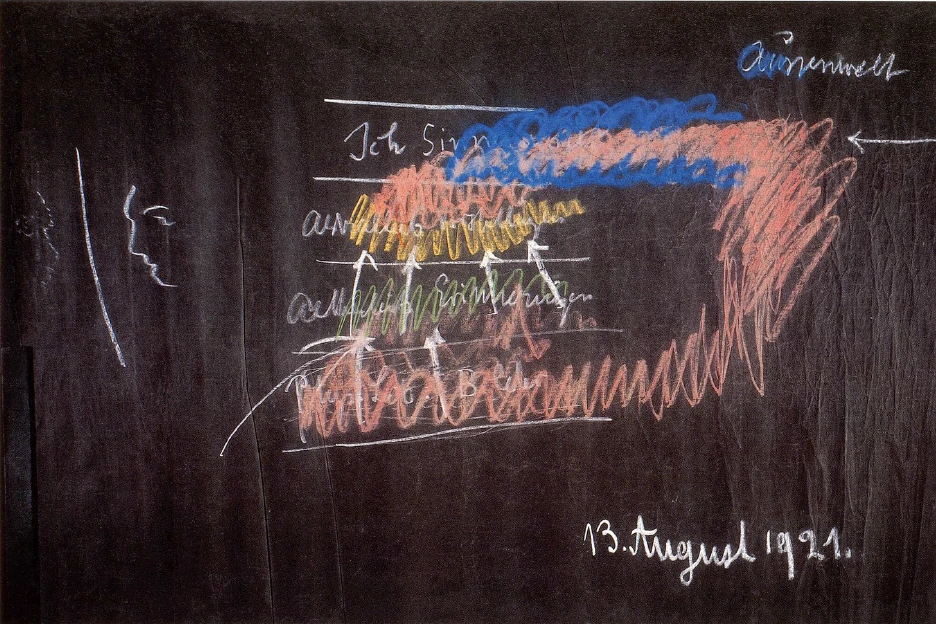
So you see: if you want to imagine this relationship of the I to what is usually called a human being and what you think of as being limited within the skin, then you actually have to imagine – if I first draw the eye as a representative of sensory perception here – that the I is not inside, but that the I lives here outside and penetrates inwards through the senses. We usually succumb to the illusion that our ego lies within what we call our physical organism. But the ego is actually situated in relation to this physical organism in the outer world and, as it were, extends its tentacles into our inner being, first in our imagination, after the astral body, or up to the astral body.
Let us now take a closer look at the world of memories. Memories are propelled upwards from what we call our inner being. As they are propelled upwards, they initially represent an activity in the etheric body, and this in turn stimulates perceptions in the astral body; but these now come in reverse (see diagram on page 135, arrows). But ultimately they must come from what are the images in the physical body.
Now you can see that, starting from the physical body, the arousal flows to the etheric body, which underlies the memory, and because the I is in it, the I is also here. So I have to draw the thing in such a way that I not only think schematically of the ego here on the outside, but that the ego is also in the physical body (reddish) and stimulates the memories (green) from the physical body, which then become perceptions (yellow).
So you see, I cannot actually get by with the scheme I have drawn. I would have to draw differently. I would have to say: I, astral body, etheric body, physical body. But if I consider the memory, then I would have to put that which is up there as I, also into the physical body. At the same time it is separate from itself, and on the other hand it also fills the physical body. You see, through the careful knowledge of what is going on in a person, it is possible to get an idea of the integration of this ego, how it is on the one hand in the outside world, and on the other hand inside.
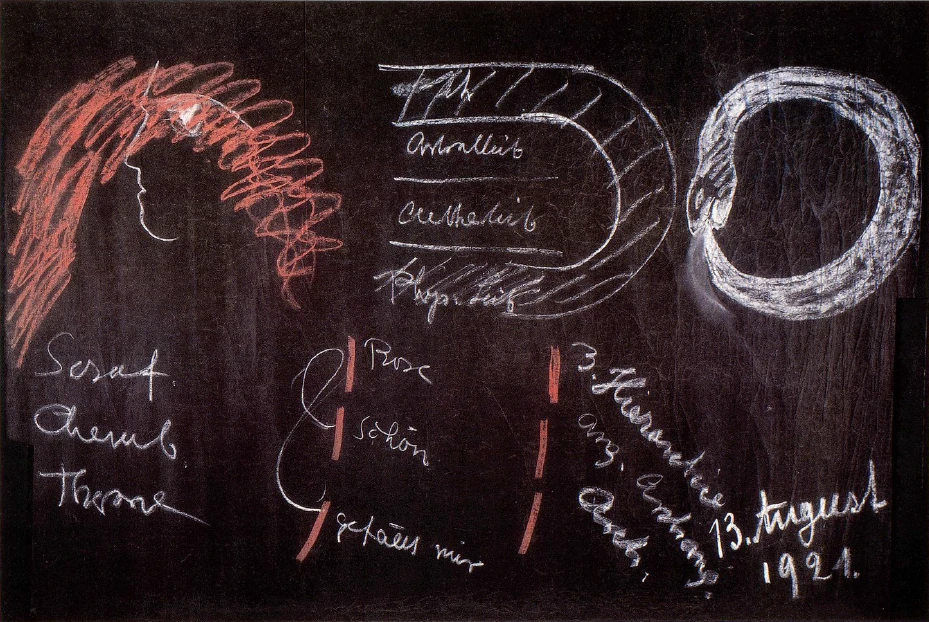
And now consider the following process. Imagine you meet a person on the street, and there you have the sensory perception of the person. Your I is there, but at the same time, memory arises from within: you recognize the person. The memory comes from within, and the sensory perceptions come from without. They interlock. This phenomenon of interlocking was already known to the old instinctively trained spiritual researchers. We are bringing it out of the sum of facts again. What I am now bringing to you from the sum of facts was known to the old spiritual researchers, and they were accustomed to drawing such things in pictures. They depicted what I have just told you, the existence of the ego, the coming together here with what comes from outside, as the snake that bites its own tail. The way in which man is related to the outer world was thus depicted as the snake that bites its own tail. When one has before him older pictures that have emerged from instinctive visions, one can often see how deep insights are hidden in such visions. Abstractions come and interpret all kinds of things. In this way, something terribly ingenious sometimes comes about; it is just of no value if it is symbolized and interpreted out of it, because one cannot grasp the facts with the intellect after all, but can only really find what is present if one again penetrates to the sources themselves.
But let us also visualize what is actually present in a different way. Let us think about this human ego as it is in sensory perception and in the imagination that follows from it. It is the case that we really live in an illusion, which has come about in the following way. Imagine that you have a mirror and you see yourself in it. Now, hypothetically, let us assume that you have never had any opportunity to gain any knowledge other than the knowledge that you have always seen yourself in the mirror. This would have led you to confuse yourself with your mirror image. The mirror image goes back and forth. Now, let us say you do not feel yourself within your skin, but you see the mirror image moving back and forth, and so you think: That is me — and you keep saying: That is me. — You are actually looking at your mirror image, but you mistake it for yourself. That is what a person actually does. In fact, the ego is like a stream that carries the sensory stimulus to the body. The body reflects it back, first of all that in which the actual self is seated. The self is here, but it is also in the outer world. It is even in the physical body, but it is reflected back to you. The human being does not perceive his real self, but the reflection. He does perceive the reflection, in that he has the sense perception. These are mirror images.
I have explained this in more detail in my book 'Von Seelenrätseln'. The images are also mirror images, they are the reflection of experiences in the external world. The ego actually lives in the external world and experiences itself in consciousness, in that what it, as the unconscious ego, stimulates in the body is reflected back to it. That is if we consider the sensory perceptions and the images.
The situation is different, however, when memory comes into play. There we really are here below in the images that have come about, with our ego within them. There, indeed, an unconscious is at work to a high degree. Just consider how difficult it is for you to bring up memories, how little you can do with your full mental consciousness. There is an unconscious at work. There is indeed — and you can feel this — a reality at work. There it is different. You no longer confuse what you see with your ego, because you feel yourself in this activity. But it also remains very dark; the ego, as I have often mentioned, remains in an inner activity like a dream or even like something asleep, because the will is at work in it. And in remembering, it is essentially the will that is at work. A will that is strangely vacillating and changing is at work within. And if we want to use an image, we can say: let us imagine that we are looking spiritually with our ego. When we have this perception and imagination, we look in this way. When we form memories and everything that belongs to them, we turn around spiritually, so to speak. Indeed, when we move from sensory perception to memory, this concept of turning around spiritually is an important concept: spiritual turning around. Because if you imagine such a spiritual turning around, you get an inner concept of mobility.
They can no longer be stored so easily next to each other: I, astral body, etheric body and physical body. This is convenient when you are presenting anthroposophy to groups of anthroposophists who want to get quite calm, gentle presentations that can be easily absorbed while sitting on armchairs. But that is not how it is in reality. In reality, when we approach the human being by wanting to grasp the soul life, we have to envisage a continuous turning and turning around of the whole inner human being, that is, the true human being. The I is like that, and in being like that, it shines through the sense perceptions; in being like that (turned around), it shines up from the physical body. The concepts must be made mobile.
This is something that shows us how we must proceed to achieve flexible, inwardly living concepts if we want to grasp the human being. Just think about what our ordinary mental life is like! You only have to think of a very small part of everyday mental life to see this person in the outer world, that person in the outer world. That is all sense world. It penetrates in as a world of ideas. In the process, all kinds of memories arise. And you can only imagine that, while there are sense perceptions, you are, as it were, looking at one side of the soul and, as the memories arise, you are looking from the other side. But since this is constantly happening in a confused manner, you must constantly think of the soul as being in an inward whirling motion.
And that is also what is to be thought of as an image: the soul in inward whirling motion. That is also what presents itself to the gaze. That is why I have indicated in my books and also repeatedly emphasized: anyone who wants to make drawings that adequately represent what is actually present as the higher aspects of human nature is in the same case as a painter who wants to paint lightning. Just as lightning cannot be painted in reality, so the higher structure cannot be painted either. Even the etheric body cannot be painted in reality. You can make a diagram of it, but you cannot paint it in reality, because there is actually no such thing as a state of rest.
Memory and impressions of the external world meet, as I said. We are dealing here with something that should be grasped very precisely. If you look at the human physical body as such, then the I is in it for the purpose of remembering. But the I is also in the external world. So the I is actually in everything that underlies sensory perception. But it is also in the physical body of man. If you go through all kinds of philosophies of modern times - and these modern times have been going on for a long time - you will hear a lot about subjective and objective. You can also do that if you stop at the stage of imagining, because you can indeed distinguish between what lives in you and what lives outside of you. But if you delve deeper into the matter, these terms lose their meaning. For what is it that makes what lives behind the sense perceptions and from which the ego brings in the sense perceptions, what is it that makes it objective? It is objective precisely through the same thing that makes the physical body objective here. There is no difference between subjective and objective. The ego lives in the external world just as it lives in its own physical body. That is where the difference between subjective and objective ceases to exist.
This difference between subjective and objective only arises when we are up here in the realm of imagination. And why does it arise here? Not for the reason usually imagined either, but here it arises because we are only dealing with images. Up here we only experience images. But images are not real in themselves. We feel this by experiencing images. We therefore speak of the images as something subjective, and of the processes on which the images are based as something objective. But we cannot do that with the impressions of the outside world, because the processes in which the ego lives are of course objective here, as are the processes through which the ego works by releasing the memory images into the physical body. That is all objective, and if you like, all subjective. Here subjective and objective become completely mixed up and intertwined and can no longer be distinguished. And that is the important thing, because it is this concept of subjective and objective that occupies people and is juggled with in much philosophy.
But now, however, there is something deeper underlying it all. Man lives first of all in his everyday experiences. There he brings it to such a soul life, as is well known everywhere. But behind all this, of course, lives a completely different world. I have described in “How to Know Higher Worlds”, in my “Occult Science in Outline”, how this world can be penetrated. But what spiritual research penetrates is, of course, a reality for every human being. It is always there, whether one knows it or not. So when one speaks of reality, one must take this into account. If one now develops those insights that arise in imagination, inspiration and intuition, then one arrives at what is present in every human being, what every human being carries around with them continually. When one ascends, as I have described, to imagination, one initially has a different soul world than the one that exists in everyday life. Through imagination, one receives images instead of the usual abstract ideas – that is why the term imagination, imaginative presentation, has been chosen – images that are clearly recognized as images. One is absolutely clear that one is dealing with images. That is the difference between what is really presented to the spiritual researcher and what lives in dreams or hallucinations: those who live in dreams or hallucinations consider their images to be reality. The spiritual researcher never does that. Only those who want to write foolish refutations talk about the fact that what is presented to the spiritual researcher could also be a hallucination or a dream. The spiritual researcher never confuses what is presented to him in pictures with reality. He is also clearly aware from the nature of these images that they are not invented images, not images conjured up by the imagination, but that they are images that point to spiritual reality.
First of all, he never confuses his images with realities, but he is clear about the fact that these images point to spiritual realities. There are many things that can lead a person to become fully aware of this pictorial quality on the one hand and the way these images point to a spiritual world on the other. If you are a fully conscious person, you are clearly aware that you link and separate your own ideas. You just have to reflect on something like this carefully. Just imagine how different your inner life would be if you could not arbitrarily combine the ideas you have, but rather if these ideas were forced together: you would be like an automaton. This inner ability to combine and separate ideas does, however, in a sense cease when one enters the imaginative world. And one must know that it stops, because through that one gets a clear consciousness of the fact that freedom, as man values it, can actually only be experienced and acquired in this physical world between birth and death. Then one also gets a clear feeling that we do not descend unnecessarily from spiritual worlds into this physical world. If we only lived in the spiritual worlds, which are otherwise accessible to us between death and a new birth, we would never be able to gain our freedom there. We gain this freedom within the physical world. Only people who do not care about freedom, who hate or undervalue this world, which man lives through between birth and death.
We particularly appreciate this freedom when we develop it as a force, let us say as a memory, namely after death. Only by feeling our way back into earthly life do we partake of freedom between death and a new birth. We must remain connected to earthly life in order to partake of freedom between death and a new birth. This can be felt by the spiritual researcher when he immerses himself in the imaginative world. If he did not stand firmly on the ground within physical reality before immersing himself in the imaginative world, he would not enter the spiritual world in a healthy state. That is why it is emphasized again and again: One must have prepared oneself well in the physical world if one wants to penetrate into the spiritual world. One must really have achieved everything that can be achieved in the physical world, namely, not to be at the mercy of one's instincts, which means bondage; not to be at the mercy of any automatic rules of habit, to which man so willingly submits. Man must really have come to the consciousness of his freedom before he can enter the spiritual world. Man should already have brought to life within himself the ideas that I have developed in my Philosophy of Freedom if he really wants to achieve his ascent into the spiritual world. This has also been emphasized in How to Know Higher Worlds.
Since we are talking about the imagination of pictures here, it must be understood that these are something thoroughly subjective. I would like to say that the degree of subjective experience is even stronger in the imaginative life than in the ordinary everyday life of the soul. The soul life is richer in the imaginations, but it is an experience of images. One knows that behind this pictorial experience is the true reality; but first one has the pictorial experience.
But there is something living in the images that does not allow them to appear so free to us. We cannot connect and disconnect in the same way, nor would we be able to penetrate to a reality if we could connect and disconnect these images of imaginative knowledge in the same way that we can connect and disconnect what we experience as ordinary ideas. We experience ordinary ideas in this way: here is an idea, here is the second, here is the third idea. We experience these, we form connections. We have the idea “rose”, we have the idea “beautiful”, the idea “I like it”. I form the connection: I like the beautiful rose. —- What I form here as a connection is definitely an inner activity; it depends on me, in that I am free. In this way, one is not free in the imaginative world. When you have images from the imaginative world, it is not the case that you now feel an inner activity through which you connect and separate these images. Just think, that cannot be the case, because although you feel free in the physical world, you can connect and separate, but you still separate and connect in the physical world in the way that the external physical-sensory world demands. So you have a regulative for connecting and disconnecting. You must also have such a regulative in the imaginative world. You just must not take what the physical world has dictated to you and put it into this imaginative world. That is what those Nebulists do, those fantasists or perhaps even people who are imaginative in the best sense of the word. They take some means of the sensuous-physical world and combine and separate them according to some judgment of taste. This may be very beautiful, but it cannot happen in the case of imaginative knowledge. There must be something there that gives rise in such a way to linking one element to another, to creating connections.
If you now take this idea, you will see: you arrive at something that lives in the imaginative world, that works in the imaginative world in the same way that our own mind otherwise works, in that it connects and separates the ideas of the ordinary world. There you come out into the objective. You come behind the worlds that are given as sensory perceptions; but you come into something that connects and separates.
What is it then? I would like to say that it is experienced in such a way that the imaginations begin to unfold their own life. I may use a comparison here: if you look at a human embryo at a very early stage, it has a highly developed head, with only the beginnings of the other organs attached to it; but these then take shape. In the same way, what lives in the imaginative world grows inwardly. One cannot place images there in an arbitrary way. It arises of its own accord. So there is something living within it that arises of its own accord. And this is gradually recognized as the world we call the world of the third hierarchy: Angeloi, Archangeloi, Archai.
It is a thoroughly real process of human experience, in which one lives. I have now described it to you as a process of knowledge. But it is not a mere process of knowledge, because what is effective there is that which lives in the I and the astral body.
Now consider: we are children, we grow up. First, up to the age of seven, we receive the world of imitation within us, then the world that we accept on authority up to the age of fourteen or fifteen, and so on. If we observe life, we will find how much – not all, of course – of what we absorb in this way, through the sensations of the senses being brought to us and our processing of the sensations and perceptions, is later reflected in our face. Compare the dull face of someone who could not take in anything, who could not process anything from sensory perceptions in the life of ideas, with the speaking face, the speaking physiognomy of someone who, as a child, was introduced to the sensory world and to its processing in the imagination in the right way. This is something that lives in us from the soul-spiritual. We are shaped there. It is, I would say, the most subtle thing that works in us, and which only extends its forces into the whole physical life of the human being in a very subtle way.
Those who are able to observe people can still see from their gait at a later age whether they had a happy childhood or a childhood such as is sometimes the case among today's teaching staff. This is not an unreality that works from the I and the astral body into the whole human being. The spiritual researcher looks only into what actually lives in the I and astral body, and he discovers it through his imaginative world. There he discovers the world of angels, archangels, archai. But this is inherent in what develops in the human being as the spiritual-soul develops him, develops him in such a way that his development is initially an individual one. We can observe it in the way I have just explained. But this development also belongs to a group of people, to a nation. We distinguish between what grows within a person in so far as he belongs to a group of people, a nation, and in turn we distinguish between a modern person and an ancient Greek. In short, we distinguish the individual development of the human being, depending on the hierarchy of the angels; the development within the various ethnic groups, brought about by the hierarchy of the archangels; and we distinguish the human beings in different epochs, brought about by the hierarchy of the archai.
What is being discovered through spiritual science are realities that are effective in the spirits of the times, effective in the spirits of nations, and effective in those spirits that carry the life of the individual from consciousness into constitutional and organic life. We do not create our own physiognomy, just as the watchmaker makes a watch, by the fact that we may have been educated to joyful contemplation in our youth and have acquired a friendly physiognomy; something must help there. The nature of the hierarchy of the angels also plays a role. And we certainly do not put ourselves in the place of a people and imagine the various national physiognomies, just as the watchmaker makes the watch.
You see, we come across realities that are only shown in knowledge, but which are effective within the human being. We have, so to speak, the human being from one side, to speak with the old clairvoyants: from the side of the snake's head. Let us now approach the matter from the other side. We can approach that other side, the snake's tail, by turning to the world of memories that emerge from below, from where the human being also recognizes this world, where subjective and objective lose their meaning.
Yes, what emerges as the power of memory is grasped by the ego, but it emerges from the very subterranean depths of the human being. We know, or at least we can know, how intimately connected we are with our human nature when we unfold this power of remembrance. This points us even more to such depths, which we do not reach in ordinary life with our mental experience. This points us precisely to something that we are, but that is also how the outer nature is. There is something in us that is exactly the same as the outer nature. We do not have the same intimate connection with it as we do with the world, which we understand in terms of the hierarchy of the angels, archangels, and archai. Something is at work here that is not at all close to our present consciousness. I would like to say that there is only a thin veil between our present consciousness and the angels, archangels, and archai. But we enter a world that is deeply hidden from ordinary consciousness when we descend into that inner being of man from which only the power of memory shines forth, which we can still, I would like to say, just intercept. But what we intercept there is connected with contents that lie beyond ordinary consciousness.
But just as we can reach the world that I just characterized and from which we are separated in our imaginations as if by a thin membrane, we can now also, by progressing in spiritual science, recognize the world to which we are pointed on the other side: the side we reach when we turn around or turn to the other side of the snake. But we only reach this world when we rise to the third stage of spiritual knowledge, to intuition. And there we reach those beings that are referred to in my books as seraphim, cherubim, thrones. The world of cherubim, seraphim, thrones is just as much behind what shines up in our memory as activity in our life, as it is behind the sense perceptions and representations of the world of the angeloi, archangeloi, archai.
We will speak about these connections between the human world, which lives among our memories, and these hierarchies and what stands in between, Kyriotetes, Dynamis, Exusiai, tomorrow.
Source: The Rudolf Steiner Archive


 Posts
Posts


No comments:
Post a Comment