Rudolf Steiner, Dornach, Switzerland
July 15, 1921
Today I will summarize some truths that will serve us in turn to provide further explanations in a certain direction in the coming days. If we consider our soul life, we can say that towards one pole of this soul life lies the element of thinking, towards the other pole the element of will, and between the two the element of feeling, that which in ordinary life we call feeling, the content of the mind, and so on. In the actual life of the soul, as it takes place in us in our waking state, there is never just one-sided thinking or will, but they are always in connection with each other, they play into each other. Let us assume that we behave very calmly in life, so that we can say, for example, that our will is not active externally. However, when we think during such outwardly directed calmness, we must be aware that will is at work in the thoughts we unfold: in connecting one thought with another, will is at work in this thinking. So even when we are seemingly merely contemplative, merely thinking, at least inwardly the will is present in us, and unless we are raving or sleepwalking, we cannot be willfully active without letting our volitional impulses flow through thoughts. Thoughts always permeate our volition, so that we can say: the will is never present in the life of the soul in isolation. But what is not present in this isolated way can still have different origins. And so the one pole of our soul life, thinking, has a completely different origin than the life of the will.
Even if we only consider everyday life, we will find that thinking always refers to something that is there, that has prerequisites. Thinking is mostly a reflection. Even when we think ahead, when we plan something that we then carry out through the will, such thinking is based on experience, which we then act upon. In a certain respect, this thinking is, of course, also a reflection. The will cannot be directed towards what is already there. In that case, it would always be too late. The will can only be directed towards what is to come, towards the future. In short, if you reflect a little on the inner life of thought, of thinking and of the will, you will find that even in ordinary life, thinking relates more to the past, while the will relates to the future. The inner life of feeling stands between the two. We accompany our thoughts with feeling. Thoughts please us, repel us. Out of our feeling we lead our impulses of will into life. Feeling, the content of the mind, stands between thinking and willing, right in the middle.
But just as it is the case in ordinary life, even if only in a suggestive way, so it is in the great world. And there we have to say: what constitutes our thinking power, what makes up the fact that we can think, that the possibility of thought is in us, we owe it to the life before our birth, or rather before our conception. In the little child that comes to meet us, all the thinking abilities that a person develops are already present in the germ. The child uses thoughts only - as you know from lectures I have already given - as directing forces to build up its body. Especially in the first seven years of life, until the change of teeth, the child uses the powers of thought to build up its body as directing forces. Then they emerge more and more as actual thought forces. But they are thoroughly predisposed in the human being as thought forces when he enters physical, earthly life.
What develops as will forces - an unbiased observation readily reveals this - is actually connected with this thought force only to a small extent in the child. Just observe a wriggling, moving child in the first weeks of life, and you will already realize that this wriggling, this chaotic movement, has only been acquired by the child because his soul and spirit have been clothed with physical corporeality by the physical external world. In this physical body, which we only develop little by little from conception and birth, the will initially lies, and the development of a child's life consists in the fact that gradually the will is, so to speak, captured by the powers of thought that we already bring with us into physical existence through birth. Just observe how the child at first moves its limbs quite senselessly, as it comes out of the activity of the physical body, and how gradually, I might say, thought intrudes into these movements, so that they become meaningful. So there is a pressing and thrusting of thinking into the life of the will, which lives entirely within the shell that surrounds the human being when he is born, or rather, conceived. This life of the will is contained entirely within it.
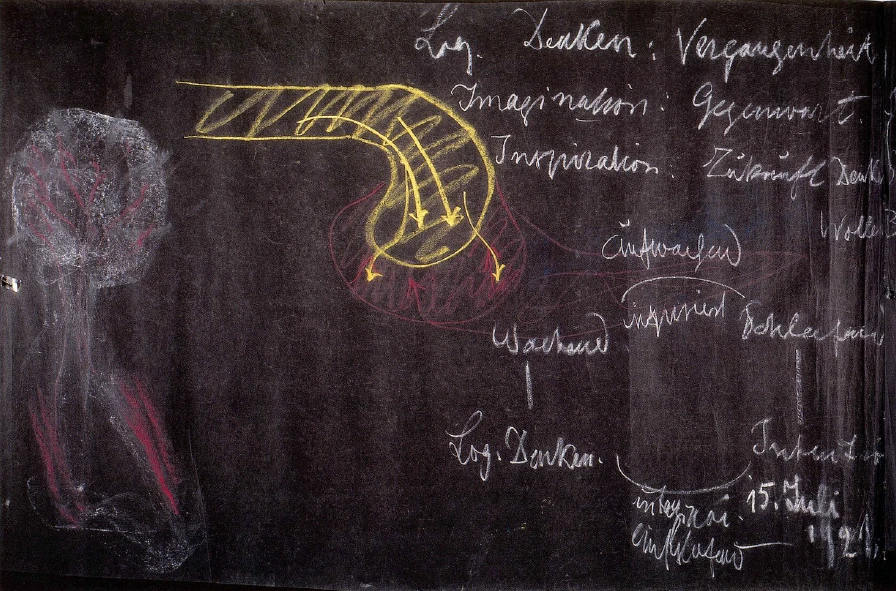
So that we can draw a schematic picture of a human being, in which we say that he brings his life of thought with him when he descends from the spiritual world. I will indicate this schematically (see drawing, yellow). And he begins his life of will in the physical body that is given to him by his parents (red). The forces of will are within, expressing themselves in a chaotic manner. And within are the powers of thought (arrows), which initially serve as directing forces to spiritualize the will in its corporeality in the right way.
We then perceive these forces of will when we pass through death into the spiritual world. But there they are highly organized. We carry them through the gate of death into spiritual life. The powers of thought that we bring with us from the supersensible life into earthly life, we actually lose in the course of earthly life.
With human beings who die young, it is somewhat different. For now, let us speak first of normal human beings. A normal human being who lives past the age of fifty has basically already lost the real powers of thought that were brought along from the previous life and has just retained the directional powers of the will, which are then carried over through death into the life that we enter when we go through the gate of death.
One can assume that someone is now thinking: Yes, so if you are over fifty years old, you have lost your thinking! - In a sense, this is even the case for most people who are not interested in anything spiritual today. I would just like you to really endeavor to register how much original, inventive thought power is produced by those people today who have reached the age of fifty! As a rule, it is the thoughts of earlier years that have automatically moved on and left an impression on the body, and the body then moves on automatically. After all, the body is a reflection of our mental life, and the person continues in the old rut of thought according to the law of inertia. Today, the only way to protect oneself from continuing in the old rut of thought is to absorb thoughts during one's lifetime that are of a spiritual nature, that are similar to the thought-forces in which we were placed before our birth. So that indeed the time is approaching when old people will be mere automatons if they do not take care to absorb thought-forces from the supersensible world. Of course, man can continue to think automatically; it may appear as if he is thinking. But it is only an automatic movement of the organs in which thoughts have been laid, have been woven in, if the human being is not grasped by that youthful element that comes when we absorb thoughts from spiritual science. This absorption of thoughts from spiritual science is certainly not just any kind of theorizing, but it intervenes quite deeply in human life.
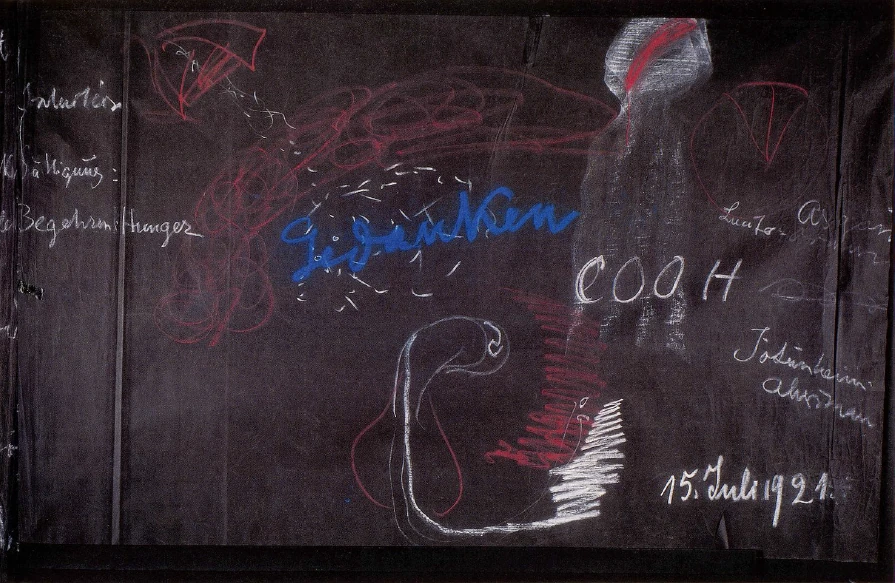
But the matter takes on particular significance when we now consider man's relationship to the surrounding nature. I now understand by nature all that surrounds us for our senses, to which we are thus exposed from waking up to falling asleep. This can be considered in a certain way in the following way. One can visualize what one sees — I mean before spiritual eyes. We call it the sensory carpet. I will draw it schematically. Behind everything that one sees, hears, perceives as warmth, the colors in nature and so on – I draw an eye as a schema for what is perceived there – there is something behind this sensory carpet. Physicists or people of the present world view say: Behind it are atoms and they swirl -, and afterwards, right, as they continue to swirl, there is no sensory carpet at all, but somehow in the eye or in the brain or somewhere or not somewhere, they then evoke the colors and the sounds and so on. Now, please, imagine, quite impartially, that you begin to think about this sensory carpet. If you start thinking and do not assume the illusion that you can observe this huge army of atoms, which the chemists have arranged in such a military way of thinking, let us say, for example, there is Corporal C, then two privates, C, O, O, and then another private as an H; isn't that right, that's how we arranged it militarily: aether, atoms and so on. Now, if, as I said, you do not succumb to this illusion but remain with reality, then you know: the sensory carpet is spread out, the sensory qualities are out there, and what I still grasp with consciousness about what lies in the sensory qualities is just thoughts. In reality, there is nothing behind this sensory carpet but thoughts (blue). I mean, behind what we have in the physical world, there is nothing but thoughts. We will talk about the fact that these are carried by beings. But you can only get behind what we have in our consciousness with thoughts. But the power to think we have from our prenatal life or from the life before our conception. Why is it then that we can penetrate behind the sensory curtain by means of this power?
Just try to familiarize yourself with the idea that I have just mentioned, and try to properly present the question to yourself on the basis of what we have just hinted at, which we have already considered in many contexts. Why is it that we can reach below the sensory level with our thoughts, when our thoughts come from our prenatal life? Very simply, because behind it is that which is not in the present at all, but which is in the past, which belongs to the past. That which is under the carpet of sense is indeed a past, and we only see it correctly when we recognize it as a past. The past has an effect on our present, and out of the past sprouts that which appears to us in the present. Imagine a meadow full of flowers. You see the grass as a green blanket, you see the meadow's floral decoration. That is the present, but it grows out of the past. And if you think through this, then underneath it you do not have an atomistic present, but in reality you have the past as related to what comes from you yourself from the past.
It is interesting: when we begin to reflect on things, it is not the present that is revealed to us, but the past. What is the present? The present has no logical structure at all. The sunbeam falls on some plant, it shines there; in the next moment, when the direction of the sunbeam is different, it shines in a different direction. The image changes every moment. The present is such that we cannot grasp it with mathematics, not with the mere structure of thought. What we can grasp with the mere structure of thought is the past, which continues in the present.
This is something that can reveal itself to man as a great, as a significant truth: When you think, you basically only think the past; when you spin logic, you basically reflect on what has passed. - Anyone who grasps this thought will no longer seek miracles in the past either. For in that the past is woven into the present, it must be in the present as it is in the past. If you think about it, if you ate cherries yesterday, that is a past action; you cannot undo it because it is a past action. But if the cherries had the habit of making a mark somewhere before they disappeared into your mouth, that mark would remain. You could not change this sign. If every cherry had registered its past in your mouth after you had eaten cherries yesterday, and someone came and wanted to cross out five, he could cross them out, but the fact would not change. Nor can you perform any miracle with regard to all natural phenomena, because they are all intrusions from the past. And everything we can grasp with natural laws has already passed, is no longer present. You cannot grasp the present other than through images; that is a fluctuating thing. When a body lights up here, a shadow is created. You have to let the shadow properly define itself, so to speak, and so on. You can construct the shadow. That the shadow really comes into being can only be determined by devotion to the picture. So that one can say: even in ordinary life, limitation, I could also say logical thinking, refers to the past. And the imagination refers to the present. In relation to the present, man always has imaginations.
Just think, if you wanted to live logically in the present! No, to live logically means to draw one concept from another, to move from one concept to another in a lawful manner. Now, just imagine yourself in life. You see some event: is the next one logically connected to it? Can you logically deduce the next event from the previous one? When you look at life, are not its images similar to a dream? The present is similar to a dream, and only that the past is mixed into the present, which causes the present to proceed in a lawful, logical manner. And if you want to divine something in the future in the present, yes, if you just want to think of something you want to do in the future, then that has happened in a completely non-representational way in the first instance. What you will experience tonight is not in your mind as an image, but as something more non-pictorial than an image. At most, it is in your mind as inspiration. Inspiration relates to the future. Logical thinking: past Imagination: present Intuition Inspiration: future.
| Logical thinking: | Past | Intuition |
| Imagination: | Present | |
| Inspiration: | Future |
We can also use a simple diagram to visualize what is involved. When a person – let me characterize him here by this eye (see drawing on page 198) – looks at the tapestry of the senses, he sees it in its transforming images, but he now comes and introduces laws into these images. He develops a natural science out of the changing images of the sensory world. He develops a specialized science. But think about how this natural science is developed. You investigate, you investigate while thinking. You cannot possibly, if you want to develop a science about what spreads out as a carpet of senses, a science that proceeds in logical thoughts, you cannot possibly gain these logical thoughts from the external world. If what is recognized as thoughts and laws of nature were to follow from the external world itself, then it would not be necessary for us to learn anything about the external world. Then the person who, for example, looks at this light would have to know the exact electrical laws and so on, like the other person who has learned it! Equally, if he has not learned it, man knows nothing at all, let us say, about the relationship of an arc to the radius and so on. We bring forth from our inner being the thoughts that we carry into the outer world.
Yes, it is so: what we carry into the outer world as thoughts, we bring forth from our inner being. We are first of all this human being, who is constructed as a head human being. This human being looks at the carpet of senses. Inside the carpet of senses is what we reach through thoughts (see drawing page 198, white) and between this and between what we have inside us, what we do not perceive, there is a connection, so to speak an underground connection. Therefore, what we do not perceive in the external world because it extends into us, we bring out of our inner being in the form of thought life and place it in the external world. This is how it is with counting. The external world does not present anything to us; the laws of counting lie within our own inner being. But that this is true arises from the fact that between these predispositions, which are there in the external world, and our own earthly laws, there is an underground connection, a sub-physical connection, and so we draw the number out of our inner being. It then fits with what is outside. But the path is not through our eyes, not through our senses, but through our organism. And that which we develop as human beings, we develop as whole human beings. It is not true that we grasp some law of nature through the senses; we grasp it as a whole human being.
These things must be considered if we want to properly bring to mind the relationship between man and the environment. We are constantly in imaginations, and one need only compare life with dreams without prejudice. When a dream unfolds, it is certainly very chaotic, but it is much more similar to life than logical thinking. Let us take an extreme case. If you take a conversation between reasonable people of the present day, you listen and you talk yourself. Think about what is said in the course of, say, half an hour, and whether there is more coherence in the succession of thoughts than there is in dreams, or whether there is as much coherence as in logical thinking. If you were to demand that logical thinking develops there, you would probably be greatly disappointed. The present world presents itself to us entirely in images, so that basically we are actually dreaming all the time. We have yet to bring logic into it. We wrest logic from our prenatal existence; we first bring it into the context of things and thereby also encounter the past in things. We embrace the present with imagination.
When we observe this imaginative life that constantly surrounds us in the sensual present, we can say to ourselves: this imaginative life gives itself to us. We do nothing to it. Just think how hard you had to work to arrive at logical thinking! You didn't have to make any effort to enjoy life, to observe life; it reveals its images to you by itself. Now, that's how it is in life with imagining the images of the ordinary world around us. But all one needs is to acquire the ability to make images – but now through one's own activity, as one otherwise does in thinking – and to experience images through inner effort, as one otherwise does in thinking. Then one not only sees the present in images, but one also extends pictorial imagination to life before birth or before conception, and one sees before birth or before conception. And when you look into these images, then thinking is populated with the images, and then prenatal life becomes reality. We just have to be able to think in images by training the abilities that are spoken of in “How to Know Higher Worlds”, without these images coming to us by themselves, as is the case in ordinary life. When we make this life of images, in which we actually always live in ordinary life, into an inner life, then we look into the spiritual world, and then we do see the way in which our life actually unfolds.
Today, it is considered almost exclusively spiritual when someone – I have spoken about this often – truly despises material life and says: I strive towards the spirit, matter remains far beneath me. This is a weakness, because only the one who does not need to leave matter below him, but who understands matter itself in its effectiveness as spirit, who can recognize everything material as spiritual and everything spiritual, even in its manifestation as material, only he truly attains a spiritual life. This becomes especially significant when we look at thinking and willing. At most, language, which contains a secret genius within it, still has something of what leads to knowledge in this field.
Consider the basis of will in everyday life: you know that it arises from desire; even the most ideal will arises from desire. Now take the coarsest form of desire. What is the coarsest form of desire? Hunger. Therefore, everything that arises from desire is basically always related to hunger. From what I am trying to suggest to you today, you can see that thinking is the other pole, and will therefore behave like the opposite of desire. We can say: if we base desire on the will, we have to base thinking on satiation, on being full, not on hunger.
This actually corresponds to the facts in the deepest sense. If you take our head organization as human beings and the other organization that is attached to it, it is indeed the case that we perceive. What does it mean to perceive? We perceive through our senses. As we perceive, something is actually constantly being removed within us. Something passes from the outside into our inner being. The ray of light that enters our eye actually carries something away. In a sense, a hole is drilled into our own matter (see drawing on page 201). There was matter, but now the beam of light has drilled a hole into it, and now there is hunger. This hunger must be satisfied, and it is satisfied from the organism, from the available food; that is, this hole is filled with the food that is inside us (red). Now we have thought, now we have thought what we have perceived: by thinking, we continually fill the holes that sensory perceptions create in us with satiety that arises from our organism.
It is extremely interesting to observe, when we consider the organization of the head, how we fill the holes that arise in our remaining organism through the ears and eyes, through the sensations of warmth; there are holes everywhere. Man fills himself completely by thinking, by filling that which is there, in the holes (red).
And it is similar with us if we want it to be. Only then it does not work from outside in, so that we are hollowed out, but it works from within. If we want, hollows arise everywhere in us; these must in turn be filled with matter. So that we can say, we receive negative effects, hollowing out effects, both from outside and from inside, and constantly push our matter into them.
These are the most intimate effects, these hollowing effects, which actually destroy all earthly existence in us. Because by receiving the ray of light, by hearing the sound, we destroy our earthly existence. But we react to this, we in turn fill this with earthly existence. So we have a life between the destruction of earthly existence and the filling of earthly existence: luciferic, ahrimanic. The Luciferic is actually constantly striving to partially turn us into something non-material, to completely remove us from our earthly existence; for if he could, Lucifer would like to spiritualize us completely, that is, dematerialize us. But Ahriman is his opponent; he works in such a way that what Lucifer excavates is constantly being filled in again. Ahriman is the constant filler. If you form Lucifer plastically and make Ahriman plastically, you could quite well, if the matter went through in confusion, always push Ahriman into the cavity of Lucifer, or put Lucifer over it. But since there are also cavities inside, you also have to push in. Ahriman and Lucifer are the two opposing forces at work in man. He himself is the state of equilibrium. Lucifer, with continuous dematerialization, results in continuous materialization: Ahriman. When we perceive, that is Lucifer. When we think about what we have perceived: Ahriman. When we form the idea, this or that we should want: Lucifer. When we really want on earth: Ahriman. So we are in the middle of the two. We oscillate back and forth between them, and we must be clear about ourselves: as human beings, we are placed in the most intimate way between the Ahrimanic and the Luciferic. Actually, you only get to know a person when you take these two opposing poles in him into account.
This is an approach that is based neither on an abstract spiritual reality – for this abstract spiritual reality is, after all, nebulous and mystical – nor on a material one, but rather everything that is materially effective is also spiritual at the same time. We are dealing with the spiritual everywhere. And we see through matter in its existence, in its effectiveness, by being able to see the spirit in everything.
I have already told you that imagination comes to us of its own accord in relation to the present. When we develop imagination artificially, we look into the past. When we develop inspiration, we look into the future, just as one calculates into the future by calculating solar or lunar eclipses, not in relation to the details, but to a higher degree in relation to the great laws of the future. And intuition encompasses all three. And we are actually subject to intuition all the time, we just sleep through it. When we sleep, we are completely immersed in the outside world with our ego and our astral body; there we unfold that intuitive activity that one must otherwise consciously unfold in intuition. But in this present organization the human being is too weak to be conscious when he is intuiting; but he does intuit in fact at night. So one can say: Asleep, the human being develops intuition; awake, he develops—to a certain extent, of course—logical thinking; between the two stands inspiration and imagination. When a person comes out of sleep into waking life, his I and his astral body enter into the physical body and the etheric body; what he brings with him is the inspiration to which I have already drawn your attention in previous lectures. We can say: Man is asleep in intuition, awake in logical thinking, when he wakes up he inspires himself, when he falls asleep he imagines. - You can see from this that the activities we mention as the higher activities of knowledge are not alien to ordinary life, but that they are very much present in ordinary life, that they only have to be raised into consciousness if a higher knowledge is to be developed.
It must be pointed out again and again that in the last three to four centuries, external science has summarized a large number of purely material facts and brought them into laws. These facts must first be spiritually penetrated. But it is good - if I may say so, although it sounds paradoxical at first - that materialism was there, otherwise people would have fallen into nebulosity. They would have finally lost all connection with their earthly existence. When materialism began in the 15th century, humanity was in fact in danger of falling prey to Luciferic influences to a high degree, of being hollowed out more and more and more. That is when the Ahrimanic influences came from that time on. And in the last four or five centuries, the Ahrimanic influences have developed to a certain extent. Today they have become very strong and there is a danger that they will overshoot their target if we do not counter them with something that will effectively weaken them: if we do not counter them with the spiritual.
But here it is important to develop the right feeling for the relationship between the spiritual and the material. In the older German way of thinking, there is a poem called “Muspilli”, which was first found in a book dedicated to Louis the German in the 9th century, but which of course dates from a much earlier time. There is something purely Christian in this poem: it presents us with the battle of Elijah with the Antichrist. But the whole way in which this story unfolds, this fight between Elijah and the Antichrist, is reminiscent of the ancient struggles of the sagas, the inhabitants of Asgard with the inhabitants of Jötunheim, the inhabitants of the realm of the giants. It is simply the realm of the Æsir transformed into the realm of Elijah, the realm of the giants into the realm of the Antichrist.
This way of thinking, which we still encounter, conceals the true fact less than the later ways of thinking. The later ways of thinking always talk about duality, about good and evil, about God and the devil, and so on. But these ways of thinking, which were developed in later times, no longer correspond to the earlier ones. Those people who developed the struggle between the Gods' home and the giants' home did not see the same in the Gods as, for example, today's Christian understands in the realm of his God. Instead, these older ideas had, for example, Asgard, the realm of the Gods, above, and Jötunheim, the realm of the giants, below; in the middle, Man unfolds, Midgard. This is nothing other than the same thing in the Germanic-European way that was present in ancient Persia as Ormuzd and Ahriman. There we would have to say in our language: Lucifer and Ahriman. We would have to address Ormuzd as Lucifer and not just as the good God. And that is the great mistake that is made, that one understands this dualism as if Ormuzd were only the good God and his opponent Ahriman the evil God. The relationship is rather like that of Lucifer to Ahriman. And in Middlegard, at the time when this poem “Muspilli” was written, it is still not imagined that The Christ sends his blood down from above – but: Elijah is there, and sends his blood down. And man is placed in the middle. At the time when Louis the German probably wrote this poem into his book, the idea was still more correct than the later one. For later times have committed the strange act of disregarding the Trinity; that is, to understand the upper gods, who are in Asgard, and the lower gods, the giants, who are in the Ahrimanic realm, as the All, and to understand the upper, the Luciferic ones, as the good gods and the others as the evil gods. This was done in later times; in earlier times, this opposition between Lucifer and Ahriman was still properly envisaged, and therefore something like Elijah was placed in the Luciferic realm with his emotional prophecy, with that which he was able to proclaim at that time, because one wanted to place the Christ in Midgard, in that which lies in the middle.
We must go back to these ideas in full consciousness, otherwise we will not come back to the Trinity: to the Luciferic Gods, to the Ahrimanic powers and in between to what the Christ-realm is. Without advancing to this, we will not come to a real understanding of the world.
Do you think that the fact that the old Ormuzd was made into a good god, while he is actually a Luciferic power, a power of light, is a tremendous secret of the historical development of European humanity? But in this way one could have the satisfaction of making Lucifer as bad as possible; because the name Lucifer did not suit Ormuzd, one made Lucifer resemble Ahriman, made a hotchpotch that still has an effect on Goethe in the figure of Mephistopheles, in that there too Lucifer and Ahriman are mixed together, as I have explicitly shown in my little book 'Goethe's Spiritual Nature'. Indeed, European humanity, the humanity of present civilization, has entered into a great confusion, and this confusion ultimately permeates all thinking. It can only be compensated by leading out of duality back into trinity, because everything dual ultimately leads to something in which man cannot live, which he must regard as a polarity, in which he can now really find the balance: Christ is there to balance Lucifer and Ahriman, to balance Ormuzd and Ahriman, and so on.
This is the topic I wanted to broach, and we will continue to discuss it in the coming days in various ways.
Source: The Rudolf Steiner Archive


 Posts
Posts


No comments:
Post a Comment