Rudolf Steiner, Dornach, Switzerland
July 8, 1921
Today, in preparation for the next two reflections, we want to call to mind something about the nature of the human being, insofar as the human being is a being of thought. It is precisely this characteristic of the human being, that he is a being of thought, that is scientifically unrecognized today, interpreted in a completely wrong way. It is thought that thoughts, as they are experienced by the human being, come about in the human being, that the human being is, so to speak, the bearer of thoughts. No wonder this view is held, for the human being's essential being is only accessible to a finer observation. Precisely this human essence withdraws from coarser observation.
If we regard the human being as a being of thought, it is because we perceive, in the waking state, from waking to sleeping, that he accompanies his other experiences with thoughts, with the content of his thinking. These thought experiences seem to arise somehow from within the person and to cease to some extent during the period between falling asleep and waking up, that is, during sleep. And because one is of the opinion that thought experiences are there for a person as long as he is awake, but get lost in sleep in some kind of vagueness, about which one does not try to get further clarification and one just imagines the matter, one cannot actually enlighten oneself about the human being as a thinking being. A more delicate observation, which does not yet advance very far into the region I have described in my book “How to Know Higher Worlds,” shows that the life of thought is not at all as simple as one usually imagines it to be. We need only compare this ordinary thought life, the coarse thought life, of which everyone becomes aware when observing a person between waking and sleeping, with an element that is indeed problematic for ordinary consciousness, namely the element of dreaming.
Usually, when we talk about dreams, we do not really get involved in anything other than a general characteristic of dreaming. One compares the state of dreaming with the state of waking thought and finds that in dreaming, arbitrary associations of thoughts are present, as one would say, that images string together without such a connection being perceptible in this stringing together as it is perceptible in the external world of being. Or else one relates what takes place in the dream to the external sense world, sees how it stands out, as it were, how it does not fit into the processes of the external sense world after beginning and end.
Of course, one does advance to these observations, and in relation to these observations, beautiful results can certainly be seen. But what is not noticed is that, firstly, when a person abandons themselves a little, I would say with a touch of contemplation, lets themselves go a little and lets their thoughts run free, they can then perceive how something is mixed into this ordinary train of thought, which follows on from the external course of events, that is not unlike dreaming, even when we are awake. One could say that from the moment we wake until we fall asleep, while we are making an effort to adapt our thoughts to the external circumstances in which we are immersed, there is a kind of vague dreaming. It can seem to us, in a sense, like two currents that are there: the upper current, which we control with our arbitrariness, and a lower current, which actually runs much as dreams themselves run in their succession of images. Of course, you have to give yourself a little to your inner life if you want to notice what I am talking about right now. But it is always there. You will always notice: there is an undercurrent. Thoughts swirl around in just as pictorial a way as they do in dreams, where the most colorful things line up next to each other. Memories arise from all sorts of things, and just as in dreams mere similarity of sound may call other thoughts and connect them with them. And people who let themselves go inwardly, people who are too indolent to adapt themselves to outer conditions with their train of thought, they may notice how there is an inner striving to give themselves up to such waking dreams.
These waking dreams differ from ordinary dreams only in that the images are more faded, more like mental images. But in terms of the mutual relationship of these images, waking dreams do not differ particularly from so-called real dreams. There are, of course, all degrees of people, from those who do not even notice that such waking dreams are present in the undercurrents of their consciousness, who thus let their thoughts run entirely along the lines of external events, to those who indulge in waking dreams and let them run in their consciousness, as, I might say, the thoughts there want to interweave and intertwine. There are, after all, all degrees of human nature, from those of a dreamy nature, as they are also called, to those who are very dry natures, who accept nothing but what exactly matches some factual course of events. And we must say that a large part of what inspires people artistically, poetically, and so on, comes from this undercurrent of waking dreams during the day.
That is one side of the matter. It should certainly be taken into account. Then we would know that a surging dreaming is actually constantly taking place within us, which we only tame through our contact with the outside world. And then we would also know that it is essentially the will that adapts to the outside world and brings system, coherence, and logic into the otherwise randomly flowing inner mass of thoughts. It is the will that brings logic into our thinking. But as I said, that is only one side of it.
The other side of the matter is this: here too one can notice, observe – as soon as one only enters a little into those regions which I have described in my book “How to Know Higher Worlds” – how, when one wakes up, one takes something with one from the state in which we were from falling asleep to waking up. And if you add just a little to what you can perceive, you will be able to see very clearly how you wake up, as it were, from a sea of thoughts when you wake up. You do not wake up from a vague, dark state, but rather from a sea of thoughts, thoughts that seem to have been very, very distinct while you were asleep, but you cannot hold on to them when you transition into the waking state.
And if you continue such observations, you will be able to notice that these thoughts, which you bring with you, as it were, from the state of sleep, are very similar to the ideas, the inventions that we have in relation to something we are supposed to do in the outer world, that even these thoughts, which we bring with us when we wake up, are very similar to the moral intuitions, as I have called them in my “Philosophy of Freedom”.
While in the former kind of thought weaving, which to a certain extent runs as an undercurrent of our clear consciousness, we always have the feeling that we are standing face to face with our waking dreams, that something is seething and bubbling within us, we cannot say that about the latter. Rather, we have to say to ourselves about the latter: when we return to our body and to the use of our body when we wake up, we are no longer able to hold on to what we have lived in thought from falling asleep to waking up.
Whoever truly realizes these two sides of human life will cease to regard thought as something that is, as it were, produced in the human organism. For what I characterized last, in particular, what we distinguish ourselves from when we wake up, we cannot directly see as some product of the human organism as such, but we can only see it as something that we experience between falling asleep and waking up, when we are torn out of our body with our ego and our astral body.
Where are we then? This is the first question we must ask ourselves. We are outside our physical and etheric bodies with our ego and our astral body. A simple consideration, which one cannot escape from if one simply devotes oneself to life without prejudice, must tell us: in that which appears to us when we direct our senses to the external world, as the sensory veil of the world, as everything that sensory qualities present to us, in that we are when we are outside ourselves. Only then, in ordinary life, does consciousness fade away. And we feel why consciousness fades when we wake up from this state in the morning. We then feel weak in our body, too weak to hold on to what we have experienced from falling asleep to waking up. Our ego and our astral body cannot hold on to what they have experienced by immersing themselves in the physical and etheric bodies. And by then participating in the experiences that are made through the body, what is experienced from falling asleep to waking up is erased for them. And as I said, only when we have ideas that relate to the external world, or when we have moral intuitions, do we experience something like what must appear to us in an immediate contemplation of what we live in between falling asleep and waking up.
If we look at it this way, we see a very clear contrast between our inner and outer world. In a sense, this also sheds light on the statement we often make that the outer world, as it presents itself to us from waking to sleeping, is a kind of delusion, a kind of maya. For in this world, which shows its outside to us, we are in it when we are not in our body, but when we are outside our body. Then we dive into the world that we otherwise perceive only through our sense revelation. So that we have to say to ourselves: This world, which we perceive through our sense revelation, has subsoils, subsoils that actually contain its causes, its essences. And in our ordinary consciousness we are too weak to perceive these causes and these essences directly.
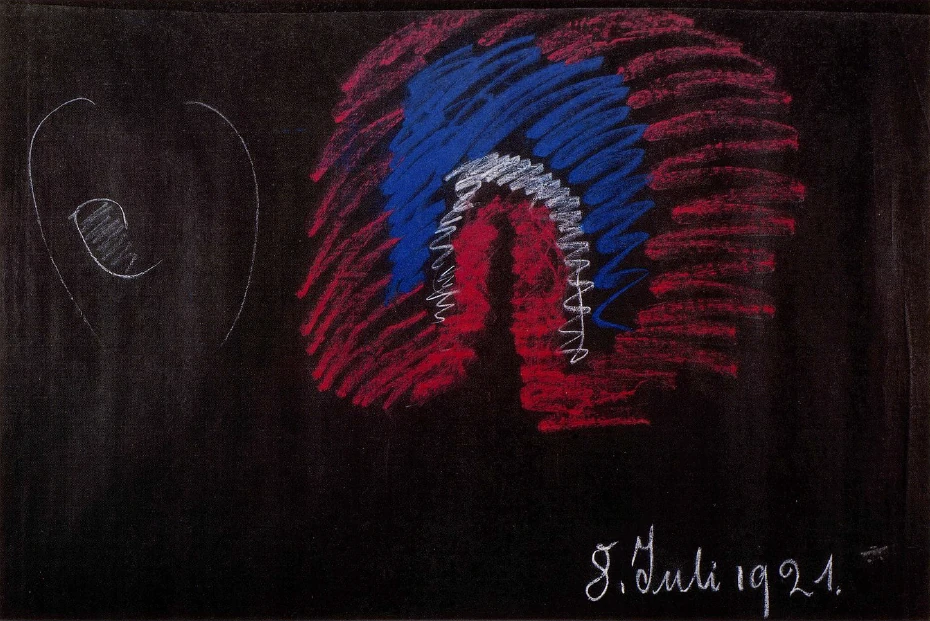
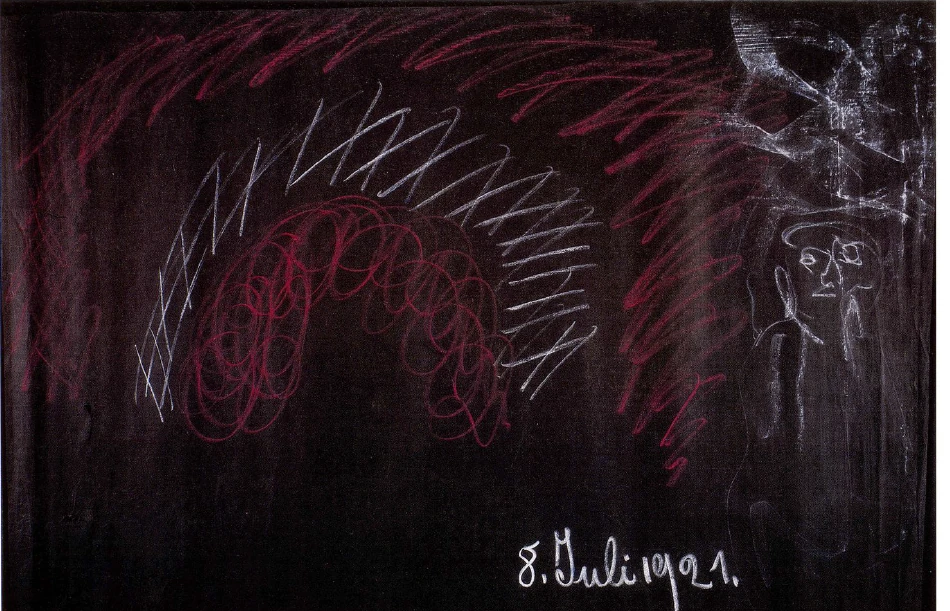
Nevertheless, even unprejudiced observation yields something that reaches far into the regions described in “How to Know Higher Worlds”; unprejudiced observation already yields that which I can schematically present in the following way. If I want to depict the ordinary life of thought, then I do so by having it embrace everything that a person experiences inwardly and mentally from waking up to falling asleep, whether in terms of external perceptions or in terms of physical pain, physical feelings of pleasure, and so on. What is experienced in the mind during ordinary consciousness, I would like to represent schematically as follows (see drawing, white). Below this, like a waking dream, weaves and lives, not subject to the laws of logic, what I first depicted (red below). On the other hand, when we pass into the external world between falling asleep and waking up, we live, as we can perceive in reminiscence after waking up, again in a world of thought, but of thoughts that absorb us, that are not in us, from which we emerge when we wake up (red outside). So that, as it were, we have separated two worlds of thought from each other through our ordinary thinking: an inner world of thought and an outer world of thought, a world of thought that fills the cosmos that receives us when we fall asleep. We can call the latter world of thought the cosmic world of thought. The former is just any world of thought; we will discuss it in more detail in the course of these days.
Thus we see ourselves, as it were, with our ordinary world of thoughts placed in a general world of thoughts, which is kept apart as if by a boundary, and of which one part is in us and one part is outside us. That which is in us appears to us very clearly as a kind of dream. There always rests at the bottom of our soul a chaotic web of thoughts, we can say, something that is not permeated by logic. But this outer world of thoughts, yes, it cannot be perceived by the ordinary consciousness. So only the real spiritual vision can reveal the nature of this outer world of thoughts from direct observation, from direct experience, and then it enters even more deeply into the regions described in “How to Know Higher Worlds”. But then it also turns out that this world of thoughts, into which we plunge between falling asleep and waking up, is a world of thoughts that is not only as logical as our ordinary world of thoughts is logical, but that contains a much higher logic. If one does not want to misunderstand the expression, I would like to call this world of thoughts a super-logical world of thoughts. I would say that it is just as far above ordinary logic as our dream world, our waking dream world, is below logic.
As I said, this can only be fathomed through spiritual vision. But there is another way by which you can check this spiritual vision on this point. It is clear to you, however, that ordinary consciousness cannot penetrate into certain regions of one's own organism. I have spoken about this a great deal in recent lectures. I have said that in the fact that we have our memory, our ability to remember, for ordinary consciousness, we have, as it were, a skin drawn inwardly towards our inner organs. We cannot observe directly through inner vision what the inner organs are, lungs, liver and so on. But I also said: It is a false mysticism, a nebulous mysticism, which only fantasizes about the inner being and speaks in the manner of Saint Therese or Mechthild of Magdeburg, who find all sorts of beautiful poetic images (the beauty of which should not be denied), but which are nothing more than organic effusions. If instead of devoting oneself to this nebulous mysticism, one really studies the human mind, then, when one penetrates to the inner being of man, one comes to an understanding of the organs. One sees spiritually the significance of the lungs, liver, kidneys, etc., one pierces spiritually the memory membrane and comes to an inner insight into man. But this is something that cannot be achieved with ordinary consciousness. With ordinary consciousness, it is only possible to observe externally through anatomy how the organs look when they are viewed as belonging to the ordinary physical and mineral world. But to look inwardly and see what permeates them, what is active in them, what I have described to you in recent days, requires a truly developed spiritual vision.
So there is something in man that he cannot reach with ordinary consciousness. Why can he not reach it with ordinary consciousness? Because it does not belong to him alone. What can be reached with the ordinary consciousness belongs to the human being alone. That which pulsates down there in the organs does not belong to the human being alone, it belongs to the human being as a world being, it belongs to the human being and at the same time to the world.
Perhaps it will become most clear to us through the following discussion. If we look at the human being schematically and have any organ, lung or liver in him, we have forces in such an organ. These forces are not merely inner human forces, these forces are world forces. And when everything that is the external physical world and appears to us as the physical world, when all this has once disappeared with the end of the earth, what now exists as the inner forces of our organs will continue to work. One might be tempted to say that everything our eyes can see and our ears can hear, the whole external world, will fade away with the end of the earth. What covers our skin, what we carry within us, what is enclosed by our organization, is what spiritually contains that which will continue to exist when the external world that our senses see will no longer be there. In essence, something works within the human skin that lives beyond the earth; within the human skin lie the centers, the forces of that which works beyond earthly existence. We do not stand as human beings in the world merely to enclose our organs for ourselves; we stand in the world as human beings so that the cosmos itself is formed within our skin. In that which our ordinary consciousness does not reach, we enclose something that does not merely belong to us, that belongs to the world. Is what belongs to the world built out of the chaotic processes of waking dreaming?
We need only look at these chaotic processes of waking dreaming and you will say to yourself: the whole structure, everything that you perceive as a kind of undercurrent of your consciousness, is most certainly not the builder of your organs, of your entire organism. The organism would look beautiful if everything that lives chaotically in your subconscious were to build your organs, your whole organism! You would see what strange caricatures you would be if you were a reflection of what pulsates in your subconscious. No, just as the outer world, which reveals itself to us through the senses, so to speak on the surface that it presents to us, is constructed from the thoughts that we experience between falling asleep and waking up, so we ourselves are constructed from the same outer powers of thought, within our ordinary consciousness, in what we do not reach within ourselves. If I want to fully represent what a human being is, then I would have to draw it schematically like this. I would have to say: There is the surrounding world of thought (red). This surrounding world of thought also builds up the human organism, and this human organism produces, as it were, flooding over it, the higher world of thought (white), which inclines towards the sensual outer Maja between our thoughts and the surrounding world (blue).
Try to visualize how only a small part of yourself is actually aware of what you are encompassing with your consciousness, and how a large part of yourself is constructed from the same external world into which you submerge yourself between falling asleep and waking up. But this can also be seen from another point of view when you look at a person impartially, and I have already pointed out this point of view here on several occasions.
Man, in his ordinary consciousness, actually encompasses only his thoughts; his feelings are already like dreams floating among thoughts. Feelings arise and subside. Man does not see through them with the clarity with which he sees through his thoughts, his ideas. But the experience between falling asleep and waking up is quite different from the experience of what is willed in us during the day. And what does a person know – as I have often told you – of what happens when he moves his hand or arm through the will! He knows all of this conceptually; first he knows: I want to move my arm. That is a concept. Then he knows what it looks like in his form when he has moved his arm: again, an idea. What he knows of it in his ordinary consciousness is a fabric of ideas; feelings surge beneath this fabric of ideas. But what works in him as will sleeps just as deeply during waking as our whole being sleeps from falling asleep to waking.
What sleeps there? That which sleeps down there, which is built into us from the outer cosmos, is just as much asleep as the minerals and plants are asleep for us outside. That is to say, we do not penetrate into them from the outside, do not look down into what is cosmic for us. We weave and live in this cosmic from falling asleep to waking up. And to the same extent that we see through the outer world, we live ourselves into our own organization. To the same extent that we stop having mere reminiscences, as we peel them from life's events, we get ideas of forces that constitute and build up our organs — the lungs, liver, stomach, and so on. To the same extent that we learn to see through the outer world, we learn to see through our piece of cosmos, which we have incorporated, in which we are, which is in our skin, without us knowing anything about it in our ordinary consciousness.
What do we take with us from this cosmos when we wake up in the morning? The thing that we take with us is very clearly experienced by the unbiased observer as will. And basically, the difference between the life of waking thought and that which flows dreamily in the subconscious is nothing other than that the former is permeated by the will. It is the will that introduces logic, and logic is basically not actually a doctrine of thinking, but a doctrine of how the will orders and tames thought images and brings them into a certain external order, which then corresponds to the external course of the world.
When we wake up with a dream, we perceive particularly strongly this surge down there of chaotic, illogical swirls of images, and we can notice how we plunge our will into this chaotic swirling of images, and our will then orders what lives in us in such a way that it is logically ordered. But we do not take with us the world logic, what I just called super-logic, we only take the will with us.
How is it that this will now works logically in us? You see, here lies an important human mystery, something extraordinarily significant. It is this: when we delve into our cosmic existence, which is not present in ordinary consciousness, when we delve into our whole organization, then we feel in our will, which is spreading there, the cosmic logic of our organs. We feel the cosmic logic of our organs.
It is extremely important to realize that when we wake up in the morning and plunge into our body, we are forced by this immersion to form our will in a certain way. If our body were not already formed in a certain way, the will would swirl like a jellyfish in all directions when we wake up; the will could strive chaotically in all directions like a jellyfish when we wake up. It does not do that because it is immersed in the existing human form. There it submerges, takes on all these forms; this gives it a logical structure. This is why he gives logic to the otherwise chaotically swirling thoughts within the human body. At night, when man sleeps, he is incorporated into the super-logic of the cosmos. He cannot hold on to it. But when he submerges into the body, the will takes on the form of the body. Just as when you pour water into a vessel and the water takes on the shape of the vessel, so the will takes on the form of the body. But it is not just that the will takes on the spatial forms, like when you pour water into a vessel and the water takes on the whole shape of the vessel. Rather, it flows into the smallest veins everywhere. That cannot move, at most, according to Professor Traub, tables and chairs in the room move by themselves, but that is theological university logic, otherwise such a device does not move – the water takes on the resting form and only touches the outer walls. But in the case of humans, this will is completely integrated into all the individual branches and from there it then dominates the otherwise chaotic sequence of images. What one perceives as an undercurrent is, I would say, released from the body. It is truly released from the body, it is something that is connected to the human body, but which actually constantly strives to free itself from the human body, which constantly wants to get out of the forms of this human body. But what the human being carries out of the body when falling asleep, what he carries into the cosmos, what then submerges, that submits to the law of the body.
Now it is the case that with all the organization, which is the human head organization, the human being would only come to images. It is a general physiological prejudice that we also reason and draw conclusions with our heads. No, we merely imagine with our heads. If we only had a head and the rest of the body were inactive for our imaginative life, then we would be waking dreamers. The head has only the ability to dream while awake. And when we return from the head to the body in the morning, passing through the will, the dreams come to our consciousness. Only when we penetrate deeper into our body, when the will adapts not only to the head but also to the rest of the organization, only then is this will again able to bring logic into the otherwise pictorially intertwined powers of images.
This will lead you to something that I have already mentioned in previous lectures. It must be clear to you that man visualizes with his head and that he judges, as strange and paradoxical as it may sound, with his legs and also with his hands, and then again concludes with his legs and hands. This is how we arrive at what we call a conclusion, a judgment. When we imagine, it is only the image that is reflected back into our heads; we are judging and concluding as a whole person, not just as a head person. Of course, it does not occur to us that if a person is mutilated, they cannot or should not judge and conclude, because it depends on how things are arranged
in such people who, as it were, happen to lack one or other limb. We must learn to relate what the human being is spiritually and soulfully to the whole human being, to realize that we bring logic into our imaginative life from the same regions that we do not even reach with ordinary consciousness, which are occupied by the being of feeling and the being of will. Our judgments and conclusions arise from the same sleeping regions of our own inner being, from which our feelings and our will resound.
The most cosmic region in us is the mathematical region. The mathematical region belongs to us not only as a resting human being, but as a walking human being. We always move somehow in mathematical figures. When we look at a walking person from the outside, we see something spatial; when we experience it internally, we experience the mathematics within us, which is cosmic, only that the cosmic also builds us up. The spatial directions that we have outside also build us up and we experience them within us. And by experiencing them, we abstract them, take the images that are mirrored in the brain and interweave them with what is shown to us externally in the world.
It is important to note today that what man puts into the world in the form of mathematics is actually the same thing that builds him up, that is, what is cosmic in nature. For through nonsensical Kantianism, space has been made merely a subjective form. It is not a subjective form; it is something that we experience in the same region as the will. And there it shines forth. There the shining forth becomes something with which we then penetrate that which presents itself externally.
Today's world is still far from being able to study this inner interweaving of the human being with the cosmos, this standing within the cosmos. I have drawn attention to this relationship in a striking way in my Philosophy of Freedom, where you will find remarkable passages in which I show that, in our ordinary consciousness, human beings are connected with the whole cosmos, that they are a part of the whole cosmos, and that, as it were, the individual human element blossoms out of this general cosmic element, which is then embraced by ordinary consciousness. This passage in particular of my “Philosophy of Freedom” has been understood by very few people; most have not known what it is about. It is no wonder that in an age in which abstraction flourishes to the point of being taken for granted, in an age in which this view, which is admittedly extremely ingenious in itself but absolutely abstract, is presented to the world as something special, that which seeks to introduce reality, true reality, is not understood.
It must be emphasized again and again: it is not enough for something to be logical. Einsteinism is logical, but it is not in touch with reality. All relativism is not in touch with reality as such. Thinking in touch with reality begins only where one can no longer leave reality by thinking. Isn't it true that today man reads, or listens, I should say, quite calmly, when Einstein says, as an example: What would happen if a clock were to fly out into the cosmos at the speed of light? Yes, a person today listens to that quite calmly. A clock flying out into the cosmos at the speed of light is, for someone who lives in reality in his thinking, lives in reality in his soul, roughly the same as if someone were to say: What happens to a person when I cut off his head, and in addition, his right hand and his left hand, or his right arm and so on? He simply ceases to be a human being. In the same way, what one is still justified in imagining when one talks about a clock flying out into the cosmos at the speed of light immediately ceases to be a clock! It is not possible to imagine that. If one wants to arrive at valid thinking, the reality must be adhered to. Something can be logical and ingenious to an enormous degree, but it does not necessarily follow that it is in accordance with reality. And it is thinking in accordance with reality that we need in this age. For abstract thinking ultimately really leads us to no longer seeing reality at all because of all the abstractions. And today humanity admires the abstractions that are presented to it in this way. It does not matter whether these abstractions are somehow logically substantiated or the like. What matters is that man learns to grow together with reality, so that he can no longer say anything other than what is actually spoken from reality.
But such conceptions about the human being, as I have presented to you today, provide a kind of guide to realistic thinking. They are often ridiculed today by those who have been trained in our abstract thinking. For three to four centuries, Western humanity has been trained through mere abstraction. But we live in the age in which a reversal in this direction must take place, in which we must find our way back to reality. People have become materialistic, not because they have lost logic, but because they have lost reality. Materialism is logical, spiritualism is logical, monism is logical, dualism is logical, everything is logical, as long as it is not based on real errors in reasoning. But just because something is logical does not mean that it corresponds to reality. Reality can only be found if we bring our thinking more and more into that region of which I said: in pure thinking, one has the world event at one corner. This is in my epistemological writings, and this is what must be gained as the basis for an understanding of the world.
In the moment when one still has thinking, despite having no sensory perception, in that moment one has thinking as will at the same time. There is no longer any difference between willing and thinking. For thinking is a willing and willing is then a thinking. When thinking has become completely free of sensuality, then one has a glimpse of world events. And that is what one must strive for above all: to get the concept of this pure thinking. We will continue our discussion from this point tomorrow.
Source: The Rudolf Steiner Archive


 Posts
Posts


No comments:
Post a Comment