Tuesday, September 30, 2025
Yoga: The well-balanced life

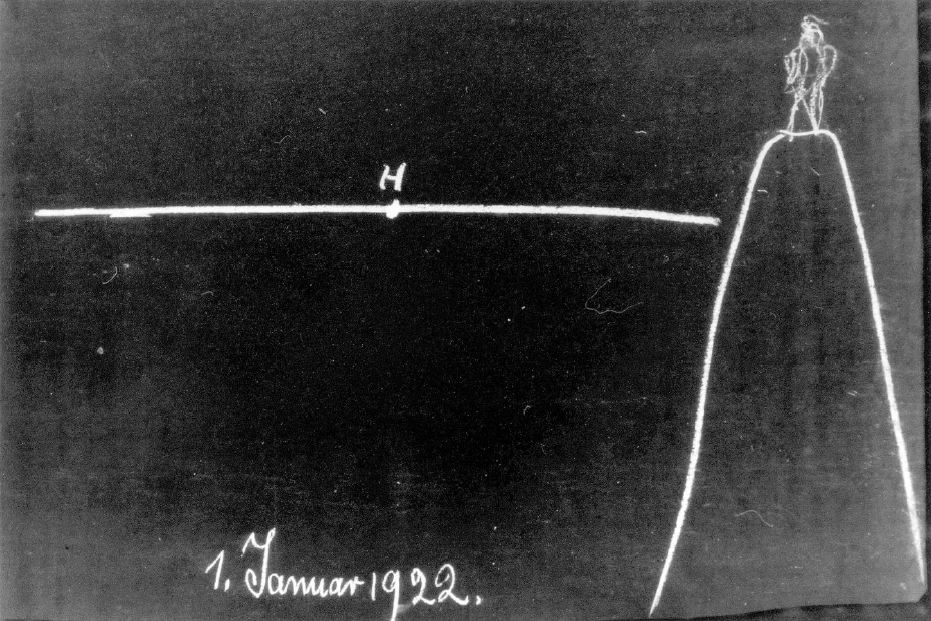
Rudolf Steiner: "When we begin to comprehend the world in its true nature we feel as though we were standing on a high rock with one abyss on our right and another on our left. The abyss is ever-present, but in ordinary life we do not see this abyss, or rather these two abysses. To learn to know ourselves fully we have to perceive these abysses, or at least we have to learn about them. We are drawn in the one direction towards Lucifer and in the other towards Ahriman."
Source: The Rudolf Steiner Archive
January 1, 1922. GA 210
Our Petty Ego: The Prodigal Son. The two opposing spiritual streams of our time.
![]() |
| "No one comes unto the Father except through me." ~John 14:6 |
Materialism and the Task of Anthroposophy
Lecture 9
Rudolf Steiner, Dornach, Switzerland
April 24, 1921
In the course of the last week we reflected on a number of considerations suited to throw light on the spiritual condition of the present and the immediate future. Recently, we have referred in particular to the decisive turning point of humanity's development in Europe in the fourth century. Earlier, at least in the south of Europe, people understood the Mystery of Golgotha to some extent on the basis of Oriental wisdom. They still grasped with a certain comprehension something that is viewed today with such antipathy by some circles, namely, the Gnosis. The Gnosis was indeed the final remnant of Oriental primeval wisdom, that primeval wisdom which, though proceeding from instinctive forces of human cognition, did penetrate deeply into the nature of the world's configuration. With the aid of the conceptions and feelings acquired through Gnostic knowledge, people were able to have insight into what had taken place in the Mystery of Golgotha. But the Christian stream that increasingly flowed into the Roman political system and took on its form was actively involved in destroying this Gnostic world outlook. Except for a few quite insignificant remainders from which little can be gained, this Christian stream eradicated everything that once existed as Gnosis. And, as we have seen, nothing was left behind of ancient Oriental wisdom in the consciousness of mankind in Europe except for the simple narrations, clothed in material events, about what took place in Palestine at the time of the Mystery of Golgotha.
To begin with, these narrations were clothed in the form that originated in ancient paganism, as you can see in theHeliand. They were adopted by European civilization. But there was less and less of a feeling that these stories should be penetrated with a certain cognitive force. People increasingly lost the feeling that a profound world riddle and secret should be sought for in the Mystery of Golgotha. For concerning the one who had been united with Jesus as Christ, dogmas determined by council decisions had been established. The demand had been raised that people believe in these established dogmas; thus, gradually all living knowledge that had still existed up until the time of the fourth Christian century passed over into the solidly structured system of doctrines of the Roman State Church.
Then, if we have an overview of this whole system of the Occidental Christian church stream, we see that the nature of the Mystery of Golgotha was enveloped in certain firm, rigid, and more and more incomprehensible doctrines, and that any living spiritual knowledge was in fact eradicated.
We are faced with a strange factor in European evolution. One might say that the fertile, living Oriental wisdom flowed into the doctrines adopted by the Roman Church and became rigid. In dogma, it continued on through the ensuing centuries. This dogma existed. One must remember that there were some people who to some extent knew what to make of these dogmas, but it had become impossible for the general consciousness of humanity to receive anything but a dead form. Certainly, we encounter a number of splendid minds. We need only to recall some of those who came from the Irish centers of knowledge; we need only recall Scotus Erigena who lived at the court of Charles the Bald. [Note 1] In individuals like him, we have people who received the doctrines and still sensed the spirit in them, or discovered it more or less. Then we have scholasticism, often mentioned here in a certain connection, which attempted in a more abstract form to penetrate the doctrines with its thinking. We face the fact that an extensive system of religious content was present in rigidified doctrines and was handed down from generation to generation; it survived as a system of dogmas. On the one hand, there were the theological dogmas, on the other, the narrations concerning the events of Palestine clothed in materialistic pictures.
Now, if we wish to comprehend our modern age, we must not forget what these Roman-Catholic dogmas couched in Roman political concepts are fundamentally all about. Among them are doctrines of great significance, splendid doctrines. There is, above all, the doctrine of the Trinity, which, in other terminology of later times, points to the Father, the Son, and the Spirit. An ancient and profound primordial wisdom was frozen into this doctrine, something great and mighty that human perception once possessed instinctively. Yet, only the brilliant, inspired insight of a few could fathom what is contained in such a doctrine.
Running through the various council resolutions, there was what finally rigidified into the dogma of the two persons of Christ and Jesus in one man. There were dogmas concerning the birth, the nature of Christ Jesus, the death, the Resurrection, and the Ascension. Finally, there were dogmas establishing the various festivals; and all this was basically the skeleton, the silhouette of a wondrous, ancient wisdom. Now this shadowy image, this skeleton, continued on through the centuries. One particular reason why it was able to go on was that it assumed a certain form of ancient cults. The content of what was thus expressed in dogmas, in the most sublime dogmas, such as the dogma of the transubstantiation of the bread and wine into the body and blood of Christ, could spread because it was clothed in the form of an ancient, sacred cult, namely, the Sacrifice of the Mass. The ancient cult was just altered a bit but as such continued on. The various metamorphoses of the Christian festivals lived on through the whole ecclesiastical year. Those aspects lived on that you know as the sacraments. They were intended to lift the human being out of the ordinary material life through the agency of the Church, so to speak, into a higher, spiritual sphere. Because of all this and because of its link with the impulse of Christianity, this content lived on throughout the centuries of historical development in Europe. Side by side with this, as I have said, existed the humble narration of the events in Palestine, but garbed in materialistic formulas.
Because of its significant content and because people basically had nothing else with which to establish a relationship to the super-sensible worlds, all these doctrines together were something that affected minds striving for such higher knowledge. Due to the ritual and the simple narration of the Gospel, however, these doctrines could also unfold that form of activity that gained influence over the broad masses of Europe's population.
In addition to this, another separate and different cult system spread, one that counted less on Christianity as such but frequently accepted it. It was basically not organically connected with Christianity but proceeded more from older cults. This other system culminated in the dogma of present day Freemasonry, which, indeed, had and still has only a superficial relationship to Christianity. As you know, the element that clothed itself in the form of Roman-Catholic dogmatism and the element that in Masonic tradition is linked to other cults and symbolism fight each other tooth and nail to this day.
This development can be traced more or less if only we focus our soul on the historical facts with some sense. But what presents itself can be fully comprehended only when we look to that turning point of European evolution in the fourth Christian century that, in a sense, sank all the ancient spiritual wisdom and its aftereffects into a sort of abyss. Due to that, people in Europe knew little of Oriental primeval wisdom throughout the ensuing centuries.
As I pointed out yesterday, the inner faculties that enabled human beings in ancient times to experience weight, number, and measure in their own being had gradually disappeared. Measure, numbers, and weight then turned into abstractions. With these abstractions, people then established in the fifth post-Atlantean epoch what has today become our natural scientific world view, something that could not include human beings in its sphere and stopped short of them, unable in any way to comprehend them. By means of the abstractions of weight, number, and measure, it did, however, grasp the external natural phenomena with a certain excellence and arrived at a kind of culmination point in the nineteenth century.
People today do not yet have enough distance from these matters; they do not yet realize that a quite special point in time was actually reached in European development in the middle of the nineteenth century. Intellectual striving, pure rational effort, attained to its fullest and greatest unfolding at that time. It was the trend that resulted from those same sources from which the modern natural scientific views have been flowing since the first third of the fifteenth century. Yet, at the same time, this was the trend that ultimately could no longer make anything of the cult that had spread; indeed, this trend basically had been unable for a long time to do anything with the ritual and dogmatic formulas established by the Church councils. Merely a few vestiges had survived, a few remnants; for example, the vestige of the Council of 869, [Note 2] where it had been resolved that the human being consists not of body, soul, and spirit, but merely of body and soul, with the latter possessing a few spiritual qualities. This vestige remained and lived on in the modern philosophical views that believed themselves to be objective but actually only reiterated what had originated in this Catholic dogmatism.
The modern mood of European civilization, which tended increasingly to a purely intellectual, rational view of the universe, formed out of all these directions. Having been prepared for centuries, this mood reached its culmination in the middle of the nineteenth century. How can we understand this culmination if we observe the human being from a soul-spiritual standpoint? We have to focus on human nature, as it was in ancient times and as it has gradually changed. We have done this already from a number of different viewpoints and shall do so again today from yet a certain other standpoint.
Let us place the human being schematically before us. Take, first of all, man's physical body (red). As I said, I am making a schematic drawing.
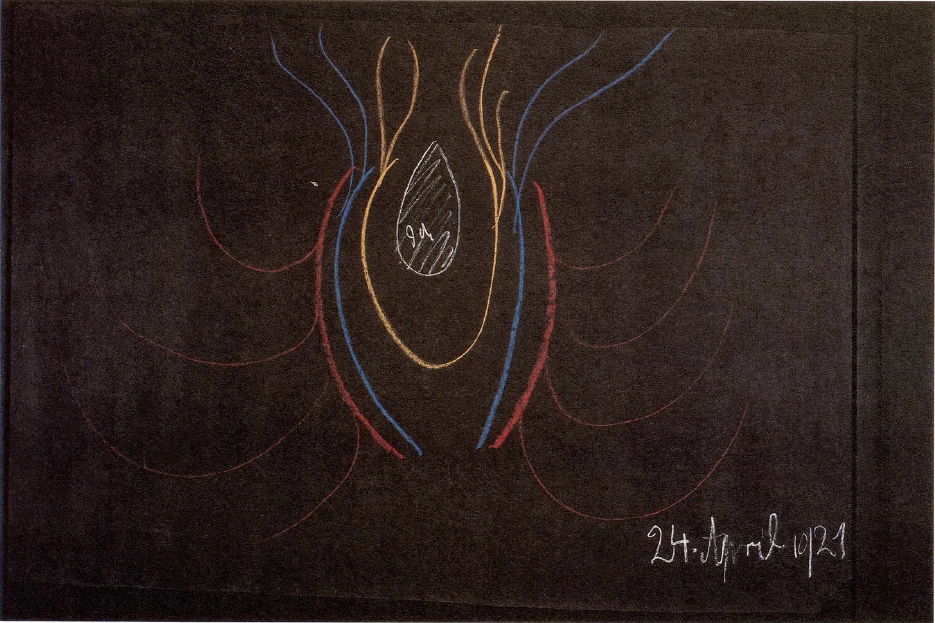
This is man's etheric body (blue); that is the human astral body (yellow); here we have man's ego. Let us first consider the human being as he was in ancient times, those ancient times when instinctive clairvoyance still existed, which then faded, withered, and gradually disappeared. The ego is basically a product of the earth and we need to give it less consideration. But we must be clear about the fact that the whole world actually dwells in man's physical, etheric, and astral bodies. We can say, in this physical body lives the element that represents the whole world. The corporeality is born out of it and continues to reconstruct itself through the intake of nourishment. In the etheric body, the whole world lives as well; in the most diverse ways, influences enter constantly into it and send their effects into the human being in a superphysical manner, effects that express themselves in the forces of growth, for example in the circulation of the blood, in the breath, and so on. They are by no means identical with the forces that are present in the intake of food and in digestion. In addition, there are all the influences living in our astral body that receive impressions from the world through the senses, and so forth. It is like this to this day and was like this in the days when the human being still lived with his ancient instinctive clairvoyance, but in that age, he was more intimately connected with his physical body, his etheric, and astral bodies than he is today. When he woke up in the morning, he submerged with his ego and astral body into his physical and etheric bodies. A close connection developed between his ego and astral body and his etheric body and physical corporeality. And he not only dwelled in his physical body, he also lived in the forces that worked within the latter.
Let me give you a vivid description of this. Imagine that a person possessing ancient clairvoyance ate a plum. It seems almost grotesque to a human being of today when something like this is described, but it is profoundly true. Assume that such an ancient clairvoyant ate a plum; this plum contains etheric forces. If a person eats a plum today, he is not aware of what goes on within this plum. The ancient clairvoyant ate a plum; it was then in his stomach, was digested, and he experienced how the etheric forces in the plum passed over into his body. He cosmically participated in this experience. When he inwardly made comparisons between the various things he ingested into his stomach, he saw that all the relationships in the outside world continued inside the human being, and he perceived them inwardly. From waking in the morning to going to sleep at night, such a person was filled with the vivid inner perception of the life lived outside by the plums, by the apples, and by much else that he ate. Inwardly, through the breathing process, he was aware of the essential, spiritual being of the air. Through the warmth that coursed through his circulation process, he was familiar with the warmth forces of the cosmos in his surroundings. He did not stop short at merely sensing the light in his eyes. He felt how the light rays streamed in through the nerves of his eyes; how, in his own etheric body, they encountered the physical limbs and dwelled within them.
Such a person experienced himself quite concretely within the cosmic element. While it was a dim consciousness, it was present. During the day, it was muted by what a person perceived outwardly even in those days. But even in the early times of Greek civilization, it was true that human beings still retained an aftereffect of what is possessed today only by creatures other than man. I have already mentioned several times that it is most interesting to look with spiritual sight upon a meadow where cows are lying down and digesting. This whole activity of digestion is a cosmic experience for the cows. It is even more so the case with snakes; they lie down and digest and do indeed experience cosmic events. Out of their organism, something blossoms and sprouts that is “world” to their perception. Something arises out of their inner being that is much more beautiful than anything we are ever able to see with our eyes from outside. Something like this was present as an underlying mood in human beings who still possessed ancient, instinctive clairvoyance. While it was muted throughout most of the day by external perceptions, when these people fell asleep, they carried with them what they had thus experienced and received into their astral body and ego. Then, when their ego was alone with its astral body, these experiences arose powerfully in the form of true dreams. Then, in the form of true dreams, these people experienced after the fact what they had only dimly experienced during the day.
You see, I am referring you to the inner soul-bodily manner of experiencing on the part of human beings of ancient times; because they were able to experience in this way, they had cosmic experiences. It was in this that they found their cosmic, super-sensible perception. Then, when people in the Orient drank the Soma drink, [Note 3] they knew the nature of the Spirit of the Heights. This Soma drink permeated, surged, and wove through their inner being, enlivening their blood. When these people subsequently fell asleep and the ego and astral body, which had been active in the blood, took along the forms that had come into being through the digestion of the Soma drink, then their being widened out in the widths of space and, in their nocturnal experience, they felt the spiritual beings of the cosmos.
Such an experience was still present in those among whom the ancient Zarathustra found willing listeners in the ancient Persian epoch. If one is unaware of these things, one does not understand what finally came down to us from the Oriental scriptures that have survived. This living cosmic perception gradually became extinguished. Already in the historical Egyptian age, little of it can be found, only its aftereffects are still present. And except for final vestiges that have always been retained among primitive human beings, it then disappeared in the fourth Christian century. From then on, the intellect, the rational element, increasingly struggled to come to the fore in the human being, the element that is completely tied to the mere physical body in its isolation from the world.
If you have a pictorial imagination and enter into your body, you cannot help but experience something cosmic. If you have retained something of the inner quality of numbers and enter into your body with it, you cannot help but experience the number element of the cosmos. The same is true for the ratios of weight. However, if you enter into the human organism with the power of the ego, which is active as a purely rational, intellectual element, then you immerse yourself only in the isolated human body, in what the human body is by virtue of its own nature, without its relationship to the cosmos. You enter into the earthly human body in its total isolation. Thus, if I would try to sketch this from the point of view of the intellect, I would have to do it like this:
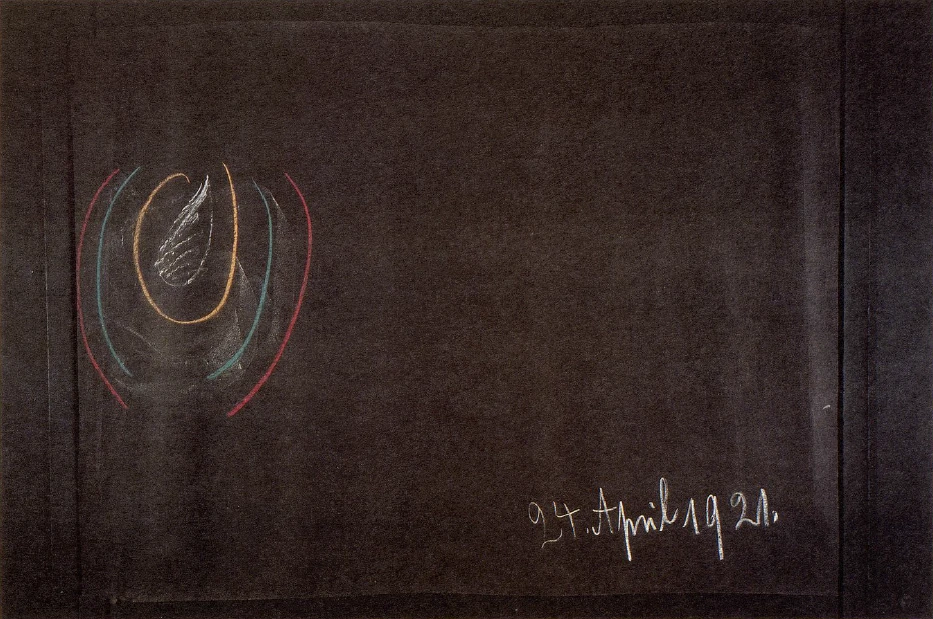
The etheric body, the astral body, and the ego (see above, blue, yellow, and shape in the middle) are present there too. But the ego no longer experiences anything of the cosmic element here within the human being. It only has a dim experience of its own existence, of its own immersion in the isolated human organism. Therefore, when this purely intellectual ego goes into its surroundings in sleep, it takes nothing along. The fact that it takes along nothing is the reason that at most reminiscences, dream images of an unrealistic kind, can arise in the human being, and that this ego can in no way be permeated by anything from the cosmos. Basically, from the moment of falling asleep until awakening, the human being experiences nothing of significance, because his whole manner of experiencing is calculated for the isolated human organism, which in turn affects the ego with those forces that have nothing to do with the cosmos. This is why the ego is dulled from the moment of falling asleep until waking up.
Indeed, it must be so, for though instinctively clairvoyant ancient human beings possessed cosmic vision and dwelled in instinctive Imaginations, Inspirations, and Intuitions, they possessed no independent rational thinking. If this independent rational thinking, this actual intellectual thinking, is to develop, it has to make use of the instrument of the isolated human body. It has to be dull during sleep and therefore brings nothing along when it awakens. The ancient human being, on the other hand, having carried his experiences in the body out into the cosmos, brought with him what he had experienced in the encounter of the cosmic aftereffects with the actual spiritual-cosmic occurrences out there. Again, he brought back aftereffects of what he had experienced there and thus enjoyed a lively relationship with the cosmos. What is attained by the human being through intellectual thinking is acquired in the period from waking up until falling asleep and dims down after sleep begins. Human beings now have to depend on the time when they are awake.
We come across the strange phenomenon that in ancient times the human being was bound more to his body than he is today, but that he experienced in this body the spiritual aspect of the cosmos. Modern man has lost this experience in the body. The human being today is more spiritual but he has the most rarefied spirit; he lives in the intellect and can dwell in the spirit only from the time he awakens until he falls asleep. When he enters the spiritual world with his completely rarefied intellectual spirit, his consciousness is dimmed.
Why have we developed materialism? And why did ancient humanity not have materialism? The ancients did not have it because they dwelled within the matter of the body; modern men have materialism because they dwell only in the spirit, because they are completely free of a cosmic connection to their body. Materialism actually comes about because the human being became spiritual, but spiritual in a rarefied manner. People were most spiritual during the mid-nineteenth century. But they lied to themselves in an ahrimanic way inasmuch as they did not recognize that it was the rarefied spirit in which they dwelled. Into the most spiritual element possible for the human being, he only absorbed the concept of materiality. The human being had turned into a completely spiritual vessel, but into this vessel he only let flow the thoughts of material existence. It is the secret of materialism that human beings turned to matter because of their spirituality. This is modern man's negation of his own spirituality. The culmination point of this spiritual condition was in the middle of the nineteenth century, but human beings did not grasp this condition of spirituality.
As I said, this developed slowly through the centuries. The ancient instinctive spirituality had slowly died down in the fourth Christian century; beginning in the first third of the fifteenth century, the new spirituality dawned; the time between is in a sense an episode of purely human experience. Now, however, after this point in time in the first third of the fifteenth century and after that century as a whole, this dependence of man on his isolated physical body made itself felt. Now he no longer developed any relationship to what was frozen into dogmatic council doctrines and what, although rigidified, still possessed a grandiose content. Now, too, human beings basically could no longer find any relationship to the humble narrations of Palestine. For a while yet, they forced themselves to connect some meaning with them. However, meaning can be connected with them only when they are penetrated by knowledge. In particular, modern human beings no longer could connect any meaning with the cults, the ritual itself. The Sacrifice of the Mass, a religious act of the greatest cosmic significance, turned into an external, symbolic act because it was no longer understood. The sacrament of the Transubstantiation, which had survived through the Middle Ages and which has profound cosmic significance, became part of purely intellectual disputes. Certainly it goes without saying that when people began to question with their isolated intellect how the Christ could be contained in the sacraments of the altar, they could not comprehend it, for these matters are not suited for comprehension by the intellect. But now human beings began to try to understand them by means of the intellect.
This then led to the emergence of debates of great importance in world history known as the “Eucharist-Dispute,” [Note 4] and linked to names like Hus [Note 5] and others. The most progressive individuals in Europe, those most advanced in the rational comprehension of the world, then arrived at the various forms of Protestantism. It is the intellect's reaction against something that had emerged from a much broader, much more intense power of cognition than is the intellect itself. The powers that had developed in the modern soul as intellectual faculties and what dwelled in the rigid dogmas yet containing something great and mighty, these two confronted each other as two alien views! Protestant confessions of the greatest variety arose as compromises between the intellect and the ancient traditions. The sixteenth, seventeenth, eighteenth and nineteenth centuries passed, and in the middle of the nineteenth century the human being reached the culmination of his intellectual development. He became a spiritual being through and through.
With this spirituality, he could comprehend what exists in the outer, sensory world, but he did not comprehend himself as spirit. People hardly had an inkling any longer of the meaning of a sentence such as the one by Leibnitz that states, “Nothing dwells in the intellect that did not dwell earlier in the senses, except for the intellect itself.” [Note 6] Modern people completely omitted the phrase at the end and acknowledged only the sentence, “Nothing dwells in the intellect that did not dwell earlier in the senses,” whereas Leibnitz clearly discerned that the intellect is something totally spiritual at work in the human being quite independently of all aspects of the physical corporeality.
As I have said, the intellect was active but did not recognize itself. Thus, it has been our experience that human beings are now in the transition to another phase of development in their life, and, so to speak, they carry nothing out with them into the night. For what is intellectually acquired is attained through the body and has no relationship to what is outside the body. People now have to work their way anew into the spiritual world. The possibility distinctly exists for them to look into this spiritual world. What people earlier had attained from their physical and etheric bodies as well as from their astral body in regard to an instinctive view of the cosmos can be attained again today. We can come to Imaginations and by means of them we can describe the world evolution from Saturn, Sun, Moon, to earth, and so on. We can behold what dwells in the nature of numbers, namely, the being of numbers. Through Inspirations, we can receive insight into how the world is shaped out of cosmic spirituality according to the laws of numbers. It is entirely possible that we can have insight into the world in this way through Imagination, Inspiration, and Intuition.
Most people will say: If we have not ourselves become clairvoyant, we can at most study these matters. Good and well, but one can study them, and it has been said again and again that the ordinary intellect can grasp them. Today, I shall add the reason why the ordinary intellect is able to grasp these matters. Assume that you are reading something like An Outline of Occult Science. Imagine that you try to place yourself into these descriptions with your ordinary intellect. You take it in with the intellect, which is only linked to the isolated human body. But you do take something in that you could not receive through this intellect, since throughout the past few centuries this intellect did not comprehend itself. Now you take something in that is incomprehensible on the basis of those concepts that the intellect derives from the external sense world. It does become comprehensible, however, when the intellect on its own makes the effort to understand it, initially neither agreeing nor disagreeing but only comprehending. After all, the emphasis is on understanding these things.
Initially, you need simply understand them. If you do, then you create something with the insight the ego has gained that extends into the night. Then, during the night, you no longer remain dull as is the case with the merely intellectual attitude towards the world; then, from the time of falling asleep until waking up, you dwell in a different content in the delicately filtered spirituality. Then, you awaken and find that the possibility has been added — small though it is each time — of inwardly acquiring what you have struggled to understand intellectually. With each passing night, every time we sleep, something of an inner relationship is added, we acquire an inward connection. Each time, upon falling asleep, we bear the aftereffect of our daytime comprehension with us into the world beyond corporeality. In this way, we acquire a relationship to the spiritual world, a relationship acquired completely out of reality. This, however, is the case only if the human being does not ruin this relationship by means of something with which he so frequently ruins it today. I have mentioned these means for ruining spirituality quite often. As you know, many people are intent on acquiring a certain state of sleepiness prior to going to sleep; they consume as many glasses of beer as it takes to have the necessary degree of sleepiness. This is a quite common practice, especially among “intelligent” people. In that case, the faculties I just mentioned certainly cannot develop.
Spirituality can be researched, however, and this spirituality can indeed be experienced as well in the manner just described. The human being has grown away from spirituality. He is capable of growing into it again. Today, we are only at the beginning of this process of growing into spirituality. In the past few centuries, from the fifteenth century into the nineteenth century when the intellect had reached its highest level, a certain spirituality has developed, in particular among the most progressive people in Europe, albeit a spirituality that has as yet no content. For it is only when we turn to Imagination that this spirituality receives its first content. This spirituality, which is filtered to the extreme, must first receive its content.
At this point in time, this content is being rejected by the majority of the people. The world wishes to remain with the filtered spirituality; it wishes to produce a content derived from the outer material world. People do not wish to struggle with their intellect to comprehend the results of insight into the spiritual world offered. The confessions that follow the Gospel are, after all, compromises between the intellect and ancient traditions; they have lost the connecting link. Ritual means nothing to them. This is why the latter has gradually disappeared within these confessions. People arrived at abstract concepts instead of a living comprehension of, for example, the Transubstantiation. At most, the simple stories can be told, but no meaning other than the one that is compatible with a materialistic theology can be connected with them, namely, that one is dealing with occurrences that can be linked to the humble man from Nazareth, and so forth. All this can no longer lead to a content; it is something that loses all connection with spirituality.
Thus, the situation in the world today is such that there is, first of all a faith that has rejected the intellect and did not strike any compromise. Due to this, in vast segments of the population a relationship has been retained, albeit an instinctive one, to the doctrines and dogmas, the content of which is no longer accessible to human beings but did flow out into these dogmas. This segment of the populace also has retained its living relationship to the cult, to the ceremonial ritual; it has retained its link to the sacraments. As depleted as all this is, the ancient spirituality — the spirituality to which there is still a connection through dogmas — did once dwell in what has become a skeleton, a shadow. Among the more recent Protestant confessions, where a compromise is being tried out, such a connection is no longer alive. And then we have those who call themselves quite enlightened and dwell only in the intellect, which is spiritual but does not wish to grasp the spirit.
These are the three streams we confront. In regard to the future, we cannot count on the fruitfulness of those streams that only tried to make an external compromise; we cannot count on mere intellectuality that cannot arrive at any content and therefore can only lose itself since it does not want to understand itself. We can only count on the direction in which these streams are gradually heading, and they are more and more clearly heading there, namely, we can count on what has been poured into ancient doctrines and is represented in the surviving Roman-Catholic Church. We can count on the attitude that takes the new intellectuality seriously and deepens it Imaginatively, Inspiratively, and Intuitively, thus arriving at a new spirituality. The modern world is becoming divided and estranged in these two contrasting directions. On the one hand stand people with their intellect. They are inwardly lazy and do not wish to utilize this intellect, but they need a content. So they refer to the dead dogmas. Particularly among intelligent people, who are, however, mentally indolent, who are in a certain respect intellectual and Dadaistic, a neo-Catholic movement is making itself felt that is trying to take hold of the old traditions that have rigidified in dogmas and that is trying to receive a content from outside, through historical phenomena but that rigidifies in historical forms. Based on the intellect, this trend tries desperately to make some sense of the ancient content; thus we have intellectual battles that, by means of the old content, try to prepare their rigidified doctrines in a new way for the use of human beings.
To cite an example, on many pages in the newest edition of the magazine Tat, [Note 7] we can observe an intellectual, cramped tendency towards rigidified doctrines. After all, the publisher, Diederichs, does everything; he puts everything into categories and on paper. Thus, he has now dedicated a whole edition of Tat to the neo-Catholic movement. It allows us to discern how cramped people's thoughts are today, how people are developing inwardly cramped thinking so that they can avoid having to rouse themselves and can remain mentally lazy in order to grasp with the intellect whatever moves forward most indolently.
People experiment with all this in order to be able to reject this life-filled striving out of modern intellectuality towards spirituality, a striving that can and must be grasped. More and more, things will come to a head in such a way that a powerful movement with a fascinating, suggestive, hypnotic effect on all those wishing to remain lazy within the intellect permeates the world. A Catholic wave is even pervading the world of intelligent people who wish, however, to remain lazy within their intelligence. The drowsy souls just do not realize it. But it must remain unfruitful to strive for what Oswald Spengler described so vividly in his Decline of the West. [Note 8] One can turn the Occident Catholic, but one will thereby slay its civilization. This Occident has to concern itself with waking up, with becoming inwardly active. Its intelligence must not remain lazy, for this intelligence can rouse itself; it can fill itself inwardly with an understanding for the new view of the spirit.
This battle is in preparation; in fact, it is here — and it is the main point. In the future, everything else concerning world views will become crushed between these two streams. We must turn our attention to this, for what is coming to expression conceals itself in any number of formulas and forms. Nobody is living fully in the present who believes that he can make progress with something that people were perhaps still dreaming about at the beginning of this century. He alone lives fully in the present who develops an eye for what dwells in the two streams described above. We have to be aware of this. For everything I have discussed a week ago when I said that nowadays a great number of people love evil and, purely due to their tendency towards evil, indulge in slander in the way I described — all this is what must come before our souls. We must bear in mind that inner untruthfulness, which expresses itself in the facts — as I told you — that people, who are supposed to be strengthened in their Catholic faith, are sent to the Catholic church in Stuttgart to attend a lecture by General von Gleich, and that this Catholic general concludes with a hymn by Luther! There, the two tendencies come together that care nothing about the confessions but only try to stream together in the proliferation of lies.
These things must be noticed today. If this is not done, then one is asleep and does not participate in what alone can make the human being today truly human.
Source: The Rudolf Steiner Archive
The Revelation of John: September 30, A.D. 395
From the notes of a listener to an Esoteric Lesson given by Rudolf Steiner on March 5, 1911:
Two sayings are given to pupils in Rosicrucian schools to support them in their meditations: Beware of drowning in your esoteric striving. Beware of burning in the fire of your own ego.
There's an outer and an inner way to strive towards the spiritual.
Everything around us is like a veil, like a cover before the spiritual that we must punch through to get to the spiritual behind it. But in which direction? This cover surrounds us on all sides: above, below, front, back, right, and left. And inwardly, everything that we experience as joy, pain, etc., is like a veil, like fog that conceals the spiritual in us, and this spiritual is the same one that we find when we break through the outer cover.
So that mankind can evolve further and get into the spiritual there are always men from time to time who are more advanced than is permitted by the momentary stage of human development, and who have things to tell us about states of human evolution that reach far into the future. Such advanced beings must exist to lead men further. John, the writer of the Apocalypse, was such a man. When he wanted to write a revelation of the future, he told himself: If I write this book out of the whole surroundings in which I'm living here and now, it'll be influenced by the self that's in my body, since I'm connected with everything around and in me. I must free myself from all of this. He had to place himself on something like a rock that served him as a firm support, on which he didn't wobble and wasn't influenced by anything that surged around and in him. And he moved himself to the evening of September 30, 395 A.D., to the island of Patmos, as the Sun had already disappeared under the horizon, though its effect could still be felt, and as the Moon and stars appeared. The Virgin constellation was there in the western sky, irradiated by the last gleam of the Sun that had set, with the Moon under it. This picture is reproduced in one of the seals — the Virgin with the radiating Sun, and the Moon under her feet. Thus, all of these seals were produced out of deep mystical connections.
John broke through the cover that surrounds us in this one direction — that of Virgo. There are 12 of these signs. Seven of them are good — the ones reproduced in the seals; the other five are more or less dangerous. Just as John chose this particular point in time and space to become completely separated from himself and all temporal things around him, so a Rosicrucian pupil must acquire a firm foundation in himself. The best way to do this is to let theosophical teachings work on us. Our astral body and thereby our etheric body become expanded by listening to theosophical ideas. This is the effect on anyone who hears anything about theosophy. But the effect on those who are inclined toward theosophy is different than on those who aren't. The former feel the etheric body's expansion and fill it up with theosophical teachings, by accepting them. The other feel an emptiness in their etheric body through its expansion because they don't accept these ideas and so don't fill the expansion. Then doubt and skepticism arise through this emptiness. Whereas with the first men, it's like a pouring of oneself into the universe, which they can't let go too far, for they'll get a feeling of hollowness, of not feeling at home in these widths of space, like a fish that's taken out of water and can't live in air, because its organs haven't adapted themselves to this changed element. When a theosophist devotes himself to the teachings and his astral body expands evermore, he loses himself in this unfamiliar element. One must avoid drowning here. And this is possible if one studies theosophy seriously, takes it in, elaborates it, and grasps it with feeling, not just with thinking and will, but permeates it completely with feeling. One can only do this with great earnestness. One must gain a firm support within oneself — like John when he wanted to write the Apocalypse and he transported himself to the island of Patmos at sundown of Sept. 30, 395.
The configuration of the Sun, Virgo, and Moon on that evening can be checked astronomically, and this was done. From this materialistic science draws the conclusion: Therefore the Apocalypse was written at that time. And then we're told that science has ascertained this. That's the way science ascertains things.
On the inner path one finds all the joys and sorrows, pains and blissfulness that live in us. But all of this is attached to our lower, perishable ego. This whole desire-world surrounds us like a fog that covers the spiritual for us. It keeps us from seeing and noticing the spiritual. We must break through it to get to the spiritual. There are forces that approach an esoteric pupil to make this fog even denser. The fog gets even denser if we don't resist it. We must burn it to avoid burning in the fire of our passions. If we don't overcome this fog, if we don't resist its becoming ever denser through Luciferic and Ahrimanic forces, we're prisoners, as occultists say. There actually are men today who are born with great capacities and reach certain stages very quickly, but are then completely wrapped up in such a fog by the adversarial powers that they can't get out. One calls this occult imprisonment.
Our desire-world consists entirely of egoism. And we can only overcome this egoism in deep humility. Which thought can lead us to an overcoming of egoism? The thought that we already spoke about yesterday in the exoteric lecture, the thought that we killed Christ. We're murderers, yes, that's what we are. We can transform this fact, but only if we let Paul's words live and become truth in us, “Not I, but Christ in me.” We shouldn't kill the divine in us through egoism, through our life of desires, etc., we should let Christ live in us. We should begin to carry out this easy and yet so difficult thing in us with shivering earnestness.
We arose from the divine: Ex Deo nascimur. We should take all suffering upon us willingly and patiently with the thought that we killed Christ; we should devote ourselves to him completely and die in him: In Christo morimur. Then we'll be reborn, reawakened through the Holy Spirit: Per Spiritum Sanctum reviviscimus. This verse sounds different exoterically than esoterically, but the difference is in only one word that's left out in the esoteric version. As we leave this word out and don't speak this word in shy reverence for what this word expresses, our feeling goes out to what is left unspoken in shy reverence.
Ex Deo nascimur
In … morimur
Per Spiritum Sanctum reviviscimus.
This tells us that man arose from the spiritual; that he was originally contained in the spirit:
In the spirit lay the germ of my body.
And the spirit has imprinted in my body
The eyes of sense,
That through them I may see
The lights of bodies.
And the spirit has imprinted in my body
Reason and sensation
And feeling and will,
That through them I may perceive bodies
And act upon them.
In the spirit lay the germ of my body.
In my body lies the germ of the spirit.
And I will incorporate into my spirit
The supersensible eyes
That through them I may behold the light of spirits.
And I will imprint in my spirit
Wisdom and power and love,
So that through me the spirits may act
And I become a self-conscious organ
Of their deeds.
In my body lies the germ of the spirit.
Monday, September 29, 2025
Anthroposophy: The Bridge Between the Sense World and the Moral World
Supersensible KnowledgeLecture 2 of 2
Rudolf Steiner, Vienna
September 29, 1923
[102 years ago today]
On last Wednesday I had the opportunity to explain to you how a supersensible knowledge may come into existence out of the further development of those capacities of the human soul which belong to our everyday life, and which are recognized also in science when methodically applied. I undertook to show how a systematic further development of these capacities of the soul actually brings about for the human being a form of perception whereby he can become aware of a supersensible world, just as he becomes aware of the physical sensible world environing him by means of his physical senses. Through such vision we penetrate upward not only to an abstract sort of conviction that, in addition to the world of the senses, there exists also a world of the spirit, but to acquisition of real knowledge, to a real experience of spiritual beings, which constitute the environment of man himself to the extent that he lifts himself up into a condition of spirituality, just as plants and animals constitute his environment in the physical world.
Such a supersensible knowledge is something different in its entire nature from that which we designate as knowledge in ordinary life and for our everyday consciousness, as well as in ordinary science.
In this ordinary knowledge we come into possession, in a certain sense, of ideas — for example such ideas as embrace the laws of nature. But this possession of ideas does not really penetrate into the soul in such a way as to become an immediate power of the soul, comparable as a spiritual power to muscular force as this passes over into activity. Thoughts remain rather shadowy, and everyone knows through immediate experiences how indifferent, in a certain sense, is the reaction of the human heart to thoughts when we are dealing with matters which affect the human heart in the profoundest degree.
Now, I think I have shown already in the first lecture that when a human being actually penetrates into the spiritual world by means of such a perception as we have in mind here, he then becomes aware of his supersensible being as it was before it descended to earthly existence. And the fact that he achieves for himself something of this kind as regards his own self in its relationship to the spiritual world does not leave his heart, the needs of his profoundest sensibilities, unaffected to the same extent as in the case of abstract forms of knowledge. It is certainly true that one who has himself led a life devoted to the acquisition of knowledge does not undervalue all the inner drama of the soul associated with the struggle for knowledge even in the ordinarily recognized sense, yet the knowledge that we thus acquire remains, nevertheless, mere pictures of the external world. Indeed, if we are scientifically educated at the present time, we are generally proud of the fact that these pictures merely reflect, in a certain sense, quite objectively the external world and do not dart with such inner force through the life of the soul as, in the case of the physical body, the circulating blood drives its pulsing waves through man's being. The fact is that what is here meant by supersensible knowledge is something which acts upon the human being in a manner entirely unlike that of ordinary knowledge. And in order that I may make myself perfectly clear precisely in reference to this point, I should like to begin with a comparison — which is, however, something more than a comparison, something that fits the matter completely in its reality.
I should like to begin with the fact that the human being, even in ordinary life, lives in two states of consciousness — we might say three states, but let us consider sleeping and dreaming as constituting a single state of consciousness — that he is separated completely from the external world during sleep, and that a world existent only within him reveals its effects in dreams in a grotesque and often chaotic manner. Even though we are in the same space with many other persons, our dream world belongs to us alone; we do not share it with the other persons. And a profounder reflection upon the world of dreams is the very thing that may show us that what we have to consider as our own inner human nature is connected with this dream world. Even the corporeal nature of man is reflected in a remarkable way in dreams: it is mirrored in fantastic pictures. One condition or another affecting an organ, a condition of illness or of excitation, may emerge in a special symbol during a dream; or some noise occurring near us may appear in a dream in a very dramatic symbolism. The dream creates pictures out of our own inner nature and out of the external world. But all of this is intimately connected, in turn, with the whole course of our life upon Earth. From the most remote epochs of this life the dream draws the shadows of experiences into its chaotic but always dramatic course. And the more deeply we penetrate into all this, the more are we led to the conclusion that the innermost being of man is connected, even though in an instinctive and unconscious manner, with that which flows and weaves in dreams.
One who has the capacity, for example, for observing the moment of waking and, from this point on, fixing the eye of the mind upon the ordinary daily life, not in the superficial way in which this usually occurs, but in a deeper fashion, will come to see that this waking life of day is characterized by the fact that what we experience in a wholly isolated manner during sleep and during dreams, in a manner that we can share with other persons at most only in special instances — that this soul-spiritual element sinks down into our corporeal being, inserts itself in a way into the will, and thereby also into the forces of thought and the sense forces permeated by the will, and thus enters indirectly, through the body, into a relationship with the external world. Thus does the act of waking constitute a transition to an entirely different state of consciousness from that which we have in dreams. We are inserted into the external course of events through the fact that we participate, with our soul element, in the occurrences of our own organisms, which are connected, in turn, with external occurrences. Evidences of the fact that I am really describing the process in a wholly objective way can, naturally, not be obtained by the manner of abstract calculation, nor in an experimental way; but they are revealed to one who is able to observe in this field — particularly one who is able to observe how there is something like a “dreaming while awake,” a subconscious imagining, a living in pictures, which is always in process at the bottom of the dry, matter-of-fact life of the soul, of the intellect. The situation is such that, just as we may dive down from the surface of a stream of water into its profounder depths, so may we penetrate from our intellectual life into the deeper regions of the soul. There we enter into something which concerns us more intimately than the intellectual life, even though its connection with the external world is less exact. There we come also upon everything which stimulates the intellectual life to its independent, inventive power, which stimulates this life of the intellect when it passes over into artistic creation, which stimulates this intellectual life even — as I shall have to show later — when the human heart turns away from the ordinary reflections about the universe and surrenders itself to a reverent and religious veneration for the spiritual essence of the world.
In the act of waking in the ordinary life the situation is really such that, through the insertion of our soul being into the organs of our body, we enter into such a connection with the external world that we can entrust, not to the dream, but only to the waking life of day, responsibility for the judgment which is to be passed upon the nature of the dream, upon its rightness and wrongness, its truth and untruth. It would be psychopathic for anyone to suppose that, in the chaotic, though dramatic, processes of the dream something “higher” is to be seen than that which his waking experience defines as the significance of this life of dreams.
In this waking experience do we remain also — at about the same level of experience — when we devote ourselves to the intellectual life, to the ordinary life of science, to everyday knowledge. By means of that absorption, immersion, and I might say strengthening of the soul about which I spoke on the previous occasion, the human being exercises consciously at a higher level for the life of his soul something similar to what he exercises unconsciously through his bodily organization for the ordinary act of waking. And the immersion in a supersensible form of knowledge is a higher awaking. Just as we relate any sort of dream picture to our waking life of day, through the help of our memory and other forces of our soul, in order to connect this dream picture, let us say, with some bodily excitation or external experience, and thus to fit it into the course of reality, so do we arrive by means of such a supersensible cognition as I have described at the point where we may rightly fit what we have in our ordinary sensible environment, what we fix by means of observation and experiment, into a higher world, into a spiritual world in which we ourselves are made participants by means of those exercises of which I spoke, just as we have been made participants in the corporeal world in the ordinary waking by means of our own organism. Thus supersensible knowledge really constitutes the dawn of a new world, a real awaking to a new world, an awaking at a higher level. And this awaking compels him who has awaked to judge the whole sensible-physical world, in turn, from the point of view of this experience, just as he judges the dream life from the point of view of the waking life. What I do here during my earthly life, what appears to me by means of my physical knowledge, I then learn to relate to the processes through which I have passed as a spirit-soul being in a purely spiritual world before my descent into the earthly world, just as I connect the dream with the waking life. I learn to relate everything that exists in physical nature not “in general” to a fantastic world of spirit, but to a concrete spiritual world, to a spiritual world which is complete in its content, which becomes a visible environment of the human being by reason of the powers of knowledge I have described as Imagination, Inspiration, and Intuition.
But just as a person feels himself in ordinary life to be in different states of soul when awake and when dreaming, so does the whole state of soul become different when one arrives at this higher awaking. For this reason, in describing supersensible knowledge in the manner that I have employed here, we do not describe merely the formal taking of pictures of the supersensible world, but the transition of a person from one state of consciousness into another, from one condition of soul into another. In this process, however, even those contents of the soul in which one is absorbed in ordinary life become something entirely different. Just as one becomes a different person in ordinary life through awaking, so does one become, in a certain sense, a different human being through this supersensible knowledge. The concepts and ideas that we have had in ordinary consciousness are transformed. There occurs not only a conceptual revolution in a person consisting in the fact that he understands more, but also a revolution in his life. This penetrates into the profoundest human conceptions. It is precisely in the profoundest human conceptions, I wish to say, in the very roots of the soul being, that a person is transformed through the fact that he is able to enter into the sphere of this supersensible knowledge — something which happens, of course, only for momentary periods in one's life.
Here I must call your attention to two conceptions that play the greatest imaginable role in everyday life. These are conceptions completely and profoundly valid in ordinary life which take on an utterly different form the moment one ascends into the supersensible world. These are the two concepts on the basis of which we form our judgments in the world: the concepts true and false, right and wrong. I beg you not to imagine that in this explanation I intend, through a frivolous handling of the problem of knowledge, to undermine the validity of the concepts true and false, right and wrong. To undermine something which is wholesome in ordinary life is by no means in keeping with a genuine supersensible knowledge. This higher knowledge enables us to acquire something in addition for ordinary life, but never subtracts from it. Those persons who — whether really or in sentimentality — become untrue in their ordinary lives, unpractically mystical for this aspect of life, are also unsuited for a genuine supersensible knowledge. A genuine supersensible knowledge is not born out of fantastic persons, dreamers, but out of those very persons who are able to take their place in their full humanity in earthly existence, as persons capable in real life. In other words, it is not our purpose to undermine what we experience in our everyday lives, and what is bound up in its very depths with the concepts true and false, right and wrong; on the contrary, truthfulness in this sphere, I should like to emphasize, is strengthened in one's feelings by that very thing which now comes about in connection with a higher knowledge by reason of a metamorphosis, a transformation, of the concepts true and false, right and wrong.
When we have really entered into this higher, supersensible world, we do not any longer say in such an abstract way that a thing is true or false, that it is right or wrong, but the concept of the true and the right passes over into a concept with which we are familiar in ordinary life, though in a more instinctive way; only, this concept belonging to the ordinary life is transmuted into a spiritual form. True and right pass over into the concept healthy; false and wrong pass over into the concept diseased. In other words, when we reflect about something in ordinary life — feel, sense, or will something — we say: “This is right, that is wrong.” But, when we are in the realm of supersensible knowledge, we do not arrive at this impression of right or wrong but we actually reach the impression that something is healthy, something else is diseased.
You will say that healthy and ill are concepts to which a certain indefiniteness is attached. But this is attached to them only in the ordinary life or the ordinary state of consciousness.
The indefiniteness ceases when the higher knowledge is sought for in so exact a manner as I have explained in the first lecture. Precision then enters also into what we experience in this realm of higher knowledge. Healthy and ill — these are the terms we apply to what we experience in association with the beings of the supersensible world of whom we become aware through such a form of knowledge.
Just think how deeply that which becomes an object of supersensible knowledge may affect us: it affects us as intimately as health and illness of the body. In regard to one thing that is experienced in the supersensible, we may say: “I enter livingly into it. It benefits and stimulates my life; it elevates my life. I become through it in a certain way more ‘real.’ It is healthful.” In regard to something else I say: “It paralyzes — indeed, it kills — my own life. Thereby do I recognize that it is something diseased.” And just as we help ourselves onward in the ordinary world through right and wrong, just as we place our own human nature in the moral and the social life, so do we place ourselves rightly in the supersensible world through healthy and ill. But we are thus fitted into this supersensible world with our whole being in a manner far more real than that in which we are fitted into the sense world. In the sense world we separate ourselves from things in this element of the right or the wrong. I mean to say that right does not benefit us very intensely and wrong does not cause us much distress — especially in the case of many persons. In the supersensible world it is by no means possible that experiences shall touch us in this way. There our whole existence, our whole reality, enters into the manner in which we experience this supersensible world. For this realm, therefore, all conflict of opinion ceases as to whether things are reality or mere phenomena; whether they manifest to us merely the effects produced upon our own sense organs, and the like — questions about which I do not wish to speak here because the time would not suffice. But everything about which people can argue in this way in relation to the physical reality — to carry on such discussion with reference to the spiritual world really has no significance whatever for the spiritual, supersensible world. For we test its reality or unreality through the fact that we can say: “One thing affects me wholesomely, another thing in an ill way — causing injury” — I mean to say, taking the word in its full meaning and weight. The moment a person ascends to the supersensible world, he observes at once that what was previously knowledge void of power becomes an inner power of the human soul itself. We permeate the soul with this supersensible knowledge as we permeate our bodies with blood. Thus we learn also in such knowledge the whole relationship of the soul and the spirit to the human body; we learn to see how the spirit-soul being of man descends out of a supersensible prenatal existence and unites with the inherited body. In order to see into this, it is necessary first to learn to know the spirit-soul element so truly that through this reality, as healthy or diseased, we experience the actuality in our own — I cannot say body here, but — in our own soul.
Supersensible knowledge, therefore — although we make such a statement reluctantly, because one seems at once to fall into sentimentality — is really not a mere understanding but an ensouling of the human being. It is soul itself, soul content, which enters into us when we penetrate to this supersensible knowledge. We become aware of our eternity, our immortality, by no means through the solution of a philosophical problem: we become aware of them through immediate experience, just as we become aware of external things in immediate experience through our senses.
What I have thus described is exposed, of course, to the objection: “To be sure, one may speak in this way, perhaps, who participates in such supersensible knowledge; but what shall anyone say to these things who is himself not as yet a participant in this supersensible knowledge?” Now, one of the most beautiful ways in which human beings can live together is that in which one person develops through contact with the other, when one goes through the process of becoming, in his soul nature, through the help of the other. This is precisely the way in which the human community is most wonderfully established. Thus we may say that just as it is not possible for all persons to become astronomers or botanists and yet the results of astronomy and botany may possess importance and significance for all persons — at least, their primary results — and can be taken in by means of the insight possessed by a sound human intellect, it is likewise possible that a sound human mind and heart can directly grasp and assimilate what is presented by a spiritual-scientist who is able to penetrate into the supersensible world. For the human being is born not for untruth, but for truth! And what the spiritual-scientist has to say will always be clothed, of course, in such words and combinations of words that it diverges, even in its formulation, from what we are accustomed to receive as pictures out of the sensible-physical world. Therefore, as the spiritual-scientist lays open what he has beheld, this may work in such a way upon the whole human being, upon the simple, wholesome human mind, that this wholesome human mind is awakened — so awakened that it actually discovers itself to be in that state of waking of which I have spoken today. I must repeat again and again therefore that, although I have certainly undertaken to explain in such books as Occult Science — an Outline, and Knowledge of the Higher Worlds and Its Attainment, and in other volumes, how it is possible to arrive through systematic exercises at what I must designate as “looking into the spiritual world,” so that everyone possesses the possibility today, up to a certain degree, of becoming a spiritual-scientist, yet it is not necessary to do this. For a sound human constitution of soul is such that what the spiritual-scientist has to say can be received when it comes into contact with the human soul — provided only that the soul is sufficiently unprejudiced — as something long known. For this is precisely the peculiar characteristic of this spiritual research, this supersensible knowledge to which we are referring: that it brings nothing which is not subconsciously present already in every human being. Thus everyone can feel: “I already knew that; it is within me. If only I had not permitted myself to be rendered unreceptive through the authoritarian and other preconceptions of natural science, I should already have grasped, through one experience or another, some part of what this spiritual research is able to present as a connected whole.”
But the fact of such a thing as this transformation of the concepts true and false into the healthy and the diseased renders the inner experience of the soul more and more intense. At a higher level man places himself more intensely within a reality than he places himself in the physical reality through the ordinary waking of the daily life. In this way feelings, sentiments, experiences of the soul are generated in relationship to these items of knowledge, which are altogether exact, just as they are generated through our being confronted by external things. That which the supersensible knowledge can bestow lays hold upon the whole human being, whereas it is really only the head that is laid hold of by what the knowledge of the senses can bestow. I trust you will permit me to visualize this relationship of supersensible knowledge to the complete human being by referring to something personal, although the personal in this realm is also factual, for the facts are intensely bound up with the personal.
In order to render it clear that supersensible knowledge cannot really be a mere head-knowledge, but lays hold upon the human being in a vastly more living and intense way than head-knowledge, I should like to mention the following. Whoever is accustomed to a living participation in ordinary knowledge — as every true supersensible knower should really be — knows that the head participates in this ordinary knowledge. If he then ascends — especially if he has been active through his entire life in the ordinary knowledge — to supersensible knowledge, the situation becomes such that he must exert all his powers in order to keep firm hold upon this supersensible knowledge which comes upon him, which manifests itself to him. He observes that the power by means of which one holds fast to an idea about nature, to a law of nature, to the course of an experiment or of a clinical observation, is very slight in comparison with the inner force of soul which must be unfolded in order to hold fast to the perception of a supersensible being. And here I have always found it necessary not only, so to speak, to employ the head in order to hold firmly to these items of supersensible knowledge, but to support the force which the head can employ by means of other organs — for example, by means of the hand. If we sketch in a few strokes something that we have reached through supersensible research, if we fix it in brief characteristic sentences or even in mere words, then this thing — which we have brought into existence not merely by means of a force evoked through the nerve system applied in ordinary cognition, but have brought into existence by means of a force drawing upon a wide expanse of the organism as a support for our cognition — this thing becomes something which produces the result that we possess these items of supersensible knowledge not as something momentary, that they do not fall away from us like dreams, but that we are able to retain them. I may disclose to you, therefore, that I really find it necessary to work in general always in this way, and that I have thus produced wagon-loads of notebooks in my lifetime which I have never again looked into. For the necessary thing here lies in the activity; and the result of the activity is that one retains in spirit what has sought to manifest itself, not that one must read these notes again. Obviously, this writing or sketching is nothing automatic, mediumistic, but just as conscious as that which one employs in connection with scientific work or any other kind of work. And its only reason for existence lies in the fact that what presses upon us in the form of supersensible knowledge must be grasped with one's whole being. But the result of this is that it affects, in turn, the whole human being, grasps the whole person, is not limited to an impression upon the head, goes further to produce impressions upon the whole human life in heart and mind. What we experience otherwise while the earthly life passes by us, the joy we have experienced in connection with one thing or another — joy in all its inner living quality, the pain we have experienced in lesser or deeper measure, what we have experienced through the external world of the senses, through association with other persons, in connection with the falling and rising tides of life — all this appears again at a higher level, at a soul-spiritual level, when we ascend into those regions of the supersensible where we can no longer speak of the true and the false but must speak of the healthy and the diseased.
Especially when we have passed through all that I described the last time, especially that feeling of intense pain at a certain level on the way to the supersensible, do we then progress to a level of experience where we pass through this inner living dramatic crisis as supersensible experiences and items of knowledge confront us: where knowledge can bestow upon us joy and pleasure as these are possible otherwise only in the physical life; or where knowledge may cause the profoundest pain; where we have the whole life of the soul renewed, as it were, at a higher level with all the inner coloring, with all the inner nuances of color, with all the intimate inwardness of the life of the soul and the mind that one enjoys through being rooted together with the corporeal organization in everyday existence. And it is here that the higher knowledge, the supersensible experience, comes into contact with that which plays its role in the ordinary life as the moral existence of the human being; this moral existence of the human being with everything connected with it, with the religious sentiment, with the consciousness of freedom.
At the moment when we ascend to a direct experience of the health-giving or the disease-bringing spiritual life, we come into contact with the very roots of the moral life of man, the roots of the whole moral existence. We come into contact with these roots of the moral existence only when we have reached the perception that the physical life of the senses and that which flows out of the human being is really, from the point of view of a higher life, a kind of dream, related to this higher life as the dream is related to the ordinary life. And that which we sense out of the indefinite depths of our human nature as conscience, which enables us to conduct our ordinary life, which determines whether we are helpful or harmful for our fellow men, that which shines upward from the very bottom of our human nature, stimulating us morally or immorally, becomes luminous; it is linked up in a reality just as the dream is linked up in a reality when we wake. We learn to recognize the conscience as something existing in man as a dimly mirrored gleam of the sense and significance of the spiritual world — of that supersensible world to which we human beings belong, after all, in the depths of our nature. We now understand why it is necessary to take what the knowledge of the sense world can offer us as a point of departure and to proceed from this to a supersensible knowledge, when we are considering the moral order of the world, and desire to arrive at the reality of this moral world order.
This is what I endeavored to set forth thirty years ago as an ethical problem, merely as a moral world riddle, in my Philosophy of Spiritual Activity. Without taking into account supersensible knowledge, I sought by simply following out the moral impulses of the human being to establish the fact that the ethical arises in every instance not out of the kind of thinking which simply absorbs external things — external occurrences or the occurrences of one's own body — but out of that thinking life of the soul which lays hold upon the heart and the will and yet in its very foundation is, nonetheless, a thinking soul life, resting upon its own foundations, rooted in the spiritual nature of the world. I was compelled to seek at that time in my Philosophy of Spiritual Activity for a life of the soul independent of the corporeal being of man, a life that seems, indeed, a shadowy unreality in comparison with the solid reality of the external world of the senses, but which is rooted in its true nature in the very spiritual foundations of the universe. And the fact that the ethical impulses proceed from this kind of thinking, purified from the external world of the senses but wholly alive within man, gives to the human being his ethical character. When we learn to see now through supersensible knowledge that what is rooted in us as our conscience is, in its essence, the mirroring within our inner being of the real spiritual world which weaves and breathes throughout the world of the senses, we then learn to recognize the moral nature of man as that which forever unites us without our knowing this, even when we sense it only as a still small voice within us, with that spiritual world which can be laid open to us through supersensible knowledge.
But let no one say that this supersensible knowledge is meaningless, therefore, for our moral life for the very reason that we have the voice of conscience, for the reason that we possess the practical intentions of life for its individual situations. Especially will one who sees that the ancient spiritual traditions, supersensible knowledge handed down from primeval times and continuing until now, have faded away and continue their existence today as pale religious creeds, will be able to see that man stands in need of a new stimulus in this very sphere. Indeed, many persons are the victims of a great delusion in this field. We can see that scientific knowledge, which is considered by many today as the only valid knowledge — that the form which this scientific knowledge has taken on, with its Ignorabimus, “We cannot know” — has caused many persons to doubt all knowledge, in that they say that moral impulses, religious intentions, cannot be gained out of any knowledge whatever, but that these ethical-religious impulses in the conduct of life must be developed out of special endowments belonging to man, independent of all knowledge. This has gone so far, indeed, that knowledge is declared not to possess any capacity for setting in motion in the human being such impulses as to enrich him in his moral-religious existence through the fact that he takes in his own spiritual being — for this is really what he does take in with supersensible knowledge. It has gone so far that people doubt this possibility! On the other hand, however, especially if one is not such a practical person as the so-called practical persons of our present-day life, who merely follow a routine, if one takes the whole world into account, on the contrary, as a genuinely practical person — the world consisting of body, soul, and spirit — one will certainly see that in the individual life situations for which we may be permeated in actual existence with moral-religious content, more is needed than the faded traditions, which cannot really any longer inspire the human being in a completely moral sense. One recognizes something of this sort.
Permit me to introduce here a special example.
Out of everything that fails to satisfy us in that which confronts us today also in the educational life, what concerned us when the Waldorf School was to be founded in Stuttgart on the initiative of Emil Molt was to answer the question how a human being ought really to be educated. In approaching this task, we addressed this question to the supersensible world of which I am here speaking. I will mention only briefly what sort of purposes had then to be made basic.
First of all, the question had to be raised: “How is a child educated so that he becomes a real human being, bearing his whole being within himself but also manifesting his whole being in the ethical-religious conduct of life?” A genuine knowledge of man in body, soul, and spirit was necessary for this. But such a knowledge of man in body, soul, and spirit is entirely impossible today on the basis of what is considered valid — most of all such a knowledge as may become actually practical so that it enables one to lay hold upon the manifold duties of life. In connection with this let me discuss the question by pointing out to you very briefly that what we so generally feel today to be a just ground for our pride — external science, dealing through observation and experimentation with material substance — is not qualified to penetrate into the secrets of the material itself. What I shall introduce here now will be stated very briefly, but you can find it set forth with all necessary proofs in my writings, especially in the volume Riddles of the Soul. When we pay attention nowadays to ordinary science, we receive the conception, for example, that the human heart is a kind of pump, which drives the blood through the organs like a pumping machine. Spirit-science, such as we have in mind, which introduces us to a view of what constitutes not only the physical body of the human being but his spirit-soul nature, shows us how this spirit-soul nature permeates the corporeal nature, how the blood is driven through the human being not as if by the action of the “heart pumping machine,” but through the direct action of the spirit-soul nature itself; how this spirit-soul nature so lays hold upon the circulation of the blood that it is this spirit-soul element which constitutes the force that causes the blood to pulse through our organism. But the heart is then looked upon as something like a sense organ. As I consciously perceive the external world with my eyes, and through my concepts make this something of my own, thus do I likewise perceive through this inner sense organ of the heart — again, in an unconscious way — that which I develop unconsciously through my spirit-soul forces as the pulsation in my blood. The heart is no pump; the heart is the inner sense organ through which we perceive what the spirit-soul nature develops inwardly in connection with our blood, just as we perceive through the external senses the external world. The moment that we pass over from an intellectual analysis of the human organism to a vision of the whole human being, the heart reveals itself in its true essence, in its true significance — as an inner sense organ. In the heart the effects of the circulation of human blood, with its life impulses, are manifest; the heart is not the instrument causing this pulsation.
This is an example of the tragic fact that the very science bearing a materialistic coloring is not able to penetrate into the secrets of the material life; an example of the fact that we do not penetrate into the secrets of the material life until we do this by observing the spirit in its true work, in its creative work upon matter.
When we become aware through such supersensible knowledge, on the one hand, of the creative spirit in the very course of material occurrences, we become aware on the other hand of the power-filled spirit — not merely of the abstractly thinking spirit — of the real spirit in its essence. Then only does there result a genuine knowledge of man, such a knowledge as is needed if we wish to develop in the growing child that which can live and breathe in the human being until death, full of power, suited to life, corresponding with reality. Such an intensive vitalizing of the knowledge of man causes the educator to see the child as something fundamentally different from what he is to the merely external observer. In a fundamental sense, from the very first moment of earthly life, the growing child is the most wonderful earthly phenomenon. The emergence out of the profoundest inner nature, at first mysteriously indeterminate, of something that renders the indeterminate features more and more determinate, changing the countenance, at first so expressionless, into an expressive physiognomy, the manner in which the vague, unskillful movements of the limbs come to correspond to purpose and objective — all this is something wonderful to behold. And a great sense of responsibility is necessary in bringing this to development. If we stand in the presence of the developing human being in such a way that we say, with all the inner fervor associated with supersensible knowledge: “In this child there is manifest that which lived as spirit and soul in pre-earthly existence in supersensible beauty, that which has left behind, in a certain sense, its supersensible beauty, has submerged itself in the particular body that could be given to it in the course of physical heredity; but you, as a teacher, must release that which rests in the human body as a gift of the gods, in order that it may lay hold year by year, month by month, week by week upon the physical body, may permeate this, may be able to mold it plastically into a likeness of the soul; you have to awaken still further in the human being that which is manifest in him” — if we stand thus before the child, we then confront the task of educating the child not with intellectual principles, but with our whole human nature, with the fullness of our human heart and mind, with a comprehensive sense of human responsibility in confronting the problem of education. We then gradually come to know that we do not have to observe only the child if we wish to know what we must do with him at any particular time, but that we must survey the whole human being. This observation is not convenient. But it is true that what is manifest in a person under certain circumstances in the period of tenderest childhood, let us say, first becomes manifest in a special form as either health-giving or disease-bringing only in high old age after it has long remained hidden in the inner being. As educators, we hold in our hands not only the immediate age of childhood but the whole earthly life of the human being. Persons who frequently say from a superficial pedagogical point of view that we must present to the child only what it can already understand make a very serious mistake. Such persons live in the moment, and not in the observation of the whole human life. For there is a period of childhood, from the change of teeth until adolescence, when it is exceedingly beneficial to a child to receive something that it does not yet understand, something that cannot yet be made clear to it, on the authority of a beloved teacher — to the greatest blessing for this human life, because, when the child sees in the self-evident authority of a teacher and educator the embodiment of truth, beauty, and goodness, in a certain sense, when it sees the world embodied in the teacher, the effect of this is the awaking of the forces of life. This is not something which contradicts human freedom; it is something which appeals to self-evident authority, which in its further development becomes a fountainhead of strength for the whole life. If, at the age of 35 years, we bring something into our heart and mind which is suited by its nature only now to be understood by us as mature persons, but which we took into our hearts upon the authority of a beloved teacher personality even in our eighth year — if we bring that up into consciousness which we have already possessed, which lived in us because of love and now for the first time at a mature age is understood by us, this understanding of what was present in us in germ is the fountain for an inner enrichment of life. This inner enrichment of life is taken away from the human being when, in a manner reducing things to trivialities, only that is introduced to the child which it can already understand. We view the mode of a child's experience in the right way only when we are able to enter into the whole human being and, most of all, into that which enters as yet primarily into the human heart.
For example, we become acquainted with persons who radiate a blessing when they enter the company of other persons. Their influence is quieting, bestowing peace even upon excited persons whose tempers clash with one another. When we are really able to look back — as I said, this is not convenient — and see how such persons, apart from their innate qualities, have developed such a quality also through education, we often go back into a very tender age of the life where certain teacher personalities have stood very close to these children in their inner heart life, so that they learned to look up with reverence to these personalities. This looking up, this capacity for reverence, is like a mountain brook which flows into a crevice in the rock and only later appears again on the surface. What the soul acquired then in childhood exerts its influence below in its depths, manifesting itself only in high old age, when it becomes a power that radiates blessing.
What I have just introduced to you might be indicated in a picture if we say that, in relationship to the universe as well, the human being may be so educated that he may transmute into forces of blessing in high old age the forces of reverence of his tender childhood. Permit me to indicate in a picture what I mean. No one will be able to open his hands in blessing in old age who has not learned in tender childhood to fold his hands in reverent prayer.
This may indicate to us that in such a special case a life task, education, may lead to an ethical-religious attitude of mind; may indicate how that which our hearts and minds, and our wills, become as a result of entering livingly into spirit-knowledge may enter with vital reality into our conduct of life, so that what we develop otherwise, perhaps, only in an external and technical way shall become a component part of our moral-religious conduct of life. The fact, however, that instruction and education in the Stuttgart Waldorf School, and in the other schools which have arisen as its offshoots, have been brought into such an atmosphere does not by any means result in a lack of attention to the factual, the purely pedagogical; on the contrary, these are given full consideration. But the task of education has really become something here which, together with all its technique of teaching, its practice of instruction and everything methodical, at the same time radiates an ethical-religious atmosphere over the child. Educational acts become ethical-religious acts, because what is done springs from the profoundest moral impulses. Since the practice of teaching flows from a teacher-conscience, since the God-given soul nature is seen in the developing human being, educational action becomes religious in its nature. And this does not necessarily have any sentimental meaning but the meaning may be precisely what is especially necessary for our life, which has become so prosaic: that life may become in a wholly unsentimental sense a form of divine service to the world, as in the single example we have given of education, by reason of the fact that spiritual science becomes a light illuminating the actions of our life, the whole conduct of life. Since supersensible knowledge leads us not to abstractions but to human powers, when these forms of knowledge gained through supersensible cognition simply become immediate forces of life they can flow over into our whole conduct of life, permeating this with that which lifts the human being above his own level — out of the sensible into the supersensible — elevating him to the level of a moral being. They may bring him to the stage where he becomes in consecrated love one with the Spirit of the World, thus arriving at truly religious piety.
Indeed, this is especially manifest also in education. If we observe the child up to his seventh year, we see that he is wholly given over, in a physical sense, to his environment. He is an imitator, an imitative being even in his speech. And when we observe this physical devotion, when we observe what constitutes a natural environment of the child, and remains such a natural environment because the soul is not yet awake, then we feel inclined to say that what confronts us in a natural way in the child is the natural form of the state of religious consecration to the world. The reason why the child learns so much is that it is consecrated to the world in a natural-religious way. Then the human being separates himself from the world; and, from the seventh year on, it is his educational environment which gives a different, dimly sensed guidance to his soul. At the period of adolescence he arrives at the stage of independent judgment; then does he become a being who determines his own direction and goal from within himself. Blessed is he if now, when freed from his sensuous organism, he can follow the guidance of thought, of the spirit, and grow into the spiritual just as he lived in a natural way while a child in the world — if he can return as an adult in relationship to the spirit to the naturalness of the child's feeling for the world! If our spirit can live in the spirit of the world at the period of adolescence as the body of a child lives in the world of nature, then do we enter into the spirit of the world in true religious devotion to the innermost depths of our human nature: we become religious human beings.
We must willingly accept the necessity of transforming ordinary concepts into living forces if we wish to grasp the real nature, the central nerve, of supersensible knowledge. So is it, likewise, when we view the human being by means of what I described the last time as supersensible knowledge in Imagination. When we become aware that what lives in him is not only this physical body which we study in physiology, which we dissect in the medical laboratory and thereby develop the science of physiology, when we see that a supersensible being lives in him which is beheld in the manner I have described, we then come to know that this supersensible being is a sculptor that works upon the physical body itself. But it is necessary then to possess the capacity of going over from the ordinary abstract concepts which afford us only the laws of nature to an artistic conception of the human being. The system of laws under which we ordinarily conceive the human physical form must be changed into molded contents; science must pass over into art. The supersensible human being cannot be grasped by means of abstract science. We gain a knowledge of the supersensible being only by means of a perception which leads scientific knowledge wholly over into an artistic experience. It must not be said that science must remain something logical, experimental. Of course, such a demand can be set up; but what does the world care about what we set up as “demands”! If we wish to gain a grasp of the world, our process must be determined in accordance with the world, not in accordance with our demands or even with our logical thoughts; for the world might itself pass over from mere logical thoughts into that which is artistic. And it actually does this. For this reason, only he arrives at a true conception of life who — by means of “perceptive power of thought,” to use the expression so beautifully coined by Goethe — can guide that which confronts us in the form of logically conceived laws of nature into plastically molded laws of nature. We then ascend through art — in Schiller's expression “through the morning glow of the beautiful” — upwards into the land of knowledge, but also the land of reverent devotion, the land of the religious.
We then learn to know — permit me to say this in conclusion — what a state of things we really have with all the doubts that come over a human being when he says that knowledge can never bestow upon us religious and ethical impulses, but that these require special forces far removed from those of knowledge. I, likewise, shall never maintain, on the basis of supersensible knowledge, that any kind of knowledge as such can guide a human being into a moral and religious conduct of life. But that which really brings the human being into a moral and religious conduct of life does not belong in the realm of the senses: it can be investigated only in the realm of the supersensible. For this reason a true knowledge of human freedom can be gained only when we penetrate into the supersensible. So likewise do we gain real knowledge of the human conscience only when we advance to the sphere of the supersensible. For we arrive in this way at that spiritual element which does not compel the human being as he is compelled by natural laws, but permits him to work as a free being, and yet at the same time permeates him and streams through him with those impulses which are manifest in the conscience. Thus is manifested to man that which he vaguely senses as the divine element in the world, in his innocent faith as a naive human being imbued with religious piety.
It is certainly true that one does not stand in immediate need of knowledge such as I have described in order to be a religious and pious person; it is possible to be such a person in complete naiveté. But that is not the state of the case, as history proves. One who asserts that the religious and ethical life of man must come to flower out of a different root from that of knowledge does not realize on the basis of historical evolution that all religious movements of liberation — naturally, the religious aptitudes always exist in the human being — have had their source in the sphere of knowledge as supersensible sources of knowledge existed in the prehistorical epochs. There is no such thing as a content of morality or religion that has not grown out of the roots of knowledge. At the present time the roots of knowledge have given birth to scientific thinking — which is incapable, however, of reaching to the spirit. As regards the religious conduct of life, many people cling instead to traditions, believing that what exists in traditions is a revelation coming out of something like a “religious genius.” As a matter of fact, these are atavistic, inherited traditions. But they are at the present time so faded out that we need a new impulse of knowledge, not working abstractly, but constituting a force for knowledge, in order that what exists in knowledge may give to the human being the impulse to enter even into the conduct of practical life with ethical-religious motives in all their primal quality.
This we need. And if it is maintained on the one hand — assuredly, with a certain measure of justification — that the human being does not need knowledge as such in order to develop an ethical-religious conduct of life, yet it must be maintained, on the other hand, as history teaches in this respect also, that knowledge need not confuse the human being in his religious and his ethical thinking. It must be possible for him to gain the loftiest stages of knowledge, and with this knowledge — such, naturally, as it is possible for him to attain, for there will always remain very much beyond this — to arrive at the home in which he dwelt by the will of God and under the guidance of God before he had attained to knowledge. That which existed as a dim premonition, and which had its justification as premonition, must be found again even when our striving is toward the loftiest light of knowledge. It will be possible then for knowledge to be something whose influence does not work destructively upon the moral conduct of life; it may be the influence which kindles and permeates the whole moral-religious conduct of life. Through such knowledge, however, the human being will become aware of the profounder meaning of life — about which it is permissible, after all, to speak: he will become aware that, through the dispensation of the mysteries of the universe, of the whole cosmic guidance, he is a being willed by the Spirit, as he deeply senses; that he can develop further as a being willed by the Spirit; that, whereas external knowledge brings him only to what is indefinite, where he is led into doubt and where the unity which lived within him while he possessed only naive intimations is torn apart, he returns to what is God-given and permeated of spirit within himself if he awakens out of the ordinary knowledge to supersensible knowledge.
Only thus can that which is so greatly needed by our sorely tested time really be furthered — a new impulse in the ethical-religious conduct of life: in that, just as knowledge has advanced up to the present time from the knowledge of vague premonition and dream to the wakeful clarity of our times, we shall advance from this wakeful clarity to a higher form of waking, to a state of union with the supersensible world. Thus, likewise, will that impulse be bestowed upon the human being which he so imperatively requires especially for the renewal of his social existence at this time of bitter testing for humanity in all parts of the world — indeed, we may say, for all social thinking of the present time. As the very root of an ethical-religious conduct of life, understanding must awaken for the fact that the human being must pass from the ordinary knowledge to an artistic and supersensible awaking and enter into a religious-ethical conduct of life, into a true piety, free from all sentimentality, in which service to life becomes, so to speak, service to the spirit. He must enter there in that his knowledge strives for the light of the supersensible, so that this light of the supersensible causes him to awaken in a supersensible world wherein alone he may feel himself to be a free soul in relationship to the laws of nature, wherein alone he may dwell in a true piety and a genuine inwardness and true religiousness as a spirit man in the spirit world.
Source: The Rudolf Steiner Archive
Subscribe to:
Comments (Atom)