Tuesday, April 2, 2024

The urgent necessity to revivify scientific thinking. The Salvation of Science. Lecture Series #3: Life [Astronomy/Embryology]. Lecture 16 of 18


Adam Kadmon in the golden womb, Hiranyagarbha


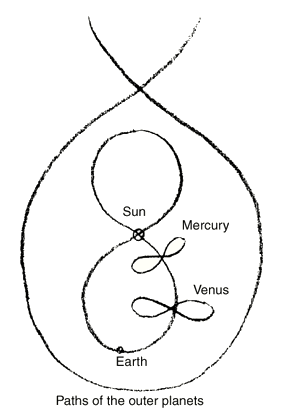
Figure 7 and Figure 8
"'Fate' and 'soul' are two names for one concept."  — Novalis


"Anthroposophy is a path of knowledge, to guide the spiritual in the human being to the spiritual in the universe.... The nature of man cannot be understood unless we are just as conscious of our connection with the stars as of our connection with the Earth."  — Rudolf Steiner


Rudolf Steiner, Stuttgart, January 16, 1921: 


My Dear Friends,

What we are doing, as you will have seen, is to bring together the diverse elements by means of which in the last resort we shall be able to determine the forms of movement of the heavenly bodies, and — in addition to the forms of movement — what may perhaps be described as their mutual positions. A comprehensive view of our system of heavenly bodies will only be gained when we are able to determine first the curve-forms (inasmuch as forms of movement are called curves), i.e. the true geometrical figures, and then the centres of observation. Such is the task before us along our present lines of study, which I have formed as I have done for very definite reasons.
The greatest errors that are made in scientific life consist in this: they try to make syntheses and comprehensive theories when they have not yet established the conditions of true synthesis. They are impatient to set up theories — to gain a conclusive view of the thing in question, — they do not want to wait till the conditions are fulfilled, subject to which alone theories can properly be made. Our scientific life and practice needs this infusion badly, — needs to acquire a feeling of the fact that you ought not to try and answer questions when the conditions for an intelligent answer are not yet achieved. I know that many people (present company of course excepted) would be better pleased if one presented them with curves all ready made, for planetary or other movements. For they would then be in possession of tangible answers. What they are asking is in effect to be told how such and such things are in the Universe, in terms of the ideas and concepts they already have. What if the real questions are such as cannot be answered at all with the existing ideas and concepts? In that case, theoretical talk will be to no purpose. One's question may be set at rest, but the satisfaction is illusionary. Hence, in respect to scientific education, I have attempted to form these lectures as I have done.
The results we have gained so far have shown that we must make careful distinctions if we wish to find true forms of curves for the celestial movements. Such things as these, for instance, we must differentiate: the apparent movements seen in the paths of Venus and of Mars respectively, — Venus making a loop when in conjunction, Mars when in opposition to the Sun. We came to this conclusion when trying to perceive how diverse are the forms of curves that arise in man himself through the forces that build and form him. We ascertained quite different forms of curve in the region of the head-nature and in the organization of the metabolism and the limbs. The two types of form are none the less related, but the transition from one to the other must be sought for outside of space, — at least beyond the bounds of rigid Euclidean space.
Then comes a further transition, which still remains for us to find. We have to pass from what we thus discover in our own human frame, to what is there outside in Universal Space, which only looks to us plainly Euclidean. We think it nicely there, a rigid space, but that is mere appearance. As to this question, we only gain an answer by persevering with the same method we have so far developed. Namely we have to seek the real connection of what goes on in man himself and what goes on outside in Universal Space, in the movements of the celestial bodies. Then we are bound to put this fundamental question: What relation is there, as to cognition itself, between those movements that may legitimately be considered relative and those that may not? We know that amid the forming and shaping forces of the human body we have two kinds: those that work radially and those which we must think of as working spherically. The question now is, with regard to outer movements: How, with our human cognition do we apprehend that element of movement which takes its course purely within the Sphere, and how do we apprehend that element which takes its course along the Radius?
Figure 1
A beginning has been made in Science as you know, even experimentally, in respect of these two kinds of spatial movement. The movements of a heavenly body upon the Sphere can of course be seen and traced visually. Spectrum analysis however also enables us to detect those movements that are along the line of sight, spectrum analysis enables us to recognise the fact. Interesting results have for example been arrived at with double stars that move around each other. The movement was only recognizable by tackling the problem with the help of Doppler's principle, — that is the experimental method to which I am referring.
For us, the question now is whether the method which includes man in the whole cosmic system will give us any criterion — I express myself with caution — any criterion to tell whether a movement may perhaps only be apparent or whether we must conclude that it is real. Is there anything to indicate that a given movement must be a real one? I have already spoken of this. We must distinguish between movements that may quite well be merely relative and on the other hand such movements as the “rotating, shearing and deforming movements” (so we described them), the very character of which will indicate that they cannot be taken in a merely relative sense. We must look for a criterion of true movement. We shall gain it in no other way than by envisaging the inner conditions of what is moving. We cannot possibly confine ourselves to the mere outer relations of position.
A trite example I have often given is of two men whom I see side by side at 9 am and again at 3 in the afternoon. The only difference is, one of them stayed there while the other went on an errand lasting six hours. I was away in the meantime and did not see what happened. At 3 pm I see them side by side again. Merely observing where they are outwardly in space will never tell me the true fact. Only by seeing that one is more tired than the other — taking account of an inner condition therefore — shall I be able to tell which of them has been moving. This is the point. If we would characterize any movement as an inherent and not a merely relative movement, we must perceive what the thing moved has undergone in some more inward sense. For this, a further factor will be needed, of which tomorrow. Today we will at least approach the problem.
We must in fact get hold of it from quite another angle. If we in our time study the form and formation of the human body and look for some connection with what is there in cosmic space, the most we can do to begin with is in some outward sense to see that the connection is there. Man is today very largely independent of the movements of cosmic space; everything points to the fact that this is so. For all that comes to expression in his immediate experience, man has emancipated himself from the phenomena of the Universe. We therefore have to look back into the time when what he underwent depended less upon his conscious life of soul than in his ordinary — by which I mean, post-natal — life on Earth. We must look back into the time when he was an embryo. In the embryo the forming and development of man does indeed take place in harmony with cosmic forces. What afterwards remains is only what is carried forward, so to speak. Implanted in the whole human organization during the embryonic life, it then persists. We cannot say it is "inherited" in the customary sense, for in fact nothing is inherited, but we must think of some such process whereby entities derived from an earlier period of development stay on.
We must now look for an answer to the question: Is there still anything in the ordinary life we lead after our birth — after full consciousness has been attained — is there still any hint of our connection with the cosmic forces? Let us consider the human alternation of waking and sleeping. Even the civilized man of today still has to let this alternation happen. In its main periodicity, if he would stay in good health, it still has to follow the natural alternation of day and night. Yet as you know very well, man of today does lift it out of its natural course. In city life we no longer make it coincide with Nature. Only the country folk do so still. Nay, just because they do so, their state of soul is different. They sleep at night and wake by day. When days are longer and nights shorter they sleep less; when nights are longer, they sleep longer. These aspects however can at most lead to vague comparisons; no clear perception can be derived from them. To recognize how the great cosmic conditions interpenetrate the subjective conditions of man, we must go into the question more deeply. So shall we find in the inner life of man some indication of what are absolute movements in the great Universe.
I will now draw your attention to something you can very well observe if only you are prepared to extend your observation to wider fields: namely, however easily man may emancipate himself from the Universe in the alternation of sleeping and waking as regards time, he cannot with impunity emancipate himself as regards spatial position. Sophisticated folk — for such there are — may turn night into day, day into night, but even they, when they do go to sleep, must adopt a position other than the upright one of waking life. They must, as it were, bring the line of their spine into the same direction as the animal's. One might investigate a thing like this in greater detail. For instance, it is a physiological fact that there are people who in conditions of illness cannot sleep properly when horizontal but have to sit more upright. Precisely these deviations from the normal association of sleep with the horizontal posture will help to indicate the underlying law. A careful study of these exceptions — due as they are to more or less palpable diseases (as in the case of asthmatic subjects, for example) — will be indicative of the true laws in the domain. Taking the facts together, you can quite truly put it in this way: To go to sleep, man must adopt a position whereby his life is enabled in some respects to take a similar course, while he is sleeping, to that of animal life. You will find further confirmation in a careful study of those animals whose spinal axis is not exactly parallel to the Earth's surface.
Here again I can only give you guiding lines. For the most part, these things have not been studied in detail; the facts have not been looked at in this manner, or not exhaustively. I know they have never been gone into thoroughly. The necessary researches have not been undertaken.
And now another thing: You know that what is trivially called “fatigue” represents a highly complex sequence of events. It can come about by our moving deliberately. When we move deliberately, we move our centre of gravity in a direction parallel to the surface of the Earth. In a sense, we move about a surface parallel to the Earth's surface. The process which accompanies our outward and deliberate movements takes its course in such a surface. Now here again we can discover what belongs together. On the one hand we have our movement and mobility parallel to the surface of the Earth, and our fatigue, — becoming tired. Now we go further in our line of thought. This movement parallel to the surface of the Earth, finding its symptomatic expression in fatigue, involves a metabolic process — an expenditure of metabolism. Underlying the horizontal movement there is therefore a recognizable inner process in the human body.
Now the human being is so constituted that he cannot well do without such movement — including all the concomitant phenomena, the metabolic expenditure of substance and so on. He needs all this for bodily well-being. If you're a postman, your calling sees to it that you move about horizontally; if you are not a postman you take a walk. Hence the relationship, highly significant for economics, between the use and value of that mobility of man which enters into economic life and that which stays outside it — as in athletics, games and the like. Physiological and economic aspects meet in reality. In my critique of the economic concept of labour, you may remember, I have often mentioned this. It is at this point that the relation emerges between a purely social science and the science of physiology, nor can we truly study economics if we disregard it. For us however at the present moment, the important thing is to observe this parallelism of movement in a horizontal surface with a certain kind of metabolic process.
Now the same metabolic process can also be looked for along another line. We think once more of the alternation of sleeping and waking. But there is this essential difference. The metabolic transformation, when it takes place with our deliberate movements, makes itself felt at once as an external process, even apart from what goes on inside the human being. If I may put it so, something is then going on for which the surface of the human body is no exclusive frontier. Substance is being transformed, yet so that the transformation takes place as it were in the absolute; the importance of it is not only for the inside of man's body. (The world “absolute” must of course again be taken relatively!)
That we get tired is, as I said, a symptomatic concomitant of movement and of the metabolic process it involves. Yet we also get tired if we have only lived the livelong day while doing nothing. Therefore the same entities which are at work when we move about with a will are also at work in the human being in his daily life simply by virtue of his internal organization. The metabolic transformation must also be taking place when we just get tired, without our bringing it about by any deliberate action.
We put ourselves into the horizontal posture so as to bring about the same metabolism which takes place when we are not acting deliberately, — which takes place simply with the lapse of time, if I may so express it. We put ourselves into the horizontal posture during sleep so that in this horizontal position our body may be able to carry out what it also carries out when we are moving deliberately in waking life. You see from this that the horizontal position as such is of great significance. It is not a matter of indifference whether or not we get into this position. To let our inner organism carry out a certain process without our doing anything to the purpose, we must bring ourselves into the horizontal position in which there happens in our body something that also happens when we are moving by our deliberate will.
A movement must therefore be going on in our body which we do not bring about by our deliberate will. A movement which we do not bring about by our deliberate will must be of significance for our body. Try to observe and interpret the given facts and you will come to the following conclusion, although again — for lack of time — in saying this I must leave out many connecting links. Human movement, as we said just now, involves an absolute metabolic process or change of substance, so that what then goes on in our metabolism has, so to speak, real chemical or physical significance, for which the limits of our skin are in some sense non-existent; — so that the human being in this process belongs to the whole Cosmos. And now the very same metabolic change of substance is brought about in sleep, only that then its significance remains inside the human body. The change of substance that takes place in our deliberate movement takes place also in our sleep, but the outcome of it is then carried from one part of our body to another. During sleep, in effect, we are supplying our own head. We are then carrying out — or rather, letting the inside of our body carry out for us — a metabolic process of transformation for which the human skin is an effective frontier. The transmutation so takes place that the final process to which it leads has its significance within the bodily organization of man.
Once more then, we may truly say: We move of our own will, and a metabolic process (a transformation of substance) is taking place. We let the Cosmos move us: a transformation of substance is taking place once more. But the latter process goes on in such a way that the outcome of it — which in the former metabolic process takes its course, so to speak, in the external world — turns inward to make itself felt as such within the human head. It turns back and does not go flowing outward and away. Yet to enable it to turn back, nay to enable it to be there at all, we have to bring ourselves into the horizontal posture. We must therefore study the connection between those processes in the human body that take place when we move deliberately, and those that take place when we are sleeping. And from the very fact that we are obliged to do this at a certain stage of our present studies, you may divine how much is implied when in the general Anthroposophical lectures I emphasize — as indeed I must do, time and gain, — that our life of will, bound as it is to our metabolism, is to our life of thought and ideation even as sleeping is to waking.
In the unfolding of our will, as I have said again and again, we are always asleep. Here now you have the more exact determination of it. Moving of his own will and in a horizontal surface, man does precisely the same as in sleep. He sleeps by virtue of his will. Sleep, and deliberate or willful movement, are in this relation. When we are sleeping in the horizontal posture, only the outcome is different. Namely, what scatters and is dispersed in the external world when we are moving deliberately is received and assimilated, made further use of, by our own head-organisation when we are asleep.
We have then these two processes, clearly to be distinguished from one another: — the outward dispersal of the metabolic process when we move about deliberately in day-waking life, and the inward assimilation of the metabolic process by all that happens in our head when we are sleeping. And if we now relate this to the animal kingdom, we may divine how much it signifies that the animal spends its whole life in the horizontal posture. This turning-inward of the metabolism to provide the head must be quite different in the animal. Also, deliberate movement must be quite different in the animal from what it is in man.
This is the kind of thing so much neglected in the science of today. Scientists only speak of what presents itself externally, failing to see that the same external process may stand for something different in the one creature and in the other. For example — quite apart now from any religious implication — man dies and the animal dies. It does not follow that this is psychologically the same in either case. A scientist who takes it to be the same and bases his research on this assumption is like a man who would pick up a razor and declare: This is a kind of knife; therefore it has the same function as any other knife; so I will use it to cut my dumpling. Put on this simple level, you may answer: No one would be so silly. Yet have a care, for this is just what happens in the most advanced researches.
This then is what we are led to see. In our deliberate movements we have a process finding its characteristic expression in curves that run parallel to the surface of the Earth; we cannot but make curves of this direction. What have we taken as fundamental now, in this whole line of thought? We began with an inner process which takes its course in man. In sleep this is the given thing, yet on the other hand we ourselves bring a like process about by our own action. Through what we do ourselves, we can therefore define the other. The possibility is given, logically. What is done to our bodily nature from out of cosmic space when are sleeping, this we can treat as the thing to be defined, — the nature of which we seek to know. And we can use as the defining concept what we ourselves do in the outer world — what is therefore well-known to as to its spatial relations. This is the kind of thing we have to look for altogether, in scientific method: Not to define phenomena by means of abstract concepts, but to define phenomena by means of other phenomena. Of course it presupposes that we do really understand the phenomena in question, for only then can we define them by one another. This is characteristic of Anthroposophical scientific endeavour. It seeks to reach a true Phenomenalism, — to explain phenomena by phenomena instead of making abstract concepts to explain them. Nor does it want a mere blunt description of phenomena, leaving them just as they are in the chance distributions of empirical fact and circumstance, where they may long be standing side by side without explaining one another.
I may digress a moment at this point, to indicate the far-reaching possibilities of this “phenomenological” direction in research. The empirical data are at hand, for us to reach the right idea. There is enough and to spare of empirical data. What we are lacking in is quite another thing, namely the power to synthesize them, — in other words, to explain one phenomenon by another. Once more, we have to understand the phenomena before we can explain them by each other. Hence we must first have the will to proceed as we are now trying to do, — to learn to penetrate the phenomenon before us. This is so often neglected. In our Research Institute we shall not want to go on experimenting in the first place with the old ways and methods, which have produced enough and to spare of empirical data. (I speak here not from the point of view of technical applications but of the inner synthesis which is needed.) There is no call for us to go on experimenting in the old ways. As I said in the lectures on Heat last winter, we have to arrange experiments in quite new ways. We need not only the usual instruments from the optical instrument makers; we must devise our own, so as to get quite different kinds of experiments, in which phenomena are so presented that the one sheds light on the other. Hence we shall have to work from the bottom upward. If we do so, we shall find an abundance of material for fresh enlightenment. With the existing instruments our contemporaries can do all that is necessary; they have acquired admirable skill in using them in their one-sided way. We need experiments along new lines, as you must see, for with the old kind of experiment we should never get beyond certain limits. Nor on the other hand will it do for us merely to take our start from the old results and then indulge in speculation. Again and again we need fresh experimental results, to bring us back to the facts when we have gone too far afield. We must be always ready to find ways and means, when we have reached a certain point in our experimental researches, not just to go on theorising but to pass on to some fresh observation which will help elucidate the former one. Otherwise we shall not get beyond certain limits, transient though they are, in the development of science.
I will here draw attention to one such limit, which, though not felt to be insurmountable by our contemporaries, will in fact only be surmounted when fresh kinds of experiment are made. I mean the problem of the constitution of the Sun. Careful and conscientious observations have of course been made by all the scientific methods hitherto available, and with this outcome: First they distinguish the innermost part of the Sun; what it is, is quite unclear to them. They call it the solar nucleus, but none can tell us what it is; the methods of research do not reach thus far. To say this is no unfriendly criticism; everyone admits it. They then suppose the Sun's nucleus to be surrounded by the so-called photosphere, the atmosphere, the chromosphere, and the corona. From the photosphere onward they begin to have definite ideas abut it. Thus they are able to form some idea about the atmosphere, the chromosphere. Suppose for instance that they are trying to imagine how Sunspots arise. Incidentally, this strange phenomenon does not happen quite at random; it shows a certain rhythm, with maxima and minima in periods of about eleven years. Examine the Sunspot phenomena and you will find they must in some way be related to processes that take place outside the actual body of the Sun. In trying to imagine what these processes are like, our scientists are apt to speak of explosions or analogous conditions. The point is that when thinking in this way they always take their start from premises derived from the earthly field. Indeed, this is almost bound to be so if one has not first made the effort to widen out one's range of concepts, — as we did for instance when we imagined curves going out of space. If one has not done something of this kind for one' s own inner training, one has no other possibility than to interpret on the analogy of earthly conditions such observations as are available of a celestial body that is far beyond this earthly world.
Nay, what could be more natural — with the existing range of thought — than to imagine the processes of the solar life analogous to the terrestial, but for the obvious modifications. Yet in so doing one soon encounters almost insuperable obstacles. That which is commonly thought of as the physical constitution of the Sun can never really be understood with the ideas we derive from earthly life. We must of course begin with the results of simple observation, which are indeed eloquent up to a point; then however we must try to penetrate them with ideas that are true to their real nature. And in this effort we shall have to come to terms with a principle which I may characterize as follows.
It is so, is it not? Given some outer fact or distribution which we are able thoroughly to illuminate with a truth of pure geometry, we say to ourselves: how well it fits: we build it up purely by geometrical thinking and now the outer reality accords with it. It hinges-in, so to speak. We feel more at one with outer reality when we thus find again and recognize what we ourselves first constructed, (yet the delight of it should not be carried too far. Somehow or other, one must admit, it always “hinges-in” even for those theorists who get a little unhinged themselves in the process: They too are always finding the ideas they first developed in their mind in excellent agreement with the external reality. The principle is valid, none the less.)
The following attempt must now be made. We may begin by imagining some process that takes place in earthly life. We follow the direction of it outward from some central point. It takes its course therefore in a radial direction. It may be a kind of outbreak, such for example as a volcanic eruption, or the tendency of deformation in an earthquake or the like. We follow such a process upon Earth in the direction of a line that goes outward from the given centre. And now in contrast to this you may conceive the inside of the Sun, as we are want to call it, to be of such a nature that its phenomena are not thrust outward from the centre, but on the contrary: they take their course from the corona inward, via the chromosphere, atmosphere and photosphere, — not from within outward therefore, but from without inward. You are to conceive , once more, — if this (Fig. 2) is the photosphere, this the atmosphere, this the chromosphere, and this the corona, — that the processes go inward and, so to speak, gradually lose themselves towards the central point to which they tend, just as phenomena that issue from the Earth lose themselves outward in expanding spheres, into the wide expanse. You will thus gain a mental picture which will enable you to bring some kind of synthesis and order into the empirical results. Speaking more concretely, you would have to say: If causes on the Earth are such as to bring about the upward outbreak, for example, of an active crater, the cause on the Sun will be such that if there is anything analogous to such an outbreak, it will happen from without inward. The whole nature of the phenomenon holds it together in quite another way. While on the Earth it tends apart, dispersing far and wide, here this will tend together, striving towards the centre.
Figure 2
You see, then what is necessary. First you must penetrate the phenomena and understand them truly. Only then can you explain them by one another. And only when we enter thus into the qualitative aspect, — only when we are prepared, in the widest sense of the word, to unfold a kind of qualitative mathematics, — shall we make essential progress. Of this we shall speak more tomorrow. Here I should only like to add that there is a possibility, notably for pure mathematicians, to find the transition to a qualitative mathematics. Indeed this possibility is there in a high degree, especially in our time. We need only consider Analytical Geometry, with all its manifold results, in relation to Synthetic Geometry — to the real inner experience of Projective Geometry. True, this will only give us the beginning, but it is a very, very good beginning. You will be able to confirm this if you once begin along this pathway, — if for example you really enter into the thought and make it clear to yourself that a line has not two infinitely distinct points (one in the one direction, and one in the opposite direction), but only one point, — a fact of which there is no doubt. You will then find truer and more realistic concepts in this field, and from this starting-point you will find your way into a qualitative form of mathematics.
This will enable you to conceive the polarities of Nature no longer merely in the sense of outwardly opposite directions, where all the time the inner quality would be the same — whereas in fact the inner quality, the inner sense and direction, is not the same. The phenomena at the anode and the cathode, for example, have not the same inner direction; an inherent difference underlies them, and to discover what the difference is, we must take this pathway. We must not allow ourselves to think of a real line as though it had two ends. We should be clear in our mind that a real line in its totality must be conceived not with two ends but with one. Simply by virtue of the real conditions, the other end goes on into a continuation, which must be somewhere. Please do not underestimate the scope and bearing of these lines of thought. For they lead deep into many a riddle of Nature, which, when approached without such preparation, will after all only be taken in such a way that our thoughts remain outside the phenomena and fail to penetrate.


Related post: 


Monday, April 1, 2024

no nonsense


no  no
nse nse


A Lesson in Prosody


"Peter, Peter, pumpkin-eater"
   
Is trochaic tetrameter.


Tulsa King


Harry closed his eyes. He never wanted to open them again. His heart sent this message to his molecules: "For reasons obvious to all of us, this galaxy is dissolved."
— Kurt Vonnegut, Breakfast of Champions


In 1965 I was a high-school senior in Tulsa. Will Rogers High School, a 3-year public school with 3,000 students. The Will Rogers Ropers. Well, as everyone knows, sometimes you're a roper, and sometimes you're the roped. One beautiful late-May day as were filing into the auditorium for our last general assembly I was told that the principal would be calling me up to the stage to congratulate me on being a National Merit Scholar. Well can I just say that I could no more walk up onto that stage than I could fly to the moon: as the son of an outrageously alcoholic father, I had always tried to be invisible. So when the principal called out my name I didn't — I couldn't — move a muscle during the entire soul-crucifixion. Finally, blessed relief: "Lawrence seems not to be here today." Sometimes you seize the moment, and Sometimes the moment seizes you. This too shall pass — yes, but you'll never be the same.


When I told my parents what had happened, my father told me that the answer to the question "Why me, Lord?" is "Because you piss me off."


Related posts:

My dharma is penance 

How Drinking Works

Touché

"Why me, Lord?"

Christ the Lord of Karma

Life is the unfolding glory of the rose of expiation

Tulsa Queen

The Wall

My TED Talk: "Viryananda: The Joy of BigDick Energy"


"In the beholding of God we do not fall;
in the beholding of ourselves we may not stand."
                          — Julian of Norwich


What the world needs now is anthroposophy. "Not I, but Christ in me"


Rudolf Steiner:  "Now that mankind has passed through that period in evolution which as it were shed darkness over the Mystery of Golgotha, the time has come when human longings are reaching out for a deeper knowledge of the Mystery of Golgotha. And that longing can be satisfied only through anthroposophy, only through the advent of a new knowledge which works in a spiritual way. The full significance for humanity of the Mystery of Golgotha will then again be acquired. Then men will again come to realize that the most important teachings of all were given, not by the Christ Who until the Mystery of Golgotha lived in a physical body, but by the Risen Christ after the Mystery of Golgotha. Men will acquire a new understanding for words of an initiate such as Paul: “If Christ be not risen, then is your faith vain.” After the event at Damascus, Paul knew that everything depended upon grasping the reality of the Risen Christ, upon the power of the Risen Christ being united with the human being in such a way that he can affirm: 'Not I, but Christ in me.'”


Source: The Teachings of the Risen Christ


The Teachings of the Risen Christ


Rudolf Steiner, The Hague, April 13, 1922:

I want to speak today about a certain aspect of the Mystery of Golgotha of which I have often spoken before in more intimate anthroposophical gatherings. What there is to be said about the Mystery of Golgotha is so extensive in range, so rich in content and of such significance, that new light needs constantly to be shed upon it before any real approach can be made to this greatest of all Mysteries in the evolution of the earth and of humanity.
The importance of the Mystery of Golgotha can be rightly assessed only when we envisage two streams of evolution in man's earthly existence: the stream which preceded the Mystery of Golgotha and the stream which, following it, will continue for the rest of the earth's existence.
In speaking of the very early period in earth-evolution when thinking of a certain kind — dream-like, imaginative, but still, thinking — was already active, we must be quite clear that in those times men possessed faculties whereby — if I may so express it — they were able to commune with Beings of a higher cosmic order. From the book Occult Science and other works of mine, you know something of these Beings of the higher Hierarchies. In his ordinary consciousness to-day man knows little of these Beings, for his intercourse with them has, as it were, been broken off. In earlier periods of human evolution it was different. To imagine that coming into contact with a Being of the higher Hierarchies in those ancient times in any way resembled the meeting between two men incarnate in physical bodies to-day would of course be a wrong conclusion. Such intercourse had quite a different character. What these Beings communicated to man in the original, primeval language of the earth could be apprehended only by spiritual organs. Momentous secrets of existence were communicated by these Beings, secrets which flowed into the human heart and awakened the consciousness that above and on all sides — where we to-day see only clouds and stars — earthly existence is connected with divine worlds. Super-earthly Beings belonging to these worlds came down in a spiritual manner to the men of earth, revealing themselves in such a way that through them men received what we may call the primal wisdom. The revelations proceeding from these Beings contained an abundance of wisdom which in their earthly life men could not have discovered themselves. For at the beginning of earth-evolution — the period of which I am now speaking — men could discover little through their own faculties. Whatever vision, whatever perceptive knowledge they possessed was received from their divine Teachers. These divine teachings were infinitely rich in content, but one thing they did not include — a thing which it was unnecessary for men of those times to know, but which for the present-day humanity is essential. The divine Teachers imparted many aspects of knowledge, truths in profusion, but they never spoke of the two fundamental boundaries of man's earthly life; they never spoke of birth and death.
Needless to say, in this short hour I cannot attempt to speak of everything that was communicated to the human race in those ancient times by the divine Teachers. A great deal is already known to you. But I want now to stress the point that among all those teachings there were none concerning birth and death. The reason for this was that for the men of those times — and for a considerable period after them — it was unnecessary to have knowledge of the facts of birth and death. The whole consciousness of mankind has changed in the course of earth-evolution. The animal consciousness of to-day, even that of the higher animals, must never be compared with human consciousness, even as it was in those ages of primitive antiquity. Yet we may perhaps find a point of approach by considering the life of the animal to-day. This lies at a level below the human, whereas the earliest form of the life of primitive man lay, in a certain respect, above the present level of the human, in spite of having certain animal-like characteristics. If you think, without preconceived ideas, about the animal to-day, you will say that the animal is unconcerned with birth and death because its existence is wholly passed in the state of life between them. Disregarding birth — although here too, of course, it is an obvious fact — we need think only of the carefree lack of concern with which the animal lives on towards death. The animal accepts death. It is simply transformation of its existence, a transition from individual to group-soul existence. The animal does not experience any such deep incision into life as is the case with the human being.
Now as I said, the primeval man of earth — in spite of his animal-like organisation — was at a higher level than the animal; he possessed an instinctive clairvoyance which enabled him to commune, to have intercourse with, his divine Teachers. But, like the animal of to-day, he was unconcerned with the approach of death. It never occurred to him, if I may so express it, to pay any particular attention to death. And why? With his instinctive clairvoyance, the primeval man was clearly aware of what was still his nature even after his descent through birth from the spiritual world into the physical world. He knew that his own essential being had entered into a physical body; and because he could say with certain knowledge, ‘An immortal, eternal being lives in me,’ the transformation taking place at death was not a matter of interest or concern to him. At most the process was like that experienced by a snake when it sheds its skin and has it replaced by another. The impression of birth and death was taken much more as a matter of course; birth and death were far less drastic incisions in human existence. Men still had clear vision of the life of the soul; to-day they have no such vision.
Even in dreams the transition from the sleeping to the waking state is hardly perceptible and the dream, with its pictures, is regarded as part of the sleeping state, as itself a semi-sleep. But what came to primeval man in his dream-pictures belonged, in reality, to a waking state, not yet fully awake. He knew that what he received in these dream-pictures was reality. In this way he felt and experienced his life of soul. Therefore questions about birth and death could not seem to him as crucial as they must inevitably be to-day.
This condition was very marked in the earliest epochs of human evolution on the earth, but it faded gradually away. As men began more and more to be aware that death makes a drastic incision not only into earthly physical life, but into the life of the soul as well, their attention was inevitably drawn to the fact of birth. On account of this change in human consciousness, earthly life assumed a character of increasing importance for men; and because experience of the life of soul was also growing dim, they felt themselves more and more removed during their sojourn on earth from an existence of soul-and-spirit. This condition became more and more marked as the time of the Mystery of Golgotha approached. Even among the Greeks it had reached the point where they felt life outside the physical body to be a shadow-existence, and regarded death as an event fraught with tragedy. The knowledge received by men from their earliest, divine Teachers did not cover the facts of birth and death. Hence before the Mystery of Golgotha took place, men were exposed to the danger of having to face experiences in their earthly life that would be unknown and incomprehensible to their earthly consciousness — namely, the experiences of birth and death.
Now let us imagine that those early, divine Teachers of humanity had descended to the earthly realm at the time of the Mystery of Golgotha. They might have been able, through the Mysteries, to reveal themselves to a few specially prepared pupils or men of knowledge, to communicate to priests trained in the Mysteries the wealth of the ancient, divine wisdom; but in the whole range of these teachings there would have been nothing concerning birth and death. The riddle of death would not have been presented to man through the revelations of this divine wisdom, not even within the Mysteries; and in their outer life on earth men would have observed facts of vital importance and interest to them — namely the facts of birth and death — of which the gods had said nothing! And why?
You must approach this matter with a certain freedom from bias, laying aside many of the conceptions that have become part of traditional religion to-day, and be clear about the following. The Beings of the higher Hierarchies who were the divine Teachers of primeval humanity had never experienced birth and death in their own realms. For birth and death, in the form in which they are experienced on the earth, are experienced only on the earth, and, again, only by human beings on the earth. The death of an animal and the dying of a plant are altogether different matters from the death of a human being. And in the divine worlds where dwelt the first great Teachers of mankind there is no birth or death, but only transformation, metamorphosis from one state of existence into another. These divine Teachers, therefore, had no inner understanding of the facts of dying and being-born.
Now to these divine Teachers belongs the host of beings connected with Jahve, with the Bodhisattvas, with the early interpreters of the world to humanity. Just think how in the Old Testament, for example, the mystery of death as it confronts men, comes to be fraught with an increasing sense of tragedy, and how, in fact, none of the teaching conveyed by the Old Testament gives any adequate or revealing illumination on the subject of death. If, therefore, at the time of the Mystery of Golgotha there had happened nothing that differed from what had already happened in the realm of the earth, and in the higher worlds connected with the earth, men would have faced a terrible situation in their earthly evolution. On the earth they would have lived through the experiences of birth and death, which now confronted them, not as simple metamorphoses but as drastic transitions in their whole human existence, and they could have learnt nothing of the significance and purpose of death and of birth in the earthly life of the human being. In order that there might gradually be imparted to mankind teaching concerning birth and death, it was necessary for the Being we call the Christ to enter the realm of earthly life, the Christ Who indeed belongs to those worlds whence the ancient Teachers too had come, but Who in accordance with a decision taken in these divine worlds, accepted for Himself a destiny different from that of the other Beings of the divine Hierarchies connected with the earth. He lent Himself to the divine decree of higher worlds that He should incarnate in an earthly body and with His own divine soul pass through birth and death on earth. (see Note 2)
You see, therefore, that what came to pass in the Mystery of Golgotha is not merely an inner affair of men or of the earth, but is equally an affair of the gods. Through the Event on Golgotha, the gods themselves for the first time acquired inner knowledge of the mystery of death and of birth on the earth, for they had previously had no part in either. Therefore we have this momentous fact before us: a divine Being resolved to pass through human destiny on the earth in order to undergo the same fate, the same experiences in earthly existence, as are the lot of man.
Many things concerning the Mystery of Golgotha have become known to mankind. A tradition exists, the Gospels exists, the whole New Testament exists, and modern humanity approaches the Mystery of Golgotha for the most part by way of the New Testament and such interpretation of it as is possible to-day. But very little real insight into the Mystery of Golgotha is to be gained from the interpretations of the New Testament current at the present time. It is inevitable that modern humanity should pass through the stage of acquiring knowledge in this external way, but knowledge so gained is itself external. There is no realisation to-day of how differently men in the first Christian centuries looked back to the Mystery of Golgotha; how differently — in a way that became impossible later on — it was regarded by those who understood its import. The reason is that at the time of the Mystery of Golgotha, although the change I have described was beginning to take place, vestiges of ancient, instinctive clairvoyance still survived in certain individuals. They were no more than vestiges, it is true, but they enabled men, until the fourth century A.D., to look back to the Mystery of Golgotha in a quite different way from that which was possible later on. It is not without meaning that at that time — and some confirmation of this, although in very many respects wanting, can be found in the historical traditions emanating from the earliest Church Fathers and other Christian teachers — those who came forward as teachers valued more highly than any written traditions the fact that they had received information concerning Christ Jesus from direct eye-witnesses, or from those who had been pupils of the Apostles themselves or again pupils of pupils of the Apostles, and so on. This continued until the fourth century A.D., so that a living connection was still claimed for those who were teaching at that time. As I have said, by far the greater part of the historical records have been destroyed, but those who study attentively what is left, can still discover by these external means what value was placed upon the testimony: I have had a teacher, he too had a teacher ... until at the end of the line was an Apostle who had seen the Saviour face to face.
Even of this tradition a great deal has been lost. But still more has been lost of the genuine esoteric wisdom surviving during the first four centuries of Christendom thanks to the remaining vestiges of the old clairvoyant insight. External tradition had lost wellnigh everything that was known in those days about the Risen Christ, the Christ Who had passed through the Mystery of Golgotha and then, in a spirit-body, like the early teachers of primeval humanity, had taught certain chosen disciples after His Resurrection. (see Note 3) In the story, for example, of Christ meeting the disciples who had gone out to seek Him there are indications in the New Testament — but scanty indications even there — of the significance of the teachings given by the Risen Christ to His disciples. (see Note 4) And Paul himself regards his experience at Damascus as a teaching which, given by the Risen Christ, made the man Saul into Paul.
In those early times there was full realisation that Christ Jesus, the Risen One, had secrets of a very special kind to impart to men. The fact that later on they were unable to receive these communications was due entirely to their own human evolution. For it was necessary that man should begin to unfold those forces of soul which, later, were to operate in the exercise of human freedom and of the human intellect. Evidence of this is clear from the fifteenth century onwards, but its beginnings can be traced to the fourth century.
The question naturally arises: What was the content and substance of the teachings which could be given by the Risen Christ to His chosen disciples? — He had appeared to them in the same manner in which the divine Teachers had appeared to primeval humanity. But now, if I may so express it, He was able to tell them out of divine wisdom what He had experienced and other divine Beings had not. From His own divine vantage-point He was able to explain to them the mystery of birth and death. He was able to convey to them the knowledge that in the future there would arise in the men of earth a day-consciousness, unable to have direct perception of the immortal element in human life, a consciousness that is extinguished in sleep, so that in sleep too the immortal element is invisible even to the eyes of the soul.
But He was also able to make them aware that it is possible for the Mystery of Golgotha to be drawn into the field of man's understanding. He was able to make clear to them what I will try to express in the following words. They can only be feeble, stammering words because human language has no others to offer, but I will try to express it in these halting words:

“The human body,” He taught, “has gradually become so dense, the death-forces in it so powerful that, although man will now be able to develop his intellect and his own inner freedom, he can do this only in a life that definitely experiences death, a life into which death makes a marked incision, a life from which vision of the immortal soul is obliterated during waking consciousness. But,” — so Christ taught His initiated disciples, — “you can receive into your souls a certain wisdom. It is the wisdom which through the Mystery of Golgotha, my own being has made possible for you, something with which you your selves can be filled if only you can attain the insight that Christ came down from spheres beyond the earth to the men of earth; if only you can come to realise that here on the earth there is something which cannot be perceived by earthly means, but only by means higher than those of the earth; if you can behold the Mystery of Golgotha as a Divine Event set into earthly life; if you can apprehend that a god has passed through the Mystery of Golgotha. Through everything else that comes to fulfilment on earth you can acquire earthly wisdom, but in order to understand the significance of death to humanity it would avail you nothing. Earthly wisdom would suffice you only if you, like the men of earlier times, could feel no intense interest in death. But since you must needs be concerned with death, you must strengthen your perceptive faculty by drawing into it a force stronger than all earthly forces of perception, a force so strong that you can realise that in the Mystery of Golgotha there came to pass something to which all earthly laws of nature are inapplicable. If you can include in your beliefs only the laws of earthly nature, you will, it is true, be able to observe death, but you will never discover its significance for human life. But if you can attain the insight that the earth has now for the first time received its true meaning and purpose, that at this middle point of earth-evolution a Divine Event has taken place in the Mystery of Golgotha, an Event beyond the comprehension of earthly means of perception, then you are preparing a special power of wisdom.”

This power of wisdom is the same as the power of faith; it is a special power of Spirit-Wisdom, a power of faith born of wisdom. Strength of soul is expressed when a man says: “I believe! I know through faith what I can never know by earthly means. This is a stronger force in me than when I claim to have knowledge of what can be fathomed merely by earthly means.” A man is lacking, even were he to possess all the science known on earth, if his wisdom is able to embrace only what can be grasped by earthly means. To perceive the reality of the super-earthly within the earthly, a far greater inner activity must be unfolded.
Contemplation of the Mystery of Golgotha gives a stimulus to unfold such inner activity. And in ever new variations, this teaching that a god had lived through a human destiny and had thereby united Himself with the destiny of the earth — an experience hitherto unknown to the gods in their own realm — was proclaimed over and over again by the Risen Christ to His disciples. And it worked with stupendous power. Try to realise the power of it by thinking of the conditions prevailing to-day. Less is demanded of a man who can grasp what his thinking has extracted from earthly concepts and also out of the generally acknowledged, traditional tenets of religion than of one who is required to attain understanding of the fact that there were some among the gods who, until the Mystery of Golgotha, possessed no wisdom concerning birth and death and then for the first time acquired this wisdom for the salvation of mankind. To penetrate into the realm of divine wisdom needs a very definite strength. No particular strength is required to repeat from some catechism, ‘God is all-knowing, all-powerful, all-divine,’ and so forth. One needs only to use the prefix ‘all’ and there is the definition of the Divine — ready-made, but utterly nebulous. People do not muster the courage to-day to penetrate into the wisdom of the gods. But this must happen. The divine Beings themselves added this wisdom which the gods acquired through the fact that One from among them passed through human birth and human death.
That this secret should have been entrusted to Christ's first disciples after His Resurrection is a fact of supreme moment, and so was the sequel to it, that through this knowledge they were brought to realise clearly that man once possessed the power to behold and understand the eternal nature of his own soul. This understanding, this insight into the eternal nature of the human soul can never be acquired through brain-knowledge, that is, through the intellectual, cogitated knowledge which uses the brain as its instrument. It can never in any real sense be acquired unless, as in earlier times, nature comes to the help of man, through the kind of knowledge that may still be attained through a particular development of the human rhythmic system. Yoga achieved much while the old instinctive clairvoyance could still come to its aid, while the last possessors of instinctive clairvoyance were still practising yoga. But it is a long time since the modern Oriental, the Indian — about whom many Westerners weave such fantastic ideas to-day — has attained any real vision of the eternal essence of the human soul when he engages in his exercises. He lives for the most part in illusions, in that he has a fleeting experience belonging to some elemental reality of earthly life, and then reads into the experience something from his sacred books. Real and fundamental knowledge of the divine nature of the human soul has been possible for humanity only in two ways: either as primeval humanity attained it, or as man can again attain it to-day, in a much more spiritual way, through Intuitive cognition, through cognition which, rising to Imaginative knowledge, and then to knowledge through Inspiration, finally becomes Intuition.
Now during earthly life the thinking part of the soul has poured itself into the human nervous system; it has built up this plastic structure and in it no longer has a separate existence. In the rhythmic system it is only partially absorbed. We can say of this is that there remains here some possibility of independent thought-activity. But the really eternal element of the human soul is hidden in the metabolic system, in the system which, for earthly life, has the most material function of all. Outwardly it is indeed the most material, but just because of this, the spiritual remains separate from it. The spiritual is drawn into, absorbed by the other material parts of the organism, by the brain and the rhythmic system, and is no longer there independently. In the crude materiality, the spiritual is present in itself. But to use it, a man must be able to see, to perceive, by means of the crude outer materiality. This was a possibility in primeval humanity and, although it is not a condition to be striven after, it may still occur to-day in pathological states. It is known by very few, for example, that the secret of Nietzsche's style in Thus Spake Zarathustra lies in the fact that he imbibed certain poisonous substances which brought into play within him a particular rhythm, which is the distinctive style of this work. In Nietzsche, it was a definitely material substratum that was really doing the thinking. This, needless to say, is a pathological condition, although in a certain respect again there is a kind of grandeur in it. If we are to understand these things we must no longer have false ideas, either about them, or about Intuition and the like, which lie at the opposite pole. We must understand what it means that Nietzsche should have imbibed certain poisons — a procedure not to be imitated — which substances work in such a way that they lead to an etherisation, an etherealised mode of experience in the human organism. This irradiates the thinking and produces what we find in Thus Spake Zarathustra. Intuition, on the other hand, is able to perceive the spirit-and-soul as such, separated from matter. Nothing of a material nature is at work in Intuition as described in the books Knowledge of the Higher Worlds and Its Attainment or in An Outline of Occult Science. Here we have two opposite poles of spiritual knowledge.
But in the Mysteries into which Christ sent His message, it was still known that men once possessed a sublime knowledge born of the working of material substances, born of metabolism. No attempt was made to awaken the old matter-born knowledge of spirit-reality in the manner in which this had been done in primeval humanity, nor in the degenerate way subsequently pursued by hashish-eaters and others with similar habits in order to acquire, through the workings of matter, knowledge not otherwise accessible. An attempt was made in quite another way to awaken this matter-born knowledge, namely, by clothing the Mystery of Golgotha in ritual, in mantric formulae, above all in the whole structure of the Mystery as Revelation, Offering, Transubstantiation, Communion, in the administration of the sacrament of the Eucharist in bread and wine. It was not poisons, therefore, but the Lord's Supper, clothed in what arises from the mantric formulae of the Mass, and from its fourfold membering: Gospel, Offering, Transubstantiation, Communion. For the intention was that after the fourth part of the Mass, the Communion, actual communion among the faithful should take place, with the aim of giving an intimation, at least, that thereby a knowledge leading to what was once achieved instinctively by the old metabolism-born knowledge, must be re-acquired.
It is difficult for men to-day to form any conception of this metabolism-born knowledge, because they have no inkling of how much more a bird knows than a man — although not in the intellectual, abstract sense — how much more even a camel, an animal wholly given up to the process of metabolism, knows than a man. It is, of course, a dim knowledge, a dream-knowledge, for degeneration has entered to-day into what was contained in the metabolic process of primeval man. But on the basis of the earliest Christian teachings, the sacrament at the altar was conceived as a means of pointing to the need to re-acquire a knowledge of the eternal nature of the human soul.
At the time when the Risen Christ was teaching His initiated disciples it was beyond men's power to acquire such knowledge by themselves. It was taught them by Christ. And until the fourth century of Christendom this knowledge was in a certain sense still alive. Then it ossified in the Western Catholic Church, because, although the Mass was retained, the Church could no longer interpret it. The Mass, conceived merely as a continuation of the Lord's Supper described in the Bible, can obviously have no meaning unless meaning is imbued into it. The establishment of the Mass with its wonderful ritual, its reproduction of the four stages of the Mysteries, stems from the fact that the Risen Christ was also the Teacher of those who were able to receive these teachings in a higher, esoteric sense. In the centuries following there remained only an elementary kind of instruction about the Mystery of Golgotha. A faculty was developing in man whereby, to begin with, this knowledge concerning the Mystery of Golgotha was veiled, concealed. Men had first to become firmly rooted in what is connected with death. This is the stage of early medieval civilisation.
Traditions have been preserved. The rituals of many secret societies existing at the present time contain formulae which, for those who understand and recognise them, are unmistakably reminiscent of the teachings given by the Risen Christ to His initiated disciples. But the individuals who come together in all kinds of masonic and other secret societies do not understand what their ritual contains, have not the remotest inkling of it. It would be possible to learn a great deal from these rituals because they contain much wisdom, even if it be in dead letters, — but this does not happen. Now that mankind has passed through that period in evolution which as it were shed darkness over the Mystery of Golgotha, the time has come when human longings are reaching out for a deeper knowledge of the Mystery of Golgotha. And that longing can be satisfied only through spiritual science, only through the advent of a new knowledge which works in a spiritual way. The full significance for humanity of the Mystery of Golgotha will then again be acquired. Then men will again come to realise that the most important teachings of all were given, not by the Christ Who until the Mystery of Golgotha lived in a physical body, but by the Risen Christ after the Mystery of Golgotha. Men will acquire a new understanding for words of an Initiate such as Paul: “If Christ be not risen, then is your faith vain.” After the event at Damascus, Paul knew that everything depended upon grasping the reality of the Risen Christ, upon the power of the Risen Christ being united with the human being in such a way that he can affirm: “Not I, but Christ in me.”
It is an all too characteristic contrast to this that there should have arisen in the 19th century a kind of theology which has really no desire to know anything about the reality of the Risen Christ. It is also a significant symptom of our times that a tutor of theology in Basle — Overbeck, a friend of Nietzsche — should have written a book about the Christianity of modern theology, in which he sets out to prove that this modern theology is no longer Christian. He concedes that there may still be a great deal in the world that is Christian, but he declares that the theology taught by Christian theologians is not Christian. That, in effect, is the view of Overbeck, himself a Christian theologian. And this view is brilliantly substantiated in his book. In respect of the understanding of the Mystery of Golgotha, mankind has come to a point where those officially appointed by their Church to tell men something of the Mystery of Golgotha are least of all capable of doing so. As a result of this there is springing up the human longing to learn something about the need for Christ that every individual may experience in his heart.
I have often made it evident that Anthroposophy has many services to render to humanity to-day. One significant service will be that rendered to the religious life. — This is in no sense the founding of a new religion. With the Event of a god passing through the human destiny of birth and death, the earth received its meaning and purpose in such completeness that this Event can never be surpassed. To one who understands the nature of its founding it is quite evident that there can be no question of inaugurating a new religion after Christianity. To believe such a thing possible would be to have a false idea of Christianity. But as men themselves make strides in super-sensible knowledge, the Mystery of Golgotha, and together with it the Christ Being Himself, will be more and more deeply understood. Anthroposophy would fain contribute to this understanding what perhaps it alone, at the present time, is able to contribute. For it is hardly possible anywhere else to hear about the divine Teachers of primeval humanity who spoke of all things, save only of birth and death — of which they had had no experience — and about that Teacher Who appeared to His initiated disciples in the same manner as that in which the divine primeval Teachers had appeared, but Whose momentous teachings included the crucial one of how a god shared the human destiny of birth and death. This revelation was intended to give men the power to regard death — which from that time must inevitably be a matter of concern to them — in such a way that they would realise: “Death indeed there is, but the soul is beyond its reach! The fact that men can assert this is due to the Mystery of Golgotha.”
Paul knew that if the Mystery of Golgotha had not taken place, if Christ had not risen, the soul would be involved in the destiny of the body, that is to say in the dispersion of the elements of the body into the elements of the earth. Had Christ not risen, had he not united Himself with earthly forces, the human soul would unite with the body between birth and death in such a way that the soul would be united, too, with all the molecules which become part of the earth through cremation or decomposition. It would have come about that at the end of earth-evolution, human souls would go the way of earthly matter. But in that Christ has passed through the Mystery of Golgotha, He wrests this fate away from the human soul. The earth will go her way in the universe, but just as the human soul can emerge from the single human body, so will all human souls be able to free themselves from the earth and go forward to a new cosmic existence. Christ is thus intimately united with earth-existence. But the union can be understood only if the mystery is approached in the way indicated.
To one or another the thought may occur: “What, then, of those who cannot believe in Christ?” Here let me give you reassurance. Christ died for all men, for those, too, who to-day cannot unite with Him. The Mystery of Golgotha is an objective fact, unaffected by human knowledge. Human knowledge, however, strengthens the inner forces of the soul. All the means, therefore, at the disposal of human knowledge, human feelings, and human will, must be applied, in order that in the further course of earth-evolution the presence of Christ in this earth-evolution shall be an experienced reality, through direct knowledge.

Note 1:
See also: Exoteric and Esoteric Christianity. Lecture given at Dornach, 22nd April, 1922. Anthroposophical Publishing Company.
Note 2:
Cp. Epistle to the Hebrews II, 14, 15.
Note 3:
“Not baptism alone sets us free, but knowledge (Gnosis): who we are, what we have become, where we were, whither we have sunk, whither we hasten; whence we are redeemed, what is birth, and what is re-birth.”
  Fragment from the Eastern School of Valentinus, copied by his pupil Theodotus.
Note 4:
See Acts, I, 3.


Source: https://wn.rsarchive.org/Lectures/Dates/19220413p01.html