Friday, June 28, 2024

Agricultural Course: Address following Lecture 3


Diagram III


Rudolf Steiner, June 11, 1924:


My dear friends,

Allow me in the first place to express my deep satisfaction that this Experimental Circle has been created as suggested by Count Keyserlingk, and extended to include all those concerned with agriculture who are now present for the first time at such a meeting. In point of time, the foundation has come about as follows. To begin with, Herr Stegemann, in response to several requests, communicated some of the things which he and I had discussed together in recent years concerning the various guiding lines in agriculture, which he himself has tested in one way or another in his very praiseworthy endeavours on his own farm. Thence there arose a discussion between him and our good friend Count Keyserlingk, leading in the first place to a consultation during which the resolution which has to-day been read out was drafted.

As a result of this we have come together here to-day. It is deeply satisfying that a number of persons have now found themselves together who will be the bearers, so to speak, of the experiments which will follow the guiding lines (for to begin with they can only be guiding lines) which I have given you in these lectures. These persons will now make experiments in confirmation of these guiding lines, and demonstrate how well they can be used in practice.

At such a moment, however, when so good a beginning has been made, we should also be careful to turn to good account the experiences we have had in the past with our attempts in other domains in the Anthroposophical Movement. Above all, we should avoid the mistakes which only became evident during the years when from the central anthroposophical work—if I may so describe it—we went on to other work which lay more at the periphery. I mean when we began to introduce what Anthroposophical Science must and can be for the several domains of life.

For the work which this Agricultural Circle has before it, it will not be without interest to hear the kind of experiences we have had in introducing Anthroposophical Science, for example, into the scientific life in general. As a general rule, when it came to this point, those who had hitherto administered the central anthroposophical life with real inner faithfulness and devotion in their own way, and those who stood more at the periphery and wanted to apply it to a particular domain of life, did not as a rule confront one another with full mutual understanding.

We experienced it only too well, especially in working with our scientific Research Institutes. There on the one side are the anthroposophists who find their full life in the heart of Anthroposophia itself—in Anthroposophical Science as a world-conception, a content of life which they may even have carried through the world with strong and deep feeling, every moment of their lives. There are the anthroposophists who live Anthroposophia and love it, making it the content of their lives. Generally, though not always, they have the idea that something important has been done when one has gained, here or there, one more adherent, or perhaps several more adherents, for the anthroposophical movement. When they work outwardly at all, their idea seems to be—you will forgive the expression—that people must somehow be able to be won over “by the scruff of the neck.” Imagine, for example, a University professor in some branch of Natural Science. Placed as he is in the very centre of the scientific work on which he is engaged, he ought none the less to be able to be won over there and then—so they imagine.

Such anthroposophists, with all their love and good-will, naturally imagine that we should also be able to get hold of the farmer there and then—to get him too “by the scruff of the neck,” so to speak, from one day to another, into the anthroposophical life—to get him in “lock, stock and barrel” with the land and all that is comprised with it, with all the products which his farm sends out into the world. So do the “central anthroposophists” imagine. They are of course in error. And although many of them say that they are faithful followers of mine, often, alas! though it is true enough that they are faithful in their inner feeling, they none the less turn a deaf ear to what I have to say in decisive moments. They do not hear it when I say, for instance, that it is utterly naive to imagine that you can win over to Anthroposophical Science some professor or scientist or scholar from one day to the next and without more ado. Of course you cannot. Such a man would have to break with twenty or thirty years of his past life and work, and to do so, he would have to leave an abyss behind him. These things must be faced as they exist in real life. Anthroposophists often imagine that life consists merely in thought. It does not consist in mere thought. I am obliged to say these things, hoping that they may fall upon the right soil.

On the other hand, there are those who out of good and faithful hearts want to unite some special sphere of life with Anthroposophia—some branch of science, for example. They also did not make things quite clear to themselves when they became workers in Spiritual Science. Again and again they set out with the mistaken opinion that we must do these things as they have hitherto been done in Science; that we must proceed precisely in the same way. For instance, there are a number of very good and devoted anthroposophists working with us in Medicine (with regard to what I shall now say, Dr. Wegman is an absolute exception; she always saw quite clearly the necessity prevailing in our Society). But a number of them always seemed to believe that the doctor must now apply what proceeds from anthroposophical therapy in the same medical style and manner to which he has hitherto been accustomed.

What do we then experience? Here it is not so much a question of spreading the central teachings of Spiritual Science; here it is more a question of spreading the anthroposophical life into the world. What did we experience? The other people said “Well, we have done that kind of thing before; we are the experts in that line. That is a thing we can thoroughly grasp with our own methods; we can judge of it without any doubt or difficulty. And yet, what these anthroposophists are bringing forward is quite contrary to what we have hitherto found by our methods.” Then they declared that the things we say and do are wrong.

We had this experience: If our friends tried to imitate the outer scientists, the latter replied that they could do far better. And in such cases it was undeniable; they can in fact apply their methods better, if only for the reason that in the science of the last few years the methods have been swallowing up the science! The sciences of to-day seem to have nothing left but methods. They no longer set out on the objective problems; they have been eaten up by their own methods. To-day therefore, you can have scientific researches without any substance to them whatever.

And we have had this experience: Scientists who had the most excellent command of their own methods became violently angry when anthroposophists came forward and did nothing else but make use of these methods. What does this prove? In spite of all the pretty things that we could do in this way, in spite of the splendid researches that are being done in the Biological Institute, the one thing that emerged was that the other scientists grew wild with anger when our scientists spoke in their lectures on the basis of the very same methods. They were wild with anger, because they only heard again the things they were accustomed to in their own grooves of thought.

But we also had another important experience, namely this: A few of our scientists at last bestirred themselves, and departed to some extent from their old custom of imitating the others. But they only did it half and half. They did it in this way: In the first part of their lectures they would be thoroughly scientific; in the first part of their explanations they would apply all the methods of science, “comme il faut.” Then the audience grew very angry. “Why do they come, clumsily meddling in our affairs? Impertinent fellows, these anthroposophists, meddling in their dilettante way with our science!”

Then, in the second part of their lectures, our speakers would pass on to the essential life—no longer elaborated in the old way, but derived as anthroposophical content from realms beyond the Earth. And the same people who had previously been angry became exceedingly attentive, hungry to hear more. Then they began to catch fire! They liked the Spiritual Science well enough, but they could not abide (and what is more, as I myself admitted, rightly not), what had been patched together as a confused “mixtum compositum” of Spiritual Science and Science. We cannot make progress on such lines.

I therefore welcome with joy what has now arisen out of Count Keyserlingk's initiative, namely that the professional circle of farmers will now unite on the basis of what we have founded in Dornach—the Natural Science Section. This Section, like all the other things that are now coming before us, is a result of the Christmas Foundation Meeting. From Dornach, in good time, will go out what is intended. There we shall find, out of the heart of Anthroposophia itself, scientific researches and methods of the greatest exactitude.

Only, of course, I cannot agree with Count Keyserlingk's remark that the professional farmers' circle should only be an executive organ. From Dornach, you will soon be convinced, guiding lines and indications will go out which will call for everyone at his post to be a fully independent fellow-worker, provided only that he wishes to work with us. Nay more, as will emerge at the end of my lectures (for I shall have to give the first guiding lines for this work at the close of the present lectures) the foundation for the beginning of our work at Dornach will in the first place have to come from you. The guiding lines we shall have to give will be such that we can only begin on the basis of the answers we receive from you.

From the beginning, therefore, we shall need most active fellow-workers—no mere executive organs. To mention only one thing, which has been a subject of frequent discussions in these days between Count Keyserlingk and myself—an agricultural estate is always an individuality, in the sense that it is never the same as any other. The climate, the conditions of the soil, provide the very first basis for the individuality of a farm. A farming estate in Silesia is not like one in Thuringia, or in South Germany. They are real individualities.

Now, above all in Spiritual Science, vague generalities and abstractions are of no value, least of all when we wish to take a hand in practical life. What is the value of speaking only in vague and general terms of such a practical matter as a farm is? We must always bear in mind the concrete things; then we can understand what has to be applied. Just as the most varied expressions are composed of the twenty-six letters of the alphabet, so you will have to deal with what has been given in these lectures. What you are seeking will first have to be composed from the indications given in these lectures—as words are composed from the letters of the alphabet. If on the basis of our sixty members we wish to speak of practical questions, our task, after all, will be to find the practical indications and foundations of work for those sixty individual farmers.

The first thing will be to gather up what we already know. Then our first series of experiments will follow, and we shall work in a really practical way. We therefore need the most active members. That is what we need in the Anthroposophical Society as a whole—good, practical people who will not depart from the principle that practical life, after all, calls forth something that cannot be made real from one day to the next. If those whom I have called the “central anthroposophists” believe that a professor, farmer or doctor—who has been immersed for decades past in a certain milieu and atmosphere—can accept anthroposophical convictions from one day to the next, they are greatly mistaken.

The fact will emerge quickly enough in agriculture! The farming anthroposophist no doubt, if he is idealistic enough, can go over entirely to the anthrospophical way of working—say, between his twenty-ninth and his thirtieth year—even with the work on his farm. But will his fields do likewise? Will the whole Organisation of the farm do likewise? Will those who have to mediate between him and the consumer do likewise—and so on and so on? You cannot make them all anthroposophists at once—from your twenty-ninth to your thirtieth year. And when you begin to see that you cannot do so, it is then that you lose heart. That is the point, my dear friends—do not lose heart; know that it is not the momentary success that matters; it is the working on and on with iron perseverance.

One man can do more, another less. In the last resort, paradoxical as it may sound, you will be able to do more, the more you restrict yourself in regard to the area of land which you begin to cultivate in our ways. After all, if you go wrong on a small area of land, you will not be spoiling so much as you would on a larger area. Moreover, such improvements as result from our anthroposophical methods will then be able to appear very rapidly, for you will not have much to alter. The inherent efficiency of the methods will be proved more easily than on a large estate. In so practical a sphere as farming these things must come about by mutual agreement if our Circle is to be successful. Indeed, it is very strange—with all good humour and without irony, for one enjoyed it—there has been much talk in these days as to the differences that arose in the first meeting between the Count and Herr Stegemann. Such things bring with them a certain colouring; indeed, I almost thought I should have to consider whether the anthroposophical “Vorstand,” or some one else, should not be asked to be present every evening to bring the warring elements together.

By and by however, I came to quite a different conclusion; namely, that what is here making itself felt is the foundation of a rather intimate mutual tolerance among farmers—an intimate “live and let live” among fellow-farmers. They only have a rough exterior. As a matter of fact the farmer, more than many other people, needs
to protect his own skin. It can easily happen that people start interfering with things which he alone understands. And at rock bottom you will discover in him a certain sweet tolerance. All these things must be truly felt, and I only make these observations now because I think it necessary to begin on a right basis from the outset.

Therefore I think I may once again express my deep satisfaction at what has been done by you here. I believe we have truly taken into account the experiences of the Anthroposophical Society. What has now been begun will be a thing of great blessing, and Dornach will not fail to work vigorously with those who wish to be with us as active fellow-workers in this cause.

We can only be glad, that what is now being done in Koberwitz has been thus introduced. And if Count Keyserlingk so frequently refers to the burden I took upon myself in coming here, I for my part would answer—though not in order to call up any more discussion:– What trouble have I had? I had only to travel here, and am here under the best and most beautiful conditions. All the unpleasant talks are undertaken by others; I only have to speak every day, though I confess I stood before these lectures with a certain awe—for they enter into a new domain. My trouble after all, was not so great. But when I see all the trouble to which Count Keyserlingk and his whole household have been put—when I see those who have come here—then I must say, for so it seems to me, that all the countless things that had to be done by those who have helped to enable us to be together here, tower above what I have had to do, who have simply sat down in the middle of it all when all was ready.

In this, then, I cannot agree with the Count. Whatever appreciation or gratitude you feel for the fact that this Agricultural Course has been achieved, I must ask you to direct your gratitude to him, remembering above all that if he had not thought and pondered with such iron strength, and sent his representative to Dornach, never relinquishing his purpose—then, considering the many things that have to be done from Dornach, it is scarcely likely that this Course in the farthest Eastern corner of the country could have been given.

Hence I do not at all agree that your feelings of gratitude should be expended on me, for they belong in the fullest sense to Count Keyserlingk and to his House.

That is what I wished to interpolate in the discussion.


For the Moment, there is not much more to be said—only this. We in Dornach shall need, from everyone who wishes to work with us in the Circle, a description of what he has beneath his soil, and what he has above it, and how the two are working together. If our indications are to be of use to you, we must know exactly what the things are like, to which these indications refer. You from your practical work will know far better than we can know in Dornach, what is the nature of your soil, what kind of woodland there is and how much, and so on; what has been grown on the farm in the last few years, and what the yield has been. We must know all these things, which, after all, every farmer must know for himself if he wants to run his farm in an intelligent way—with “peasant wit.”

These are the first indications we shall need: what is there on your farm, and what your experiences have been. That is quickly told. As to how these things are to be put together, that will emerge during the further course of the conference. Fresh points of view will be given which may help some of you to grasp the real connections between what the soil yields and what the soil itself is, with all that surrounds it. With these words I think I have adequately characterised the form which Count Keyserlingk wished the members of the Circle to fill in. As to the kind and friendly words which the Count has once again spoken to us all, with his fine-feeling distinction between “farmers” and “scientists,” as though all the farmers were in the Circle and all the scientists at Dornach—this also cannot and must not remain so. We shall have to grow far more together; in Dornach itself, as much as possible of the peasant-farmer must prevail, in spite of our being “scientific.” Moreover, the science that shall come from Dornach must be such as will seem good and evident to the most conservative, “thick-headed” farmer.

I hope it was only a kind of friendliness when Count Keyserlingk said that he did not understand me—a special kind of friendliness. For I am sure we shall soon grow together like twins—Dornach and the Circle. In the end he called me a “Grossbauer,” that is, a yeoman farmer—thereby already showing that he too has a feeling that we can grow together. All the same, I cannot be addressed as such merely on the strength of the little initial attempt I made in stirring the manure—a tack to which I had to give myself just before I came here. (Indeed it had to be continued, for I could not go on stirring long enough. You have to stir for a long time; I could only begin to stir, then someone else had to continue).

These are small matters, but it was not out of this that I originally came. I grew up entirely out of the peasant folk, and in my spirit I have always remained there—I indicated this in my autobiography. Though it was not on a large farming estate such as you have here; in a smaller domain I myself planted potatoes, and though I did not breed horses, at any rate I helped to breed pigs. And in the farmyard of our immediate neighbourhood I lent a hand with the cattle. These things were absolutely near my life for a long time; I took part in them most actively. Thus I am at any rate lovingly devoted to farming, for I grew up in the midst of it myself, and there is far more of that in me than the little bit of “stirring the manure“” just now.

Perhaps I may also declare myself not quite in agreement with another matter at this point. As I look back on my own life, I must say that the most valuable farmer is not the large farmer, but the small peasant farmer who himself as a little boy worked on the farm. And if this is to be realised on a larger scale—translated into scientific terms—then it will truly have to grow “out of the skull of a peasant,” as they say in Lower Austria. In my life this will serve me far more than anything I have subsequently undertaken.

Therefore, I beg you to regard me as the small peasant farmer who has conceived a real love for farming; one who remembers his small peasant farm and who thereby, perhaps, can understand what lives in the peasantry, in the farmers and yeomen of our agricultural life. They will be well understood at Dornach; of that you may rest assured. For I have always had the opinion (this was not meant ironically, though it seems to have been misunderstood) I have always had the opinion that their alleged stupidity or foolishness is “wisdom before God,” that is to say, before the Spirit. I have always considered what the peasants and farmers thought about their things far wiser than what the scientists were thinking. I have invariably found it wiser, and I do so to-day. Far rather would I listen to what is said of his own experiences in a chance conversation, by one who works directly on the soil, than to all the Ahrimanic statistics that issue from our learned science. I have always been glad when I could listen to such things, for I have always found them extremely wise, while, as to science—in its practical effects and conduct I have found it very stupid. This is what we at Dornach are striving for, and this will make our science wise—will make it wise precisely through the so-called “peasant stupidity.” We shall take pains at Dornach to carry a little of this peasant stupidity into our science. Then this stupidity will become—“wisdom before God.”

Let us then work together in this way; it will be a genuinely conservative, yet at the same time a most radical and progressive beginning. And it will always be a beautiful memory to me if this Course becomes the starting point for carrying some of the real and genuine “peasant wit” into the methods of science. I must not say that these methods have become stupid, for that would not be courteous, but they have certainly become dead.

Dr. Wachsmuth has also set aside this deadened science, and has called for a living science which must first be fertilised by true “peasant wisdom.” Let us then grow together thus like good Siamese Twins—Dornach and the Circle. It is said of twins that they have a common feeling and a common thinking. Let us then have this common feeling and thinking; then we shall go forward in the best way in our domain.


Source: June 11, 1924

Agricultural Course Lecture 3: The Revelation of the Holy Spirit: The Biodynamics of the Holy Spirit: The Working of Cosmic Forces Through Earthly Substances


Diagram III

The Agriculture Course. Lecture 3 of 8.
Rudolf Steiner, Koberwitz, Silesia, June 11, 1924:


    MY DEAR FRIENDS,
The earthly and cosmic forces of which I have spoken work in the farm through the substances of the Earth, needless to say. In the next lectures we shall pass on to various practical aspects, but before we can do so we must enter a little more precisely into the question: How do these forces work through the substances of the Earth? In the present lecture we shall consider Nature's activity quite generally speaking.
One of the most important questions in agriculture is that of the significance of nitrogen — its influence in all farm-production. This is generally recognized; nevertheless the question of what is the essence of nitrogen's activity has fallen into great confusion nowadays. Wherever nitrogen is active, men only recognize, as it were, the last excrescence of its activities — the most superficial aspects in which it finds expression. They do not penetrate to the relationships of Nature wherein nitrogen is working, nor can they do so, so long as they remain within restricted spheres. We must look out into the wide spaces, into the wider aspects of Nature, and study the activities of nitrogen in the Universe as a whole. We might even say — and this indeed will presently emerge — that nitrogen as such does not play the first and foremost part in the life of plants. Nevertheless, to understand plant-life it is of the first importance for us to learn to know the part which nitrogen does play.
Nitrogen, as she works in the life of Nature, has, so to speak, four sisters, whose working we must learn to know at the same time if we would understand the functions and significance of nitrogen herself in Nature's so-called household. The four sisters of nitrogen are those that are united with her in plant and animal protein, in a way that is not yet clear to the outer science of today. I mean the four sisters, carbon, oxygen, hydrogen, and sulphur.
To know the full significance of protein it will not suffice us to enumerate as its main ingredients hydrogen, oxygen, nitrogen, and carbon. We must include another substance, of the profoundest importance for protein, and that is sulphur. Sulphur in protein is the very element which acts as mediator between the Spiritual that is spread throughout the Universe — the formative power of the Spiritual — and the physical.
Truly we may say that whoever would trace the tracks which the Spiritual marks out in the material world must follow the activity of sulphur. Though this activity appears less obvious than that of other substances, nevertheless it is of great importance; for it is along the paths of sulphur that the Spiritual works into the physical domain of Nature. Sulphur is actually the carrier of the Spiritual. Hence the ancient name, “sulphur,” which is closely akin to the name “phosphorus.” The name is due to the fact that in olden time they recognized in the out-spreading, sun-filled light the Spiritual itself as it spreads far and wide. Therefore they named “light-bearers” these substances — like sulphur and phosphorus — which have to do with the working of light into matter.
Seeing that sulphur's activity in the economy of Nature is so very fine and delicate, we shall, however, best approach it by first considering the four other sisters: carbon, hydrogen, nitrogen, and oxygen. These we must first learn to understand; we shall see what they signify in the whole being of the Universe. The chemist of today knows little of these substances. He knows what they look like when he has them in his laboratory, but he knows practically nothing of their inner significance in the working of the Cosmos as a whole. The knowledge of modern chemistry about them is scarcely more than our knowledge of a man of whose outer form we caught a glimpse as we passed by him in the street — or maybe we took a snapshot of him, and with the help of the photograph we can now call him to mind. We must learn to know the deeper essence of these substances. What science does is scarcely more than to take snapshots of them with a camera. All that is said of them in scientific books and lectures is scarcely more than that.
Let us begin with carbon. (The application of these matters to plant-life will presently emerge). Carbon indeed has fallen in our time from a highly aristocratic status to a very plebeian one. Alas, how many other beings of the Universe have followed it along the same sad way! What do we see in carbon nowadays? That which we use, as coal, to heat our ovens! That which we use, as graphite, for our writing. True, we still assign an aristocratic value to one modification of carbon, namely diamond, but we have little opportunity to value even that, for we can no longer afford to buy it!
What is known about carbon nowadays is very little when you consider its infinite significance in the Universe. The time is not so very long ago — only a few centuries — when this black fellow, carbon, was so highly esteemed as to be called by a very noble name. They called it the Stone of the Wise — the Philosopher's Stone. There has been much chatter es to what the “Stone of the Wise” may be. Very little has emerged from it. When the old alchemists and such people spoke of the Stone of the Wise, they meant carbon — in the various modifications in which it occurs. They held the name so secret and occult, only because if they had not done so, anyone and everyone would have possessed it — for it was only carbon. Why then was carbon the “Stone of the Wise?”
Here we can answer with an idea from olden time, a point we need to understand again in our time when speaking about carbon. It is quite true that carbon occurs today in Nature in a broken, crumbled form, as coal or even graphite — broken and crumbled, owing to certain processes which it has undergone. How different it appears, however, when we perceive it in its living activity, passing through the human or animal body, or building up the plant-body out of its peculiar conditions. Then the amorphous, formless substance which we see as coal or carbon proves to be only the last excrescence — the corpse of that which coal or carbon truly is in Nature's household.
Carbon, in effect, is the bearer of all the creatively formative processes in Nature. Whatever in Nature is formed and shaped — be it the form of the plant persisting for a comparatively short time, or the eternally changing configuration of the animal body — carbon is everywhere the great plastician. It does not only carry in itself its black substantiality. Wherever we find it in full action and inner mobility, it bears within it the creative and formative cosmic pictures — the sublime cosmic Imaginations, out of which all that is formed in Nature must ultimately proceed.
There is a hidden plastic artist in carbon, and this plastician building the manifold forms that are built up in Nature — makes use of sulphur in the process. Truly to see the carbon as it works in Nature, we must behold the Spirit-activity of the great Universe, moistening itself so-to-speak with sulphur, and working as a plastic artist — building with the help of carbon the more firm and well-defined form of the plant, or again, building the form in man, which passes away again the very moment it comes into being.
For it is thus that man is not plant, but man. He has the faculty to time and again destroy the form as soon as it arises; for he excretes the carbon, bound to the oxygen, as carbonic acid. Carbon in the human body would form us too stiffly and firmly — it would stiffen our form like a palm. Carbon is constantly about to make us still and firm in this way, and for this very reason our breathing must constantly dismantle what the carbon builds. Our breathing tears the carbon out of its rigidity, unites it with the oxygen and carries it outward. So we are formed in the mobility which we as human beings need. In plants, the carbon is present in a very different way. To a certain degree it is fastened — even in annual plants — in firm configuration.
There is an old saying in respect of man: “Blood is a very special fluid” — and we can truly say: the human ego, pulsating in the blood, finds there its physical expression. More accurately speaking, however, it is in the carbon — weaving and wielding, forming itself, dissolving the form again. It is on the paths of this carbon — moistened with sulphur — that the spiritual being which we call the ego of man moves through the blood. And as the human ego — the essential Spirit of man — lives in the carbon, so in a manner of speaking the ego of the Universe lives as the Spirit of the Universe — lives via the sulphur in the carbon as it forms itself and ever again dissolves the form.
In bygone epochs of Earth-evolution carbon alone was deposited or precipitated. Only at a later stage was there added to it, for example, the limestone nature which man makes use of to create something more solid as a basis and support — a solid scaffolding for his existence. Precisely in order to enable what is living in the carbon to remain in perpetual movement, man creates an underlying framework in his limestone-bony skeleton. So does the animal — at any rate the higher animal. Thus, in    his ever-mobile carbon-formative process, man lifts himself out of the merely mineral and rigid limestone-formation which the Earth possesses and which he too incorporates in order to have some solid Earth within him. For in the limestone form of the skeleton he has the solid Earth within him.
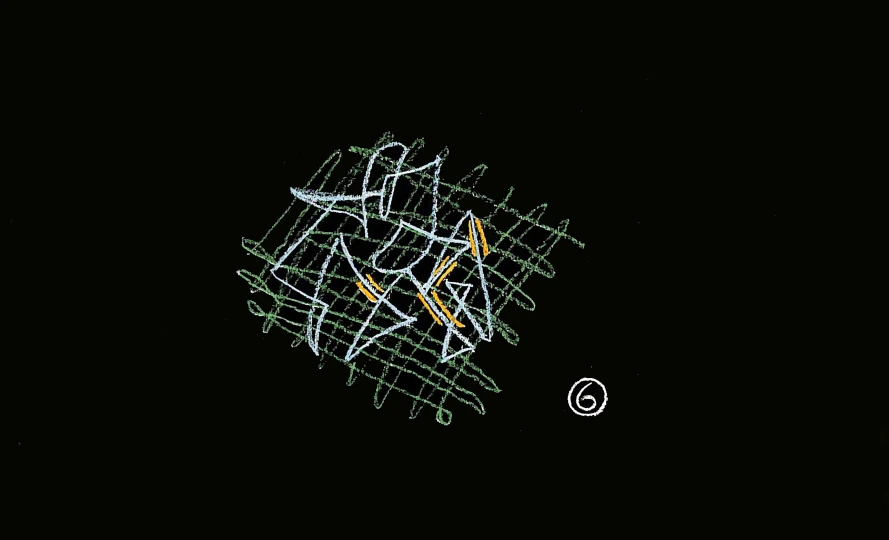
So you can have the following idea. Underlying all living things is a carbon-like scaffolding or framework — more or less rigid or fluctuating as the case may be — and along the paths of this framework the Spiritual moves through the World. Let me now make a drawing (purely diagrammatic) so that we have it before us visibly and graphically.

Diagram III

    I will here draw a scaffolding or framework such as the Spirit builds, working always with the help of sulphur. This, therefore, is either the ever-changing carbon constantly moving in the sulphur, in its very fine dilution — or, as in plants, it is a carbon framework more or less hard and fast, having become solidified, mingled with other ingredients.
Now, whether it be man or any other living being, the living being must always be permeated by an ethereal — for the ethereal is the true bearer of life, as we have often emphasized. This, therefore, which represents the carbonaceous framework of a living entity, must in its turn be permeated by an ethereal. The latter will either stay still — holding fast to the beams of the framework — or it will also be involved in more or less fluctuating movement. In either case, the ethereal must be spread out, wherever the framework is. Once more: there must be something ethereal wherever the framework is. Now, this ethereal, if it remained alone, could certainly not exist as such within our physical and earthly world. It would, so to speak, always slide through into the empty void. It could not hold what it must take hold of in the physical, earthly world, if it had not a physical carrier.
This, after all, is the peculiarity of all that we have on Earth: the Spiritual here must always have physical carriers. Then the materialists come, and take only the physical carrier into account, forgetting the Spiritual which it carries. And they are always in the right — for the first thing that meets us is the physical carrier. They only leave out of account that it is the Spiritual which must have a physical carrier everywhere.
What then is the physical carrier of that Spiritual which works in the ethereal? (For we may say, the ethereal represents the lowest kind of spiritual working). What is the physical carrier which is so permeated by the ethereal that the ethereal, moistened once more with sulphur, brings into it what it has to carry — not in formation this time, not in the building of the framework — but in eternal quickness and mobility into the midst of the framework? This physical element which with the help of sulphur carries the influences of life out of the universal ether into the physical, is none other than oxygen. I have sketched it here in green. if you regard it physically, it represents the oxygen. It is the weaving, vibrant and pulsating essence that moves along the paths of the oxygen. For the ethereal moves with the help of sulphur along the paths of oxygen.
Only now does the breathing process reveal its meaning. In breathing we absorb the oxygen. A modern materialist will only speak of oxygen such as he has in his retort when he accomplishes, say, an electrolysis of water. But in this oxygen the lowest of the supersensible — that is, the ethereal — is living — unless indeed it has been killed or driven out, as it must be in the air we have around us. In the air of our breathing the living quality is killed, is driven out, for the living oxygen would make us faint. Whenever anything more highly living enters into us we become faint. Even an ordinary hypertrophy of growth — if it occurs at a place where it ought not to occur — will make us faint, nay even more than faint. If we were surrounded by living air in which the living oxygen were present, we should go about stunned and benumbed. The oxygen around us must be killed. Nevertheless, by virtue of its native essence it is the bearer of life — that is, of the ethereal. And it becomes the bearer of life the moment it escapes from the sphere of those tasks which are allotted to it inasmuch as it surrounds the human being outwardly, around the senses. As soon as it enters into us through our breathing it becomes alive again. Inside us it must be alive.
Circulating inside us, the oxygen is not the same as it is where it surrounds us externally. Within us it is living oxygen, and in like manner it becomes living oxygen the moment it passes from the atmosphere we breathe into the soil of the Earth. Albeit it is not so highly living there as it is in us and in the animals, nevertheless, there too it becomes living oxygen. Oxygen under the earth is not the same as oxygen above the earth.
It is difficult to come to an understanding on these matters which the physicists and chemists, for — by the methods they apply — from the very outset the oxygen must always be drawn out of the earth realm; hence they can only have dead oxygen before them. There is no other possibility for them. That is the fate of every science that only considers the physical: it can only understand the corpse. In reality, oxygen is the bearer of the living ether, and the living ether holds sway in it by using sulphur as its way of access.
But we must now go farther. I have placed two things side by side; on the one hand the carbon framework, wherein are manifested the workings of the highest spiritual essence which is accessible to us on Earth: the human ego, or the cosmic spiritual being which is working in the plants. Observe the human process: we have the breathing before us — the living oxygen as it occurs inside the human being, the living oxygen carrying the ether. And in the background we have the carbon-framework, which in the human being is in perpetual movement. These two must come together. The oxygen must somehow find its way along the paths mapped out by the framework. Wherever any line, or the like, is drawn by the carbon — by the spirit of the carbon — whether in man or anywhere in Nature, there the ethereal oxygen-principle must somehow find its way. It must find access to the spiritual carbon-principle. How does it do so? Where is the mediator in this process?


Diagram III


The mediator is none other than nitrogen. Nitrogen guides the life into the form or configuration which is embodied in the carbon. Wherever nitrogen occurs, its task is to mediate between the life and the spiritual essence which to begin with is in the carbon-nature. Everywhere — in the animal kingdom and in the plant and even in the Earth — the bridge between carbon and oxygen is built by nitrogen. And the spirituality which — once again with the help of sulphur — is working thus in nitrogen, is that which we are wont to describe as the astral. It is the astral spirituality in the human astral body. It is the astral spirituality in the Earth's environment. For as you know, there too the astral is working — in the life of plants and animals, and so on.
Thus, spiritually speaking we have the astral placed between the oxygen and the carbon, and this astral impresses itself upon the physical by making use of nitrogen. Nitrogen enables it to work physically. Wherever nitrogen is, thither the astral extends. The ethereal principle of life would flow away everywhere like a cloud, it would take no account of the carbon-framework, were it not for the nitrogen. The nitrogen has an immense power of attraction for the carbon-framework. Wherever the lines are traced and the paths mapped out in the carbon, thither the nitrogen carries the oxygen — thither the astral in the nitrogen drags the ethereal.
Nitrogen is forever dragging the living to the spiritual principle. Therefore, in man, nitrogen is so essential to the life of the soul. For the soul itself is the mediator between the Spirit and the mere principle of life. Truly, this nitrogen is a most wonderful thing. If we could trace its paths in the human organism, we should perceive in it once more a complete human being. This “nitrogen-man” actually exists. If we could peal him out of the body he would be the finest ghost you could imagine. For the nitrogen-man imitates to perfection whatever is there in the solid human framework, while on the other hand it flows perpetually into the element of life.
Now you can see into the human breathing process. Through it man receives into himself the oxygen — that is, the ethereal life. Then comes the internal nitrogen, and carries the oxygen everywhere — wherever there is carbon, i.e., wherever there is something formed and figured, albeit in everlasting change and movement. Thither the nitrogen carries the oxygen, so that it may fetch the carbon and get rid of it. Nitrogen is the real mediator for the oxygen to be turned into carbonic acid and so to be breathed out.
This nitrogen surrounds us on all hands. As you know, we have around us only a small proportion of oxygen, which is the bearer of life, and a far larger proportion of nitrogen—the bearer of the astral spirit. By day we have great need of the oxygen, and by night too we need this oxygen in our environment. But we pay far less attention, whether by day or by night, to the nitrogen. We imagine that we are less in need of it—I mean now the nitrogen in the air we breathe. But it is precisely the nitrogen which has a spiritual relation to us. You might undertake the following experiment.
Put a human being in a given space filled with air, and then remove a small quantity of nitrogen from the air that fills the space, thus making the air around him slightly poorer in nitrogen than it is in normal life. If the experiment could be done carefully enough, you would convince yourselves that the nitrogen is immediately replaced. If not from without, then, as you could prove, it would be replaced from within the human being. He himself would have to give it off, in order to bring it back again into that quantitative condition to which, as nitrogen, it is accustomed. As human beings we must establish the right percentage-relationship between our whole inner nature and the nitrogen that surrounds us. It will not do for the nitrogen around us to be decreased. True, in a certain sense it would still suffice us. We do not actually need to breathe nitrogen. But for the spiritual relation, which is no less a reality, only the quantity of nitrogen to which we are accustomed in the air is right and proper. You see from this how strongly nitrogen plays over into the spiritual realm.
At this point I think you will have a true idea of the necessity of nitrogen for the life of plants. The plant as it stands before us in the soul has only a physical and an ether-body; unlike the animal, it has not an astral body within it. Nevertheless, outside it the astral must be there on all hands. The plant would never blossom if the astral did not touch it from outside. Though it does not absorb it (as man and the animals do), nevertheless the plant must be touched by the astral from outside. The astral is everywhere, and nitrogen itself — the bearer of the astral — is everywhere, moving about as a corpse in the air. But the moment it comes into the Earth, it is alive again. Just as the oxygen does, so too the nitrogen becomes alive; nay, more: it becomes sentient and sensitive inside the Earth. Strange as it may sound to the materialist madcaps of today, nitrogen not only becomes alive but sensitive inside the Earth; and this is of the greatest importance for agriculture. Nitrogen becomes the bearer of that mysterious sensitiveness which is poured out over the whole life of the Earth.
It is the nitrogen which senses whether there is the proper quantity of water in a given district of the Earth. If so, it has a sympathetic feeling. If there is too little water, it has a feeling of antipathy. It has a sympathetic feeling if the right plants are there for the given soil. In a word, nitrogen pours out over all things a kind of sensitive life. And above all, you will remember what I told you yesterday and in the previous lectures: how the planets Saturn, Sun, Moon, etc., have an influence on the formation and life of plants. You might say, nobody knows of that! It is quite true, for ordinary life you can say so. Nobody knows! But the nitrogen that is everywhere present — the nitrogen knows very well indeed, and knows it quite correctly. Nitrogen is not unconscious of that which comes from the stars and works itself out in the life of plants, in the life of Earth. Nitrogen is the sensitive mediator, even as in our human nerves-and-senses system it is the nitrogen which mediates for our sensation. Nitrogen is verily the bearer of sensation. So you can penetrate into the intimate life of Nature if you can see the nitrogen everywhere, moving about like flowing, fluctuating feelings. We shall find the treatment of nitrogen, above all, infinitely important for the life of plants. These things we shall enter into later. Now, however, one thing more is necessary.
You have seen how there is a living interplay. On the one hand there is that which works out of the Spirit in the carbon-principle, taking on forms as of a scaffolding or framework. This is in constant interplay with what works out of the astral in the nitrogen-principle, permeating the framework with inner life, making it sentient. And in all this, life itself is working through the oxygen-principle. But these things can only work together in the earthly realm inasmuch as it is permeated by yet another principle, which for our physical world establishes the connection with the wide spaces of the Cosmos.
For earthly life it is impossible that the Earth should wander through the Cosmos as a solid thing, separate from the surrounding Universe. If the Earth did so, it would be like a man who lived on a farm but wanted to remain independent, leaving outside him all that is growing in the fields. If he is sensible, he will not do so! There are many things out in the fields today which in the near future will be in the stomachs of this honoured company, and — thence in one way or another — it will find its way back again on to the fields. As human beings we cannot truly say that we are separate. We cannot sever ourselves. We are united with our surroundings — we belong to our environment. As my little finger belongs to me, so do the things that are around us naturally belong to the whole human being. There must be constant interchange of substance, and so it must be between the Earth — with all its creatures —and the entire Universe. All that is living in physical forms upon the Earth must eventually be led back again into the great Universe. It must be able to be purified and cleansed, so to speak, in the universal All. So now we have the following:—

Diagram III

To begin with, we have what I sketched before in blue, the carbon-framework. Then there is that which you see here in green: the ethereal, oxygen principle. And then — everywhere emerging from the oxygen, carried by nitrogen to all these lines, there is that which develops as the astral, as the transition    between the carbonaceous and the oxygen principle. I could show you everywhere how the nitrogen carries into these blue lines what is indicated diagrammatically in the green.
But now, all that is thus developed in the living creature structurally, as in a fine and delicate design, must eventually be able to vanish again. It is not the Spirit that vanishes, but that which the Spirit has built into the carbon, drawing the life to itself out of the oxygen as it does so. This must be able once more to disappear. Not only in the sense that it vanishes on Earth; it must be able to vanish into the Cosmos, into the universal All.
This is achieved by a substance which is as nearly as possible akin to the physical, and yet again as nearly akin to the spiritual — and that is hydrogen. Truly, in hydrogen — although it is itself the finest of physical elements — the physical flows outward, utterly broken and scattered, and carried once more by the sulphur out into the void, into the indistinguishable realms of the Cosmos.
We may describe the process thus: In all these structures, the Spiritual has become physical. There it is living in the body astrally, there it is living in its image, as the Spirit or the ego — living in a physical way as Spirit transmuted into the physical. After a time, however, it no longer feels comfortable there. It wants to dissolve again. And now once more — moistening itself with sulphur — it needs a substance wherein it can take its leave of all structure and definition, and find its way outward into the undefined chaos of the universal All, where there is nothing more of this organization or that.
Now, the substance which is so near to the Spiritual on the one hand and to the substantial on the other, is hydrogen. Hydrogen carries out again into the far spaces of the Universe all that is formed, and     alive, and astral. Hydrogen carries it upward and outward, till it becomes of such a nature that it can be received out of the Universe once more, as we described above. It is hydrogen which dissolves everything away.
So then we have these five substances. They, to begin with, represent what works and weaves in the living — and in the apparently dead, which after all is only transiently dead. Sulphur, carbon, hydrogen, oxygen, nitrogen: each of these materials is inwardly related to a specific spiritual principle. They are therefore very different from what our modern chemists would relate. Our chemists speak only of the corpses of the substances — not of the real substances, which we must rather learn to know as sentient and living entities, with the single exception of hydrogen. Precisely because hydrogen is apparently the thinnest element — with the least atomic weight —it is really the least spiritual of all.
And now I ask you to observe: When you meditate, what are you really doing? (I must insert this observation; I want you to see that these things are not conceived “out of the blue”). The Orientals used to meditate in their way; we in the mid-European West do it in our way. Our meditation is connected only indirectly with the breathing. We live and weave in concentration and meditation. However, all that we do when we devote ourselves to these exercises of the soul still has its bodily counterpart. Albeit this is delicate and subtle, nevertheless, however subtly, meditation somewhat modifies the regular course of our breathing, which as you know is connected so intimately with the life of man.
In meditating, we always retain in ourselves a little more carbon dioxide than we do in the normal process of waking consciousness. A little more carbon dioxide always remains behind in us. Thus we do not at once expel the full impetus of the carbonic acid, as we do in the everyday, bull-at-the-gate kind of life. We keep a little of it back. We do not drive the carbon dioxide with its full momentum out into the surrounding spaces, where the nitrogen is all around us. We keep it back a little.
If you knock up against something with your skull — if you knock against a table, for example — you will only be conscious of your own pain. If, however, you rub against it gently, you will be conscious of the surface of the table. So it is when you meditate. By and by you grow into a conscious living experience of the nitrogen all around you. Such is the real process in meditation. All becomes knowledge and perception — even that which is living in the nitrogen. And this nitrogen is a very clever fellow! He will inform you of what Mercury and Venus and the rest are doing. He knows it all, he really senses it. These things are based on absolutely real processes, and I shall presently touch on some of them in somewhat greater detail. This is the point where the Spiritual in our inner life begins to have a certain bearing on our work as farmers.
This is the point which has always awakened the keen interest of our dear friend Stegemann. I mean this working-together of the soul and Spirit in us, with all that is around us. It is not at all a bad thing if he who has farming to do can meditate. He thereby makes himself receptive to the revelations of nitrogen. He becomes more and more receptive to them. If we have made ourselves thus receptive to nitrogen's revelations, we shall presently conduct our farming in a very different style than before. We suddenly begin to know all kinds of things, all kinds of things emerge. All kinds of secrets that prevail in farm and farmyard — we suddenly begin to know them.
Nay, more! I cannot repeat what I said here an hour ago, but in another way I may perhaps characterize it again. Think of a simple peasant-farmer, one whom your scholar will certainly not deem to be a learned man. There he is, walking out over his fields. The peasant is stupid — so the learned man will say. But in reality it is not true, for the simple reason that the peasant — forgive me, but it is so — is himself a meditator. Oh, it is very much that he meditates in the long winter nights! He does indeed acquire a kind of method — a method of spiritual perception. Only he cannot express it. It suddenly emerges in him. We go through the fields, and all of a sudden the knowledge is there in us. We know it absolutely. Afterwards we put it to the test and find it confirmed. I in my youth — at least when I lived among the peasant folk — could witness this again and again. It really is so, and from such things as these we must take our start once more. The merely intellectual life is not sufficient — it can never lead into these depths. We must begin again from such things. After all, the weaving life of Nature is very fine and delicate. We cannot sense it — it eludes our coarse-grained intellectual conceptions. Such is the mistake science has made in recent times. With coarse-grained, wide-meshed intellectual conceptions it tries to apprehend things that are far more finely woven.
All of these substances — sulphur, carbon, nitrogen, hydrogen — all are united together in protein. Now we are in a position to understand the process of seed-formation a little more fully than hitherto. Wherever carbon, hydrogen, nitrogen occur — in leaf or flower, calyx or root — everywhere they are bound to other substances in one form or another. They are dependent on these other substances; they are not independent. There are only two ways in which they can become independent: namely, on the one hand when the hydrogen carries them outward into the far spaces of the Universe — separates them all, carries them all away and merges them into an universal chaos; and on the other hand, when the hydrogen drives these fundamental substances of protein into the tiny seed-formation and makes them independent there, so that they become receptive to the inpouring forces of the Cosmos. In the tiny seed-formation there is chaos, and away in the far circumference there is chaos once more. Chaos in the seed must interact with chaos in the farthest circles of the Universe. Then the new being arises.
Now let us look how the action of these so-called substances — which in reality are bearers of the Spirit — comes about in Nature. You see, that which works even inside the human being as oxygen and nitrogen    behaves itself tolerably well. There in the human being the properties of oxygen and nitrogen are living. One only does not perceive them with ordinary science, for they are hidden to outward appearance. But the products of the carbon and hydrogen principles cannot behave quite so simply.
Take, to begin with, carbon. When the carbon, with its inherent activity, comes from the plant into the animal or human kingdom, it must first become mobile — in the transient stage at any rate. If it is then to present the firm and solid figure (man or animal), it must build on a more deep-seated scaffolding or framework. This is none other than the very deep-seated framework which is contained not only in our bony skeleton with its limestone nature, but also in the silicious element which we continually bear within us.
To a certain extent, the carbon in man and animal masks its native power of configuration. It finds a pillar of support in the configurative forces of limestone and silicon. Limestone gives it the earthly, silicon the cosmic formative power. Carbon, therefore, in man himself — and in the animal — does not declare itself exclusively competent, but seeks support in the formative activities of limestone and silicon.
Now, we find limestone and silicon as the basis of plant growth too. Our need is to gain a knowledge of what the carbon develops throughout the processes of digestion, breathing, and circulation in man — in relation to the bony structure and the silicious structure. We must somehow evolve a knowledge of what is going on in there — inside the human being. We should be able to see it all if we could somehow creep inside. We should see the carbonaceous formative activity raying out from the circulatory process into the calcium and silicon in man.
This is the kind of vision we must unfold when we look out over the surface of the Earth, covered as it is with plants and having beneath it the limestone and the silica — the calcium and silicon. We cannot look inside the human being; we must evolve the same knowledge by looking out over the Earth. There we behold the oxygen-nature caught up by the nitrogen and carried down into the carbon-nature. (The carbon itself, however, seeks support in the principles of calcium and silicon. We might also say that the process only passes through the carbon). That which is living in our environment — kindled to life in the oxygen — must be carried into the depths of the Earth, there to find support in the silica, working formatively in the calcium or limestone.
If we have any feeling or receptivity for these things, we can observe the process most wonderfully in the papilionaceae or leguminosae — in all those plants which are well known in farming as the nitrogen-collectors. They indeed have the function of drawing in the nitrogen, so to communicate it to that which is beneath them. Observe these leguminosae. We may truly say that down there in the Earth something is athirst for nitrogen; something is there that needs it, even as the lung of man needs oxygen. It is the limestone principle. Truly we may say, the limestone in the Earth is dependent on a kind of nitrogen-inbreathing, even as the human lung depends on the inbreathing of oxygen. These plants. the papilionaceae, represent something not unlike what takes place in our epithelial cells. By a kind of inbreathing process it finds its way down there.
Broadly speaking, the papilionaceae are the only plants of this kind. All other plants are akin not to the inbreathing, but to the outbreathing process. Indeed, the entire organism of the plant-world is dissolved into two when we contemplate it in relation to nitrogen. Observe it as a kind of nitrogen-breathing, and the entire organism of the plant-world is thus dissolved. On the one hand, where we encounter any species of papilionaceae, we are observing as it were the paths of the breathing, and where we find any other plants, there we are looking at the remaining organs, which breathe in a far more hidden way and have indeed other specific functions. We must learn to regard the plant-world in this way. Every plant species must appear to us, placed in the total organism of the plant-world, like the single human organs in the total organism of man. We must regard the several plants as parts of a totality. Look on the matter in this way, and we shall perceive the great significance of the papilionaceae. It is no doubt already known, but we must also recognize the spiritual foundations of these things. Otherwise the danger is very great that in the near future, when still more of the old will be lost, men will adopt false paths in the application of the new.
Observe how the papilionaceae work. They all have the tendency to retain, to some extent in the region of the leaf-like nature, the fruiting process which in the other plants goes farther upward. They have a tendency to fruit even before the flowering process. You can see this everywhere in the papilionaceae: they tend to fruit even before they come to flower. It is due to the fact that they retain far nearer to the Earth that which expresses itself in the nitrogen nature. Indeed, as you know, they actually carry the nitrogen-nature into the soil.
Therefore in these plants everything that belongs to nitrogen lives far more nearly inclined to the Earth than in the other plants, where it evolves at a greater distance from the Earth. See how they tend to colour their leaves not with the ordinary green, but often with a darker shade. Observe too how the fruit, properly speaking, tends to be stunted. The seeds, for instance, only retain their germinating power for a short time, after which they lose it.
In effect, these plants are so organized as to bring to expression, most of all, what the plant-world receives from the winter — not what it has from the summer. Hence, one would say, there is always a tendency in these plants to wait for the winter. With all that they evolve, they tend to wait for the winter. Their growth is retarded when they find a sufficiency of what they need — i.e., of the nitrogen of the air, which in their own way they can carry downward.
In such ways as these we can look into the life and growth of all that goes on in and above the surface of the soil. Now you must also include this fact: the limestone-nature has in it a wonderful kinship to the world of human cravings. See how it all becomes organic and alive! Take the chalk or limestone when it is still in the form of its element — as calcium. Then indeed it gives no rest at all. It wants to feel and fill itself at all costs; it wants to become quicklime, that is, to unite its calcium with oxygen. Even then it is not satisfied, but craves for all sorts of things — wants to absorb all manner of metallic acids, or even bitumen, which is scarcely mineral at all. It wants to draw everything to itself. Down there in the ground it unfolds a regular craving-nature.
He who is sensitive will feel this difference, as against a certain other substance. Limestone sucks us out. We have the distinct feeling: wherever the limestone principle extends, there is something that reveals a thorough craving nature. It draws the very plant-life to itself. In effect, all that the limestone desires to have, lives in the plant-nature. Time and again, this must be wrested away from it. How so? By the most aristocratic principle — that which desires nothing for itself. There is such a principle, which wants for nothing more but rests content in itself. That is the silica-nature. It has indeed come to rest in itself.
If men believe that they can only see the silica where it has hard mineral outline, they are mistaken. In homeopathic proportions, the silicious principle is everywhere around us; moreover it rests in itself — it makes no claims. Limestone claims everything; the silicon principle claims nothing for itself. It is like our own sense organs. They too do not perceive themselves, but that which is outside them. Thesilica-nature is the universal sense within the earthly realm, the limestone-nature is the universal craving; and the clay mediates between the two. Clay stands rather nearer to the silicious nature, but it still mediates toward the limestone.
These things we ought at length to see quite clearly; then we shall gain a kind of sensitive cognition. Once more we ought to feel the chalk or limestone as the kernel-of-desire. Limestone is the fellow who would like to snatch at everything for himself. Silica, on the other hand, we should feel as the very superior gentleman who wrests away all that can be wrested from the clutches of the limestone, carries it into the atmosphere, and so unfolds the forms of plants. This aristocratic gentleman, silica, lives either in the ramparts of his castle — as in the equisetum plant — or else distributed in very fine degree, sometimes indeed in highly homeopathic doses. And he contrives to tear away what must be torn away from the limestone.
Here once more you see how we encounter Nature's most wonderfully intimate workings. Carbon is the true form-creator in all plants; carbon it is that forms the framework or scaffolding. But in the course of earthly evolution this was made difficult for carbon. It could indeed form the plants if it only had water beneath it. Then it would be equal to the task. But now the limestone is there beneath it, and the limestone disturbs it. Therefore it allies itself to silica. Silica and carbon together — in union with clay — once more create the forms. They do so in alliance because the resistance of the limestone-nature must be overcome.
How then does the plant itself live in the midst of this process? Down there below, the limestone-principle tries to get hold of it with tentacles and clutches, while up above the silica would tend to make it very fine, slender and fibrous — like the aquatic plants. But in the midst — giving rise to our actual plant forms — there is the carbon, which orders all these things. And as our astral body brings about an inner order between our ego and our ether body, so does the nitrogen work in between, as the astral.
All this we must learn to understand. We must perceive how the nitrogen is there at work, in between the lime, the clay, and the silicious natures —in between all that the limestone of itself would constantly drag downward, and the silica of itself would constantly ray upward. Here then the question arises: What is the proper way to bring the nitrogen-nature into the world of plants? We shall deal with this question tomorrow, and so find our way to the various forms of manuring.


Related posts: 


Thursday, June 27, 2024

The Thorny Path : Becoming the penitential Prodigal Son and receiving our crown of thorns : Our etheric body — resonant with wisdom, streaming with gratitude and shame — becomes the Holy Grail


The Effects of Esoteric Development

Lecture 5 of 10

Rudolf Steiner, The Hague, March 24, 1913:


This course of lectures should rightly be considered as an explanation of certain experiences passed through by the student as changes produced in him by his esoteric development, or, shall we say, Theosophy; so that what is described is really to be looked upon as something that can actually be experienced during development. Naturally, only outstanding experiences, typical experiences, as it were, can be explained; but from the description of these characteristic experiences we may gain an idea of many other things we have to notice in the course of development.

In the last lecture we spoke principally of the fact that the student acquires a great sensitivity with respect to what goes on in the external life-ether, or in the ether as a whole. These experiences are connected with many other things, and one which we should particularly notice is the experience we have with respect to our power of judgment. As human beings, we are so placed in the world that in a certain way we judge the things that come before us, we form ideas about things; we consider one thing to be right, another wrong. A person's capacity for judging depends upon what is known as shrewdness, cleverness, discernment. This shrewdness, this cleverness, this discernment, is in course of his development gradually placed in a different light. This was briefly indicated in the last lecture. The student finds more and more that for the actual affairs of the higher, spiritual life, this shrewdness or cleverness is not of the slightest value, although he must bring as much of it as possible at his starting point on the physical plane if he wishes to enter upon the path to the higher worlds. And thus he comes inevitably into a position which may easily seem unendurable to the utilitarian; for while of necessity he needs something at first for his higher development, yet when he has acquired the needful quality it loses its value. To a certain extent the student must do everything possible to develop a sound power of judgment here on the physical plane, one that weighs the facts carefully; but having done so he must quite clearly understand that during his sojourn in the higher worlds this power of judgment has not the same value as it possesses here below on the physical plane. If the student wishes his higher senses to be sound he must proceed from a healthy power of judgment; but for the higher vision healthy judgment must be transformed into healthy vision.

But however highly we may develop, as long as we have to live on the physical plane we are still human beings of this plane, and on this physical plane we have the task of developing our power of judgment in a healthy way. Therefore we must take care to learn betimes not to mix the life in the higher worlds with that of the physical plane. One who wishes to make direct use on the physical plane of what he experiences in the higher worlds will easily become a visionary, an incompetent man. We must accustom ourselves to be able to live clearly in the higher worlds, and then, when we pass out of that condition, to hold again as firmly as possible to what is suitable for the physical plane. We must carefully and conscientiously maintain the twofold attitude demanded by the twofold nature of the spiritual and physical life. We accustom ourselves to the right attitude towards the world in this respect by accustoming ourselves not to bring what belongs to the higher worlds into the everyday course of life; to bring into everyday affairs as little as possible of that which may easily tempt us to say, for instance, when something in a person is unsympathetic to us, that we cannot bear his aura. In ordinary life, when speaking of this or that as unsympathetic, it is better to keep to the ordinary terms; it is better in this respect to remain like one's fellows on the physical plane, and to be as sparing as possible in ordinary life of expressions which only have their true application when used for the higher life. We ought carefully to refrain from mixing into daily life words, ideas, conceptions, belonging to the higher life. This may perhaps seem a sort of pedantic requirement to anyone who, from a certain enthusiasm for the spiritual life, shall we say, finds it necessary to permeate his whole being with it. And yet, that which in an ordinary way in ordinary life may perhaps seem pedantic, is an important principle of training for the higher worlds. Therefore, even if it should seem more natural to describe the ordinary life in words belonging to the higher life, let us translate them into the language most fitted for the physical plane. It must be emphasised again and again that these things are not without consequence, but are full of significance and possess active power. This being admitted, we may also speak without prejudice of the fact that, as regards the life in the higher worlds, the ordinary power of judgment ceases to be of use, and we learn to feel, to a certain extent, that the sort of cleverness we had before is now at an end. And here again the student notices — this is an experience which grows more and more frequent — he notices his dependence upon the etheric life of the world, that is, upon time. How often do we find in our particular age that people, even quite young people, approach everything in the world upon which judgment can be passed, and think that when they have acquired a certain power of judgment they can pronounce opinion about everything in existence, and speculate on everything possible. In esoteric development the belief that one can speculate on all things is torn out of the soul by the roots; for we then notice that our opinions are capable of growth and, above all, that they need to mature.

The student learns to recognise that if he wishes to arrive at an opinion with which he is himself able to agree, he must live for some while with certain ideas which he has acquired, so that his own etheric body can come to an understanding with them. He learns that he must wait before he can arrive at a certain opinion. Only then does he realise the great significance of the words: ‘Let what is in the soul mature.’ He really becomes more and more modest. But this ‘becoming modest’ is a very special matter, because it is not always possible to hold the balance between being obliged to form an opinion and being able to wait for maturity to have an opinion upon a subject, though delusion about these things is possible to a high degree, and because there is really nothing but life itself which can explain these things. A philosopher may dispute with a person who has reached a certain degree of esoteric development concerning some cosmic mystery, or cosmic law; if the philosopher can only form philosophic opinion he will believe himself necessarily in the right concerning the matter, and we can understand that he must have this belief; but the other person will know quite well that the question cannot be decided by the capacity for judgment possessed by the philosopher. For he knows that in former times he also used the conceptions upon which the philosopher bases his opinion, but allowed them to mature within him, which process made it possible for him to have an opinion on the subject; he knows that he has lived with it, thereby making himself ripe enough to form the opinion which he now pronounces at a higher stage of maturity. But an understanding between these two persons is really out of the question, and in many cases cannot be brought about directly; it can only come to pass when in the philosopher there arises a feeling of the necessity of allowing certain things to mature in his soul before he permits himself to give an opinion about them. Opinions, views must be battled for, must be won by effort — this the student recognises more and more. He acquires a profound, intense feeling of this, because he gains the inner feeling of time which is essentially connected with the development of the etheric body. Indeed, he gradually notices a certain opposition arise in his soul between the way he formerly judged and the way he now judges after having attained a certain maturity in this particular matter; and he notices that the opinion he formed in the past and the opinion he now holds confront each other like two powers, and he then notices in himself a certain inner mobility of the temporal within him; he notices that the earlier must be overcome by the later. This is the dawn in the consciousness of a certain feeling for time, which arises from the presence of inner conflicts, coming into existence through a certain opposition between the later and the earlier. It is absolutely necessary to acquire this inner feeling, this inner perception of time, for we must remember that we can only learn to experience the etheric when we acquire an inner idea of time. This develops into our always having the feeling that the earlier originates in ourselves, in our judgment, in our knowledge; but that the later flows into us, as it were, streams towards us, is vouchsafed to us. More and more clearly comes the feeling of what was described in the last lecture, viz., that the cleverness which springs from oneself must be separated from the wisdom which is acquired by surrender to the stream flowing towards one from the future. To feel ourselves being filled by thoughts, in contradistinction to our former experiences of consciously forming the thoughts ourselves — this shows progress. When the student learns more and more to feel that he no longer forms thoughts, but that the thoughts think themselves in him — when he has this feeling it is a sign that his etheric body is gradually developing the necessary inner feeling of time. All that went before will have the attribute of being something formed egotistically; all that is attained by maturing will have the characteristic of burning up and consuming what the student has made for himself. Thus the gradual change in his inner being results in a very remarkable experience; he becomes increasingly conscious that his own thinking, his own thought processes must be suppressed because they are of little value, compared with his devotion to the thoughts which stream to him from the cosmos. The individual life loses, as it were, one of its parts — that is extremely important — it loses the part we usually call personal-thinking, and there only remains personal-feeling and personal-willing. But these too undergo a change at the same time as the thinking. The student no longer produces his thoughts, but they think themselves within his soul. With the feeling that the thoughts have their own inner power through which they think themselves, comes a certain merging of feeling and will. Feeling, we might say, becomes more and more active, and the will becomes more and more allied to feeling. Feeling and will become more closely related to each other than they were before on the physical plane. No impulse of the will can be formed without accompanying development of feeling. Many of the student's deeds produce within him a bitter feeling, others produce an uplifting feeling. As regards his will, he feels at the same time that his own will-impulses must be adjusted in conformity with his feelings. He gradually finds that feelings which are there merely for the sake of enjoyment give rise to a kind of reproach; but feelings which are so perceived that he says: ‘The human soul must furnish the field of work for such feelings, they must be experienced inwardly, otherwise they would not exist in the universe’ — such feelings he gradually finds more justifiable than the others. An example shall be given at once, a characteristic example, in order that what is meant may be made quite clear; it is not intended to decry anything, but only to express the essential nature of this difference. Someone may find his pleasure in having good meals. When he experiences this pleasure, something happens within him — this is indisputable. But it does not make much difference in the universe, in the cosmos, when an individual experiences this pleasure in a good meal; it is not of much consequence to the general life of the world. But if someone takes up St. John's Gospel and reads but three lines of it, that is of immense consequence to the whole universe; for if among all the souls on earth none were to read St. John's Gospel, the whole mission of the earth could not be fulfilled; from our taking part in such activities there stream forth spiritually the forces which ever add new life to the earth in place of that which dies within it. We must distinguish a difference in experience between ordinary egotistic feeling and that in which we are but providing the field for experience of a feeling necessary for the existence of the world. Under certain circumstances a man may do very little externally, but when in his developed soul, for no personal pleasure, he is aware that through his feeling the opportunity is given for the existence of a feeling important to the universal existence — then he is doing an enormous amount.

Strange as it may seem, the following may also be said: There was once a Greek philosopher named Plato. He wrote many books. As long as a person only lives with his soul on the physical plane, he reads these books for his own instruction. Such outer instruction has its significance for the physical plane, and it is very good to make use of every means of instruction on the physical plane, for otherwise we remain stupid. The things achieved on the physical plane are there for the purpose of our instruction. But when a soul has developed esoterically, he then takes Plato, shall we say, and reads him again for a different reason; that is, because Plato and his works only have a meaning in the earthly existence if what he has written is also experienced in other souls; and the student then reads not only to instruct himself, but because something is accomplished thereby.

Something must be added to our feeling, enabling us to recognise a difference between egotistic feeling, which leans more towards enjoyment, and selfless feeling, which presents itself to us as an inner spiritual duty. This may extend even into external life and the external conception of life; and here we come to speak on a point which shines, it might be said, out of individual into social experience.

When a person acquainted with the secrets of esotericism observes what goes on in the world — how so many people waste their spare time instead of ennobling their feelings with what comes into the earthly existence from spiritual creations — he might weep over the stupidity which ignores all that in human life flows through human feeling and sentiment. And in this connection it should be noticed that when these experiences begin a certain more delicate egoism appears in human nature. In the following lectures we shall hear how this finer egoism is assumed for the purpose of overcoming itself; but at first it merely appears as a finer egoism, and during our theosophical development we shall find that a sort of higher thirst for enjoyment appears, a thirst for the enjoyment of spiritual things. And, grotesque as it may sound, it is nevertheless true that a man who is undergoing an esoteric development may at a certain stage declare, even though he may not allow this consciousness to grow into pride and vanity, that all that lies before him on the earth in the way of spiritual creations must be enjoyed by him; it is there for his enjoyment — so it belongs to him. And gradually he develops a certain urge towards such spiritual enjoyments. In this respect esotericism will not cause any mischief in the world, for we may be quite sure that when such a desire for the spiritual creations of humanity appears it will not be a drawback.

As a result of this something else appears. Gradually the student feels in a sense the awakening of his own etheric body, by becoming aware that feeling his own thinking is of less value, and by feeling the inflow of thought from the cosmos, interwoven as it is with the Divine. He feels more and more how will and feeling arise from himself; he begins to feel egoism only in his will and feeling, while he perceives the gifts of the wisdom, which he feels streaming through, as connecting him with the whole cosmos.

This experience is connected with another. He begins to feel inner activity of feeling and will, interwoven with inner sympathy and antipathy. A more subtle and delicate feeling tells him that when he himself does this or that it is a disgrace, for he has within him a certain amount of wisdom. Of something else he may feel that it is right to do it, according to his amount of wisdom. An experience of self-control appearing in feeling comes about naturally. We are overcome with feelings of bitterness when we feel a will arising from within, impelling us to do something or other which does not seem to be right in view of the wisdom in which we have now learned to share. This bitter feeling is most clearly perceived with respect to the things we have said; and it is well for one who is developing theosophically not to pass by inattentively without noticing how the whole of the inner life of feeling may be refined in this respect. While in the case of a person in exoteric life, when he has uttered certain words, when he has said something or other, that is the end of the matter, in the case of a person who has undergone a theosophical development there comes a clear after-feeling regarding what he has said; he feels something like an inner shame when he has expressed what is not right in a moral or intellectual sense; and something like a sort of thankfulness — not satisfaction with himself — when he has been able to express something to which the wisdom he has attained can give assent. And if he feels — and for this, too, he acquires a delicate sensitiveness — that something like an inner self-satisfaction, a self-complaisance with himself arises when he has said something that is right, that is a sign that he still possesses too much vanity, which is no good in his development. He learns to distinguish between the feeling of satisfaction which follows when he has said something with which he can agree, and the self-complaisance which is worthless. He should try not to allow this latter feeling to arise, but only to develop the feeling of shame when he has said anything untrue or non-moral, and, when he has succeeded in saying something suitable to the occasion, to develop a feeling of gratitude for the wisdom he now has part in, and to which he does not lay claim as his own, but receives as a gift from the universe.

Little by little the student feels in this way with respect to his own thinking. As has already been said, he must remain a man on the physical plane; and while not attaching too much value to the self-formed thoughts, he must still form them; but this self-thinking itself now alters, so much that he holds it under the self-control we have just described. Regarding a thought of which he may say: ‘I have thought that and it is in keeping with the Wisdom’ — regarding this thought he develops a feeling of gratitude towards the Wisdom. A thought which arises as a wrong, ugly, non-moral thought leads to a certain inner feeling of shame, and the student feels: ‘Can I really still be like this? Is it possible that I have still sufficient egotism to think this, in the face of the Wisdom that has entered into me?’ It is extremely important for him to feel this kind of self-control in his inner being. The peculiarity of this self-control is that it never comes through the critical intellect, but always appears in feeling, in perception. Let us pay great attention to this, my dear friends: A man who is only clever, who only possesses the judgment of the outer life, who is critical, can never arrive at what we are now speaking of; for this must appear as feeling. When he has acquired this feeling — when it arises as if from his own inner being — he identifies himself with this feeling either of shame or thankfulness, and feels that his own self is connected with this feeling. And if I were to make a diagram of what is thus experienced, it is as though one felt wisdom streaming in from above, coming towards one from above, streaming into one's head in front and then filling one from above downwards. On the other hand, a student feels that, as though coming from his own body, there streams towards that wisdom a feeling of shame, so that he identifies himself with this feeling, and addresses the wisdom as something given from outside; and feels within himself a region wherein this feeling, which is now the ego, meets the instreaming wisdom bestowed.


The pupil can inwardly experience the region where these two meet. To feel this meeting, proves a right inner experience of the etheric world; he experiences the thoughts pressing in from the external etheric world — for it is the wisdom streaming towards him from the external etheric world that presses in and is perceived by means of the two feelings — that is the rightly-perceived etheric world. And when he perceives it thus he ascends to the higher Beings which only descend as far as to an etheric body and not to a physical human body. On the other hand, he may experience this etheric world wrongly, in a certain sense. Rightly, the etheric world is experienced between thinking and feeling, in the manner just described. The experience is purely an inner process in the soul. The elementary or etheric world may be experienced wrongly, if it is experienced on the boundary between breathing and our own etheric body. If the student performs breathing exercises too soon, or in an incorrect way, he gradually becomes a witness of his own breathing-process. With the breathing-process of which he is then aware (the act of breathing being usually unnoticed), he may acquire a breathing which perceives itself. And this feeling may be associated with a certain perception of the etheric world. By means of all kinds of breathing-exercises a person may gain the power of observing certain etheric processes which really are in the external world, but which belong to the lowest external psychic processes, and which, if experienced too soon, can never give the right idea of the true spiritual world.

Of course, from a certain point in the esoteric practice a regulated breathing-process may also begin; but this must be properly directed. It then comes about that we perceive the etheric world, as has been described, on the border between thinking and feeling, and what we thus learn to recognise is only strengthened by our also coming to know the grosser etheric processes which take place on the border between the etheric world and our breathing-processes. For the matter is as follows: — There is a world of genuine higher Spirituality; this we attain through the interaction which takes place — as we have described — between wisdom and feeling; there we come to the deeds accomplished in the etheric world by the beings belonging to the higher hierarchies. But there are a great number of all sorts of good and bad and hostile and horrible and dangerous elementary beings, which, if we become acquainted at the wrong time, obtrude themselves upon us as if they really were a valuable spiritual world, while they are nothing more, in a certain sense, than the lowest dregs of the beings of the Spiritual world. He who wishes to penetrate into the Spiritual world must indeed become acquainted with these beings, but it is not well to become acquainted with them at the beginning. For the peculiarity is this: that if a person becomes acquainted with these beings at first, without traversing the difficult path of his own inner experience, he grows fond of them, has astonishing partiality for them; and it may then occur that a man who thus raises himself into the spiritual world in a wrong way, especially through such physical training as may be called a changing of the breathing-processes, will describe certain things pertaining to this spiritual world, as they appear to him. He describes them in such a way that many people may think them extremely beautiful, while to the occultist who perceives them in the inward experience, they may be horrible and loathsome. Such things are quite possible in the experience of the spiritual world.

We need not here speak of other processes which a person may undertake as a training, and through which he may enter evil worlds, because in Occultism it is the custom not to speak of that which one comes to know as the dross of the spiritual world. It is not necessary that we should enter spiritually into that world; hence it is not the practice to speak of the methods which go still lower than the breathing processes. Even the breathing-process, when it is not done in the right way, really leads to the dross-beings, which we must indeed come to know, but not at first, as they then make us enamoured of them, which ought not to be. We shall only obtain a true, objective standpoint regarding their value when we have penetrated into the spiritual world from the other side.

If the student now begins in this way to feel streaming out of himself, as it were, responsive feelings towards wisdom — the feeling of shame, and the feeling of thankfulness  if these responsive feelings spring up, as it were, from his own organism, then he thereby becomes first acquainted in the most elementary way with something of which he must learn more in the course of his further occult development. In the last lecture we pointed out that in the course of our gradual experience of the etheric we become aware of what is active in the etheric part of our brain, the Amshaspands, referred to in the teaching of Zarathustra. As regards our ideas we may also say: There we learn at first to form an idea of the active archangel beings and what they have to do in us. Through what is here stored up, through what here arises within us as the feeling of thankfulness or shame, which feeling has a personal character because it comes forth from ourselves — through this we gain the first elementary true conception of what are called the Archai or Primal forces; for we experience in the first most elementary way in the manner described what the Primal forces bring about in us. While the student — when he begins to experience in the etheric — first experiences the Archangels in his head in a shadowy way, one might say, in their activities, in their etheric working, he experiences in that with which the wisdom comes in contact in him, and which reacts to it, the Primal forces permeated with something like will, not entirely of its nature, but the Primal forces which have entered into him and work in the human personality. When he learns to feel in this way, he gradually obtains an idea of what the occultist means when he says: On that primeval embodiment of our earth, Ancient Saturn, dwelt the Primal Forces or the Spirits of Personality at their human stage, so to speak. At that time these Primal Forces or Spirits of Personality were human. They have now developed further, and in so doing they have attained the capacity of working from the supersensible world. And how do they manifest at the present time, in our earth-period, this power which they have acquired through the progress of their evolution as far as the earth? They have attained the capacity of being able to work from the supersensible upon our own bodily nature, and so to work on our sheath that they produce forces in our etheric body manifesting in the manner described. They have placed these forces in us, and if we feel today we are so organised that we can develop within ourselves the above-mentioned feelings of gratitude and shame as an inner natural process (and this can become our own experience), we must admit: That this can become an inward experience, that our etheric body should pulsate in this way, and respond in this manner to the Wisdom — to this end have the Primal forces poured forces into it. In the same way man himself in future incarnations of our earth will attain to the ability to imprint capacities such as these into a corresponding covering in other beings, who will be below him; he will imprint them into their inner being. What man is to know regarding the higher worlds will gradually be gained by inner experience, by our ascending, by our passing over from physical to etheric experience.

Let us try to make these matters still clearer. On ancient Saturn — as you know — heat was the densest physical condition, as it were, the only physical condition which had been reached by the middle of the Saturn period. And as you may read in my book An Outline Of Occult Science, the Saturn activities in the physical were currents of heat and cold. We may also speak of these currents of heat and cold from the psychic, soul-aspect, and say: Heat flowed in streams, but this heat was the flowing gratitude of the Spirits of Personality; or this flowing heat which moved in a different direction was the flowing feeling of shame of the Spirits of Personality. What we must gradually acquire is the capacity of connecting the physical with the moral activity; for the further we go into the higher worlds the more closely are these two things connected — the physical occurrence, which then ceases to be physical, and the moral, which then flows through the world with the power of the laws of nature.

All that has just been described as something which appears in inner experience through the altered etheric body brings about something else in the human soul. This human soul gradually begins to feel discomfort in being this individual man at all, this single, personal human being. It is important for us to learn to notice this; and it is well to make a rule of noticing it. The less interest one has developed previously to this stage of esoteric development in what concerns humanity in general, in what is common to humanity, the more disquieting does one find this on pressing forward. A person having developed no interest in mankind in general, and yet wishing to undergo an esoteric development, would feel himself more and more as a burden. For example, a person to whom it is possible to go through the world without sympathy and fellow-feeling with what another may suffer and enjoy, who cannot well enter into the souls of others, nor transpose himself into the souls of other human beings, such a person, when he progresses in esoteric development, feels himself to be a kind of burden. If in spite of remaining unmoved by human sorrow and human joy he undergoes a theosophical development, the student drags himself about with him as a heavy weight; and we may be quite sure his theosophical development will merely remain external, an intellectual affair only, that such a person is merely taking up theosophy like learning a cookery-book or some external science, unless he feels that he is a mere weight if in spite of his development he cannot develop a heart that truly feels with all human sorrow and all human gladness. Hence it is very good if, during a theosophical, occult development, we extend our human interests; and really nothing is worse during this esoteric progress than not to try to gain an understanding of every kind of human feeling and human sensation and human life. Of course, this does not postulate the principle — this must be emphasised again and again — that we should pass over all the wrong that is done in the world without criticism, for that would be an injustice towards the world; but it postulates something else; whereas before esoteric development we may have felt a certain pleasure in finding fault with some human failing, this pleasure in finding fault with other people entirely ceases in the course of esoteric development. Who does not know in external life people who like to deliver very pertinent criticisms of other people's faults? Not that the pertinence of judgment over human faults has to cease, not that under all circumstances, such an act as was committed, let us say, by Erasmus of Rotterdam when he wrote his book, The Praise of Folly, should be condoned; no, it may be quite justifiable to be stern against the wrongs done in the world; but in the case of one who undergoes an esoteric development every word of blame he utters or sets in motion pains him, and prepares more and more pain for him. And the sorrow at being obliged to find fault is something which can also act as a barometer of the esoteric development. The more we are still able to feel pleasure when we are obliged to find fault or when we find the world ludicrous, the less we are really ready to progress; and we must gradually gain a sort of feeling that there is, developing more and more within us, a life which makes us see these follies and errors in the world with eyes of which one is critical and the other filled with tears, one dry and the other wet. This inner dividing into parts, this becoming more independent, as it were, of that which was previously intermingled, also forms part of the change undergone by the human etheric body.


Source: March 24, 1913

N.B. My birthday is March 24.


Related posts: 

A screaming comes across the sky

My dharma is penance

https://martyrion.blogspot.com/2021/09/my-yoke-is-easy-my-dharma-is-penance.html

https://martyrion.blogspot.com/2021/11/if-everything-is-maya-then-cause-of-our.html

https://martyrion.blogspot.com/2021/10/how-does-one-attain-capacity-to-lift.html

https://martyrion.blogspot.com/2021/10/the-effects-of-esoteric-development-on.html

https://martyrion.blogspot.com/2021/10/i-am-light-of-world.html

https://martyrion.blogspot.com/2021/10/anthroposophia-our-very-own-being-our_17.html


https://martyrion.blogspot.com/2021/10/the-paradise-legend-and-holy-grail.html


https://martyrion.blogspot.com/2022/09/nobody-expects-steiner-disquisition.html?fbclid=IwAR3TiW7-yEIrke_E6BXtShsPwjMo1h0T8iNyRxg3DIbGuQPpciEPBz3ykAU