"Dotting the i in Jeremy Bearimy"
"Spirit Triumphant! Flame through the impotence of fettered, faltering souls! Burn up selfishness, kindle compassion, so that selflessness, the lifestream of humanity, may flow as the wellspring of spiritual rebirth!" — Rudolf Steiner
My Dear Friends!
In times past, when men had a more intense, but of course still instinctive, feeling of what it is in man that reveals itself in his speaking, they were aware of the process that does actually take place in the forming of speech, a process that consists in the astral body laying hold — quite simply — of the etheric. Today we speak and talk, knowing no more of what is going on within us at the time than we do in regard to any other of our actions; for of the complicated inner processes that accompany all human activities we are quite unaware. And it is of course only right that we do not watch our actions too closely while we are doing them, or they would lose their spontaneity. But one who sets out to be an artist in the forming of speech and in the use of mime and gesture must learn to recognise how astral body and ether body have here found their way into an independent cooperation; at any rate, during the time of his training the reality of this should be constantly present to his consciousness. The artist must have felt — I do not say he must have seen, but he must have experienced in feeling — what it means when we say that through the working together of astral body and ether body a second man has been begotten within us, has been set free within us, and lives in speech.
The life that now makes its appearance is, however, so richly and delicately formed within that it is in fact difficult for us to perceive how, over and above the content of our speaking, something is detaching itself from us in the whole body of the speech; and that is why it is so important that during his training the student should learn to apprehend what is happening here with his speaking, apprehending it with the insight of an artist. For he can do so; and it will help him more than anything else to make his speaking inwardly strong and mobile. With this end in view, let him practise his exercises as far as possible as though he were a person who cannot speak but wants to. This is a situation that can well occur in life, for it is only in connection with other human beings that we ever learn to speak.
There have been not a few instances in history of persons who have grown up in solitude, living almost the life of a wild animal. Such persons, in spite of possessing good and sound organs both for hearing and for speaking, have yet not learned to speak. If in course of time someone discovered them, he was bound to assume that they could quite well have learned to speak, and had only not done so because they were not together with other human beings.
It has generally been found, however, that human beings left in this way in solitude do make a kind of modest attempt at speaking. They will produce some such sounds as hum, ham, häm, him—that is to say, the sound h swept along into the production of gesture with some rather undefined vowel sound in between. And on investigating this groping attempt at speech, we find that as we boom out this sound-sequence, we can become conscious of how our astral body is here seizing hold of our ether body. Try uttering again and again these sounds: hum, ham, häm and so on, and you will feel as though something were liberating itself from you and living purely in vibrations. If you were to introduce this as an exercise in schools of dramatic art, and have the pupils booming out hm, it would create a most singular impression; you would feel as though a great buzzing were rising up out of you all, like an independent entity on its own. Anyone who has had this experience will readily agree that we have here an excellent first exercise for the forming of speech.
Let your students begin with practising: hm, hum, ham, häm, and it will bring movement into their speaking.
hm, hum, ham, häm.
They must of course then go on to something else; for if they continued with that exercise alone, you would be leaving them in the condition of savages. The point is, that for their start they should go back to the first elements where speech begins to free itself, begins to come forth from the human being.
Let me say here, in parenthesis, that one should not of course use this method with children. It has no pedagogical value. As soon as we begin to study things with the eye of an artist, it becomes necessary to make a clear distinction between the different spheres of life. Anthroposophy never tends to disturb or confuse the different kinds of human activity; on the contrary it assigns to each its proper sphere, and furthers its growth and progress in that sphere.
And now, how shall we continue our instruction? We have in the course of these lectures learned to distinguish among the consonants’ impact’ or ‘thrust’ sounds, and then again ‘breath’ or ‘blown’ sounds. We become either throwers of the spear (in the impact sounds) or trumpeters (in the breath sounds). In between we have the ‘wave’ sound l, and the trembling or ‘vibrating’ sound r in its various forms — the palatal r, the tongue r. These two come in between.
Now, it is important to see what lies behind this grouping of the consonants. For it is no arbitrary grouping, made to fit into some scheme. It is derived from the speech organism, and a fact of far-reaching significance lies behind it.
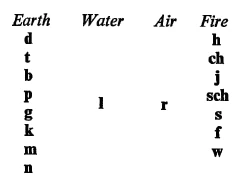
When we speak, we ‘form’ the air. This is true of all speaking of whatever kind or quality: we speak by forming the air. And we form it in ever so many different ways. Now, you can get a magnificent feeling of this forming of the air if you repeat over and over again hm, hum, ham. For you have here what I might describe as speech in full swing. Once you have experienced the great swing of speech, you will feel as you go through the impact sounds — d, t, b, p, g, k, m, n — that when you come to say hm, you would really like to achieve at long last the actual push or impact, you would like to take yourself with the hm right into it. And at the same time you can feel that you want to mould the body of the air out there in front of you to an enclosed form or figure. And you are really wanting to do this, not only with m but with all the sounds that I have named in this left-hand column. You do not quite succeed; the endeavour shows itself only in nascent condition. Nevertheless, in the case of all these sounds there is the desire on our part to enter with them into the enclosed form that is taking shape out there in the air. As we utter these’ impact’ sounds, we feel we would like to mould the air to a complete and shut-in form. And now we can well imagine we want to go farther and see what these forms are like.
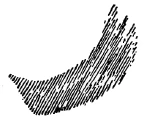
When we form the sound d, we are really wanting to form in the air a figure rather like a kind of runnel which we hold up before us like this, so that it is closed in front. That is the kind of form we want to be making as we say d.

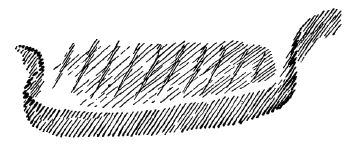
When we say b, it is as though we were wanting to make an enclosed form rather like a little ship.

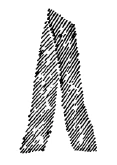
With k, we have the definite feeling of wanting to form with our speech something like a tower or pyramid.

With all these sounds we are conscious of a desire to harden the air. What we would like best of all is that the air would crystallise for us. We have indeed clearly the feeling, as we utter the sounds, that actual bodily forms are there before us spurting up into the air; and we are even surprised that these forms do not begin to fly about. As we come to feel our speaking, we are astonished that when we put forth all our strength, we cannot see b and p, d and t, g and k flying about around us, that we cannot see ms flying about like spirals or ns like the curled-up tails that animals sometimes have. We are quite astonished that this does not happen. For the remarkable thing is that these impact sounds, although we form them in the air, have all the time an inclination to the earth element. With these sounds, in fact, we work right into that which is earth in the world of the elements; they are proper to the element of earth. And from this correspondence of impact sounds with the element of earth we can learn something that will be most useful for us in our study of speech.
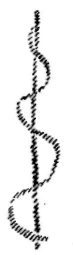
For if, as we speak k, we imagine before us a crystal form shaped somewhat like a tower, if we hold this form clearly before our mind's eye, that will do a great deal towards purifying our utterance of the sound. It will also make supple the organs we use in speaking the sound. And we shall find it a wonderful help if while speaking the sound m we imagine a climbing plant — some variety of bindweed, for example — that twines itself round the stem of another plant.

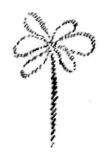
And then for n, we cannot do better than think of the woodruff, with its wreath of petals at the top of the stem.

Thus, to find the inner content of impact sounds, we have to go to the earth, we have to conjure it forth from the element of earth.
Suppose you want, for example, to get to know more intimately the inner configuration of the sound p. Call up before your mind's eye the sunflower plant, that bold-faced annual that lifts itself up to such a height. Look at its enormous overhanging golden flowers that spread out their centres so conspicuously for all to see. There you have the sound p most marvellously displayed.
To call forth from the forms and shapes in which the earth element manifests, to conjure up from them the impact sounds, will bring our speaking a stage onward. And then, what this exercise does for us will have to be brought into the lovely and smooth-running flow of speech. Let me show you how this can be achieved.
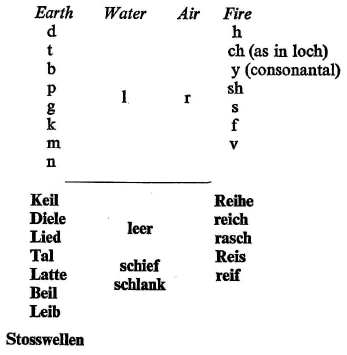
Think of the pyramid, which so well expresses a k; for as we say k, we live — in speech — in the pyramid. Now let the pyramid fall down and crumble to dust. This will mean, we let the k sound pass over into the l sound, and do you see? What before was solid and firm, is now all in flow, runs away like water. k–l — it runs away like water. What is it in a Keil (a wedge) that makes it of value for you? A wedge that won't wedge itself in, a wedge that doesn't run in, has no sense. The k is right too, for a wedge has a shape like a pyramid when you stand it up on end; but the main point for you about a wedge is that it slips in easily. Keil — the word is marvellously pregnant of meaning. Speak the word, and feel at the same time what the Keil does, feel the cleft it makes as it eases its way in. Feel then also how the firm solid element meets with hindrances as it goes over into flow, and how these find expression in the vowel, in the ei. In truth, a wonderful word! You can do the same with all the impact sounds. Bring them together with l, and you will find you are bringing them into a right and beautiful flow of speech.
You can also go the other way about: you can begin with something that is in flow and arrest it, establish it. Practise saying the word Diele (a deal or plank). It flows in the mouth wonderfully. And now take it backwards. Set out with what is living and in flow, and carry it into the earth element, letting it become fast and firm. Diele reversed takes on a most beautiful form: Lied (a song). The song, to begin with, lives in the soul; it is then given form, and wrought into a poem: Lied. You should learn to feel what lies behind these transitions from one sound to another.
Take now the sound t and follow it with an l. T expresses a hardening, a making firm; and then what has been made firm goes sloping away in l. In the word Tal (a dale or valley) you have a wonderful picture of this process. The land that has been pressed down hard runs out on to the plain below.
Now reverse the process. Take what is in flow and make it firm; and you have a Latte (a lath).

The sap in the living wood is in flow, and becomes hardened in the lath. Going through a word in this way, entering right into the feeling of each sound in turn, you come at last to the word's own secret.
Suppose now we go through the same process as we did with Keil, but take this time some tool we can manipulate by ourselves and turn easily in any direction. For a wedge, we usually require of course the help of a hammer; now we will take instead a tool with which we can make nearer contact — the one I have in mind is actually rather like a little boat that we can steer whither we will: Beil (an axe). The word answers well to the description and demonstrates quite clearly the difference between k and b.
Now take Beil backwards. Begin with the flow and then make it fast. Instead of bringing your axe into swing, you now bring what is alive into form, enclosing it in firm form — and you have Leib (a body).
Continued practice in uniting impact sounds with the wave sound l will work wonders for you. Your speaking will have clearly defined contours, and will at the same time flow well; your words will be formed and finished and yet follow one another in the sentence with ease and fluency.
From now on, therefore, let this association of impact sounds with the wave sound l be designated as the ‘Stoss-Wellen’ (Impact-Wave,—‘press-home and let-flow’). For special attention should be given to this sound-process in speech training. Students can learn from it how to form and frame their single words and at the same time also how to bring them into flow, so that the whole sentence runs like a smoothly flowing stream. All this can be learned from the practice of ‘Stoss-Wellen.’ To describe things of this kind we have, you see, to look round for new expressions.
Taking our start in this way from impact sounds and going on to 1, we find that we have passed from earth to water. For in the impact sounds we have the element of earth and in 1 that which essentially signifies the fluid element, water. You can even hear in the sound an imitation of water. But now let us suppose that water becomes so tenuous that it begins to vibrate and quiver inwardly; in effect, we begin to find ourselves in the element of air. The water is evaporating, is turning gaseous, is wanting all the time to pass into the inwardly aeriform condition. This means, we are no longer satisfied to remain in the perpetual inner flow of the watery element; the inner vibration of air must now begin for us. We have this in the sound r. The air that we use for speaking, vibrates inwardly in r. R belongs to the element of air.
Imagine you have a box in front of you. You open it, hoping to find in it a present from a friend. You feel sure there is something really exciting in that box. You open it — and there is nothing there, nothing at all! And all that flow of feeling in you (l) evaporates. Before, the moisture on your tongue had been all in movement. You open the box, and air comes to meet you, nothing but quivering air. You exclaim: Leer! (empty). In this word leer the whole course of your experience is described — even to your starting-back, which is so forcibly expressed in the double e. It would indeed be impossible to find a more adequate description of your disappointment than is given in this gesture ... and this word leer. Gesture and word taken together reproduce the experience with marvellous accuracy.
A great deal can be learned by observing words in this manner; continuing in such a study, the actor will be able to fulfil with freedom and fluency all that is required of him.
And now let us suppose that we take this vibration, this quivering, and form it, out there in the air. You will soon see what happens if you study a trumpet, not of course the metal part, but what goes on inside the trumpet when you blow. Study this carefully. Provide yourself with a highly sensitive thermometer and see what it will reveal inside the trumpet, when the vibration begins to assume forms and figures corresponding to certain tones. You will find different temperatures registered in different parts of the trumpet. This is as much as to say that the processes taking place in the trumpet express themselves in the element of fire. And the same is true of all breath sounds. When we utter feelingly the sounds: h, eh, j, sch, s, f, w, we are taken over into the element of fire or warmth. For these sounds live in the element of warmth.
You will also see from this what happens when you say hum. You set out from the warmth element; you are working, to begin with, with your own warmth. In the h you release your warmth, you let it out. Then you catch hold of what you have placed outside you and feel it as a consolidation of your being, of your whole being: hum. You take hold of your warmth and make it fast and firm: hum, ham, and so on.
Again, suppose you want to picture something that is alive, that has life in itself and is ready to go on living on its own. Continued practice with ‘breath’ or ‘blown’ sounds will bring you this experience. Words that have only such consonants are not so frequently met with, because what is alive is not posited by us as easily as are fixed objects; nevertheless you will find them here and there, where something that is outside in space is pictured as alive and unstable; and here you will again have opportunity to make interesting studies. Say, you want to express that an object is alive, but its life is uneasy, is precarious. You may describe the object as schief (aslant, on the incline). The word itself suggests that the object could at any moment — instead of remaining in life — fall over and come to grief: schief.
Suppose, however, you want, on the other hand, to consolidate what is alive and mobile. Then you will have to see how you can make stand up straight something that is naturally, of itself, full of weaving, flowing life. Imagine before you a form. At first it is a tiny little form. It grows and grows; it rises, runs up higher and higher and becomes eventually quite tall. But now you want to express that the living, weaving form has shot up in a line. You say it is schlank (lank or slender). You begin with the sch, which tells of life, and go into the l (flowing), and then, with the k, which makes the life stand up in a straight line, you come back in the end to an impact sound.
There is still another transition that should without fail be practised by any student who wants to form his speech artistically. For he will want to be able to speak so that his speaking streams out over the audience. He will not attain this by concentrating on the individual sounds he has to utter; rather does it depend on the whole general character he is able to give to his speaking.
For an actor, this is obviously a matter of first importance. His words must penetrate to the farthest limits of the theatre, they must become a living presence throughout the space of the auditorium. This result can be achieved by the following exercise; and he who knows it will find himself in possession of an esoteric secret of the art of speech. The exercise consists in letting the vibrating air move on into breath sounds, thus: Reihe, reihen, reich, rasch, Reis, reif.
And supposing you want the very sound itself to have a hypnotising effect: you can do as the lawyer did of whom we were speaking yesterday, who advised his client to say: veiw. A fine and delicate perception lies behind the use of this sound-sequence in the piece we were studying yesterday. It is, I may say, quite wonderful how many features and details in those old plays, features that were of course introduced quite instinctively, are in perfect accord with the laws of human life.
And so, in order that our speaking shall mould the sentence plastically, we must learn to form in it especially the sounds that belong to earth and water; and for our speaking to be alive and effective we must learn to give form to the air- and fire-sounds — the air-sound r and the breath sounds. I do not mean to imply that what we say will have to be expressed with these sounds. But by practising sound sequences that contain earth sounds and the water sound, we can learn to form a sentence so that it has an inner plastic force; and we can on the other hand learn how to speak impressively, so that we may with comparative certainty assume that what we say has penetrated, has gone home, by practising the exercise I gave just now, the exercise that goes between the air sound r and the fire sounds. The actor will need to develop his speaking in both these directions: he must speak beautifully, and he must also impress his listener. And I have given you here the technique whereby he can learn both.
There is still another thing which is necessary for one who wants to make progress in the forming of speech. He has to acquire the faculty of carrying into the realm of the intimate every feeling or impression that is awakened in him from without; he must be able to bring it right home to himself in an intimate way. Let me make this clear by an example.
Take the sensation that many of you are experiencing in these days when the ‘inner configuration of the air’ in this lecture room forces itself upon your notice. Some of you, I know, feel it distinctly uncomfortable. We will take the most simple and primitive sensation that someone may have. He perceives that it is hot in here — with all the other feelings that can go with this experience. Or let us say that for his feeling the room is warm — simply warm.
Now, anyone who has interested himself at all in the forming of speech will know that a word like ‘warm’ can be spoken in a variety of ways. You are probably familiar with the delightful little story illustrative of the saying: Der Ton macht die Musik. Little Itzig writes home to his father: ‘Dear Father, send me a gulden!’ The father cannot read, so takes the letter to a notary who reads out to him in a peremptory, rude tone of voice: ‘Dear Father, send me a gulden!’ ‘Whatever next! The good-for-nothing little scamp will get no money out of me, if he writes like that! Is that really what he says?' But now the poor father cannot after all find it in his heart to leave the matter at that, so he goes to the parson. The parson takes the letter and reads out to him in a gentle, quiet tone : ‘Dear Father, send me a gulden!’ ‘Is that really what he says?’ ‘Certainly!’ replies the parson. ‘The dear little fellow, I'll send him one right away!’ Yes, everything depends, you see, on the tone of voice! Similarly, the word `warm' can be spoken in many different ways. But, my dear friends, if that is so, we must be able to bring into the sounds of the word all the different fine shades of feeling that we want to express. And that has to be learned; we have to learn how to do it.
Let us return to our supposition that someone feels the room warm. (I choose this for my example, since I have a suspicion that quite a number of you may be experiencing this feeling at the present moment.) And now let him follow the experience back into the subjective. Let us imagine he shuts his eyes, forgets there are other people around him, and says to himself: Es saust (I feel a buzzing or whizzing sensation in my head!). He calls the ‘being warm’ a sensation of buzzing because he can feel it like that when he withdraws into himself and experiences it subjectively. Try to distinguish different kinds of buzzing that you can experience. When you are very cold, you feel inside you quite another kind. One could imagine, it might almost become a habit to have, when the room is warm, this inner sensation of buzzing.
warm: a buzzing sensation.
Practise this, entering into the inner feeling of it; and it will help you to make your intonation of the word ‘warm’ accord with the precise shade of experience that you want it to express. Exercises of this kind should be included in your training.
Take another: I am cold. Es perlet (I feel a tingling, a stinging sensation — and this time, especially in my legs and arms).
cold: a tingling or stinging sensation.
The more of such examples that you can find for yourselves, the better. See where you can take some word that expresses a perception or sensation, and lead it over into an experience that is more intimate, that touches you more nearly. To carry over in this way a perception that is at first more remote and separate into the realm of the intimate will give to your speaking the right inner ‘feeling’ tone.
So we have now four properties of speech:
The feeling tone of speech,
The beautiful, smooth flow of speech,
The revelation of oneself that is given out in speech,
The penetrating and convincing power of speech.
These are, every one of them, a matter of technique. The actor has simply to learn the technique for achieving them.
In past ages, such things were known instinctively, and men were also aware of their fine spiritual significance. In the school of Pythagoras, for example, the pupils had to recite strongly marked rhythms, the aim being to intervene by this means in human evolution, taking hold of what was instinctive and developing it further by education.
Take a line of verse that runs in trochees or dactyls, such as:
Singe, unsterbliche Seele, der sündigen Menschen Erlösung! 4
A rhythm of this nature, chanted in a kind of singing recitative, Pythagoras would use in his school to tame the passions of men. He knew its power. And he knew also that verse in the iambic rhythm has the effect of stirring up the emotions. Such things were well known to the men of earlier times, just as they knew too that the art of music takes us back to the Gods of the past, the plastic and pictorial arts lead us on to the Gods of the future, while the art of drama, standing between the two, conjures up the Spirits of the time in which we live.
We too must learn to perceive truths of this nature. A knowledge of them must return again among mankind; only then will art be able to take its right place in life.
It is really also quite remarkable how strongly the instinctive can still make itself feit in this domain. Look at the popular poetry composed by the Austrian poet Misson, the Piarist monk who wrote in dialect. If you study Misson's biography and read of all the other things that he did, you will find that he obviously wanted this poetry to have a soothing, calming effect. He accordingly chose for it not the iambic metre but, notwithstanding that he was writing in dialect, the hexameter.
Naaz, iazn loos, töös, was a ta sa, töös sàckt ta tai Vada.
Gottsnam, wails scho soo iis! und probiast tai Glück ö da Waiden.
Muis a da sàgn, töös, was a da sa, töös las der aa gsackt sai.
Ih unt tai Muida san alt und tahoam, wöast as ee, schaut nix aussa.
Was ma sih schint und rackert und plàckt und àbi ta scheert töös
Tuit ma für d'Kiner, was tuit ma nöd ails, bald s'nöd aus der Art schlàgn’!—
Es mar aamàl a presshafts Leut und san schwari Zaiden,
Graifan s' am aa, ma fint töös pai artlinga rachtschàffan Kinern ...
You can feel, as you listen to the lines, their soothing, quieting influence.
If you want to lead straight over to the spiritual, if you want to take your hearers away from the physical and lead them up to where they can move in the realm of the spirit, then you will have to use the iambic metre, but still forming the speaking gently, quietly.
And this is one of the reasons that prompted Goethe, for example, to write his dramas in iambics, one of the reasons also why our Mystery Plays have been written largely in iambic verse. A sensitive perception for such things will have to live within us, if we want to have again true schools of dramatic art. In such schools it must be known that speech is alive, that gesture is alive, that everything that happens on the stage is alive and active and sends its influence out far and wide.

or, using English letters:

![]() |
Friedrich Schiller [1759 ― 1805] |
Schiller and Our Age: Lecture 9 of 9
Rudolf Steiner, Berlin, March 25, 1905:
In this last lecture I want to deal with a particular question which connects up with the lecture in which I discussed Schiller's influence on the present. The problem of aesthetics in Germany comes in here because Schiller stands in close relationship to the establishment of aesthetics as a science — the science of the beautiful.
We have seen what Schiller's attitude was to the beautiful at different periods of his life. Schiller saw in the beautiful something which had a peculiar cultural value. Now a science of aesthetics such as we know today is only 150 years old. It is true that Aristotle had written on Poetics, but for centuries these views remained stationary. We know that even Lessing harked back to Aristotle. No real advance was made until the Eighteenth Century when Baumgarten grew up in the Wolffian philosophy and wrote a book on the beautiful called Aesthetica in 1750. He distinguishes the beautiful from the true in that, as he says, the true contains a clear idea, while the beautiful exists in unclear and confused ideas. It was only a few years before Schiller's time that ideas like this could occur.
We have a sort of aesthetics even in Kant's Critique of Judgment, but in him we have nothing but theory; he never had a living idea of what beauty is, and never got three miles away from his birthplace at Königsberg, and never saw any important work of art; and so could only write from the standpoint of abstract philosophy. Schiller, in his Aesthetic Letters, was the first to grasp the problem in any living way.
What was the position at the time? Goethe looked longingly to Greece, and Winckelmann also cast a regretful glance back at the age when men copied the divine in their art. Schiller felt the same regretful longing during his second period, as we can see from his Götter Griechenlands. Again, in Greek drama, what is it but a religious feeling that lies at the back of it. It is based on the mystery, the secret of God who becomes man, who suffers as man, dies and rises again. What happened in the soul was regarded as a purification; and even through the Poetic of Aristotle there still passes a faint breath of it. The tragic was to consist in the “production of an action which aroused pity and fear and aimed at the purification of these feelings.” It was difficult to understand what was meant by that; and Lessing meditated a good deal about it. In the Nineteenth Century a vast literature grew up around the problem, and whole libraries could be filled with books dealing with Katharsis. The idea was not understood because men did not understand from what it had grown up.
In Aeschylus we can still see something of this “drama of the God.” In the middle of the action stood Dionysos as the great dramatic figure, and the chorus round about him accompanied the action. This is how Edouard Schuré has recreated for us the mystery drama. The dramatic cult-action had the definite object of leading man to a higher level of existence. It was seen that man is gripped by passions, that his lower life makes him kin to them; but he can rise above them if the higher that lives in him is purified; he can raise himself by looking at the divine pattern. This type of representation was meant to bring man more easily to ennoble himself than could be achieved by teaching. As Schopenhauer said, it is easy enough to preach morality but very hard to establish it. It was only at a later age of humanity that Socrates' view grew up that virtue is teachable. But virtue is something that lives in man and is natural to him, as eating and drinking are; he can be led to it, if the divine is awoken within him, by the picture of the suffering god. This purification by the divine pattern was called Katharsis. Pity and fear were to be called forth; ordinary sympathy which is connected with the personal was to be raised to the great impersonal sympathy when the god was seen suffering for mankind. Then the dramatic action was humanised, and in the Middle Ages we can see how morality separated off and appeared independently. Thus in Christianity there was produced partially what lived incarnate in the Mysteries. The Greek looked with his own eyes on the god who rose again from humiliation. In the mysteries virtue was not merely preached but put before the eyes of men.
Schiller felt very intensely the desire to give men back this knowledge to unite the sense-world and the moral. The core of his poetry is the longing to reconcile these two — the senses and morality, that morality which Kant had interpreted so rigidly that duty led men away from everything which appeared as natural inclination. Schiller, on the contrary, demanded that duty should coincide with inclination; he wanted passion to be so cleansed that it could become identical with duty. This is why he revered Goethe so much, for in him he saw a perfect union of the sense-world and the moral.
He looked for this unification in the beautiful. And since Schiller possessed to an unusual degree the German quality of an aesthetic conscience, he wanted to make art a means of raising man to a higher level of existence. During the classical period there was a strong feeling that the beautiful did not exist merely to fill up idle hours but that it was the bridge between the sense-world and the divine. Schiller pushed far enough to find freedom here. Inclination is no longer to be suppressed: he remarked that a man must be very low in the scale if he has to be virtuous in opposition to his own inclinations. His inclination must be developed so far that he acts virtuously of himself. Earlier in his The Stage as a moral Institution he had preached something very like the severe Kantian morality.
“In the conquest of the matter by the form lies the secret of the master.” But what is, in fact, the material of the poet? In what attitude can we find the right view of the beautiful? As long as we are interested only in a single face, we have not yet got the true artistic view; there is still a clinging to matter. (“Heed the `what' but heed more the `how'!”) As long as a poet shows that he hates a villain, as if this were a personal interest, he still clings to matter and not the form; he has not yet reached the aesthetic view. He only attains that if the villain is represented in such a way that the natural order, and not the poet, inflicts the punishment. Then the “world karma” is accomplished; world-history becomes a world-judgment. The poet disregards himself and looks at world history objectively. This means moreover that what Aristotle said is realised, that poetry is truer than history. In history we cannot always survey the whole event; it is only an extract that lies before us so that we often get an impression of injustice. In this way a work of art is truer than history.
Thus was created a pure and noble conception of art; the purification, the Katharsis, stands beyond sympathy and antipathy. The spectator should stand before a work of art with a pure, almost godlike feeling, and see before him an objective, divine image of the world, and create for himself a microcosm. The dramatist shows us within a limited framework how guilt and atonement are connected, shows us in detail what the truth is, but gives this truth universal currency. Goethe means the same thing when he says that the beautiful is a manifestation of natural laws which, without the beautiful, would never find expression.
Goethe and Schiller looked for a realism, but it was an idealistic realism. Nowadays we think that we can get realism by an exact copying of nature. Schiller and Goethe would have said that that is not the whole truth; the sense-world only represents a part of what is perceptible and lacks the spiritual; nor can we regard it as truth unless we bring the whole tableau of nature simultaneously into a work. The work of art is however still only an extract of the real. In that they strove for truth, they could not admit the immediate truth of nature.
In this way Schiller and Goethe laboured to awaken an idealism, which had actually existed in earlier times. In Dante we have got a representation not of external reality but of what passes in the human soul. Later on, men demanded to see the spiritual in external form. Goethe showed in Grosskophta how anyone who materialises the spirit becomes subject to delusions; Schiller also occupied himself with this materialisation of the spiritual. At that time, there was a good deal of investigation along these lines; and much of what we nowadays call spiritualism engaged men's attention. In this, lies the occasion of the Geisterseher, which treats of these things. Before he had struggled upward, by the help of Kantianism and the artistic, to higher views, Schiller depicted the dangers to which anyone who seeks the spiritual in the external world instead of in himself, is subject. That is the origin of the Geisterseher.
A prince whose faith has become alien to him and who is not strong enough to waken the spiritual in his own soul, is greatly excited by a strange prophecy which a mysterious stranger announces to him and which is shortly afterwards fulfilled. In this mood he falls in with some tricksters who skilfully employ certain circumstances to bring him into a state of mind in which he will be receptive for the appearance of a spirit. The business is proceeding when suddenly a stranger interrupts and unmasks the trick; but himself produces an apparition in place of that of the trickster, and this apparition makes an important pronouncement to the prince. The prince is torn by doubts, for this stranger is none other than the man who had just prophesied to him; and he soon begins to think that both parties are concerned in the plot since the trickster, though he had been locked up, soon escaped. New and inexplicable incidents make him strive for an explanation of all the secrets; as a result, he comes into complete dependence on an occult society, losing all moral stability. The novel was never finished. In it the struggles of a seeker after spirits are represented in a terrifying fashion; we see how the longing for the spiritual leads men downwards when he looks for it in the external. No one who clings to the material, even if he only seeks to find the spiritual appearing in sensible form, can penetrate to the spiritual. The spiritual has to unveil itself in the soul of man.
That is the true secret of the spiritual; that is why the artist sees it first as beauty. The beautiful, conquered and permeated by the spirit, is made real in a work of art. Hence it is the worthy material of the spiritual. At first the beautiful was the only means for Schiller by which it could reveal itself. He looked with longing back to the time of the Greeks when there existed another means for the awakening of the spiritual: when man raised himself to the divine while bringing god down, making god into man and raising himself by god's means. Mankind must now rise once more to the divine by conquest over the material. Schiller in his plays was always striving higher until the physical fell away more and more until the
Und hinter ihm in wesenlosem Scheme
Lag, was uns alle bändigt, das Gemeine.
which Goethe cried to him after his death, became the full truth. The word “gemein” is not used here in any low, contemptuous sense; it is the common humanity, the common fashion of men that is meant, above which Schiller had raised himself. He had raised himself, as a true seer, to the vision of the spiritual.
He must stand as a pattern before us. That has been the whole object of these lectures; so far as it was possible in a few hours, to trace out this struggling soul of Schiller's, as it rises to greater and greater heights of spiritual insight, and seeks to grasp the spiritual, so that he may impress it upon the sense world. In this struggle we really get to know Schiller, and in him Goethe's words are in truth fulfilled:
Nur der verdient die Freiheit und das lieben
Der Täglich sie erobern muss.Only he deserves freedom and life
Who daily must conquer them anew.
In this way Schiller fought his way upward, till he became the master of an etheric spirit-permeated form.
Related post:
Life is the unfolding glory of the rose of expiation
Source:
March 25, 1905 GA 51
Rudolf Steiner, Stuttgart, August 14, 1908:
In the last lecture we learnt that man had gradually conquered the physical plane during the post-Atlantean epoch; he had come gradually to understand that the physical world into which he had entered is the expression of the spiritual powers lying behind it. We learnt also that when the Greeks and Romans were the leading peoples in human evolution man had established a kind of balance between his understanding of the physical and spiritual worlds. He had come to terms with the material world; he had learned gradually to understand and to love it.
We must not think that such processes did not have corresponding parallels in the spiritual world. Even if we go further back in human evolution we find, to the same extent as outward conditions alter as regards man's observation and perception of the physical world, conditions alter essentially also as regards other states of consciousness. So far special stress has been laid on the state of consciousness when man is withdrawn from his physical body during sleep. We saw that in the Atlantean epoch he perceived only blurred outlines when awake, but that divine spiritual beings appeared before him when he exercised the dim kind of clairvoyance he then possessed. In order that we may understand the entire human being we must take into account these alternating conditions of consciousness which are connected with what we call death and what lies beyond death; we shall then see that the ordinary life we observe between birth and death has also an essentially different side.
So far we have considered the destiny of man during his life between birth and death from the Atlantean epoch to the age of Greece and Rome; we must now inquire as precisely as possible into his destiny between death and rebirth; for the life of man continues after death. From the moment during the Lemurian epoch when he entered for the first time into earthly incarnation, and life within a physical body first alternated with life outside of it, man has led, to a certain extent, a two-fold life — one upon earth and one in the spiritual world between death and rebirth. Though some people believe that changes only occur in the physical world, and that between death and rebirth everything can be described in a few typical words, this belief is absolutely incorrect.
Destinies change in the spiritual period of human development also. We shall best understand how these changes occur if we glance at the life man leads here in the physical world, and at his relationship to the other kingdoms around him. Man, as at present developed, is by no means a being who exists absolutely by himself; he is related in various ways to all that surrounds him.
Think only how man's consciousness, his self-consciousness, depends upon that which surrounds him. If no other kingdom surrounded us, no mineral, no vegetable, no animal kingdom, if there was no atmosphere, no clouds which reflect the light to us, our ego as it is now would not have been kindled by the outer world. Man, as regards his self-consciousness, is immersed during the day in the world that surrounds him.
Between birth and death he is plunged into a certain environment through having an etheric and physical body. He draws his food from the lower kingdoms of nature, these give him the substances and forces which pass through him. We might say that up to the time of birth he evolves, and then, on entering earthly existence, he comes in contact with the lower kingdoms of nature. It is true he only enters these when he takes on a physical body, and has then to assimilate them as his means of support; in the physical world man is not an absolute being. Only think how he must continually inhale a certain quantity of air; so that he is by no means enclosed within his skin, his being extends into the air. On entering physical existence he enters into a certain relationship with the kingdoms below him; he dips into them; on leaving his body he rises into higher kingdoms, into that of the Angels, Archangels, and Archai, and indeed into still higher kingdoms. Just as through the needs of his physical body he enters into relationship with the lower kingdoms, so after death he enters into relationship with higher kingdoms.
Let us now pass to the epoch when man first began to enter upon his earthly incarnations. This was in the Lemurian epoch, when, though he did enter a physical body, he had very little connection with the physical world. He had as yet the merest trace of sense organs, and had therefore hardly any perception of the outer world. Man actually passed through a condition at the beginning of his incarnations when his connection with the physical world was very slight; because of this he was all the more at home in the worlds of the spirit. This was also the period when, having passed out of his physical body — not only during sleep but also after death — man entered a world full of spiritual light where he perceived spiritual beings; where, to a certain extent, he drew strength from these beings as he now draws it from the physical world; it was a time when he reached out into the kingdoms above him as he now reaches out into the physical world. His being extended into the kingdom of the Angels, Archangels, and even into higher kingdoms which interpenetrate his own. His consciousness was dim, and only at death did he gain true consciousness. He only drew into the physical world gradually, nourishing himself spiritually with the vision of divine spiritual beings.
Man only gained his ego in the course of time as he passed through his various incarnations; he did not have it at an early stage. Other beings of whom we said that they had passed through their human stage at an earlier period already possessed egos, and man learnt to know the ego through beholding them, but he only came to know it truly in the period between death and rebirth.
When a man died at that time he had the feeling that only when he could see divine spiritual beings did he really begin to live; it was actually the case that the farther he left death behind him the higher the stage to which he attained. He grew even more and more conscious until the time came (between death and rebirth) when the mighty Being appeared who had first given true content to his life, regarding whom he felt: “From Him I have come; I belong to Him.” This was the same Being, seen in a primeval period, who later incarnated on earth as the Christ. It was not possible in the Lemurian period for man to behold Christ in a physical body, but he did behold Him midway between death and rebirth; he thus became a part of Him and knew Him in the spiritual world.
As time passed on man grew ever more conscious in the physical world. Full consciousness came first in the middle of the Atlantean epoch, but it came gradually. The more conscious man became in the physical world and the more the rudiments of the ego had entered into him, the less did his consciousness reach up into higher worlds after death. At first he was not able to expand to the vision of the Christ; he only saw Angels and Archangels, and later, in the Atlantean epoch, even this was denied him; it was only granted to those who were most advanced. Normally, man only perceived Angels through his ancient dim clairvoyance; these were Angels also in the Christian sense, and are those who were referred to by the Greeks as Zeus, and by the Germanic people as Wotan, and were regarded as deities.
We have already said that in the Atlantean epoch, during sleep, man was the companion of the Gods; this was especially the case in the period between death and rebirth. These Gods were Angels, or, at the highest, Archangels, and only when man had prepared himself in this life by what he felt to be good deeds, was the vision of Christ, under certain circumstances, vouchsafed to him, through these subsidiary beings. Man still knew the Christ, however, through the deeds and the nature of the Angels and Archangels. Just as light is still light though tinted by passing through coloured glass, so the Christ-form was seen, but with waning strength. It was none other than the Sun-Spirit who thus appeared with waning strength, because man was attracted more and more to the physical side of existence and had learnt to love it.
So humanity developed through the different ages of post-Atlantean civilization, and in each of them appeared the remembrance of earlier epochs; these were actually experienced. In the Egyptian age we find a memory of the Lemurian epoch.
How did Initiates at that time represent the life after death? It was their endeavour that men should experience after death — if only as a faint echo — what men experienced in olden times when they raised themselves up to that in which they felt as if hidden, to that supreme Being — the great Sun-Spirit. This is the meaning of what the ancient Egyptians called the judgment of the Dead; when the dead person appeared before his judge, who weighed his deeds. If these were found to be worthy he might, through the merit acquired in the physical world, become a part of the Being looked up to as God of Light, the Sun-God, This was the same being who was called Osiris. It was the journey to Osiris — the union with him that was imparted to the dead as a recollection of an actual previous evolutional condition. This is how we must understand what is contained in the Book of the Dead, that most remarkable record of the Egyptian people.
From the nature of the conditions laid down in my book Christianity as Mystical Fact, the full esotericism of such things can obviously not be given out, but the fact remains that these things might be gone into very much more deeply. According to the ancient Egyptian idea, if a soul according to its deeds was found worthy of this vision it might be united with Osiris; indeed it was actually addressed as an Osiris, because united with Him. The words are: “Osiris was cleansed in the pool to the south of the field of Hotop and north of the field of locusts, where the Gods of growth wash in the fourth hour of the night and in the eighth of the day, with the image of the heart of the God passing from the night to the day.” It is impossible to express the full depth of meaning of this formula but it is important to understand the expression, “from the night to the day.” Previously it had been night; the soul is led over to a day — to a spiritual day — when it will be united with Osiris, when it may itself become an Osiris. The soul in this way actually experienced its destiny in another world, the world lying between death and birth.
Consciousness between death and rebirth darkened more and more, though it was never lost completely; it was never extinguished, though it grew dim. The more affection man developed for the sensible physical world, the more he had to content himself with the vision of lower beings, and the less communion could higher beings have with him. All the beings who were his good companions during the Atlantean epoch, when he was still clairvoyant, disappeared, especially in the period between death and rebirth, and gradually the connecting link between man and those ancient Gods was lost.
We know that remnants of ancient clairvoyance endured up to the later ages of European culture; that there were some people who in certain states of consciousness could still rise to the vision of the Gods. Such people also enjoyed a more vivid communion with the Gods after death; they had a more intimate life with them. Such a communion was good not only for men but also for the Gods, for man takes up with him the love he has won in the physical world; the Gods received back from him as a sacrificial offering that which as love he had acquired in the physical world. Men, however, grew ever less and less fitted for this communion with the Gods, because their love for the physical world continually increased. The souls of those dwelling in the districts from which the Germanic peoples have since sprung gradually participated less and less in the vision of the Gods, so that they had little fellowship with them between death and rebirth. Through this an idea developed that the Gods were losing their connection with the earth which they had themselves created, and losing also their rulership over it. This feeling gave rise to the conception of the “Twilight of the Gods.”
This is the actual foundation of the drama. It was felt that the Gods had to withdraw from the world they had themselves created. The Gods who, even as late as the Atlantean epoch, had descended into the bodies of the most advanced human beings and had taught them important secrets in the Mysteries were obliged gradually to withdraw, and they could only come in touch with the physical world by using the more advanced human beings as their instruments or vehicles. This actually happened in the Atlantean epoch; and those who were initiated into the ancient Druidic Mysteries knew, for example, that an ancient Atlantean individuality known as Sig appeared for long after the Atlantean catastrophe in many different ways in European bodies.
All such names as Siegfried and Sigurd preserve exoterically the remembrance of the repeated appearances of this individuality who was finally only perceptible to those who had been initiated into the Mysteries. He united himself with high Initiates, and it became more and more necessary, the nearer we approach our age, for him to seek out those who had already gone through many, incarnations in which they had purified themselves. Now, in order that we may understand our age, it is necessary to touch the fringe of a great mystery which throws light on much that had taken place in our time.
Let us turn once more to the middle of the Atlantean epoch, when the physical world was first disclosed to man. A sort of parting of the ways then took place for the Gods — those who had been the ancient companions of men in higher realms. Coming from spiritual heights man had plunged deeper and deeper into the physical world. He had already passed through three great epochs; the third being the Lemurian, the fourth the Atlantean and this will be followed by three others. We are living at present in the fifth epoch. The Lemurian epoch came to an end through great fire catastrophes; the Atlantean through mighty catastrophes of ice and water; our epoch will come to an end through other forces, through a mighty increase of egoism in human nature, and, on account of this, through the war of all against all.
Only those who turn to a spiritual life will survive the catastrophe, which, in this case, means the war of all against all, just as only a small group of people escaped from the catastrophes of Lemuria and Atlantis. The war of all against all will be still more terrible for those involved in it than were those of fire and water, however terrible we may picture them to have been. Those who are now turning towards a spiritual life should feel it their duty to do all that is possible to rescue the good seed of our age and carry it over into the sixth age, which will follow the present one. This age is made up of great subdivisions; the ancient Indian, the Persian, the Egyptian, the Greco-Latin, and the present one, which will be followed by the sixth and the seventh right on to the time of the war of all against all.
The present position of evolution is that we have passed the middle of the Earth age. Had human beings turned towards the spiritualizing of themselves before they had completely entered the physical world, the conquest of the physical plane, of which we spoke in the last lecture, would never have taken place. Man has, however, taken a path that leads him deeper and deeper into physical evolution; he has gone beyond the point that would have represented the deepest stage if at that time he had turned to self-spiritualization.
This point (which lies in the middle of the Atlantean epoch) was an important parting of the ways for certain spiritual beings. They had then to decide whether they would sink into a kind of abyss from which they would rise again later all the stronger (for through their fall they would have developed greater powers) or whether they would take the direct way. Certain spiritual beings, those who had formerly been the companions of man, took the direct way; they decided never again to enter human bodies, but to remain in the realms of the spirit. The subsequent development of humanity passed them by with hardly a trace.
There were, on the other hand, other divine beings, a number of whom have been preserved in the memory of the people of Europe and elsewhere under such names as Zeus, Wotan, etc.; they decided, for the salvation of humanity, to descend again and again into human bodies, that they might work for humanity. It was not possible for all of them to descend to the same extent, for through man having entered so deeply into the physical world human bodies became ever less suitable instruments for divine beings.
Only those men who had purified their bodies in a certain way, who throughout the course of many incarnations had developed such noble etheric and physical bodies that they had completely banished from their souls certain connections with the physical world, who, through their whole disposition, had lived less in that which was of the earth than in that which was not of the earth — only such men were still able to receive into themselves the souls of high Spiritual Beings as they would receive their own soul. So it happened that those into whom Spiritual Beings had entered could not, as it were, descend far enough into physical existence; they therefore held a very unique position in the world.
Let us picture some such being, one who for many incarnations had developed the forces of his body, had won an inner victory over it so that he lived more in the spiritual than in the physical world, and was, on this account, fitted to be the vehicle of a higher being. Was it possible for such a being to be fully understood by those who had descended completely into physical existence, who had developed a love for the physical world and strove to work on this physical plane? Would he not be better understood by those who had preserved the character of an earlier epoch, who were stragglers from an earlier epoch? He could, in truth, be much better understood by these stragglers from the Atlantean epoch.
The Mongolian peoples have not descended so deeply, nor have they entangled themselves so much in the physical plane nor done so much towards its conquest as the people of Europe. We see that external physical civilization is accomplished by western nations rather than by the stragglers from Atlantean civilization who had remained stationary, and were therefore not at home in a world of post-Atlantean development, because they had retained certain qualities and had then degenerated.
It is often pointed out that the Japanese are going through a significant development today through the qualities of their own character. This is an illusion. They are not developing through the force of their own qualities. In the last war against Russia they conquered with the help of battleships and cannon invented by Europeans; they made use of a foreign civilization. It is only progressive development when a people develops from out its own being. It is on this that development depends.
Spiritual individualities who were still the companions of men in the Atlantean epoch could be understood better by nations who had in a certain way remained stationary, and who represented, in a later epoch, conditions beyond which the people of Europe had developed because of their individual self-consciousness and feeling for freedom. Hence the teaching of these spiritual individualities had to be directed to such people, and we see here the consummation of a great mystery.
We see beings who, when the people of Europe were at an earlier stage of evolution, were fully understood, incarnating and appearing later as teachers in the schools of initiation, and on this account being honoured as Gods. We see Wotan, who had previously dwelt as an Initiate in a human body and taught in the Mysteries, being able, because he had not descended so deeply, to incarnate in a nation which, in a certain way, was backward, and on this account had preserved a feeling for the nothingness of the physical plane, of its unworthiness as an expression of the Deity, who looked on it as a place of sorrow and pain, and who held that the only real bliss was in leaving it. This individuality, known as Wotan and who had taught in the Mysteries of the Germanic peoples, is the same who appeared later as the Buddha, and with the same mission. (It is possible to touch on such secrets as we are speaking of in the privacy of an Anthroposophical Lodge.) Buddha, who mediated between our world and the higher worlds, is the same individuality who passed over Europe and is remembered there under the name of Wotan.
We see from this how those people who had preserved certain tendencies and connections with earlier conditions were provided for. Knowing this, the historical fact of the good reception Buddhism received among the Mongolian peoples is comprehensible, and entirely in accordance with the wise guidance of man.
As humanity had to conquer the physical plane more and more, it was no longer possible, in a later age, for such spiritual beings to incarnate directly in a physical body. It required a mightier Spiritual Being to do this, One who had been foretold by all the earlier teachers. Even the ancient Egyptians when they spoke of Osiris recalled their connection with the ancient Spirit of the Sun, and said: “The kingdom of Osiris will be established again upon earth.”
Before this could come to pass a Being like the Christ was needed. In that He had withdrawn more and more from the kingdom of the dead (and we do really see Him disappearing from the other side of life), He had drawn ever nearer to this side, until in the fourth age of civilization He incarnated in a human body visible to all, but in a body that had been very specially prepared.
The Christ-principle could not assume a human body in the same way as those did who descended entirely to the physical plane. Even such a Being as Jesus of Nazareth, Who had gone through many incarnations and attained to a high degree of initiation, was not capable at birth of being the vehicle of the Christ-individuality. Only after preparing himself through a life of thirty years had he succeeded in so far cleaning and purifying the outward physical sheaths — the physical, etheric, and astral bodies — that the Christ individuality could make use of them. In the thirtieth year of his life the individuality of Jesus of Nazareth left the outer vehicles which he had purified.
This took place at the baptism by John in Jordan. A change of individuality took place at this time, when the Christ took possession, not of an ordinary human body, but of a purified body. Then followed three years, during which Christ walked the earth in the body of Jesus, the years described in the Gospels between the baptism and the Mystery of Golgotha. We have here an Individuality Who had not appeared as in the ordinary course of events, where a form is provided at birth in accordance with the experience of many incarnations; but because this Individuality had entered into a body which for thirty years had been entangled in the physical world, and had received a mighty impulse through the Christ, something of profound importance took place which esotericists can read in the Gospels when they really know how to read them. There it stands; but such things are veiled.
At the baptism in Jordan, when the significant symbol of the dove appeared above the head of Jesus, he was not merely inspired but directly intuited by the Christ. On that occasion something shot through the entire body of Jesus of Nazareth, even into those parts which, at the present stage of human development, are most withdrawn from the influence of man — the very bones. I am now about to say something which to the materialistic consciousness of the present day seems nonsense; but that is of no matter. At the moment when the body of Jesus of Nazareth was permeated and fired by the Individuality of Christ — the great Sun-Spirit — the effect reached even into the bones.
If you burn a bone the cartilaginous part is consumed and the bone ash is left. The mineral substance of the bone and the cartilage are held together by a power which is opposed to fire, but also, therefore, associated with it. This power is at present entirely beyond the control of man's will, but it was under the control of Him Who was later to pass through the Event of Golgotha. Man can at present move his hand, but has no power to affect the chemical forces of his bones; he has become solid through them. The body of Jesus of Nazareth, through its having been intuited by the Christ, is the only body on earth that has ever acquired control over the force that holds cartilage and bone-ash together.
Through this control over the bones a force entered the world which is positively able to conquer death; for the bones are guilty of the death of man. Man has become entangled in the mineral part of the earth through being so constructed that he has incorporated into himself solid bony substance. Death came to him because of this, and it is not without cause that death is represented by a skeleton — the symbol is fully justified. The Christ-Impulse is the living force that is able to again transform the bones that is, to lead men gradually towards that which is spiritual; and this will come to pass in future evolution. This is why no external force was permitted to interfere with the bony structure of Jesus Christ: no bone of Him was to be broken. The others who were crucified with Him had their bones broken, but in Him the words of the prophet had to be fulfilled: “No bone of Him shall be broken!” This was in order that what had been imparted as a mighty central impulse to the earth should not be spoilt by any outside influence.
In this way the mighty Sun-Spirit worked at that time in the mystery which took place at the baptism in Jordan. It was the same Sun-Spirit who through His withdrawal from the earth had made it possible for man to enter physical matter, by which ossification took place, and Who continues to work on him so that he may perceive the impulse by which he can again uplift or spiritualize this tendency towards ossification.
Risky as it may be to speak of such matters, it is the mission of the Anthroposophical movement to declare those things that have always been known, taught, and seen within the Mysteries. Only because this mystery had been accomplished, and because of this alone, did another mystery become possible.
We know that the several parts of the human body correspond to the principles of man. The physical body corresponds to itself; the glandular system to the etheric body; the nervous system to the astral body; and the circulatory system (that of the blood) to the ego. The ego entered physically into man through his being endowed more and more with blood, thus becoming ever more capable of devoting himself to the material world.
A time came when the surplus blood had to be sacrificed. Horrible as it may sound to the chemist, it is nevertheless true that the superabundant ego, that which would have brought humanity to the war of all against all through excessive egoism, flowed from the wounds of the Redeemer on Golgotha. At the moment when the wounds of the Redeemer bled there was implanted within humanity the seed of the power by which it might raise itself again out of the state into which it had sunk so deeply.
If man had taken the upward turn in the middle of the Atlantean epoch he would never have attained to complete independence. He had to conquer the physical plane, but then on this plane the impulse by which he could rise again had to be all the stronger; and this impulse was given by the Christ. Because the Christ was stronger He could not only lead mankind out of the depths, but could do something else, something of very great importance! A part of the world is to be conquered by man, a part that will be united with the spiritual world that will be led back to the spiritual world.
It was shown in the last lecture that during the Greco-Latin age man had progressed so far in the conquest of the physical world, had become so deeply entangled in it, that he had to have a God in human form before he could recognize Him, for he could no longer penetrate to the spiritual world and perceive Him there. Meanwhile conditions on the other side of life — between death and rebirth — had also changed. Through man having descended so much further into the physical plane, and having developed so great a love for it, and derived so much pleasure from it, what was on the other side of life became ever less perceptible to him. He retained a considerable remembrance of this world when he lived on the other side between death and rebirth, and much of this has been preserved in legend. When we read in a book of Greek origin that the hero says: “It is better to be a beggar in the physical world than a king in the land of the shades,” it exactly expresses the feeling of that period. Because man had conquered so much of the physical plane he longed to come back to it, for at that time he could not take much over with him. Only through Christ having come to earth, and through man having already experienced Him in a preparatory way in the time of the Old Testament; only because man had received the Christ into his thoughts during life, could he take over with him that which brought light again to him on the other side. What he took with him made the other side clear and bright and restored the Christ to him with even greater splendour than in this world. Hence we see how consciousness on the other side became darkened more and more as the time approached which we described yesterday; and how it then grew clearer through man learning to know the Christ here. For what man learns of Him in this world is not lost in the period between death and rebirth; he takes his knowledge with him; and this is what the expression “To die in Christ” means.
From what has been said you will see that throughout evolution the life not only of the living changes, but also that of the dead. Because the dead are nourished on what they have learnt here concerning the Christ, because they take the fruits of this with them to the life between death and rebirth, returning here again in ever recurring incarnations, they will appear also in ever mightier, more Christ-filled bodies, and will make the earth more and more into an expression of what Christ can be to a transformed world when in the future He leads the earth to higher and ever higher conditions.
Thus we see how life, both on this side and on the other, cooperates in maturing the earth for what is to come; when the earth through being filled with the Spirit of Christ will be united once again with the sun, and will thereby rise a stage higher in the cosmos.
The Christ Event — the coming of Christ — is therefore not only a fact of great importance to man, but is of infinite importance also to the evolution of the whole of the cosmos.
Source: August 14, 1908 GA 105
Washed in the Blood of the Lamb are We
Awash in a Sonburst Sea
You—Love—and I—Love—and Love Divine:
We are the Trinity
You—Love—and I—We are One-Two-Three
Twining Eternally
Two—Yes—and One—Yes—and also Three:
One Dual Trinity
Radiant Calvary
Ultimate Mystery