Tuesday, August 30, 2022

The Temple Is Man. Deeper Secrets of Human History in the Light of the Gospel of St. Matthew. Lecture 2 of 3


Deeper Secrets of Human History in the Light of the Gospel of St. Matthew. Lecture 2 of 3.
Rudolf Steiner, Berlin, November 9, 1909:
 

Reference was made in the last lecture to our proposed study of the Gospels and we explained why we had decided to begin with certain aspects of St. Matthew's Gospel. In the first place it is in this Gospel that the most human side of Christ-Jesus is presented. Secondly, there is given in it a complete survey of events which show how the coming of Christ-Jesus is related to human history. This is a direct indication that this greatest of all phenomena on Earth represents the culmination of actual historical events, and it is therefore natural to assume that this particular Gospel brings us face to face with the deeper secrets of the evolution of humanity.
Once again I must emphasize that the things of which we shall now be speaking call for accurate treatment, and that great harm can easily be done to the cause of Spiritual Science by giving to the general public any incomplete or one-sided picture of matters connected with these secrets. All communications should be made with great caution; nor is it too much to expect everyone to have the patience to refrain from attempting to present to himself a complete picture of Christ-Jesus until he has become acquainted with the four aspects revealed by the four Gospels.
In the Gospel of St. Luke we are shown how the two great pre-Christian streams of spiritual life — Zoroastrianism and the stream which reached its pre-Christian culmination in Buddhism — united, in order to pour themselves into the great Christian stream of spiritual life on the Earth. The Gospel of St. Matthew is concerned primarily with a quite different theme, namely, to show how and in what respects the physical entity in which the Zarathustra individuality incarnated springs from the ancient Hebrew people. It attempts to set out the part played by the ancient Hebrew people in the whole evolutionary process of mankind. It might easily be imagined that if the Zarathustra individuality incarnated in Jesus of Bethlehem, it was simply a matter of the body being born from the Hebrew people, and that this implies nothing more than that Zarathustra was reborn in a body of Hebrew stock. Such a conception would give rise to an entirely misleading picture of the truth.
We must realize more and more clearly the fact that an individuality as great as Zarathustra uses the body as an instrument. Even if a being were to come down to the Earth out of the highest, even the very highest, divine worlds, and were to incarnate in an unsuitable physical organism, such a being could make use of that body only to the extent to which it was actually capable of being an instrument. It is for this reason that the mistaken line of thought just referred to would readily lead to misconceptions. That man's bodily organism is the temple of the soul has long ceased to be properly understood. We must always remember what has so often been emphasized among us, namely, that the human ego dwells within three sheaths, each one of which is more ancient than the ego itself. The ego is a being of Earth, the youngest of the members of man's nature. The astral body had its beginning on the Old Moon, the etheric or life-body on the Old Sun, the physical body on Old Saturn. [ Note 3] This means that the physical body is the most highly perfected, having four stages of planetary evolution behind it. The physical body has been developed through aeon after aeon until it has become what it is today — this perfect instrument in which the human ego can so unfold that man can be enabled gradually to rise again to the heights of the spirit. If the physical body were as undeveloped as the astral body and the ego, no evolution on the Earth would be possible for man
If you realize the full significance of this, the thought of Zarathustra being born from the Hebrew people can no longer be clouded by any mistaken feeling. The constitution of the ancient Hebrew people had to be just what it was if it was to provide the body for a being as great as Zarathustra. If we bear in mind that ever since the time when he had been the Teacher of the ancient Persian people, this great being had been developing to ever higher stages, we shall understand that for him a bodily instrument had to be provided from a racial stock whose greatness was commensurate with that of his own being.
An instrument had to be created that was fit for Zarathustra. Through all the evolutionary periods of Saturn, Sun, Moon, and Earth have the gods worked at the development of the human physical body. From this we may rightly infer that the more intimate preparation of one particular human body must necessarily have entailed great divine-spiritual labor, in order to produce a human body in the specially constituted form which was to be used at that time by Zarathustra.
To make this possible, the whole history of the ancient Hebrew people had to take the course it did. The Akasha Chronicle reveals that what is set down in the Old Testament conforms entirely with the historical facts. Everything that happened to the ancient Hebrew people had to be directed in such a way that it culminated in the single personality of Jesus of Bethlehem. But to achieve this, very special measures were essential. It was necessary that from the whole of post-Atlantean civilization, faculties of the highest quality should be extracted, which would enable mankind to develop powers in place of the old clairvoyant gifts. It was the Hebrew people which was chosen for this task, to the end that it might provide a bodily constitution which, right into the most delicate vessels of the brain, was so organized that what we call knowledge of the world might evolve, free from the influences of the old clairvoyance. This was to be the mission of the ancient Hebrew people. And in Abraham, the progenitor of this people, such an individuality was chosen, that out of his bodily constitution a suitable instrument might be fashioned for the development of reasoned thinking. [ Note 4] All previous thinking of any significance was still subject to the influences of the old clairvoyance. But now a personality was chosen because he possessed the brain most capable of withstanding the inrush and coercion of clairvoyant Imaginations and Intuitions, and was destined to acquire knowledge of the things of the world purely by the process of reason. This required a specially constituted brain, and the personality chosen because he possessed such a brain was Abram, or Abraham.
That the path of Abraham's journeyings led westward from beyond the river Euphrates right up to Canaan also tallies with what the Akasha Chronicle reveals. Abraham went forth, as the Bible tells us, from Ur in Chaldea. Whereas the aftermath of the ancient, shadowy clairvoyance was still in active operation in Egyptian civilization as well as in Chaldean-Babylonian civilization, there was chosen from among the Chaldeans an individual who no longer worked by means of these faculties, but by observing the phenomena of the external world. This was to be the introduction of that form of culture whose fruits are to this very day implicit in the whole of the cultural life and civilization of the West. Constructive reasoning and mathematical logic were both introduced through Abraham. Even until far into the Middle Ages he was regarded in a certain sense as the founder of arithmetic. The fundamental trend and character of his thinking led to observation of the world according to the relationships of measure and number. (See Appendix I, p. 72)
A personality so constituted was able, by his very nature, to enter into living relationship with that Divinity who was to reveal himself through the medium of external phenomena. All other divinities, with the exception of Jahve or Jehovah, proclaimed themselves in the inmost depths of the human soul, and to acquire any knowledge of them man had to awaken in his soul the faculties of Imagination, Inspiration, and Intuition. The men of ancient India gazed at the rising Sun, at the different kingdoms of the Earth, at the processes manifesting in air and ocean, but regarded all this as a great illusion, as maya, in which they would have found nothing of a divine nature had they not first acquired knowledge of the divine through inner Imagination, and then, afterwards, had proceeded to relate this knowledge to the phenomena of the external world. It must be realized that even Zarathustra could not have taught as he did of the mighty Sun Being had not Ahura Mazdao in his glory been inwardly revealed to him. This is especially apparent in the case of the Egyptian divinities, who were first experienced in the inmost depths of the soul and only afterwards related to the things of the external world. All that applies to the divinities of pre-Hebraic times must be understood in this way.
Jahve, however, is the Divine Being who gazes down upon men from outside, who comes to men from outside, manifesting Himself in wind and weather. When man penetrates to the relationships of number, measure, and weight inhering in the things of the visible world, he draws near to the God Jahve. — In earlier times the process was reversed. Brahma was recognized, first, in the inmost depths of the soul and only from that experience did man find his way into the outer world. Jahve is recognized first in the outer world and only afterwards can his reality also be confirmed in man's inmost being. This is the spiritual aspect of what is called in the Bible: Jahve's covenant with Abraham. Abraham was a man who possessed the faculty to grasp and comprehend the nature of Jahve. Abraham's bodily constitution was such that he could recognize Jahve or Jehovah as the God who lives and moves in the outer phenomena of the universe.
It was now a matter of deriving from the particular faculties possessed by the individual man Abraham, the mission of a whole people. Abraham's spiritual constitution had to be transmitted to others. But this spiritual constitution is bound up with the physical instrument; whatever is to be brought to outward expression depends upon the physical body being organized in a definite and specific way. In the ancient religions, built up as they were on the foundation of shadowy clairvoyance, the particular formation of the various parts of the brain was not of such essential importance. Understanding of Jehovah, however, was fundamentally bound up with the constitution of the physical brain. Only by way of physical heredity, within a people linked by blood relationship, could such faculties and qualities be transmitted.
Very special measures were necessary for the achievement of this end. Abraham must have descendants who would carry to further stages of development that unique physical organism which until then had been the work of the gods and which had come to its most perfect expression in Abraham. The elaboration of the physical, bodily constitution was now to be taken in hand by man independently and that which for long ages had been the work of the gods be led by man to further stages. That this process must extend over many generations is self-evident. A brain capable of understanding Jahve had to be preserved through physical heredity. Jahve's covenant with Abraham had also to pass on to his descendants. This, however, called for the uttermost devotion to Jahve on the part of Abraham; for it is possible to develop a particular organism to further stages only if it is used in conformity with the purpose for which it was originally created. If, with a certain aim in view, it is desirable that the hands, for example, shall be made particularly skillful, this can only be achieved by developing them in accordance with their own inherent character. If the physical qualities of the brain had to be developed to the point where comprehension of Jahve was possible, then devotion to and understanding of Jahve must have reached in Abraham the highest conceivable degree of intensity.
That was exactly what happened, as the Bible relates. Self-sacrifice is supreme when a man offers up all that the future holds in store for his own self. Abraham is called upon to sacrifice his son Isaac to Jahve. Therewith he would have sacrificed the whole Hebrew people, all that he himself was, and all that had to be brought, through him, into the world. Abraham was the very first human being who truly understood Jahve, in that he knew that if he desired to give proof of the fullness of his devotion, he must surrender himself utterly to Jahve. Through offering his only son, however, Abraham renounced the propagation of his line in the world. But so complete was his devotion that with full resolve, he offered up Isaac.
Then Isaac was restored to him. What does this signify? It signifies something of supreme importance. Abraham receives Isaac back at the hand of Jahve. This brings to Abraham the realization that the mission that is his by virtue of his own individuality he will not pass on to posterity through his own deed, but he is to receive it in the person of his son as a gift of Jahve. [ Note 5] Anyone who ponders this deeply will realize that here we have a fact of cosmic significance, whereby immeasurable light is shed upon the secrets of the historical evolution of humanity.
Now let us consider how events proceed. — Through Abraham's devotion to Jahve was made possible the right development of that which had hitherto been the work of the gods, namely the physical nature of humanity which had come into being out of the universe. As we know, the physical bodily constitution of man on the Earth is connected, according to number, measure, and weight, with all the laws governing the world of the stars. Out of the world of the stars man is born; in his very being he embodies the laws of that world. These laws had, as it were, to be inscribed into the blood flowing down from Abraham through the generations of the ancient Hebrew people. In this people everything must be so regulated as to ensure the continuance of the stream of ordered law which, flowing from the universe, has organized the human physical body according to the principles of number, measure, and weight prevailing in the constellations. Again this is indicated in an utterance in the Bible, which is completely mistranslated: “I will make thy seed as the stars of heaven.” [ Note 6] The meaning of the words is in no wise that God will make the Israelites as numerous as the stars of heaven, but that the way in which this people multiply and spread on the Earth shall be governed by the laws and number-relationships prevailing in the ordering of the stars in heaven. The propagation of the Hebrew people was to be regulated in accordance with the number-harmonies of the stars.
We can see how this comes to pass. Isaac has two sons, Jacob and Esau. We see how all that was carried by the blood through the generations develops — the blood of the line of Esau having been cut out and the main stream separated from it. Again, Jacob has twelve sons, corresponding to the twelve signs of the Zodiac through which the sun passes in the heavens, thus fulfilling the inner principle of the starry laws. Thus the number and measure prevailing in the heavens are factually portrayed to us in the life and descent, through their generations, of the Hebrew people.
Again, Abraham was ready to sacrifice his son Isaac, and thereby he received back his whole mission at the hand of Jahve. A ram or lamb is sacrificed in place of Isaac. This signifies something of the greatest profundity. The human corporality which was to propagate itself through the generations and which possessed the faculties necessary for comprehending the world according to number and measure, by mathematical logic — this human corporality was to be preserved intact and received back as the gift of Jahve. But in order that the intrinsic nature of this bodily constitution should remain pure and unalloyed it was necessary that all old, shadowy clairvoyance, all Imaginations and Intuitions, all inflowing revelations such as had poured into the other ancient religions, including those of Chaldea and Egypt, should be renounced. Every gift from the spiritual world must be renounced. The last gift from the spiritual world, the one gift remaining after all the others have dimmed, is denoted in mystical symbolism by the Ram. The two horns of the ram symbolize the sacrifice of the two-petalled lotus-flower.[ Note 7] The last clairvoyant gift is sacrificed, the others having already been laid aside in earlier times In order that this bodily constitution might be preserved in Isaac, the last clairvoyant gift, the gift of the ram, the two-petalled lotus-flower, is sacrificed.
As the mission of the Hebrew people progresses, these Abrahamitic faculties are transmitted from generation to generation. Whenever the old clairvoyance reappears as an atavistic element, whenever any individual sees once more into the spiritual world, the immediate reaction is that he is cast out from his people, he is not tolerated within the community. Antipathy against this gift of the ram expresses itself in direct hostility. This is exemplified in the enmity meted out to Joseph. Prophetic illuminations from the spiritual world come to Joseph in his dreams. Quite naturally he is thrust out from his people, because the gift he possesses is not in keeping with their mission, because a heritage of ancient clairvoyance appears again in him. Such is the profound meaning of the story here narrated.
On the other hand we see that something essential for the development of the Hebrew people and the fulfillment of their mission is in turn provided through Joseph, that is, through the very personality in whom was preserved a heritage which the Hebrew people could only regard as belonging to the age before Abraham. In a certain sense the gate to the world from which, through the old shadowy clairvoyance, the ancient Indian and Persian civilizations had received their religions, was closed against the Hebrew people. That gate being closed, they now looked out into the world, classified it according to measure and number, and in its all-embracing unity they beheld Jahve or Jehovah. One thing more they knew, and that was that the visible world they beheld around them and which found its unity as being entirely the creation of Jehovah, was of the same nature as the egohood of mankind.
But within this race-community no Imaginations, no inner, personal experiences, arose regarding these things. At that time this people themselves had no such inner experiences. Therefore it was necessary that they should be taught from outside, that they should learn from a people who still had these experiences. And so Joseph forms the link between the ancient Hebrew people and the Egyptians, the people from whom could be learnt those things of which the ancient Hebrews themselves had no longer actual experience. The whole picture which a man today is able to form out of his own inner experiences, the knowledge and experience derived from the outer world and from inner imagination — this had to be acquired at that time by contacting a people in whom such experiences still abounded: the Egyptian people. Harmony had to be established between inner faculties of this nature and what was acquired by the ancient Hebrews through mathematical logic and reasoning. But contact with the Egyptian people could be initiated only by a personality who himself possessed in some measure this faculty of Imagination. Joseph was the appropriate link because he still possessed this faculty.
There were two reasons why he could be of help to the Egyptians. — Firstly, he was gifted with the old clairvoyance belonging to the age before Abraham, and this enabled him to understand and interpret what the ancient Egyptians obtained through their clairvoyance. But what the Egyptian people did not possess was the faculty of mathematical logic — that is to say, they were not able to apply their powers of Imagination to physical life. Hence Pharaoh was incapable of effective action when unprecedented events befell. Imaginations were accessible, but when unprecedented factors occurred, to weigh up and assess intelligently what steps were necessary and to take appropriate measures required a different faculty, which the Egyptians did not possess. Because Joseph possessed this faculty he was able to give the right counsels at the Egyptian court and so became the appropriate personality to form the link between the Hebrew people and the Egyptians. In this way, through him the Jahve-doctrine — which until then might be described as a synthesis of outer reality in the form of a mathematical world-picture — received color and substance from the inner faculty of Imagination possessed by the Egyptians.
The actual harmonizing and unification of the ancient Egyptian clairvoyant experiences with the Hebrew experience of the outer world-order was effected by Moses. [ Note 8] Once this had been achieved, the Hebrew people could be led back again and proceed to work out, in their own way and in accordance with their own nature, what had been acquired in Egypt — though not in the form of actual experiences. For it was essential, as we have seen, that their particular gift should not be mingled with that of any other people, that the quality inherent in their own blood should remain pure and unadulterated. At the same time, the fruits of the spiritual experience of the ancient world had also to be preserved; and so the ancient heritage which still survived in the wisdom of the Egyptians was inculcated, through Moses, into the Hebrew people with their faculties of mathematical logic. Then this people had again to be extricated from that relationship, for they were destined to inherit that new faculty which could operate only through the descendants of Abraham.
It was because in the course of their history the blood of this people was regulated in strict accordance with its initial principles, because they developed, as they did, in this direction, through their successive generations, that it became possible at a certain definite point of time that there should issue from their stock the body of the Jesus-child, (See Appendix II, p. 75) into which the personality of Zarathustra could incarnate. But in order to achieve this goal the ancient Hebrew people had to grow strong and powerful.
If in the light of St. Matthew's Gospel we study the times of the Judges and Kings and follow the destinies of the ancient Hebrews, we shall see that even the circumstances which seem to indicate that this people is going astray were for a definite purpose. Above all was it necessary that the misfortune of being led into captivity in Babylon should befall them. We shall see that their racial qualities had developed to the point when it was necessary that they should be brought into contact with the other side of the ancient tradition, as it existed in Babylon. The Hebrew people had reached sufficient maturity to be united once again with faculties that had been abandoned. — That is one side of the picture.
The other side is that at the very time when the Hebrew people were brought into contact with the Babylonians a great Teacher from the East was working there, with the result that it was possible for some of the best among the Hebrews to receive the illumination of his teaching. This was the time when Zarathustra — in the person of Nazarathos or Zaratas — was teaching in the regions whither the Hebrews were led. Some of the greatest of the Prophets came under his influence. In this way it became possible to inculcate into the Hebrew people what was needed when their blood had already reached a certain stage of development, and influences from outside were required.
We shall not go very far wrong if we compare this whole racial evolution with the gradual growth of the individual human being. When a child is born, it remains until its seventh year in the bodily care of the parents. During this period the influences that affect it are mainly at the physical level. Then begins the phase inaugurated by the birth — in a real sense — of the etheric body. Development is based on the elaboration of the memory, on which depends the healthy growth of all the possibilities of the etheric body. The beginning of the third period may be described by saying that the human being now enters into relation with the external world through his astral body, at which stage he must acquire the faculty of individual judgment. — The ancient Hebrew people passed through these phases of development in a special way. The first period — from Abraham to the time of the early Kings — may be compared with the first period of the life of the individual human being up to the seventh year. Everything that then happened was for the purpose of establishing in them the particular qualities of their blood. Abraham's journeyings, the development of the twelve tribes, the introduction of the Mosaic laws, the perils in the desert — all these happenings can be compared with what flows into the human being on the physical plane during the first seven years of life. Then comes the second period: the inner consolidation of the race, the rulership of the Kings up to the time of the captivity in Babylon. — Then follows the third stage, when the influence of Chaldean wisdom is brought to bear upon the Hebrews. And the leader, through whom at that time — 600 to 550 B.C. — was released the inflow of this Oriental influence into the Hebrew people, was none other than the individuality who in ancient Persia had been Zarathustra. Thus already at the time of the Babylonian captivity Zarathustra was preparing the way that would lead to the finding of a suitable bodily organism. So down the generations from Abraham onwards there developed more and more the requisite conditions for the birth of the bodily organism in which Zarathustra could reincarnate.
The threefold grouping indicated in the genealogy at the beginning of St. Matthew's Gospel gives a wonderfully faithful picture of this evolutionary process. There are three times 14 generations. “From Abraham to David, 14 generations; from David to the time of the Babylonian captivity, 14 generations; from the Babylonian captivity to Christ-Jesus, 14 generations.” There are three times 14, that is, 42 generations. This is an indication that the bodily constitution of Jesus is an embodiment of the purest extract of all that had been in preparation from Abraham downwards, through all the vicissitudes and destinies undergone by the ancient Hebrew people. Finally a human being must appear, who in his soul and in his deeds will express all the qualities matured in the race, in his individual personality. The whole development of the Hebrew people from the time of Abraham was to reach its culmination in a single man: in the Jesus of St. Matthew's Gospel.
Such a culmination can be reached only if the whole course of preceding development is recapitulated in a spiritual way. Zarathustra goes forth in a spiritual sense from the Mysteries — from Ur of the Chaldees, the same region whence Abraham had been called. It is there that the “Golden Star” first appears, and then goes forth, followed by the Magi of the land. What had come to pass physically through Abraham is now re-enacted spiritually. The star which the Magi follow moves in spiritual fashion along the path once travelled by Abraham. The star taking this path and coming to rest upon the birthplace is the incarnating Zarathustra himself. This is the moment when the Zarathustra individuality incarnates in the child Jesus of Bethlehem. The Magi knew that, in following the star, they were following their great Teacher, Zarathustra, on his way to reincarnation.
It is now a matter of perceiving how this path continues and of realizing how the purest extract of the whole evolution of the Hebrew people is actually present in the personality of the Jesus described in St. Matthew's Gospel. Firstly, we see that spiritually the sacrificial offering of Isaac is repeated in the offering of gold, frankincense, and myrrh brought by the three Magi from the East. We are reminded, too, of other happenings among the ancient Hebrew people. The circumstances associated with the birth of this Jesus child are like a reflection of the destinies of the ancient Hebrews. Among them was a Joseph, who in his dreams possessed an inherited gift and was able to form the link between the Hebrew and the Egyptian peoples; now again there is a Joseph who has dreams and to whom it is shown in a dream not only that Jesus will be born, but that he must go with Jesus to Egypt.
The path of Zarathustra — now living in the body of the Jesus child — continues. Just as he had followed the path taken by Abraham on the physical plane from Ur in Chaldea to Canaan, so he follows it further still, to Egypt. Like the Hebrew people, the Jesus child is brought back again from Egypt. Thus, in the appearance of the Bethlehem Jesus — only later called the Nazarene — there is a recapitulation of the whole destiny of the ancient Hebrew people up to the return from Egypt to Palestine, the Promised Land. Events in the outer history of the Hebrew people, extending over long, long centuries, are now recapitulated in the destiny of that human being who was Zarathustra incarnated in the body of the Bethlehem Jesus. This — conceived on the vast scale in which it is presented in the Gospel of St. Matthew — is the secret of human history in general. Human history cannot be understood unless it is recognized that in the destiny of every great individuality charged with a special mission the whole process of development through centuries is recapitulated; that such individualities represent the essence and extract of what has been achieved in history through long ages. Far, far more than this was, of course, to be embodied in Christ-Jesus, but the bodily constitution had first to be prepared, and this was possible only through the special measures that have been described.
What kind of conditions prevailed at the point of time when the whole history of the Hebrew people was to be recapitulated in the personality of Jesus? — In what way was it a turning-point of history? Let us here review the following facts of the evolutionary process of which for some years now I have been trying to give you a picture.
Humanity proceeded from a primeval stage of evolution when everything that brought human beings together in love was bound up with the blood-tie. Love was determined by this factor, and marriage took place only between human beings very closely related by blood. In those ancient times there was no other kind of love than that which was bound up with blood-relationship. From this ‘close marriage' humanity had its beginnings. But intermingling of the particular blood-ties gradually became more general in widely separated territories of the Earth. Among all the peoples, however, there is evidence to show that they were taken aback when men and women belonging to one racial stock marry into a different stock, when the transition to ‘distant marriage' begins. In all the myths and sagas, in the legend of Gudrun, for example, this is described as an unwonted happening, one that causes astonishment.
Two streams were in operation during this phase of human evolution. In the process where human beings are brought together through ties of blood there was working the divine-spiritual principle which strives to unite humanity, to unify all mankind. Working in opposition to this was the Luciferic principle which strives to make every human being independent, to endow the single individual with the greatest possible power. Both these principles must be present in human nature, both forces must take effect in the evolution of humanity.
These two sets of powers, then, were at work in the progressive evolution of humanity: the divine-spiritual powers on the one hand, and on the other, the Luciferic powers, spirit-beings who had not completed their evolution on the Old Moon and who wished to prevent men from losing their identity as separate beings, and to make them entirely independent and self-sufficient. These opposing powers were always at work, and as a result, the ego of man, a product of the Earth, was perpetually being torn to this side or to that — toward human love on the one side and toward inner self-sufficiency on the other.
Now, at a particular point of time the interworking of these two powers reached a kind of crisis. This crisis, this crucial condition in human affairs, set in when, as the result of the deeds of the Roman Empire, widespread intermingling took place among the peoples in many territories of the Earth. This was a most crucial moment in the evolution of humanity, the moment when the still undecided question of close or distant marriage came to its issue. Men were facing the danger either of not developing the ego, by remaining within the separate racial stocks, or of losing all connection with humanity as such and becoming independent, self-sufficient, egoistic individuals.
This decisive point had been reached. What must now happen? Something quite specific. The human ego must become sufficiently mature to develop within itself what may for the first time properly be called freedom, and to unfold from within itself, in freedom, the love which, because it now belongs to the life of soul, is no longer bound up with the blood-tie. The ego was facing this decisive issue. To meet it, it must be completely liberated, must acquire full consciousness of itself. Thus, with the exception of the Oriental peoples, the whole of mankind belonging to the old world was confronting a birth of the ego through which this ego could know the love that springs from its own inmost being. Out of freedom the ego was to unfold love, and out of love, freedom. Only a being who develops an ego of this nature is in the real sense man. For a being whose love is determined solely by ties of blood is coerced into love, and merely gives expression to what, at a lower level, happens in the animal kingdom. It was at this point of history of which we have just been speaking that full manhood became, for the first time, a possibility. At this point the influence which made man truly man was to stream over the Earth.
And now let us recall what I have said many times: that man is a being ensheathed in three members: the physical body, which he has in common with the minerals; the etheric body, which he has in common with the plants; and the astral body, which up to this point of time had been the seat of the kind of love he has in common with the animals. With his fully developed ego, man is the crown of earthly creation. All other beings of the Earth have names that can be given them from outside; they are objective realities. The “ego” has a name that can be given only by itself. In the ego, the ‘I', the Godhead speaks; earthly conditions have no longer a voice. In the ‘I' the kingdom of the Spirit speaks; the Spirit from the heavens speaks when the ‘I' has become fully self-conscious. — It might be said that until that time there were three kingdoms — mineral, plant, animal — and a kingdom which had indeed risen to a higher level than these, but had not yet reached completion, had not yet been imbued with its full super-earthly reality of being. This kingdom exists by virtue of the fact that into an egohood there enters that which is otherwise nowhere to be found on Earth, namely, the spiritual world, the kingdom of heaven. — This kingdom is called in the Bible “the kingdom — or the kingdoms — of heaven”, or, more usually “the kingdom of God.”
“The kingdom of heaven” is simply an alternative expression for “the kingdom of man.” When we speak of mineral, plant, and animal kingdoms we can add in the words of the Bible a fourth, “the kingdom of man.” Men who at that time, with the insight acquired in the Mysteries, could look back into the whole course of human evolution, could speak as follows: “Look back to ancient times: humanity was then only in process of being led to the level of manhood, for the kingdom of heaven is to come to the Earth.” — So spoke the forerunner of Christ-Jesus, and Christ-Jesus Himself: “The kingdom of heaven is at hand.” In these words they indicated the essential quality of that time. It was the age when the birth of Christ-Jesus had to take place. He was to bring to mankind the forces through which the ego would be able to unfold, and develop its own inherent nature.
The whole evolution of humanity thus divides itself into two main phases: the phase when the kingdom of heaven is not yet on the Earth, and the phase when the kingdom of heaven, the kingdom of man in its highest sense, is actually on the Earth. The ancient Hebrew people was chosen to provide the bodily constitution, the bodily sheaths, which would so develop as to become fit to receive the bearer of this kingdom of heaven.
These are the secrets revealed when the historical aspect of events is studied in the light of the deepest meaning of the Gospel of St. Matthew. To the two streams which we have seen [ Note 9] were contributory to Christianity — the streams of Zarathustrianism and Buddhism — we must add a third, namely, the stream contributed by the ancient Hebrew people. We see how these great leaders, Buddha and Zarathustra, desired to bring to mankind the offering of the streams of spiritual life inaugurated by them. But a temple had to be provided, and this could be done only through the ancient Hebrew people, who produced the temple which was the physical body of Jesus. Into the temple the two streams of Zarathustra and Buddha could bring their offerings. The first offering was made by Zarathustra, in that he incarnated in this body; the later offering was made by the Buddha, in that he rayed forth his Nirmanakaya, [ Note 10] into the other Jesus. (See Appendix II, p. 75) — In this way the two streams flow into a unity.
I have only been able today to give you a slight sketch of these deeper secrets and I have had to express it in a somewhat dogmatic way. We must continue our study on some other occasion, in order that we may acquire a clearer picture of the mission of the ancient Hebrew people and of the emergence of Christ-Jesus from this people. Then will become manifest to us this unique event, that out of history itself, out of the historical flow of evolution, there evolved a being of everlasting value, imperishable and eternal. So shall we gradually come to understand how, out of a transient world, that was able to spring forth which will endure for eternity.


Source: http://wn.rsarchive.org/Lectures/Dates/19091109p01.html

Deeper Secrets of Human History in the Light of the Gospel of St. Matthew. Lecture 1 of 3


“Ah, but a man's reach should exceed his grasp,
Or what's a heaven for?”
         - Robert Browning


Deeper Secrets of Human History in the Light of the Gospel of St. Matthew. Lecture 1 of 3.
Rudolf Steiner, Berlin, November 2, 1909:


Introductory lectures have already been given on the Gospels of St. John and of St. Luke. The impression they endeavored to convey can best be described by saying that, throughout, they took the view that the Being of Christ-Jesus — as far as human understanding in our present time is capable of conceiving Him — is so great, so all-embracing, so mighty, that there can be no one-sided presentation of who Christ-Jesus was and of His significance for the spirit and soul of every single human being. To attempt anything of the kind would seem presumptuous in the presence of the greatest of all world-problems. Reverence, veneration — these are the appropriate words to express the mood pervading our studies. This reverence expresses itself in the feeling that, when confronting the greatest problem of life, one should try not to place too high a value upon human powers of comprehension, nor even upon the knowledge imparted by a spiritual science able to penetrate into the very highest realms; one should not imagine that human words can ever be capable of describing more than a single aspect of this great, overwhelming problem.
All the lectures given on the Gospel of St. John during the last three years centered around the words contained in that Gospel: “I am the Light of the world. The aim of the lectures was to make this saying comprehensible, and they will have fulfilled their purpose if they bring a gradual understanding of these words, until they become one's own — or perhaps only an intuition as to their meaning as they stand in the Gospel of St. John.
When, however, you see a light shining, have you, simply by gazing at it or even by discovering something of its nature and properties, understood what it is that is shining there? Have you acquired any real knowledge of the Sun, simply through perceiving its manifested light? One must realize that it is one thing to perceive the radiance, and quite another to understand the light that is working within that radiance. Because the Being of Whom we are speaking can say of Himself: “I am the Light of the world”, it behooves us to grasp the meaning of this saying; but even then we have understood of that Being no more than the particular manifestation of His nature that is expressed in the words “I am the Light of the world.” Everything contained in the lectures on the Gospel of St. John was necessary in order to show that that Being, Who embraces in Himself all cosmic wisdom, is verily the Light of the world. But this Being Himself is infinitely greater than anything that could be conveyed in the lectures on the Gospel of St. John. If anyone were to believe that those lectures had enabled him to understand Christ-Jesus fully and completely, he would be labouring under the erroneous idea that a single manifestation which he dimly divines enables him to understand the whole radiant Being.
A different aspect was presented in the lectures on the Gospel of St. Luke. If our studies of the Gospel of St. John might be regarded as a means for helping us to understand the words “I am the Light of the world,” the lectures on the Gospel of St. Luke — provided they have been grasped with sufficient depth — may be conceived as an exegesis on the words “Father, forgive them; for they know not what they do” or “Father, into thy hands I commend my spirit.” Here Christ-Jesus is seen not only as the Light of the world, but as the Being Who makes the offering of supreme self-surrender; the Being Who is all-comprising without losing His own identity; Who, in that He is capable of the uttermost sacrifice, of the greatest imaginable self-surrender, is the very fount of Compassion and Love; Whose warmth streams through the life of men and of the Earth now and in all ages of time to come. In everything that these words can express, a second aspect of the Being whom we call Christ-Jesus is presented.
In these two Gospels, therefore, this Being has been depicted as the One Who in His compassion can make the supreme sacrifice, and Who shines over all human existence through the power of His light. Light and Love made manifest in the Being of Christ-Jesus — these are the aspects that have been described. And those who have grasped the full compass of our studies of the Gospels of St. John and St. Luke will be able to gather some idea of what in Christ-Jesus was “Light” and what in Him was “Love and Compassion.”
We have tried, then, to understand two attributes of Christ-Jesus in their universal significance. The meaning of what was said of Christ as the Spirit-Light of the world streaming into all things, living and weaving within them as primordial, eternal wisdom, is reflected back to us from the Gospel of St. John. There is no wisdom accessible to man that is not in some way contained in this Gospel. All the wisdom of the universe is there, for he who contemplates this eternal wisdom in Christ-Jesus sees it not only as it has worked in the remote past but as it will work in the far distant future. In contemplating this Gospel, therefore, we hover, like the eagle, in heights far above the level of human existence. In glimpsing the sublime ideas which bring the Gospel of St. John into the range of our understanding, we are carried on the wings of transcendent, transforming ideas, above all occurrences in the life of the individual human soul. These all-embracing, eternal ideas are the concern of that Divine Wisdom which flows to us as we steep ourselves in this Gospel. What streams from it seems itself to be circling, like the eagle, in heights high above every happening in the daily, hourly, and momentary destiny of men.
Let us now descend from these heights, and contemplate individual human life from hour to hour, from day to day, from year to year, from century to century, from millennium to millennium, observing especially the forces expressed in what we call human love. We can perceive love surging and weaving in the living hearts and souls of men through the ages. On the one side we see how this love gives rise to deeds of supreme heroism in the life of mankind, how the greatest sacrifices spring from love for some being or cause; but we also see that, although supreme accomplishments are born of this love in human hearts, it is at the same time like a two-edged sword. For example, a mother loves her child inwardly, deeply; the child commits some misdeed, but so intense is the mother's love that she cannot bring herself to punish. A second misdeed occurs, and again the depth of the mother's love keeps her from punishing the child ... and so it goes on. The child grows up, becomes a lifelong good-for-nothing, a disturber of the peace. In speaking of matters as grave as this it is not good to take contemporary examples, so I will speak of something that happened a long time ago. In the first half of the nineteenth century there was a mother who loved her child with the very deepest intensity. Let it be emphasized that love in itself cannot be too highly valued, for whatever the circumstances, love remains one of the very highest human attributes. — But so great was the mother's love that she could not bring herself to punish the child for having committed a petty theft in the home. A second theft was again left unpunished, and finally the child became a notorious poisoner. Such was the outcome of the lack of wisdom in the mother's love. If love is pervaded by wisdom, it is capable of deeds of untold greatness. The significance of the Love that streamed into the world from Golgotha lies precisely in the fact that it was united, in a single Being, with the Light of the world, with true Wisdom. It is therefore when we contemplate these two qualities as manifested in Christ-Jesus that we realize that Love is the crowning glory of the world, but also that Love and Wisdom belong in the deepest sense together.
What have we actually understood from our studies of the Gospels of St. John and St. Luke? We have understood nothing beyond those attributes of Christ-Jesus which we may call the universal Light of Wisdom and the universal Warmth of Love, both of which flowed in Him as in no other Being, and which can never be wholly within the reach of our human comprehension. Whereas in connection with the Gospel of St. John we may speak of great, transcendental ideas sweeping like eagles in heights far above the heads of men, in the Gospel of St. Luke we find that which speaks at every moment to each individual human heart. The significance of St. Luke's Gospel is that it fills us with a warmth that is the outward expression of love, with understanding for the love that is ready to make the supreme sacrifice, which has no other desire than to surrender its very self.
A pictorial presentation of the mood and feeling arising from a right approach to the Gospel of St. Luke is to be found in portrayals of the Mithras bull being driven to the sacrifice, bearing on its back the figure of a man. Seen from below it is an earthly happening; but above the moving figures cosmic events hover. The man thrusts his knife into the body of the sacrificial bull, whose life-blood is offered up in order that man may conquer what has to be overcome. Contemplation of the sacrificial animal carrying the man, for whose sake it must be sacrificed in order that, as man, he may be able to advance along his path of life, provides the right basis of feeling for study of the Gospel of St. Luke. Those who know what the sacrificial bull, as the expression of inwardly deepened love, has betokened for men through all the ages, understand something of the qualities of love described in the Gospel of St. Luke. This Gospel, then, depicts a second attribute of Christ-Jesus.
But does knowledge of two attributes or qualities of a being justify the claim to have understood the whole nature of that being? It has been necessary to speak of these two attributes because in Christ-Jesus the greatest of all riddles stands before us. But no one should maintain that study of two such attributes yields anything like a true or complete picture of the nature of this being. In describing these two attributes of Christ-Jesus, nothing that can bring even a glimmering understanding of their infinite significance has been left unsaid. But our reverence and awe for this being is too great ever to allow us to imagine that thereby we have already grasped His other attributes.
It would be possible to speak of a third attribute, but as it involves matters which have not yet formed part of our studies, a general indication of it is all that can here be given. I may put it in this way: The Christ presented in the Gospel of St. John is, in Himself, a being of the utmost sublimity, but in His works He draws upon the powers pertaining to the realm of the wisdom-filled Cherubim. It is for this reason that, in describing the Christ of St. John's Gospel, the dominating feeling will be that evoked by the picture of the eagle-soaring Cherubim. In the Gospel of St. Luke, however, the keynote of the picture is the warmth-bringing fire of love springing from the heart of Christ. This indicates that in what Christ signified to the world in this Gospel, He worked at those sublime heights which are the realm of the Seraphim. The fiery love of the Seraphim streams through the universe, and is conveyed to our Earth through Christ-Jesus. But there is a third aspect to be considered, namely, what Christ-Jesus signified for the earthly world in that He was not alone the Light of Wisdom, not alone the Warmth of Love, not alone the channel for the Cherubim and Seraphim within Earth existence, but with His whole Power ‘was’ and ‘is’ within this Earth existence, inasmuch as He worked in the realm of the Thrones, the realm whence all Strength and Power flow into the world, to the end that Wisdom and Love may be led to fulfillment. Seraphim, Cherubim, Thrones: these are the three highest spiritual hierarchies. The Seraphim with their love lead us into the depths of the human heart, the Cherubim with their wisdom upwards to the heights of the eagle. Wisdom shines down upon us from those heights, while self-surrendering love is symbolized in the sacrificial bull. But strength pulsing through the world, strength which makes all things possible of fulfillment, strength which is the creative power surging through the world  for these, in all systems of symbolism, the token is the lion. The strength infused into our Earth through Christ-Jesus, the strength which orders and directs all things and which, when it is unfolded, signifies supreme power — that is what is described in the Gospel of St. Mark as a third attribute of Christ-Jesus. In connection with the Gospel of St. John we speak of Christ as the sublime Sun-Being, as the Light of the Earth-Sun in the spiritual sense; in connection with the Gospel of St. Luke we speak of the warmth of the Love streaming from Christ; in connection with the Gospel of St. Mark we shall speak of the Power of the Earth-Sun in the spiritual sense. Study of the Gospel of St. Mark will give us a picture of the forces present in the Earth, of the working and weaving of earthly forces and powers, both hidden and manifest. [ Note 2] If by lifting ourselves to Christ in the sense of St. John's Gospel we can claim to have some faint inkling of the transcendent ideas which came to the Earth as His earthly thoughts, if we can feel the warmth of His self-giving love by letting the warmth streaming from St. Luke's Gospel pervade our own hearts — if thus in St. John's Gospel we can glimpse Christ's thinking, and in St. Luke's Gospel His feeling — then in St. Mark's Gospel we can learn of His willing: we are presented with a picture of the forces by means of which Christ brings love and wisdom to actual fulfillment.
If the Gospel of St. Mark had been studied in addition to the Gospels of St. John and St. Luke, a tentative understanding of three attributes of Christ Jesus would be within our reach. We should then have the right to say: “With all reverence we have come nearer to Thee, and we have dimly divined something of Thy Thinking, Thy Feeling, Thy Willing. These three attributes of Thy Being hover above us as supreme prototypes of earthly existence!” We begin our study of an ordinary human being in the same way when we speak of Sentient Soul, Mind-Soul, and Spiritual Soul, and study the characteristics and functions of each. Of the ‘Spiritual Soul’ of Christ we can say that we acquire an insight into the understanding of it from St. John's Gospel; the ‘Mind-Soul’ of Christ becomes comprehensible to us through St. Luke's Gospel; and the ‘Sentient Soul’ of Christ, with all its forces of will, through St. Mark's Gospel. When we come to study this last Gospel, light will be shed on the forces of Nature, both manifest and hidden, concentrated in the single individuality of Christ, and on the essential character of all the forces operating in the world. The Gospel of St. John has deepened our understanding of the Thoughts of this Being, the Gospel of St. Luke our understanding of His Feelings, and because man is not wont to penetrate so deeply into these two realms of the life of soul, studies of the Gospels of St. John and St. Luke are relatively simple in comparison with the picture presented in the Gospel of St. Mark of the system and organization of the hidden forces, both natural and spiritual, operating in the world. All this stands revealed in the Akasha Chronicle and it will be mirrored before us when we pass on to study the power-filled Gospel of St. Mark. Then we shall begin to discern all that is concentrated in the Being of Christ, and which otherwise is distributed among the whole variety of individual beings in the world. We shall then be able to understand, and perceive in a higher, clearer way, all that we have learnt to know as the fundamental elemental laws and principles behind all kinds of existence. As we grasp the meaning of the Gospel of St. Mark, which contains all the secrets of the Universal Will, then, in all reverence, we draw nearer to Christ-Jesus, the focal point of the Universe, inasmuch as more and more we apprehend His Thinking, His Feeling, and His Willing.
When we observe the interplay of human thinking, feeling, and willing, we have an approximate picture of the whole man. But in observing a single human being, we cannot help envisaging each of these activities separately. Yet when we bring them together again into a collective whole, our observation cannot be anything like exhaustive. We make our task easier by observing each of the three functions separately, but on the other hand, the picture will lose precision when we bring them together again as a united whole. It is for our own advantage, then, that we separate the functions, inasmuch as a collective survey of the whole is beyond our power; but the picture becomes blurred when the attributes are brought together again. — In the same way, if we have acquired from the Gospels of St. John, St. Luke, and St. Mark some conception of the Thinking, Feeling, and Willing of Christ-Jesus, we can attempt to harmonize these three attributes into a united whole. The picture will inevitably lose precision and vividness, for no human faculty is capable of unifying what it has made separate and distinct. In being itself there is unity, not separation; but for us, only at the final stage is it possible to gather the separated attributes into a unity. Although it will be less vivid, we shall at last have a presentation of what Christ-Jesus was as earthly Man.
It is in the Gospel of St. Matthew that the picture is drawn for us of Christ-Jesus as man, of His life as a man during the thirty-three years of His sojourn on Earth. The contents of St. Matthew's Gospel present us with a harmonized human portrait. In St. John's Gospel we saw a Divine and Cosmic Man, in St. Luke's Gospel a Being Who is the embodiment of self-giving Love, and in St. Mark's Gospel the cosmic Will operating in a single Individuality. In St. Matthew's Gospel we have the portrait of the Man of Palestine who during the thirty-three years of His life united in His own being everything we have gathered from our study of the other three Gospels. Yet this picture of Christ-Jesus as a human being, as an earthly man, can be understood only against the background provided by our previous studies. As we saw was the case with the individual human being, so too, in this case, the attributes presented in the other three accounts are here less vividly apparent. But a picture of the human personality of Christ-Jesus can be afforded only by study of the Gospel of St. Matthew.
The situation is quite different from that in which we approached the study of St. John's Gospel. Now that the study of two Gospels lies behind us, we can perceive how they are inwardly related to each other and that we can only obtain a complete picture of Christ-Jesus if, with a similar approach, we consider the Man Who lived upon the Earth as Christ-Jesus. From St. John's Gospel we have a picture of the Divine Man, from St. Luke's Gospel a picture of the Being Who unites in Himself all the streams which came to expression in Zoroastrianism and also in Buddhism, with its teaching of compassion and love. All this from the past came before us when we studied the Gospel of St. Luke. Study of the Gospel of St. Matthew will give us, first and foremost, an intimate and faithful picture of a being who is the offspring of His own people, the ancient Hebrew race. And we shall come to realize why the blood of this people had to be prepared in a definite way in order to provide for mankind the blood of Christ-Jesus. The study of St. Matthew's Gospel will give us a picture not only of the essential character of Hebraic antiquity, but also of the mission of this people for the whole world, of the birth of the new era, of the birth of Christianity out of the ancient Hebrew world. What Christ-Jesus was and is as Man, and the secrets of human history and human evolution — these are contained in the Gospel of St. Matthew.
Thus through the Gospel of St. John we glimpse the ideas of the Divine Sophia, through the Gospel of St. Luke the mysteries of supreme, self-giving Love, through the Gospel of St. Mark the forces and powers of the Earth and the cosmos, and through the Gospel of St. Matthew we learn to understand human life, human history, human destiny.
If out of the seven years of the existence of our movement, four years had been devoted to acquainting ourselves with the principles and guiding-lines of spiritual science, and three to deepening our understanding of them as a light that must be shed on the many diverse domains of life, we might now have passed on to the study of St. Mark's Gospel, and the whole edifice could have been crowned by the study of Christ-Jesus as presented in St. Matthew's Gospel. But as human life has its limitations and this level has not been reached — at any rate in the case of everyone in the movement — it is not possible, without evoking misconceptions, to proceed at once to the study of St. Mark's Gospel. It would denote complete misunderstanding of the Being of Christ to believe that any knowledge of His nature could be derived from St. John's Gospel or St. Luke's Gospel alone, or from a one-sided application of all that is revealed in St. Mark's Gospel. The misunderstandings would be even greater than they have been already.
In view of all this we must choose the other path and pass on, as best we may, to the study of St. Matthew's Gospel. Although this means that for the present we must forgo the profundities of St. Mark's Gospel, it will prevent any repetition of the belief that by describing a single attribute, a picture is given of the whole Being, and thereby it will be possible to avoid wrong conclusions.
We shall now turn our minds to Christ-Jesus as the offspring of the ancient Hebrew people, and to the birth of Christianity in Palestine. Our studies will be based on the Gospel of St. Matthew, and it will then be easier to proceed to what we shall have to say about the Gospel of St. Mark.


Source: http://wn.rsarchive.org/Lectures/Dates/19091102p01.html

Dreamlife and External Reality


Anthroposophy and the Inner Life. Lecture 7 of 9

Rudolf Steiner, Dornach, Switzerland, February 8, 1924:


In the last lectures I have already drawn your attention to the way the Science of Initiation must speak of the alternating states of sleeping and waking, which are known to us from ordinary consciousness and through which we can really find a path of approach — one path of approach — to the secrets of human life. It is a life that finds expression while we sleep — soul life, dream life, a life that ordinary consciousness, if free from mystical or similar tendencies, does not take seriously at first. This attitude is certainly justified; the sober-minded man does not take his dream-life seriously and, to a certain extent, he is right, for he sees that it shows him all kinds of pictures and reminiscences of his ordinary life. When he compares his dream-life with his ordinary experience, he must, of course, hold fast to the latter and call it reality. But the dream-life comes with its re-combinations of ordinary experiences; and if man asks himself what it really signifies for the totality of his being, he can find no answer in ordinary consciousness.

Let us now consider this dream-life as it presents itself to us. We can distinguish two different kinds of dreams. The first conjures pictures of outer experiences before our soul. Years ago, or a few days maybe, we experienced this or that in a definite way; now a dream conjures up a picture more or less similar — usually dissimilar — to the external experience. If we discover the connection between this dream-picture and the external experience, we are at once struck by the transformation the latter has undergone. We do not usually relate the dream-picture to a particular experience in the outer world, for the resemblance does not strike us. Nevertheless, if we look more closely at this type of dream-life that conjures outer experiences in transformed pictures before the soul, we find that something in us takes hold of these experiences; we canmot, however, retain them as we can in the waking state, when we have full use of our bodily organs and experience the images of memory which resemble external life as far as possible. In memory we have pictures of outer life that are more or less true. Of course there are people who dream in their memories, but this is regarded as abnormal. In our memories we have, more or less, true pictures, in our dreams, transformed pictures of outer life. That is one kind of dream.

There is, however, another kind, and this is really much more important for a knowledge of the dream-life. It is the kind in which, for example, a man dreams of seeing a row of white pillars, one of which is damaged or dirty; he wakes up with this dream and finds he has toothache. He then sees that the row of pillars ‘symbolises’ the row of teeth; one tooth is aching, and this is represented by the damaged or, perhaps, dirty pillar. Or a man may wake up dreaming of a seething stove and find he has palpitation of the heart. Or he is distressed in his dream by a frog approaching his hand; he takes hold of the frog and fords it soft. He shudders, and wakes up to find he is holding a corner of his blanket, grasped in sleep. These things can go much further. A man may dream of all kinds of snake-like forms and wake up with intestinal pains.

So we see that there is a second kind of dream which gives pictorial, symbolic expression to man's inner organs. When we have grasped this, we learn to interpret many dream-figures in just this way. For example, we may dream of entering a vaulted cellar. The ceiling is black and covered with cobwebs; a repulsive sight. We wake up to fund we have a headache. The interior of the skull is expressed in the vaulted cellar; we even notice that the cerebral convolutions are symbolised in the peculiar formations constituting the vault. If Nye pursue our studies further in this direction we find that all our organs can appear in dreams in this pictorial way.

Here, indeed, is something that points very clearly, by means of the dream, to the whole inner life of man. There are people who, while actually asleep and dreaming, compose subjects for quite good paintings. If you have studied these things you will know what particular organ is depicted, though in an altered, symbolic form. Such paintings sometimes possess unusual beauty; and when the artist is told what organ he has really symbolised so beautifully, he is quite startled, for he has not the same respect for his organs that he has for his paintings.

These two kinds of dream can be easily distinguished by one who is prepared to study the world of dreams in an intimate way. In one kind of dream we have pictures of experiences undergone in the outer world; in the other, pictorial representations of our own internal organs.

Now it is comparatively easy to pursue the study of dreams as far as this. Most people whose attention has been called to the existence of these two kinds will recall experiences of their own that justify this classification.

But to what does this classification point? Well, if you examine the first kind of dreams, studying the special kind of pictures contained, you find that widely different external experiences can be represented by the same dream; again, one and the same experience can be depicted in different people by different dreams.

Take the case of a man who dreams he is approaching a mountain. There is a cave-like opening and into this the sun is still shining. He dreams he goes in. It soon begins to grow dark, then quite dark. He gropes his way forward, encounters an obstacle, and feels there is a little lake before him. He is in great danger, and the dream. takes a dramatic course.

Now a dream like this can represent very different external experiences. The picture I have just described may relate to a railway accident in which the dreamer was once involved. What he experienced at that time finds expression now, perhaps years afterwards, in the dream described. The pictures are quite different from what he had experienced. He could have been in a ship-wreck, or a friend may have proved unfaithful, and so on. If you compare the dream-picture with the actual experience, studying them in this intimate way, you will find that the content of the pictures is not really of great importance; it is the dramatic sequence that is significant: whether a feeling of expectation was present, whether this is relieved, or leads to a crisis. One might say that the whole complex of feelings is translated into the dream-life.

Now, if we start from here and examine dreams of this (first) type, we find that the pictures derive their whole character chiefly from the nature of the man himself, from the individuality of his ego. (Only, we must not study dreams like the psychiatrists who bring everything under one hat.) If we have an understanding of dreams — I say, of dreams, not of dream-interpretation — we can often learn to know a man better from his dreams than from observing his external life. When we study all that a person experiences in such dreams we find that it always points back to the experience of the ego in the outer world.

On the other hand, when we study the second kind of dream, we find that what it conjures before the soul in dream pictures is only experienced in a dream. For, when awake, man experiences the form of his organs at most by studying scientific anatomy and physiology. That, however, is not a real experience; it is merely looking at them externally, as one looks at stones and plants. So we may ignore it and say that, in the ordinary consciousness of daily life, man experiences very little, or nothing at all, of his internal organism. The second kind of dream, however, puts this before him in pictures, although in transformed pictures.

Now, if we study a man's life, we find that it is governed by his ego — more or less, according to his strength of will and character. But the activity of the ego within human life very strongly resembles the first kind of dream-experience. Just try to examine closely whether a person's dreams are such that in them his experiences are greatly, violently altered. In anyone who has such dreams you will find a man of strong will-nature. On the other hand, a man who dreams his life almost as it actually is, not altering it in his dreams, will be found to be a man of weak will.

Thus you see the action of the ego within a man's life expressed in the way he shapes his dreams. Such knowledge shows us that we have to relate dreams of the first kind to the human ego. Now we learnt in the last lectures that the ego and astral body are outside the physical and etheric bodies in sleep. Remembering this, we shall not be surprised to learn that Spiritual Science shows us that the ego then takes hold of the pictures of waking life — those pictures that it otherwise takes hold of in ordinary reality through the physical and etheric bodies. The first kind of dream is an activity of the ego outside the physical and etheric bodies.

What, then, is the second kind of dream? Of course it, too, must have something to do with what is outside the physical and etheric bodies during sleep. It cannot be the ego, for this knows nothing of the symbolic organ-forms presented by the dream. One is forced to see that it is the astral body of man that, in sleep, shapes these symbolic pictures of the inner organs, as the ego the pictures of external experience. Thus the two kinds of dreams point to the activity of the ego and astral body between falling asleep and waking up.

We can go further. We have seen what a weak and what a strong man does in his dreams; we have seen that the weak man dreams of things almost exactly as he experienced them, while the strong man transforms and re-arranges them, colouring then by his own character. Pursuing this to the end, we can compare our result with a man's behaviour in waking life. We then dis-cover the following intensely interesting fact. Let a man tell you his dreams; notice how one dream-picture is linked to another; study the configuration of his dreams. Then, having formed an idea of the way he dreams, look at the man himself. Stimulated by the idea you have formed of his dream-life, you will be able to form a good picture of the way he acts in life. This leads us to remarkable secrets of human nature. If you study a man as he acts in life and learn to know his individual character, you will find that only a part of his actions proceeds from his own being, from his ego. If all depended on the ego, a man would really do what he dreams; the violent character would be as violent in life as in his dreams, while one who leaves his life almost unchanged in his dreams, would hold aloof from life at all points, let it take its course, let things happen, shaping his life as little as he shapes his dreams.

And what a man does over and above this — how does that happen? My dear friends, we can very well say that it is done by God, by the spiritual beings of the world. All that man does, he does not do himself. In fact, he does just as much as he actually dreams; the rest is done through him and to him. Only, in ordinary life we do not train ourselves to observe these things; otherwise we would discover that we only actively participate in the deeds of life as much as we actively participate in our dreams. The world hinders the violent man from being as violent in life as in dreams; in the weak man instincts are working, and once more life itself adds that which happens through him, and of which he would not dream.

It is interesting to observe a man in some action of his life and to ask: what comes from him, and what from the world? From him proceeds just as much as he can dream, no more, no less. The world adds something in the case of a weak man, and subtracts something in the case of a violent man. Seen in this light, dreams become extraordinarily interesting and give us deep insight into the being of man.

Many of the things I have been saying have, it is true, dawned upon psycho-analysts in a distorted, caricatured form. But they are not able to look into what lives and weaves in human nature, so distort it all. From what I have put before you today in a quite external way, you can see the necessity of acquiring a subtle, delicate knowledge of the soul if one wants to handle such things at all; otherwise one can know nothing of the relations between dreams and external reality as realised by man in his life. Hence I once described psycho-analysis as dilettantism, because it knows nothing of man's outer life. But it also knows nothing of man's inner life. These two dilettantisms do not merely add, they must be multiplied; for ignorance of the inner life mars the outer, and ignorance of the outer life mars the inner. Multiplying d x d we get d-squared: d x d = d2. Psycho-analysis is dilettantism raised to the second power.

If we study the alternating states of waking and sleeping in this intimate way, we can perceive and understand so much of the essential nature of man that we are really led to the portal of the Science of Innitiation.

Now consider something else that I told you in these lectures: the fact that man can strengthen his soul forces by exercises, by meditations; that he then advances beyond the ordinary more or less empty, abstract thinking to a thinking inherently pictorial, called ‘imagination’. Now it was necessary to explain that man, progressing in ‘imagination’, comes to apprehend his whole life as an etheric impulse entering earthly life through conception and birth — strictly speaking, from before conception and birth. Through dreams he receives reminiscences of what he has experienced externally since descending to earth for his present life. ‘Imagination’ gives us pictures which, in the way they are experienced, can be very like dream-pictures; but they contain, not reminiscences of this earthly life, but of what preceded it. It is quite ridiculous for people who do not know Spiritual Science to say that imaginations may be dreams too. They ought only to consider what it is that we ‘dream of’ in imaginations. We do not dream of what the senses offer; the content represents man's being before he was endowed with senses. Imagination leads man to a new world.

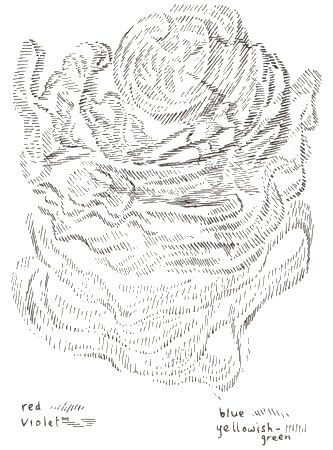
Nevertheless there is a strong resemblance between the second kind of dream and imaginative experience when first acquired through soul exercises. We experience pictures, mighty pictures — and this in all clarity, we might say exactness. We experience a universe of pictures, so wonderful, so rich in colour, so majestic that we have nothing else in our consciousness. If we would paint these pictures, we should have to paint a mighty tableau; but we could only capture the appearance of a single moment just as we cannot paint a flash of lightning, but only its momentary appearance, for all this takes its course in time. Still, if we only arrest a single moment we obtain a mighty picture.

Let us represent this diagrammatically. Naturally, this will not be very like what we behold; nevertheless, this sketch will illustrate what I mean.

Look at this sketch I have drawn. It has an inner configuration and includes the most varied forms. It is inwardly and outwardly immense. If, now, we become stronger and stronger in concentrating, in holding fast the picture, it does not merely come before us for one moment. We must seize it with presence of mind; otherwise it eludes us before we can bring it into the present moment. Altogether, presence of mind is required in spiritual observation. If we are not only able to apply sufficient presence of mind in order to seize and become conscious of it at all, but can retain it, it contracts and, instead of being something all-enibracing, becomes smaller and smaller, moving onward in time. It suddenly shrinks into something; one part becomes the human head, another the human lung, a third the human liver. The physical matter provided by the mother's body only fills out what enters from the spiritual world and becomes man. At length we say: what the liver is we now see spiritually in a mighty picture in the pre-earthly life. The same is true of the lung. And now we may compare it with the content of the second kind of dream. Here, too, an organ may appear to us in a beautiful picture, as I said before, but this is very poor compared to what imagination reveals.


Thus we gain the impression that imagination gives us some-thing created by a great master-hand, the dream something clumsy. But they both point in the same direction and represent, spiritually, man's internal organisation.

It is but a step from this to another and very true idea. When, through imagination, we discern the pre-earthly human being as a mighty etheric picture, and see this mighty etheric picture crystallise — as it were — into the physical man, we are led to ask what would happen if the dream-pictures, those relating to the inner organs, began to develop the same activity. We find that a caricature of the inner organs would arise. The human liver, so perfect in its way, is formed from an imaginative picture that points to the pre-earthly life. If the dream-picture were to become a liver, this would not be a human liver, not even a goose-liver, but a caricature of a liver. This gives us, in fact, deep insight into the whole being of man. For there is really some similarity between the dream-picture and the imaginative picture, as we now see quite clearly. And we cannot help asking how this comes about.

Well, we can go still further. Take the dream pictures of the first kind, those linked to outer-experiences. To begin with, there is nothing resembling these in imaginative cognition. But imaginative cognition reaches back to a pre-earthly experience of man's, in which he had nothing to do with other physical human beings. Imaginative vision leads to an image of pre-earthly experiences of the spirit. Just think what this implies.

When we look into man's inner life we receive the impression that certain symbolic pictures, whether they arise through imagination or in dreams [of the second kind], refer to what is within man, man's internal organisation; on the other hand, the imaginations which refer to outer experiences are connected, neither with man's internal organisation nor with outer life, but with experiences of his pre-earthly state. Beside these imaginations one can only place dream experiences of the first kind, those relating to external experiences of earthly life; but there is no inner connection here between these imaginations and these dreams. Such a connection only exists for dreams of the second kind.

Now, what do I intend by all these descriptions? I want to draw your attention to an intimate way of studying human life, a way that propounds real riddles. Man really observes life in a most superficial manner today. If he would study it more exactly, more intimately, he would notice the things I have spoken about in this lecture. In a certain sense, however, he does notice them; only, he does not actually know it. He is not really aware how strongly his dreams influence his life. He regards a dream as a flitting phantom, for he does not know that his ego is active in one kind of dream, his astral body in another. But if we seek to grasp still deeper phenomena of life, the riddles to which I referred become more insistent. Those who have been here some time will have already heard me relate such facts as the following: There is a pathological condition in which a person loses his connection with his life in memory. I have mentioned the case of an acquaintance of mine who one day, without his conscious knowledge, left his home and family, went to the station, bought a ticket and travelled, like a sleep-walker, to another station. Here he changed, bought another ticket and travelled further. He did this for a long time. He commenced his journey at a town in South Germany. It was found later, when the case was investigated, that he had been in Budapest, Lemberg (Poland), etc. At last, as his consciousness began to function again, he found himself in a casual ward in Berlin, where he had finally landed. Some weeks had passed before his arrival at the shelter, and these were quite obliterated from his consciousness. He remembered the last thing he had done at home; the rest was obliterated. It was necessary to trace his journey by external inquiries.

You see, his ego was not present in what he was doing. If you study the literature of this subject you will find hundreds and hundreds of cases of such intermittent ego-consciousness. What have we here? If you took trouble to study the dream-world of such a patient you would discover something peculiar. To begin with, you would find that, at least at certain periods of his life, the patient had had the most vivid dreams imaginable, dreams that were especially characterised by his making up his mind to do something, forming certain intentions.

Now, if you study the dreams of a normal person you will find intentions playing a very small part, if any. People dream all sorts of wonderful things, but intentions play no part, as a rule. When intentions do play a part in a dream, we usually wake up laughing at ourselves for entertaining them. But if you study the dream-life of such people with intermittent consciousness, you will find that they entertain intentions in their dreams and, on waking, take these very seriously; indeed, they take these so seriously that they feel pangs of conscience if unable to carry them out. Often these intentions are so foolish in the face of the external physical world that it is not possible to carry them out; this hurts such people and makes them quite excited. To take dreams seriously — especially in regard to their intentions (not wishes) — is the counterpart of this condition of obliterated consciousness.

One who is able to observe human beings can tell, in certain circumstances, whether a person is liable to suffer in this way. Such people have something which shows they never quite wake up in regard to certain inner and outer experiences. One gradually finds that such a person goes too far with his ego out of his physical and etheric bodies in sleep; every night he goes too far into the spiritual and cannot carry back into the physical and etheric bodies what he has experienced. At last, because he has so often not brought it completely back, it holds him outside — i.e. what he experiences too deeply within the spiritual holds the ego back and he passes into a condition in which the ego is not in the physical body.

In such a radical case as this it is especially interesting to observe the dream-life. This differs from the dream-life of our ordinary contemporaries; it is much more interesting, but of course this has its reverse side. Still, objectively considered, illness is more interesting than health; from the subjective side — i.e. for the person concerned, as well as from the point of view of ordinary life, it is another matter. For a knowledge of the human being the dream-life of such a patient is really much more interesting than the dream-life of an ordinary contemporary.

In such a case you actually see a kind of connection between the ego and the whole dream-world; one might say, it is almost tangible. And we are led to ask the following questions: What is the relation of the dream pictures that refer to internal organs, to the imaginations that also refer to internal organs?

Well, viewed ‘externally’, the pictures of man's inner organisation that are given in imagination, point to what was within man before he had his earthly body, before he was on the earth; the dream-pictures arise when once he is here. The imaginations point to the past, the dream-pictures to the present. But though an ordinary dream-picture that refers to an internal organ would correspond to a caricature of that organ, while the imagination would correspond to the perfect organ, nevertheless the caricature has the inherent possibility of growing into a perfect organ.

This leads us to the studies we shall be pursuing tomorrow. They centre in the question: Does the content of such an imagination relate to man's past life, and is the dream the beginning of the imagination of the future? Will a dream-picture of today evolve into the imagination to which we shall be able to look back in a future life on earth? Is the content of the dream perhaps the seed of the content of the imagination?

This significant question presents itself to us. What we have gained through a study of dreams is here seen in conjunction with the question of man's repeated lives on earth. You see, moreover, that we must really look more deeply into the life of man than we usually find convenient; otherwise we shall find no point of contact with what the Science of Initiation says about the being of man.

By such a lecture as this I wanted especially to awaken in you some idea of the superficial way man is studied in the civilisation of today, and of the need of intimate observation in all directions. Such intimate observation leads at once to Spiritual Science.


Source: https://wn.rsarchive.org/Lectures/GA/GA0234/19240208p01.html

Image: Thank you, Chris Manvell!