The Goal of Yoga: Union with the Spirit of Jesus Christ Through the Etherization of the Blood
Rudolf Steiner, October 1, 1911:
Wherever we, as human beings, have striven for knowledge, whether as mystics or realists or in any way at all, the acquisition of self-knowledge has been demanded of us. But as has been repeatedly emphasized on other occasions, self-knowledge is by no means as easy to achieve as many people believe — anthroposophists sometimes among them. The anthroposophist should be constantly aware of the hindrances he will encounter in his efforts. But the acquisition of self-knowledge is absolutely essential if we are to reach a worthy goal in world-existence and if our actions are to be worthy of us as members of humanity.
Let us ask ourselves the question: Why is the achievement of self-knowledge so difficult? Man is very a complicated being. If we mean to speak truly of his inner life, his life of soul, we shall not begin by regarding it as something simple and elementary. We shall rather have the patience and perseverance, the will, to penetrate more deeply into the marvellous creation of the Divine-Spiritual Powers known to us as Man.
Before we investigate the nature of self-knowledge, two aspects of the life of the human soul may present themselves to us. Just as the magnet has North and South poles, just as light and darkness are present in the world, so there are two poles in man's life of soul. These two poles become evident when we observe a person placed in two contrasting situations. Suppose we are watching someone who is entirely absorbed in the contemplation of some strikingly beautiful and impressive natural phenomenon. We see how still he is standing, moving neither hand nor foot, never turning his eyes away from the spectacle presented to him, and we are aware that inwardly he is picturing his environment. That is one situation. Another is the following: a man is walking along the street and feels that someone has insulted him. Without thinking, he is roused to anger and gives vent to it by striking the person who insulted him. We are there witnessing a manifestation of forces springing from anger, a manifestation of impulses of will, and it is easy to imagine that if the action had been preceded by thought no blow need have been struck.
We have now pictured two contrasting situations: in the one there is only ideation, a process in the life of thought from which all conscious will is absent; in the other there is no thought, no ideation, and immediate expression is given to an impulse of will. Here we have examples of the two extremes of human behavior. The first pole is complete surrender to contemplation, to thought, in which the will has no part; the second pole is the impelling force of will without thought. These facts are revealed simply by observation of external life.
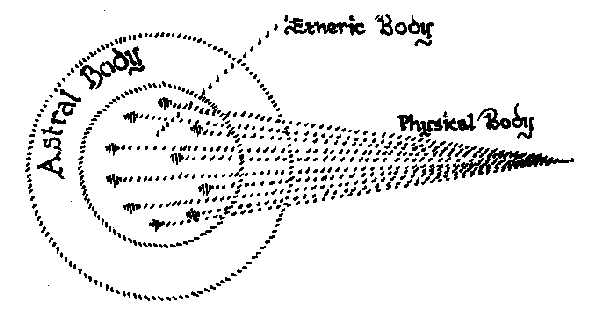
We can go into these things more deeply and we come then into spheres in which we can find our bearings only by summoning the findings of occult investigation to our aid. Here another polarity confronts us — that of sleeping and waking. From the elementary concepts of Anthroposophy we know that in waking life the four members of a man's being — physical body, etheric body, astral body, and ego — are organically and actively interwoven, but that in sleep the physical and etheric bodies remain in bed, while the astral body and ego are outpoured into the great world bordering on physical existence. These facts could also be approached from a different point of view. We might ask: what is there to be said about ideation, contemplation, thinking — and about the will and its impulses on the one hand during waking life and during sleep on the other?
When we penetrate more deeply into this question it becomes evident that in his present physical existence man is, in a certain sense, always asleep, Only there is a difference between sleep during the night and sleep during the day. Of this we can be convinced in a purely external way, for we know that we can wake in the occult sense during the day, that is to say, one can become clairvoyant and see into the spiritual world. The physical body in its ordinary state is asleep to what is then and there happening and we can rightly speak of an awakening of our spiritual senses. In the night, of course, we are asleep in the normal way. It can therefore be said: ordinary sleep is sleep as regards the outer physical world; daytime consciousness at the present time is sleep as regards the spiritual world.
These facts can be considered in yet another light. On deeper scrutiny we realize that in the ordinary waking condition of physical life, man has, as a rule, very little power or control over his will and its impulses. The will is very detached from daily life. Only consider how little of all you do from morning to evening is really the outcome of your own thinking, of your personal resolutions. When someone knocks at the door and you say “Come in!”, that cannot be called a decision of your own thinking and will. If you are hungry and seat yourself at a table, that cannot be called a decision made by the will, because it is occasioned by your circumstances, by the needs of your organism. Try to picture your daily life and you will find how little the will is directly influenced from the center of your being. Why is this the case? Occultism shows us that in respect of his will man actually sleeps by day, that is to say he is not in the real sense present in his will-impulses at all. We may evolve better and better concepts and ideas; or we may become more highly moral, more cultured individuals, but we can do nothing as regards the will. By cultivating better thoughts we can work indirectly upon the will but as far as life is concerned we can do nothing directly to it, for in the waking life of day, our will is influenced only in an indirect way, namely through sleep. When we are asleep we do not think; ideation passes over into a state of sleep. The will, however, awakes, permeates our organism from outside, and invigorates it. We feel strengthened in the morning because what has penetrated into our organism is of the nature of will. That we are not aware of this activity of the will becomes comprehensible when we remember that all conceptual activity ceases when we ourselves are asleep. To begin with, therefore, this stimulus shall be given for further contemplation, further meditation. The more progress you make in self-knowledge, the more you will find confirmation of the truth of the words that man sleeps in respect of his will when he is awake and sleeps in respect of his conceptual life when he is asleep. The life of will sleeps by day; the life of thought sleeps by night.
Man is unaware that the will does not sleep during the night because he only knows how to be awake in his life of thought. The will does not sleep during the night but it then works as it were in a fiery element, works upon his body in order to restore what has been used up by day.
Thus there are two poles in man: the life of observation and ideation, and the impulses of will; and man is related in entirely opposite ways to these two poles. The whole life of soul moves in various nuances between these two poles, and we shall come nearer to understanding it by bringing this microcosmic life of soul into relation with the higher worlds.
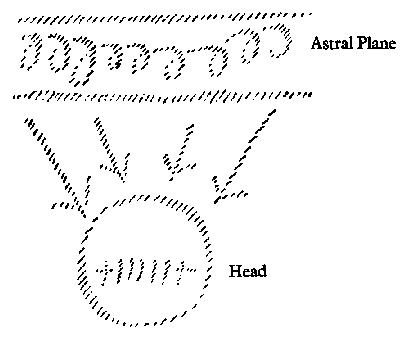
From what has been said we have learnt that the life of thought and ideation is one of the poles of man's life of soul. This life of thought is something which seems unreal to materialistically minded people. Do we not often hear it said: “Oh, ideas and thoughts are only ideas and thoughts!” This is intended to imply that if someone has a piece of bread or meat in his hand it is a reality because it can be eaten, but a thought is only a thought, it is not a reality. Why is this said? It is because what man calls his thoughts are related to what thoughts really are as a shadow-image is to the actual thing. The shadow-image of a flower points you to the flower itself, to the reality. So it is with thoughts. Human thinking is the shadowing forth of ideas and beings belonging to a higher world, the world we call the Astral plane. And you represent thinking rightly to yourself when you picture the human head thus — it is not absolutely correct but simply diagrammatic. In the head are thoughts but these thoughts must be pictured as living beings on the Astral plane. Beings of the most varied kinds are at work there in the form of teeming concepts and activities which cast their shadow-images into men, and these processes are reflected in the human head as thinking.
As well as the life of thought in the human soul, there is also the life of feeling. Feelings fall into two categories: those of pleasure and sympathy, and those of displeasure and antipathy. The former are aroused by good deeds, benevolent deeds; antipathy is aroused by evil, malevolent deeds. Here there is something more than and different from the mere forming of concepts. We form concepts of things irrespectively of any other factor. But our soul experiences sympathy or antipathy only in respect of what is beautiful and good, or what is ugly and evil. Just as everything that takes place in man in the form of thoughts points to the Astral plane, so everything connected with sympathy or antipathy points to the realm we call Lower Devachan. Processes in the Heavenly World, or Devachan, are projected, mainly into our breast, as feelings of sympathy or antipathy for what is beautiful or ugly, for what is good or evil. So that in our feelings for the moral-aesthetic element, we bear within our souls shadow-reflections of the Heavenly World or Lower Devachan.
There is still a third province in the life of the human soul, which must be strictly distinguished from the mere preference for good deeds. There is a difference between standing by and taking pleasure in witnessing some kindly deed and setting the will in action and actually performing some such deed. I will call pleasure in good deeds or displeasure in evil deeds the aesthetic element as against the moral element that impels a man to perform some good deed. The moral element is at a higher level than the purely aesthetic; mere pleasure or displeasure is at a lower level than the will to do something good or bad. In so far as our soul feels constrained to give expression to moral impulses, these impulses are the shadow-images of Higher Devachan, of the Higher Heavenly World.
It is easy to picture these three stages of activity of the human soul — the purely intellectual (thoughts, concepts), the aesthetic (pleasure or displeasure), and the moral (revealed in impulses to good or bad deeds) — as microcosmic images of the three realms which in the Macrocosm, the great Universe, lie one above the other. The Astral world is reflected in the world of thought; the Devachanic world is reflected in the aesthetic sphere of pleasure and displeasure; and the Higher Devachanic world is reflected as morality.
Thoughts: Shadow-images of Beings of the Astral Plane (Waking)
Sympathy and Antipathy: Shadow-images of Beings of Lower Devachan (Dreaming)
Moral Impulses: Shadow-images of Beings of Higher Devachan (Sleeping)
If we connect this with what was said previously concerning the two poles of the soul-life, we shall take the pole of intellect to be that which dominates the waking life, the life in which man is mentally awake. During the day he is awake in respect of his intellect; during sleep he is awake in respect of his will. It is because at night he is asleep in respect of intellect that he is unaware of what he is happening with his will. The truth is that what we call moral principles, moral impulses, are working indirectly into the will. And in point of fact man needs the life of sleep in order that the moral impulses he takes into himself through the life of thought can become active and effective. In his ordinary life today man is capable of accomplishing what is right only on the plane of intellect; he is less able to accomplish anything on the moral plane, for there he is dependent upon help coming from the Macrocosm.
What is already within us can bring about the further development of intellectuality, but the Gods must come to our aid if we are to acquire greater moral strength. We go to sleep in order that we may plunge into the Divine Will where the intellect does not intervene and where Divine Forces transform into the power of will the moral principles we accept, where they instill into our will that which we could otherwise receive only into our thoughts.
Between these two poles, that of the will which wakes by night and of the intellect which is awake by day, lies the sphere of aesthetic appreciation which is continuously present in man. During the day man is not fully awake — at least only the most prosaic, pedantic individuals are always fully awake in waking life. We must always be able to dream a little even by day when we are awake; we must be able to give ourselves up to the enjoyment art, of poetry, or of some other activity that is not concerned wholly with crass reality. Those who can give themselves up in this way form a connection with something that can enliven and invigorate the whole of existence. To give oneself up to such imaginings is like a dream making its way into waking life. Into the life of sleep you know well that dreams enter; these dreams in the usual sense, dreams which permeate sleep-consciousness. Human beings need also to dream by day if they do not wish to lead an arid, empty, unhealthy waking life. Dreaming takes place during sleep at night in any case and no proof of this is required. Midway between the two poles of night dreaming and day dreaming is the condition that can come to expression in fantasy.
So here again there is a threefold life of soul. The intellectual element in which we are really awake brings us shadow-images of the Astral Plane when by day we give ourselves up to a thought — wherein the most fruitful ideas for daily life and great inventions originate. Then during sleep, when we dream, these dreams play into our life of sleep and shadow-images from Lower Devachan are reflected into us. And when we work actively during sleep, impressing morality into our will — we cannot be aware of this actual process but certainly we can of its effects — when we are able to imbue our life of thoughts during the night with the influence of Divine Spiritual Powers, then the impulses we receive are reflections from Higher Devachan, the Higher Heavenly World. These reflections are the moral impulses and feelings which are active within us and lead to the recognition that human life is vindicated only when we place our thoughts at the service of the good and the beautiful, when we allow the very heart's blood of Divine Spiritual life to stream through our intellectual activities, permeating them with moral impulses.
The life of the human soul as presented here, first from external, exoteric observation and then from observation of a more mystical character, is revealed by deeper (occult) investigation. The processes that have been described in their more external aspect can also be perceived in man through clairvoyance. When a man stands in front of us today in his waking state and we observe him with the eye of clairvoyance, certain rays of light are seen streaming continually from the heart towards the head. Within the head these rays play around the organ known in anatomy as the pineal gland. These streamings arise because human blood, which is a physical substance, is perpetually resolving itself into etheric substance. In the region of the heart there is a continual transformation of the blood into this delicate etheric substance which streams upwards towards the head and glimmers around the pineal gland. This process — the etherization of the blood — can be perceived in the human being all the time during his waking life.
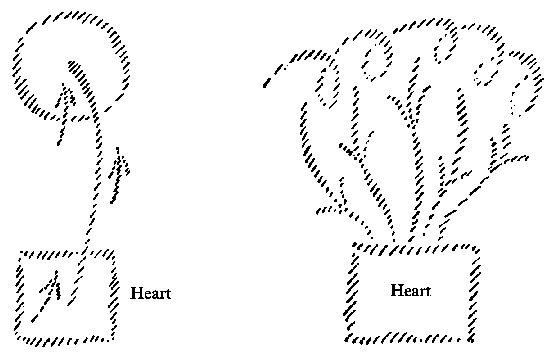
The occult observer is able to see a continual streaming from outside into the brain, and also in the reverse direction, from the brain to the heart. Now these streams, which in sleeping man come from outside, from cosmic space, from the Macrocosm, and flow into the inner constitution of the physical body and etheric bodies lying in the bed, reveal something remarkable when they are investigated. These rays vary greatly in different individuals. Sleeping human beings differ very drastically from one another, and if those who are a little vain only knew how badly they betray themselves to occult observation when they go to sleep during public gatherings, they would try their level best not to let this happen!
Moral qualities are revealed distinctly in the particular coloring of the streams which flow into human beings during sleep; in an individual of lower moral principles, the streams are quite different from what is observable in an individual of noble principles. Endeavors to dissemble are useless. In the face of the higher Cosmic Powers, no dissembling is possible. In the case of a man who has only a slight inclination towards moral principles the rays streaming into him are a brownish red in colour — various shades tending toward brownish red. In a man of high moral ideals the rays are lilac-violet in colour. At the moment of waking or of going off to sleep a kind of struggle takes place in the region of the pineal gland between what streams down from above and what streams upward from below. When a man is awake the intellectual element streams upwards from below in the form of currents of light, and what is of moral-aesthetic nature streams downwards from above. At the moment of waking or of going off to sleep, these two currents meet, and in the man of low morality a violent struggle between the two streams takes place in the region of the pineal gland. In the man of high morality there is around the pineal gland as it were a little sea of light. Moral nobility is revealed when a calm glow surrounds the pineal gland at these moments. In this way a man's moral disposition is reflected in him, and this calm glow of light often extends as far as the heart. Two streams can therefore be perceived in man — the one Macrocosmic, the other, Microcosmic.
To estimate the significance of how these two streams meet in man is possible only by considering on the one hand what was said previously in a more external way about the life of the soul and how this life reveals the threefold polarity of the intellectual, the aesthetic, and the moral elements that stream downwards from above, from the brain toward the heart; and if, on the other hand, we grasp the significance of what was said about turning our attention to the corresponding phenomenon in the Macrocosm. This corresponding phenomenon can be described today as the result of the most scrupulously careful occult investigation of recent years, undertaken by individuals among genuine Rosicrucians. These investigations have shown that something similar to what has been described in connection with the Microcosm also takes place in the Macrocosm. You will understand this more fully as time goes on.
Just as in the region of the human heart the blood is continually being transformed into etheric substance, a similar process takes place in the Macrocosm. We understand this when we turn our minds to the Mystery of Golgotha — to the moment when the blood flowed from the wounds of Jesus Christ.
This blood must not be regarded simply as chemical substance, but by reason of all that has been said concerning the nature of Jesus of Nazareth it must be recognized as something altogether unique. When it flowed from His wounds, a substance was imparted to our Earth, which in uniting with it, constituted an Event of the greatest possible significance for all future ages of the Earth's evolution — and it could take place only once. What came of this blood in the ages that followed? Nothing different from what otherwise takes place in the heart of man. In the course of Earth evolution this blood passes through a process of “etherization.” And just as our human blood streams upwards from the heart as ether, so since the Mystery of Golgotha the etherized blood of Christ Jesus has been present in the ether of the Earth. The etheric body of the Earth is permeated by the blood — now transformed — which flowed on Golgotha. This is supremely important. If what has thus come to pass through Christ Jesus had not taken place, man's condition on the Earth could only have been as previously described. But since the Mystery of Golgotha it has always been possibe for the etheric blood of Christ to flow together with the streamings from below upward, from heart to head.
Because the etherized blood of Jesus of Nazareth is present in the etheric body of the Earth, it accompanies the etherized human blood streaming upwards from the heart to the brain, so that not only those streams of which I spoke earlier meet in man, but the human bloodstream unites with the bloodstream of Christ Jesus. A union of these two streams can, however, come about only if a person is able to unfold true understanding of what is contained in the Christ Impulse. Otherwise there can be no union; the two streams then mutually repel each other, thrust each other away.
In every epoch of Earth evolution understanding must be acquired in the form suitable for that epoch. At the time when Christ Jesus lived on Earth, preceding events were rightly understood by those who came to His forerunner, John, and were baptized by him according to the rite described in the Gospels. They received baptism in order that their sin, that is to say, the karma of their previous lives — karma which had come to an end — might be changed; and in order that they might realize that the most powerful Impulse in Earth evolution was about to descend into a physical body. But the evolution of humanity progresses and in our present age what matters is that people should recognize the need for the knowledge contained in Spiritual Science and be able so to fire the streams flowing from heart to brain that this knowledge can be understood.
If this comes to pass, individuals will be able to receive and comprehend the event that has its beginning in the Twentieth Century: this event is the appearance of the Christ as an Etheric Being, in contradistinction to the Physical Christ of Palestine. For we have now reached the point of time when the Etheric Christ enters into the life of the Earth and will become visible — at first to a small number of individuals through a form of natural clairvoyance. Then in the course of the next three thousand years, He will become visible to greater and greater numbers of people. This will inevitably come to pass in the natural course of development. That it will come to pass is as true as were the achievements of electricity in the nineteenth century. A number of individuals will see the Etheric Christ and will themselves experience the event that took place at Damascus. But this will depend upon such men learning to be alert to the moment when Christ draws near to them.
In only a few decades from now it will happen, particularly to those who are young — already preparation is being made for this — that some individual here or there has certain experiences. If he has sharpened his vision through having assimilated Anthroposophy, he may become aware that suddenly someone has come near to help him, to make him alert to this or that. The truth is that Christ has come to him, although he believes that what he saw is a physical man. He will come to realize that what he saw was a supersensible being, because it immediately vanishes.
Many a human being will have this experience when sitting silent in his room, heavy-hearted and oppressed, not knowing which way to turn. The door will open, and the etheric Christ will appear and speak words of consolation to him. The Christ will become a living Comforter to men.
However strange it may as yet seem, it is true nevertheless that many a time when people — even in considerable numbers — are sitting together, not knowing what to do, and waiting, they will see the Etheric Christ. He will Himself be there, will confer with them, will make His voice heard in such gatherings. These times are approaching, and the positive, constructive element now described will take real effect in the evolution of mankind.
No word shall be said here against the great advances made by culture in our day; these achievements are essential for the welfare and the freedom of men. But whatever can be gained in the way of outer progress in mastering the forces of nature is something small and insignificant compared with the blessing bestowed upon the individual who experiences the awakening soul through Christ, the Christ who will now be operative in human culture and its concerns. Men will thereby acquire forces that make for unification. In very truth Christ brings constructive forces into human culture and civilization.
If we look into early post-Atlantean times, we would find that men built their dwelling places by methods very different from those used in modern life. In those days they made use of all kinds of growing things. Even when building palaces they summoned nature to their aid by utilizing plants interlaced with branches of trees and so on, whereas today men must build with broken fragments. All the culture of the external world is contrived with the aid of products of fragmentation. And in the course of the coming years you will realize even more clearly how much in our civilized life is the outcome of destruction.
Light itself is being destroyed in this post-Atlantean age of the Earth's existence, which until the time of Atlantis was a progressive process. Since then it has been a process of decay. What is light? Light decays, and the decaying light is electricity. What we know as electricity is light that is being destroyed in matter.
And the chemical force that undergoes a transformation in the process of Earth evolution is magnetism.
Yet a third force will become active; and if electricity seems to work wonders today, this third force will affect civilization in a still more miraculous way. The more of this force we employ, the faster the Earth will tend to become a corpse and its spiritual part prepare for the Jupiter embodiment. Forces have to be applied for the purpose of destruction, in order that man may become free of the Earth and that the Earth's body may fall away.
As long as the Earth was involved in progressive evolution, no such destruction took place, for the great achievements of electricity can only serve a decaying Earth. Strange as this sounds, it must gradually become known. By understanding the process of evolution we shall learn to assess our culture at its true value. We shall also learn that it is necessary for the Earth to be destroyed, for otherwise the spiritual could not become free. We shall also learn to value what is positive, namely the penetration of spiritual forces into our existence on Earth.
Thus we realize what a tremendous advance was signified by the fact that Christ lived for three years on the Earth in a human body specially prepared in order that He might be visible to physical eyes. Through what came to pass during those three years men have been made ready to behold the Christ who will move among them in an etheric body, who will participate in earthly life as truly and effectively as did the Physical Christ in Palestine.
If men observe such happenings with undimmed senses they will know that there is an etheric body that will move about in the physical world, but is the only etheric body able to work in the physical world as a human physical body works. It will differ from a physical body in this respect only, that it can be in two, three, nay even in a hundred, a thousand places at the same time. This is possible only for an etheric, not for a physical form.
What will be accomplished in humanity through this further advance is that the two poles of which I have spoken, the intellectual and the moral, will more and more become one; they will merge into unity. This will come about because in the course of the next millennia men will become aware of the presence of the Etheric Christ in the world; more and more they will be influenced in waking life too by the direct working of the Good from the spiritual world. Whereas at the present time the will is asleep by day, and man is only able to influence it indirectly through thought, in the course of the next millennia, through the power which from our time onwards is working in us under the aegis of Christ, it will come about that the deeds of men in waking consciousness too can be directly productive of Good.
The dream of Socrates, that virtue can be taught, will come true; more and more it will be possible on Earth not only for the intellect to be stimulated and energized by this teaching but for moral impulses to be spread abroad. Schopenhauer said “To preach morality is easy; to establish it is very difficult.” Why is this? Because no morality has yet been spread by preaching. It is quite possible to recognize moral principles and yet not abide by them. For most people the Pauline saying holds good, that the spirit is willing but the flesh is weak. This will change, because the moral fire streaming from the figure of Christ will intensify recognition of the need for moral impulses. Man will transform the Earth by feeling with ever-increasing strength that morality is an essential part of it. In the future, to be immoral will be possible only for individuals who are goaded in this direction, who are possessed by evil demons, by Ahrimanic, Asuric Powers — and moreover aspire to be so.
In time to come there will be on Earth a sufficient number of individuals who teach morality and at the same time sustain its principles; but there will also be those who by their own free decision surrender themselves to the evil Powers and thus enable an excess of evil to be pitted against a good humanity. Nobody will be forced to do this; it will lie in the free will of each individual.
Then will come the epoch when the Earth passes into conditions of which, as in so much else, Oriental Occultism and Mysticism alone give some idea. The moral atmosphere will by then have gathered strength. For many thousands of years Oriental Mysticism has spoken of this epoch, and since the coming of Gautama Buddha it has spoken with special emphasis about that future condition when the Earth will be bathed in a “moral-ether-atmosphere.” Ever since the time of the ancient Rishis it was the great hope of Oriental Mysticism that this moral impulse would come to the Earth from Vishva-Karman or, as Zarathustra proclaimed, from Ahura Mazdao. Thus Oriental Mysticism foresaw that this moral impulse, this moral atmosphere, would come to the Earth from the Being we call the Christ. And it was upon Him, upon Christ, that the hopes of Oriental Mysticism were set.
Oriental Mysticism was able to picture the consequences of that event but not the actual form it would take. The mind could picture that within a period of 5,000 years after the great Buddha achieved Enlightenment, pure Akashic forms, bathed in fire, lit by the Sun, would appear in the wake of One beyond the ken of Oriental Mysticism. A wonderful picture in very truth: that something would happen to make it possible for the Sons of Fire and of Light to move about the Earth, not in physical embodiment but as pure Akashic forms within the Earth's moral atmosphere. But then, so it was said, in 5,000 years after Gautama Buddha's Enlightenment, the Teacher will also be there to make known to men what is the nature of these wonderful forms of pure Fire and Light. This teacher — the Maitreya Buddha — will appear 3,000 years after our present era and will speak of the Christ Impulse.
Thus Oriental Mysticism unites with the Christian knowledge of the West to form a wonderfully beautiful unity. It is also disclosed that he who will appear three thousand years after our era as the Maitreya Buddha will have incarnated again and again on the Earth as a Bodhisattva, as the successor of Gautama Buddha. One of his incarnations was that of Jeshu ben Pandira, who lived a hundred years before the Christian era. The being who incarnated in Jeshu ben Pandira is he who will one day become the Maitreya Buddha, and who from century to century returns ever and again in a body of flesh, not yet as Buddha, but as Bodhisattva. Even now there proceeds from him who later on will be the Maitreya Buddha the most significant teachings concerning the Christ Being and the Sons of Fire — the Agnishvattas — of Indian Mysticism.
The indications by which the Being who is to become the Maitreya Buddha can be recognized are common to all genuine Eastern mysticism and to Christian gnosis. The Maitreya Buddha, who in contrast to the Sons of Fire will appear in a physical body as Bodhisattva, can be recognized by the fact that in the first instance his early development gives no intimation of the nature of the individuality within him. Only those possessed of understanding will recognize the presence of a Bodhisattva in such a human being between the ages of thirty and thirty-three, and not before. Something akin to a change of personality then takes place. The Maitreya Buddha will reveal his identity to humanity in the thirty-third year of his life. As Christ Jesus began His mission in His thirtieth year, so do the Bodhisattvas, who will continue to proclaim the Christ Impulse, reveal themselves — in the thirty-third year of their lives.
And the Maitreya Buddha himself, as transformed Bodhisattva, speaking in powerful words of which no adequate idea can be given at the present time, will proclaim the great secrets of existence. He will speak in a language that has first be created, for no human being today could formulate words such as those in which the Maitreya Buddha will address humanity. The reason why men cannot be addressed in this way at the present time is that the physical instrument for this form of speech does not yet exist. The teachings of the Enlightened One will not stream into men as teachings only, but will pour moral impulses into their souls. Words such as will then be spoken cannot yet be uttered by a physical larynx; in our time they can be present only in the spiritual worlds.
Anthroposophy is the preparation for everything that the future holds in store. Those who take the process of man's evolution seriously resolve not to allow the soul's development to come to a standstill but to ensure that this development will eventually enable the spiritual part of the Earth to become free, leaving the grosser part to fall away like a corpse — for men could frustrate the whole process. Those who desire evolution to succeed must acquire understanding of the life of the spirit through what we today call Anthroposophy. The cultivation of Anthroposophy thus becomes a duty; knowledge becomes something that we actually feel, something towards which we have responsibility. When we are inwardly aware of this responsibility and have this resolve, when the mysteries of the world arouse in us the wish to become Anthroposophists, then our feeling is true and right. But Anthroposophy must not be something that merely satisfies our curiosity; it must rather be something without which we cannot live. Only then are our feelings what they ought to be, only then do we live as building stones in that great work of construction which must be carried out in human souls and can embrace all mankind.
Anthroposophy is a revelation of world-happenings which will confront the men of the future, will confront our own souls whether still in the physical body or in the life between death and a new birth. The coming changes will affect us, no matter whether we are still living in the physical body or whether it has been laid aside. Understanding of these events must however be acquired during life in the physical body if they are to take effect after death. To those who acquire some understanding of the Christ while they are still living in the physical body, it will make no difference, when the moment comes for vision of the Christ, whether or not they have already passed through the gate of death. But if those who now reject any understanding of the Christ have already passed through the gate of death when this moment arrives, they must wait until their next incarnation, for such understanding cannot be acquired between death and rebirth. Once the foundation has been acquired, however, it endures, and then Christ becomes visible also during the period between death and the new birth.
And so Anthroposophy is not only something we learn for our physical life but is of essential value when we have laid aside the physical body at death.
This is what I wished to impart to you today as a help in answering many questions. Self-knowledge is difficult because man is such a complex being. The reason for this complexity is that he is connected with all the higher Worlds and Beings. We have within us shadow-images of the great Universe and all the members of our constitution — the physical, etheric, and astral bodies, and the ego — are worlds for Divine Beings. Our physical body, etheric body, astral body, and ego form one world; the other is the higher World, the Heaven world. Divine-spiritual Worlds are the bodily members of the Beings of the higher spheres of cosmic existence.
Man is the complex being he is because he is a mirror-image of the spiritual world. Realization of this should make him conscious of his intrinsic worth. But from the knowledge that although we are reflected images of the spiritual world we nevertheless fall far short of what we ought to be — from this knowledge we also acquire, as well as consciousness of our worth as human beings, the right attitude of modesty and humility towards the Macrocosm and its Gods.
--------------------------------------------------------------------------------
Rudolf Steiner's Answers to Questions at the End of the Lecture
Question: How are the words used by St. Paul, “to speak in tongues” (1 Cor. 12), to be understood?
Answer: In exceptional human beings it can happen that not only is the phenomenon of speaking present in the waking state, but that something otherwise present only in sleep-consciousness flows into this speaking. This is the phenomenon to which St. Paul refers. Goethe refers to it in the same sense; he has written two very interesting treatises on the subject.
Question: How are Christ's words of consolation received and experienced?
Answer: Men will feel these words of consolation as though arising in their own hearts. The experience may also seem like physical hearing.
Question: What is the relation of chemical forces and substances to the spiritual world?
Answer: There are in the world a number of substances which can combine with or separate from each other. What we call chemical action is projected into the physical world from the world of Devachan — the realm of the Harmony of the Spheres. In the combination of two substances according to their atomic weights, we have a reflection of two tones of the Harmony of the Spheres. The chemical affinity between two substances in the physical world is like a reflection from the realm of the Harmony of the Spheres. The numerical ratios in chemistry are an expression of the numerical ratios of the Harmony of the Spheres, which has become dumb and silent owing to the densification of matter. If one were able to etherealize material substance and to perceive in the atomic numbers the inner formative principle thereof, he would be hearing the Harmony of the Spheres.
We have the physical world, the astral world, the Lower Devachan, and the Higher Devachan. If the body is thrust down lower even than the physical world, it comes into the sub-physical world, the lower astral world, the lower or evil Lower Devachan, and the lower or evil Higher Devachan.
The evil astral world is the province of Lucifer, the evil Lower Devachan the province of Ahriman, and the evil Higher Devachan the province of the Asuras.
When chemical action is driven down beneath the physical plane — into the evil Devachanic world — magnetism arises.
When light is thrust down into the sub-material — that is to say, a stage deeper than the material world — electricity arises.
If what lives in the Harmony of the Spheres is thrust down farther still, into the province of the Asuras, an even more terrible force — which it will not be possible to keep hidden very much longer — is generated. It can only be hoped that when this force comes to be known — a force we must conceive as being far, far stronger than the most violent electrical discharge — it can only be hoped that before some discoverer gives this force into the hands of humankind, men will no longer have anything unmoral left in them.
Question: What is electricity?
Answer: Electricity is light in the sub-material state. Light is there compressed to the utmost degree. An inward quality too must be ascribed to light; light is itself at every point in space. Warmth will expand in the three dimensions of space. In light there is a fourth; it is of fourfold extension — it has the quality of inwardness as a fourth dimension.
Question: What happens to the Earth's corpse?
Answer: As the residue of the Moon-evolution we have our present moon which circles around the Earth. Similarly there will be a residue of the Earth which will circle around Jupiter. Then these residues will gradually dissolve into the universal ether. On Venus there will no longer be any residue. Venus will manifest, to begin with, as pure Warmth, then it will become Light, and then pass over into the spiritual world. The residue left behind by the Earth will be like a corpse. This is a path along which man must not accompany the Earth, for he would thereby be exposed to dreadful torments. But there are Beings who accompany this corpse, since they themselves will by that means develop to a higher stage.
Reflected as sub-physical world:
Astral World         the province of Lucifer
Lower Devachan       the province of Ahriman
Higher Devachan      the province of the Asuras


 Posts
Posts

