The Redemption of Astronomy:
Toward the Reunion of Natural Science and Social Science
Toward the Reunion of Natural Science and Social Science
Lecture 1 of 6.
Rudolf Steiner, Stuttgart, January 1, 1921:
My dear friends!
Today I should like to make some introductory remarks to what I am going to lay before you in the coming days. My reason for doing this is that you may know the purpose of these talks from the outset.
It will not be my task during the following days to deal with any narrowly defined, special branch of science, but to give various wider viewpoints, having in mind a quite definite goal in relation to science. I should therefore like to warn people not to describe this as an ‘Astronomical Course’. It is not meant to be that. But it will deal with something that I feel is especially important for us to consider at this time. I have therefore given it the title “The relation of the diverse branches of Natural Science to Astronomy,” and today in particular I shall explain what I actually intend with the giving of this title.
The fact is that in a comparatively short time much will have to be changed within what we call the sphere of science, if it is not to enter upon a complete decline. Certain groups of sciences which are now comprised under various headings and are permitted to be represented under these headings, in our ordinary schools, will have to be taken out their grooves and be classified from quite other aspects. This will necessitate a far reaching regrouping of our sciences. The grouping at present employed is entirely inadequate for a world-conception based upon reality, and yet our modern world holds so firmly to such traditional classification that it is on this basis that candidates are chosen to occupy the professorial chairs in our Universities. People confine themselves for the most part to dividing the existing, circumscribed fields of Natural Science into yet further special branches, and they then look to the specialists or experts as they are called. But a change must come into the whole scientific life by the advent of quite different categories, within which will be united, as in a whole new field of science, things that today are dealt with in Zoology or Physiology, or again, let us say, in the Theory of Knowledge. The older forms of scientific classification, often extremely abstract, must die out, and quite new scientific combinations must arise. This will meet with great obstacles at first, because people today are trained in the specialized branches of science and it will be difficult for them to find an approach to what they will urgently need in order to bring about a combination of scientific material in accordance with reality.
To put in concisely, I might say: We have today a science of astronomy, of Physics, of Chemistry, of Philosophy, we have a science of Biology, of Mathematics, and so on. Special branches have been formed, almost, I might say, so that the various specialists will not have such hard work in order to become well grounded in their subject. They do not have too much to do in mastering all the literature concerned, which, as we know, exists in immense quantities. But it will be a matter of creating new branches which will comprise quite different things, including perhaps at the same time something from Astronomy, something from Biology, and so on. For this, a reshaping of our whole life of science will of course be essential. Therefore, what we term Spiritual Science, which does indeed aim to be of a universal nature, must work precisely in this direction. It must make it its special mission to work in this direction. For we simply cannot get any further with the old grouping. Our Universities confront the world today, my dear friends, in a way that is really quite estranged from life. They turn out mathematicians, physiologists, philosophers, but none of them have any real relation to the world. They can do nothing but work in their narrowly confined spheres, putting before us a picture of the world that becomes more and more abstract, less and less realistic.
It is the change here indicated — a deep necessity for our time — to which I want to do justice in these lectures. I should like you to see how impossible it will be to continue the older classifications indefinitely, and I therefore want to show how other branches of science of the most varied kinds, which, in their present way of treatment, take no account of Astronomy, have indeed definite connections with Astronomy, that is, with a true knowledge of universal space. Certain astronomical facts must perforce be taken into account in other branches of science too, so that we may learn to master these other fields in a way conformable to reality.
The task of these lectures is therefore to build a bridge from the different fields of scientific thought to the field of Astronomy, that astronomical understanding may appear in the right way in the various fields of science.
In order not to be misunderstood, I should like to make one more remark about method. You see, the manner of presenting scientific facts which is customary nowadays must undergo considerable change, because it actually arises out of the scientific structure which has to be overcome. When today facts are referred to, which lie somewhat remote from man's understanding, — remote, just because he does not meet with them at all in his scientific knowledge, — it is usual to say: “That is stated, but no proved.” Yet in scientific work is often quite inevitable that statements must be made at first purely as results of observation, which only afterwards can be verified as more and more facts are brought to support them. So it would be wrong to assume, for instance, that right at the beginning of a discourse someone could break in and say, “That is not proved.” It will be proved in the course of time, but much will first have to be presented simply from observation, so that the right concept, the right idea, may be created.
And so I beg of you to take these lectures as a whole, and to look in the last lectures for the plain proof of many things which seem in the first lectures to be mere statements. Many things will then be verified which I shall have to handle at first in such a way as to evoke the necessary concepts and ideas.
Astronomy as we know it today, even including the domain of Astrophysics, is fundamentally a modern creation. Before the time of Copernicus or Galileo men thought about astronomical phenomena in a way which differed essentially from the way we think today. It is even extraordinarily difficult to indicate the way in which man still thought of Astronomy in, say, the 13th and 14th centuries, because this way of thinking has become completely foreign to modern man. We only live in the ideas which have been formed since the time of Galileo, Kepler, Copernicus; and from a certain point of view that is perfectly right. They are ideas which treat of the distant phenomena of universal space, in so far as they are concerned with Astronomy, in a mathematical and mechanical way. Men think of these phenomena in terms of mathematics and mechanics. In observing the phenomena, men base their ideas upon what they have acquired from an abstract mathematical science, or an abstract science of mechanics. They calculate distances, movements and forces. But the qualitative outlook still in existence in the 13th and 14th centuries, which distinguished Individualities in the stars, an Individuality of Jupiter, of Saturn ... this has become completely lost to modern man. I will make no criticism of the things at the moment, but will only point out that the mechanical and mathematical way of treating what we call the domain of Astronomy has become the exclusive one. Even if we acquaint ourselves with the stars in a popular fashion without understanding mathematics or mechanics, we still find it presented, even if in a manner suitable for the lay-mind, entirely in ideas of space and time, of a mathematical and mechanical kind. No doubts of any kind exist in the minds of our contemporaries — who believe that their judgment is authoritative — that this is the only way in which to regard the starry heavens. Anything else, they are convinced, would be merely amateurish.
Now, if the question arises as to how it has actually come about that this view of the starry heavens has emerged in the evolution of civilization, the answer of those who regard the modern scientific mode of thought as absolute, will be different from the reply which we are able to give. Those who regard the scientific thought of today as something absolute and true, will say: Well, you know, among earlier humanity there were not yet any strictly scientifically formed ideas; man had first to struggle through to such ideas, i. e., to the mathematical, mechanical mode of regarding celestial phenomena of the Universe, a later humanity has worked through to a strictly scientific comprehension of what does actually correspond to reality.
This is an answer that we cannot give, my dear friends. We must take up our position from the standpoint of the evolution of humanity, which in the course of its existence, has introduced various inner forces into its consciousness. We must say to ourselves: The manner of observing the celestial phenomena which existed among the ancient Babylonians, the Egyptians, perhaps even the Indian people, was due to the particular form which the development of the human soul-forces was taking in those times. Those human soul-forces had to be developed with the same inner necessity with which a child between the 10th and 15th year must develop certain soul-forces, while in another period it will developing other faculties, which lead it to different conclusions about the world. Then came the Ptolemaic system. That arose out of different soul-forces. Then our Copernican system. That arose from yet other soul-forces. The Copernican system did not develop because humanity had happily struggled through to objectivity, whereas before they had all been as children, but because humanity since the middle of the 15th century needed precisely the mathematical, mechanical faculties for its development. That is why modern man sees the celestial phenomena in the picture formed by the mathematical, mechanical faculties. And he will some day see them again in a different way, when in his development he has drawn up out of the depths of the soul other forces, — to his own healing and benefit. Thus it depends upon humanity what form the world-concept takes. But it is not a question of looking back in pride to earlier times when men were “more childlike,” and then thinking that in modern times we have at last struggled through to an objective understanding which can now endure for all future ages.
There is something which has become a real necessity to later humanity and has given color to the requirements of the scientific mind. It is this: Men strive on the one hand for ideas that are clear and easy to control — namely, mathematical ideas — , and on the other hand they strive for ideas through which they can surrender most strongly to an inner compulsion. The modern man at once becomes uncertain and nervous when he does not feel the strong inner compulsion presented, for instance, by the argument of the Pythagorean theorem, but realizes, let us say, that the figure which is drawn does not decide for him, but that he must develop an activity of soul and decide for himself. Then he at once becomes uncertain and nervous and is no longer willing to continue the line of thought. So he says: That is not exact science; subjectivity comes into it. Modern man is really dreadfully passive; he would like to be led everywhere by a chain of infallible arguments and conclusions. Mathematics satisfies this requirement, at least in most cases; and where it does not, where man have interposed their own opinion in recent times, — well, my dear friends, the results are according! Men still believe that they are being exact, while they hit upon the most incredible ideas.
Thus in mathematics and mechanics men think they are being led forward by leading-strings of concepts which are linked together through their own inherent logic. They feel then as if they had ground under their feet, but the moment they step off it they do not want to go on any further. Concepts which are easy to grasp on the one hand, and the element of inner compulsion on the other: this is what modern man needs for his “safety.” Fundamentally, it is on this basis that the particular form of world-conception, supplied by the modern science of Astronomy, has been built up. I am not at the moment speaking of the single facts, but merely of the world-conception as a whole.
This attitude towards a mathematical, mechanical conception of the world has so penetrated the consciousness of humanity, my dear friends, that people have come to regard everything that cannot be treated in this way as more or less unscientific. From this feeling proceeded such a phrase as that of Kant, who said: In every domain of science there is only so much real science as there is mathematics in it; one ought really to bring Arithmetic or Geometry into all the sciences. But this idea, as we know, breaks down when we think how remote the simplest mathematical ideas are to those, for instance, who study Medicine. Our present division of the sciences gives to a medical student practically nothing in the way of mathematical ideas.
And so it comes about that on the one hand what is called astronomical knowledge has been set up as an ideal. DuBois-Raymond has defined this in his address on the limits of the knowledge of Nature by saying: We only grasp truths in Nature and satisfy our need of causality inasmuch as we can apply the astronomical type of knowledge. That is to say, we regard the celestial phenomena in such a way that we draw the stars upon the chart of the sky and calculate with the material which is there given us. We can state exactly: There is a star, it exercises a force of attraction upon other stars. We begin to calculate, having the different things, to which our calculations apply, visibly before us. This is what we have brought into Astronomy in the first place. Now we observe, let us say, the molecule. Within the complex molecule we have the atoms, exercising a force of attraction on one another, moving around each other, — forming, as it were, a little universe. We observe this molecule as a small cosmic system and are satisfied if it all seems to fit. But then there is the great difference that when we look out into the starry sky all the details are given to us. We can at most ask whether we understand them rightly, whether after all, there might not be some other explanation than the one given by Newton. We have the given details and then we spin a mathematical, mechanical web over them. This web of thought is actually added to the given facts, but from a scientific point of view it satisfies the modern need of man. And now we carry the system, which we have first thought out and devised, into the world of the molecule and atom. Here we add in thought what in the other case was given to us. But we satisfy our so-called need of causality by saying: What we think of as the smallest particle, moves in such and such a way, and it is the objective counterpart of what we experience subjectively as light, sound, warmth etc. We carry the astronomic form of knowledge into every phenomenon of the world and thus satisfy our demand for causality. Du-Bois Raymond has expressed it quite bluntly: “When one cannot do that, there is no scientific explanation at all.”
Yes, my dear friends, what is here claimed should actually imply that if, for example, we wished to come to a rational form of therapy, that is to say, to understand the activity of a remedy, we should have to be able to follow the atoms in the substance of the remedy as we follow the movements of the Moon, the Sun, the planets and the fixed stars. They would all have to become little cosmic systems. We should have to be able to calculate how this or that remedy would work. This was actually an ideal for some people not so very long ago. Now they have given up such ideals. Such an idea collapses not only in reference to such a far off sphere as a rational therapy, but in those lying more within reach, simply because our sciences are divided as they are today. You see, the modern doctor is educated in such a way that he masters extraordinarily little of pure mathematics. We may talk to him perhaps of the need for a knowledge of astronomy but it would be of no use to speak of introducing mathematical ideas into his field of work. But as we have seen, everything outside mathematics, mechanics and astronomy should be described, according to the modern notion, as being unscientific in the strict sense of the word. Naturally that is not done. People regard these other sciences too as exact, but this is most inconsistent. It is, however, characteristic of the present time that the demand should have been made at all for everything to be understood on the model of mathematical Astronomy.
It is hard today to talk to people in a serious way about such thing; how hard this is I should like to make clear to you by an example.
You know of course that the question of the form of the human skull has played a great role in modern biology. I have also spoken of this matter may times in the course of our anthroposophical lectures. Goethe and Oken put forward magnificent thoughts on this question of the human skull-bones. The school of Gegenbauer also carried out classical researches upon it. But something that could satisfy the urge for a deeper knowledge in this direction does not in fact exist today.
People discuss, to what extent Goethe was right in saying that the skull-bones are metamorphosed vertebrae, bones of the spine. But it is impossible to arrive at any really penetrating view of this matter today, because in the circles where these things are discussed one would scarcely be understood, and where an understanding might be forthcoming these things are not talked of because they are not of interest. You see, it is practically impossible today to bring together in close working association a thoroughly modern doctor, a thoroughly modern mathematician, — i.e., one who is master of higher mathematics —, and a man who could understand both of them passably well. These three men could scarcely understand one another. The one who would sit in the middle, understanding both of them slightly, would be able at a pinch to talk a little with the mathematician and also with the doctor. But the mathematician and the doctor would not be able to understand each other upon important questions, because what the doctor would have to say about them would not interest the mathematician, and what the mathematician would have to say — or would say, if he found words at all, — would not be understood by the doctor, who would be lacking the necessary mathematical background. This is what would happen in an attempt to solve the problem I have just put before you. People imagine: If the skull-bones are metamorphosed vertebra, then we ought to be able to proceed directly, through a transformation which it is possible to picture spatially, from the vertebra to the skull. To extend the idea still further to the limb-bones would, on the basis of the accepted premises, be quite out of the question. The modern mathematician will be able, from his mathematical studies, to form an idea of what it really means when I turn a glove inside out, when I turn the inside to the outside. One must have in mind a certain mathematical handling of the process by which what was formerly outside is turned inward, and what was inside is turned to the outside. I will make a sketch of it (Fig. 1) — a structure of some sort that is first white on the outside and red inside. We will treat this structure as we did the glove, so that it is now red outside and white inside (Fig. 2).
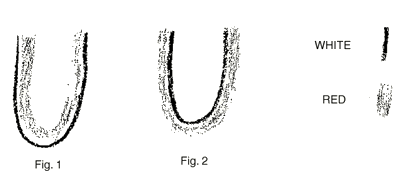
But let us go further, my dear friends, and picture to ourselves that we have something endowed with a force of its own that does not admit of being turned inside out in such a simple way as a glove which still looks like a glove after being inverted. Suppose that we invert something which has different stresses of force on the outer surface from those on the inner. We shall then find that simply through the inversion quite a new form arises. The form may appear thus before we have reversed it (Fig. 1): we turn it inside out and now different forces come into consideration on the red surface and on the white, so that perhaps, purely through the inversion, this form arises (Fig. 3). Such a form might arise merely in the process of inversion. When the red side faced inward, forces remained dominant which are developed differently when it is turned outward. And so with the white side; only when turned towards the inside can it develop its inherent forces.
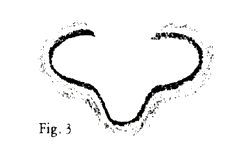
It is of course quite conceivable to give a mathematical presentation of such a subject, but people are thoroughly disinclined nowadays to apply to reality what is arrived at conceptually in such a way. The moment, however, we learn to apply this to reality, we become able to see in our long bones or tubular bones (that is, in the limb bones), a form which, when inverted, becomes our skull bones! In the drawing, let the inside of the bone, as far as the marrow, be depicted by the red, the outside by the white (Fig. 4). Certain forms and forces, which can of course be investigated, are turned inward, and what we see when we draw away the muscle from the long bone is turned outward. But now imagine these hollow bones turned inside out by the same principle as I have just given you, in which other conditions of stress and strain are brought into play;
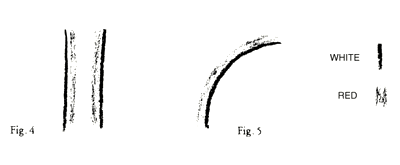
then you may easily obtain this form (Fig. 5). Now it has the white within, and what I depicted by the red comes to the outside. This is in fact the relationship of a skull-bone to a limb-bone, and in between lies the typical bone of the back — the vertebra of the spinal column. You must turn the tubular bone inside out like a glove according to its indwelling forces; then you obtain the skull-bone. The metamorphosis of the bones of the limbs into the skull-bones is only to be understood when keeping in mind the process of inversion, or ‘turning inside-out’. The important thing to realizes is that what is turned outward in the limb-bones is turned inward in the skull. The skull-bones turn towards a world of their own in the interior of the skull. That is one world. The skull-bone is orientated to the world, just as the limb-bone is orientated outward, towards the external world. This can be clearly seen in the case of the bones. Moreover, the human organism as a whole is so organized that it has on the one hand a skull organization, and on the other a limb-organization, the skull-organization being oriented inward, the limb-organization outward. The skull contains an inner world, the limb-man an outer world, and between the two is a kind of balancing system which preserves the rhythm.
My dear friends, take any literature dealing with the theory of functions, or, say, with non-Euclidean geometry, and see what countless ideas of every kind are brought forward in order to get beyond the ordinary geometrical conception of three-dimensional space; — to extend the domain — widen out the concept of geometry. You will see what industry and ingenuity are employed. But now suppose that you have become an expert at mathematics, who knows the theory of functions well and understands all that can be understood today of non-Euclidean geometry. I should like now to put a question concerning much that tends in this direction (Forgive me if it seems as if one did not value them highly, speaking of these things in such trivial terms. And yet I must do so, and I beg the audience, especially trained mathematicians, to turn it over in their minds and see if there is not truth in what I say.) The question could be put as follows: What is the use of all this spinning of purely mathematical thoughts? What is it worth to me, so to speak, in pounds, shillings and pence? No one is interested in the spheres in which it might perhaps find concrete application. Yet if we were to apply to the structure of the human organism all that has been thought out in non-Euclidean geometry, then we should be in the realm of reality, and applying immeasurably important ideas to reality, not wandering about in mere speculations. If the mathematician were so trained as to be interested also in what is real, — in the appearance of the heart, for example, so that he could form an idea of how through a mathematical process he could turn the heart inside out, and how thereby the whole human form would arise, — if he were taught to use his mathematics in actual life, then he could be working in the realm of the real. It would then be impossible to have the trained mathematician on the one hand, not interested in what the doctor learns, and on the other, the physician, understanding nothing of of how the mathematician — though in a purely abstract element — is able to change and metamorphose forms. This is the situation we must alter. If not, our sciences will fall into decay. They grow estranged from one another; people no longer understand each other's language.
How then is science to be transformed into a social science, as is implied in all that I shall be telling you in these lectures? A science which leads over into social science is not yet in existence.
On the one hand we have Astronomy, tending more and more to be clothed in mathematical forms of thought. It has become so great in its present form just because it is a purely mathematical and mechanical science. But there is another branch of science which stands, as it were, at the opposite pole to Astronomy, and which cannot be studied in its real nature without Astronomy. It is however, impossible, as science is today, to build a bridge between Astronomy and this other pole of science, namely, Embryology. He alone is studying reality, who on the one hand studies the starry skies and on the other hand the development of the human embryo. How is the human embryo generally studied today? Well, it is stated: The human embryo arises from the interaction of two cells, the sex-cells or gametes, male and female. These cells develop in the parent organism in such a way as to attain a certain state of independence before they are able to interact. They then present a certain contract, the one cell, the male, calling forth new and different possibilities of development in the other, the female. The question is put: What is a cell? As you know, since about the middle of the 19th century, Biology has largely been built upon the cell theory. The cell is described as a larger or smaller, spherule, consisting of albuminous or protein-like substances. It has a nucleus within it of a somewhat different structure and around the whole is an enclosing membrane. As such, it is the building-stone for all that arising by way of living organisms. The sex-cells are of a similar nature but are formed differently according to whether they are male or female, and from such cells every more complicated organism is built up.
But now, what is actually meant when it is said that an organism builds itself up from these cells? The idea is that substances which are otherwise in Nature are taken up into these cells and then no longer work in quite the same way as before. If oxygen, nitrogen or carbon are contained in the cells, the carbon, for instance, does not have the effect upon some other substance outside, that it would have had before; such power of direct influence is lost to it. It is taken up into the organism of the cell and can only work there as conditions in the cell allow. That is to say, the influence is exerted not so much by the carbon, but by the cell, which makes use of the particular characteristics of carbon, having incorporated a certain amount of it into itself. For example, what man has within him in the form of metal — iron for instance — only works in a circuitous way, via the cell. The cell is the building-stone. So in studying the organism, everything is traced to the cell. Considering at first only the main bulk of the cell, without the nucleus and membrane, we distinguish two parts: a transparent part composed of this fluid, and another part forming sort of framework. Describing it schematically, we may say that there is the framework of the cell, and this is embedded, as it were, in the other substance which, unlike the framework, is quite unformed. (Fig. 6) Thus we must think of the cell
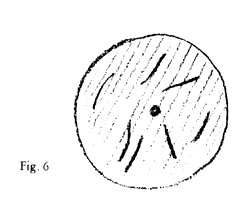
as consisting of a mass which remains fluid and unformed and a skeleton or framework which takes on a great variety of forms. This then is studied. The method of studying cells in this way has been pretty well perfected; certain parts in the cell can be stained with color, others do not take the stain. Thus with carmine or saffron, or whatever coloring matter is used, we are able to distinguish the form of the cell and can thus acquire certain ideas about its inner structure. We note, for instance, how the inner structure changes when the female germ-cell is fructified. We follow the different stages in which the cell's inner structure alters; how it divides; and how the parts become attached to one another, cell upon cell, so that the whole becomes a complicated structure. All this is studied. But it occurs to no-one to ask: With what is this whole life in the cell connected? What is really happening? It does not occur to anyone to ask this.
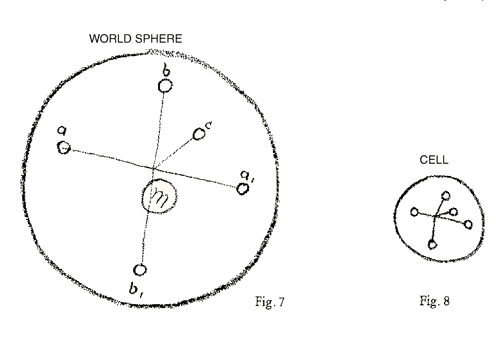
What happens in the cell is to be conceived, my dear friends, in the following way, — though to be sure, it is still a rather abstract way. There is the cell. For the moment let us consider it in its most usual form, namely the spherical form. This spherical form is partially determined by the thin fluid substance, and enclosed within it is the delicate framework. But what is the spherical form? The thin fluid mass is as yet left entirely to itself and therefore behaves according to the impulses it receives from its surroundings. What does it do? Well, my dear friends, it mirrors the universe around it! It takes on the form of the sphere because it mirrors in miniature the whole cosmos, which we indeed also picture to ourselves ideally as a sphere. Every cell in its spherical form is no less than an image of the form of the whole universe. And the framework inside, every line of the form, is conditioned by its relationship to the structure of the whole cosmos. To express myself abstractly to begin with, think of the sphere of the universe with its imaginary boundary (Fig. 7). In it, you have here a planet, and there a planet (a,a1). They work in such a way as to exert an influence upon one another in the direction of the line which joins them. Here (m) let us say — diagrammatically, of course, — a cell is formed; its outline mirrors the sphere. Here, within the framework it has a solid part which is due to the working of the one planet on the other. And suppose that here there were another constellation of planets, working upon each other along the line joining them (b,b1).
And here again there might be yet another planet (c), this one having no counterpart; — it throws the whole construction, which might otherwise have been rectangular, out of shape, and the structure takes on a somewhat different form. And so you have in the whole formation of the framework of the cell a reflection of the relationships existing in the planetary system, — altogether in the whole starry system. You can enter quite concretely into the formation of the cell and you will reach an understanding of this concrete form only if you see in the cell an image of the entire cosmos.
And now take the female ovum, and picture to yourselves that this ovum has brought the cosmic forces to a certain inner balance. They have taken on form in the framework of the cell, and are in a certain way at rest within it, supported by the female organism as a whole. Then comes the influence of the male sex-cell. This has not brought the macrocosmic forces to rest, but works in the sense of a very specialized force. It is as though the male sex-cell works precisely along this line of force (indicated by Dr. Steiner on the blackboard) upon the female ovum which has come to a condition of rest. The cell, which is an image of the whole cosmos, is thereby caused to relinquish its microcosmic form once more to a changing play of forces. At first, in the female ovum, the macrocosm comes to rest in a peaceful image. Then through the male sex-cell the female is torn out of this state of rest, and is drawn again into a region of specialized activity and brought into movement. Previously it had drawn itself together in the resting form of the image of the cosmos, but the form is drawn into movement again by the male forces which are, so to speak, images of movement. Through them the female forces, which are images of the form of the cosmos and have come to rest, are brought out of this state of rest and balance.
Here we may have some idea, from the aspect of Astronomy, of the forming and shaping of something which is minute and cellular. Embryology cannot be studied at all without Astronomy, for what Embryology has to show is only the other pole of what is seen in Astronomy. We must, in a way, follow the starry heavens on the one hand, seeing how they reveal successive stages, and we must then follow the process of development of a fructified cell. The two belong together, for the one is only the image of the other. if you understand nothing of Astronomy, you will never understand the forces which are at work in Embryology, and if you understand nothing of Embryology, you will never understand the meaning of the activities with which Astronomy has to deal. For these activities appear in miniature in the processes of Embryology.
It is conceivable that a science should be formed, in which, on the one hand, astronomical events are calculated and described, and on the other hand all that belongs to them in Embryology, which is only the other aspect of the same thing.
Now look at the position as it is today: you find that Embryology is studied on its own. It would be regarded as madness if you were to demand of a modern embryologist that he should study Astronomy in order to understand the phenomena in his own sphere of work. And yet it should be so. This is why a complete regrouping of the sciences is necessary. It will be impossible to become a real embryologist without studying Astronomy. It will no longer be possible to educate specialists who merely turn their eyes and their telescopes to the stars, for to study the stars in that way has no further meaning unless one knows that it is out of the great universe that the minute and microscopical is fashioned.
All this, — which is quite real and concrete, — has in scientific circles been changed into the utmost abstraction. It is reality to say: We must strive for astronomical knowledge in cellular theory, especially in Embryology. If DuBois-Raymond had said that the detailed astronomical facts should be applied to the cell-theory, he would have spoken out of the sphere of reality. But what he wanted corresponds to no reality, namely that something thought-out and devised — the atoms and molecules — should be examined with astronomical precision. He wanted the astronomical type of mathematical thoughts, which have been added to the world of the stars, to be sought for again in the molecule.
Thus you see, upon the one hand lies reality: movement, the active forces of the stars and the embryonic development in which there lives, in all reality, what lives in the starry heavens. That is where the reality lies and that is where we must look for it. On the other hand lies abstraction. The mathematician, the mechanist, calculates the movements and forces of the heavenly bodies and then invents the molecular structure to which to apply this kind of astronomical knowledge. Here he is withdrawn from life, living in pure abstractions.
These are the things about which we must think, remembering that now we must renew, in full consciousness, something which was in a certain sense present in earlier times. Looking back to the Egyptian Mysteries, we find astronomical observations such as were made at that time. These observations, my dear friends, were not used merely to calculate when an eclipse of the Sun or Moon would take place, but rather to arrive at what should come about in social evolution. Men were guided by what they saw in the heavens, as to what must be said to the people, what instructions should be given, so that the development of the whole social life should take its right course. Astronomy and Sociology were dealt with as one. We too, though in a different way from the Egyptians, must again learn how to connect what happens in social life with the phenomena of the great universe. We do not understand what came about in the middle of the 15th century, if we cannot relate the events of that time to the phenomena which then prevailed in the universe. It is like a blind man talking about color to speak of the changes in the civilized world in the middle of the 15th century without taking all this into account.
Spiritual Science is already a starting point. But we shall not succeed in bring together the complicated domain of Sociology — social science — with the observations of natural phenomena, unless we first begin by connecting Astronomy with Embryology, linking the embryonic facts with astronomical phenomena.


 Posts
Posts

