Tuesday, October 30, 2018
The meditator's motto: "Steady drops hollow the stone"
From the notes of an attendee at an Esoteric Lesson given by Rudolf Steiner in Berlin on March 15, 1911:
As was explained the last time [January 17, 1911] our meditation should stand under the motto: "Steady drops hollow the stone." The study of anthroposophical works serves as an effective preparation for the exercises. It is better to have read one work twenty-five times than to have read five books five times each; and anyone who has read a book two or three times must not imagine that he or she has read it at all. If on a specific day of the year we have experienced something specific while meditating, then on the same day a year later, if we have really studied in the meantime, we will be able to experience much more. It is good to retain the same meditation through long periods of time. This is much better than constantly changing one's meditation.
Source: Page 134 of http://www.steinerbooks.org/detail.html?session=6cb3ca3c2878b9570eace8b18c89bb9a&id=9780880106177
Monday, October 29, 2018
Do not pray for an easy life. Pray to be a strong person.
![]() |
"Life is either a daring adventure, or nothing." — Helen Keller |
"Either the spiritual path is difficult or it is no path at all."
— Rudolf Steiner
![]() |
| Rudolf Steiner |
We are not granted
A rest on any step;
The active human
Must live and strive
From life to life;
As plants renew themselves
From Spring to Spring,
So we must rise
Through error to Truth,
From fetters into Freedom,
Through sickness and through death
To Beauty, Health, and Life.
Rudolf Steiner
A rest on any step;
The active human
Must live and strive
From life to life;
As plants renew themselves
From Spring to Spring,
So we must rise
Through error to Truth,
From fetters into Freedom,
Through sickness and through death
To Beauty, Health, and Life.
Rudolf Steiner
The Social Question as a Question of Consciousness
Lecture 4 of 8
Lecture 4 of 8
Rudolf Steiner, Dornach, Switzerland, March 1, 1919:
In what we have here been considering I have shown how in the course of man's evolution something very different may be going on in the unconscious depths of his soul from what appears more on the surface. A man may think he is striving for this or that, whereas in reality in his innermost soul there hold sway impulses directed to quite different aims. This truth is particularly significant in our time. We see today a whole class of men setting their wills in a certain direction. But just here we may have the experience how in this age of the development of consciousness something different is coming to expression on the surface of the soul from what is living in its depths, where impulses not present in consciousness today are striving for expression, for realisation.
The consciousness of the proletariat is today filled with three things. First, the materialistic interpretation of history; secondly, the view that up to now, in reality, class struggles have been at the basis of what has gone on in the world, what is now happening being thought to be a reflection of these class struggles. The third thing is the theory of surplus value, that is, the theory that surplus value arises through the unpaid labour of the worker, which makes a profit that is than taken by the employer from the worker without the latter receiving compensation.
What makes the impulses arise in the consciousness of the proletariat, from which are drawn the forces active in the modern social movement, is derived from the combination of these three factors. This, however, refers only to what lies in the consciousness of the proletariat. In the depths of the souls of all present-day mankind, in the deeper layers of the souls of the proletariat too, three other things are living, of which the world as yet knows very little. The world does not make such effort towards self-knowledge, and therefore knows nothing of what, in the depths of the soul, is actually striving for historical realisation.
These three other things are, first, a penetration of the spiritual life, a penetration fitted for the present age, what may be called Spiritual Science. The second is freedom in the life of thought, freedom of thought. The third is socialism in its right and true sense. Without knowing it the proletariat are striving for these three things. Their instincts follow the other three things that I referred to as being active on the surface of their soul-life, in their actual consciousness.
In this very difference between the proletariat's conscious efforts and their unconscious impulses we see particularly clearly what a complete contrast they make. Take the materialistic interpretation of history. This is due to the modern materialism which has arisen during the last four centuries. This materialism first made itself felt among the leading classes of men in the field of natural science, and later took its hold on all science. It then turned to the material interpretation of history among the members of the modern proletariat, who in reality have simply taken over as heritage the kind of conceptions concerning science holding good for the bourgeoisie. This material conception of history is due to all spiritual life being, as it were, merely the smoke arising from the proceedings in the economic life, from all that is working in the sphere of man's economic life. In the historical course of man's life there is actually only what is going on in the different spheres concerned with the creation of goods — production, trade, consumption; and according to how men have carried on their economy at different times, has depended on their religious belief, what kind of art they have cultivated, what attitude they have taken to rights and morality. The spiritual life is, finally, an ideology, that is, it has no independent reality, being a reflection of the eternal economic struggle. Certainly all the ideas required by men, what they feel aesthetically, on what they bring to expression through their moral will can work back again on the economic struggle. But ultimately all spiritual life is a mirrored image of the external economic life. This is what is called the materialistic interpretation of history. If human life be a mere reflection of purely external, material, economic forces, if it be true that the world is only a world of the senses and that men's thoughts reflect only what is of the senses, if men live entirely in such ideas, wanting to see as reality only what the sense world reveals, then this is a turning away from all true life of the spirit, and signifies man's refusal to recognise an independent spirit resting on itself.
These three other things are, first, a penetration of the spiritual life, a penetration fitted for the present age, what may be called Spiritual Science. The second is freedom in the life of thought, freedom of thought. The third is socialism in its right and true sense. Without knowing it the proletariat are striving for these three things. Their instincts follow the other three things that I referred to as being active on the surface of their soul-life, in their actual consciousness.
In this very difference between the proletariat's conscious efforts and their unconscious impulses we see particularly clearly what a complete contrast they make. Take the materialistic interpretation of history. This is due to the modern materialism which has arisen during the last four centuries. This materialism first made itself felt among the leading classes of men in the field of natural science, and later took its hold on all science. It then turned to the material interpretation of history among the members of the modern proletariat, who in reality have simply taken over as heritage the kind of conceptions concerning science holding good for the bourgeoisie. This material conception of history is due to all spiritual life being, as it were, merely the smoke arising from the proceedings in the economic life, from all that is working in the sphere of man's economic life. In the historical course of man's life there is actually only what is going on in the different spheres concerned with the creation of goods — production, trade, consumption; and according to how men have carried on their economy at different times, has depended on their religious belief, what kind of art they have cultivated, what attitude they have taken to rights and morality. The spiritual life is, finally, an ideology, that is, it has no independent reality, being a reflection of the eternal economic struggle. Certainly all the ideas required by men, what they feel aesthetically, on what they bring to expression through their moral will can work back again on the economic struggle. But ultimately all spiritual life is a mirrored image of the external economic life. This is what is called the materialistic interpretation of history. If human life be a mere reflection of purely external, material, economic forces, if it be true that the world is only a world of the senses and that men's thoughts reflect only what is of the senses, if men live entirely in such ideas, wanting to see as reality only what the sense world reveals, then this is a turning away from all true life of the spirit, and signifies man's refusal to recognise an independent spirit resting on itself.
Thus in modern times efforts are directed towards marshalling more and more proofs to justify the assertion that no such thing exists as an independent spirit living in the supersensible, that there is no such thing as spirit at all. This plays upon the surface of men's life of soul, and has constituted. the essential content of modern consciousness since mankind entered the age of the consciousness soul. But in the very depths of their life of soul men today are striving for the spirit; they have, one might say, a most deep and inward need of the spirit. This may be confirmed if we look at the evolution of human history.
We have often looked back on the special kind of spirituality in the first post-Atlantian period of culture, the Indian, and described its character from the most varied standpoints. What we have learnt about it enables those who can look on the things without prejudice to say that the life of spirit, as it existed in the old Indian culture-epoch — to be discovered only by means of Spiritual Science — rests upon unconscious intuition. Mark well, unconscious, for it was then a matter of an atavistic life of spirit.
If we then pass on to the ancient Persian life of spirit and seek its sources, we find them flowing from an unconscious inspiration. The Egypto-Chaldean life of spirit is still prevalent in so-called historic Egyptian times, and if we study history without prejudice we shall be able to see that in the old Egyptian and Chaldaea knowledge we have to do with what is in the soul as unconscious though living imagination.
There then followed the Graeco-Latin life of spirit. In this the ancient imaginations remained, permeated, however, with concepts, ideas. The essential thing expressed by Greek life was that, in human evolution, the Greeks were the first to possess this element that, as an impulse of the soul, was previously non-existent. The Greeks already had ideas, concepts, as I have shown more fully in my Riddles of Philosophy. But through all their ideas and concepts there were weaving the figurative, the imaginative. This is unnoticed today, particularly when it is a question of that unaccountable Greece of which our schools and universities speak. When the Greeks uttered the word ‘idea’ for example, they had in mind nothing so abstract as the concept called up by our word. With than the word conjured up a kind of vision, which was nevertheless to be grasped clearly in the form of concept. It was something perceptible; idea was at the same time vision. In Greek one would never have been able to speak of ideology, though the word comes from the Greek. In any case a Greek would not have spoken so that the same feelings would have been aroused that are aroused today by the word ‘ideology’. For to the Greek ideas were full of being, something permeated by pictures.
Now it is characteristic of our fifth post-Atlantian epoch that imaginations have vanished from the consciousness soul, and it is the concept above all that remains.
Our modern life of spirit, with so little power of picturing things that only abstractions remain, is particularly prized by the cultured for its very dryness and dullness. These times live, so to speak, on abstractions and would reduce everything to some kind of abstract concept. It is just in what is called middle class practical life that, in the most extensive sense, this abstract concept holds sway. It is, however, already making itself felt that in the depths of men's souls slumbering, unconscious impulses are striving after renewed imagination. (This is true of the present and will continue to be so in the near future.) Thus, of the fifth epoch we may say: Concepts striving for imaginations.
1. Old Indian Culture-epoch: Unconscious intuitions as the source of the life of spirit.
2. Old Persian Culture-epoch: Unconscious inspirations as the source of the life of spirit.
3. Egypto-Chaldean Culture-epoch: Unconscious imaginations as the source of the life of spirit.
4. Graeco-Latin Culture-epoch: Unconscious imaginations with concepts.
5. Modern Culture-epoch: Concepts striving for imaginations.
Our Spiritual Science goes to meet this striving for imaginations. The overwhelmingly greater part of mankind knows as yet nothing of what goes on in the soul, and thus see all life of the spirit in mere ideas and concepts before which men feel themselves helpless. For concepts as such have in themselves no content. Till now it has been the destiny among leading circles to develop a certain predilection for purely abstract thinking. This love of abstract thinking, however, has produced something else. This thinking in pure concepts is helpless! It produces an endeavour to rely upon the reality that cannot be relied on because it is only suited to the senses, namely, external physical reality. This belief in external physical reality has, in truth, arisen from the ineffectiveness of the concepts of modern mankind.
The ineffectiveness, the helplessness, of the conceptual life is expressed in every sphere of the spiritual life. In science the great desire is to experiment, so as to discover something not otherwise given to the world of the senses. Pondering on the world of the senses with ideas alone we do not got beyond it, for concepts themselves contain no reality. In art we are getting ever more accustomed to the copying of a model and keeping to the external object alone. Up to now, in art, it has been the destiny of the leading circles of mankind to be absorbed more and more in the mere study of external sense reality. The capacity to create out of the spirit and to represent the spiritual by artistic means is being increasingly lost naturalism alone is striven for, imitation of what nature, as such, represents in the external world, because from the abstract life of the spirit nothing wells up which in itself van be given independent form.
If you consider the development of art in recent times, you will find this everywhere confirmed — this continual striving after more naturalism, after a representation of what externally is seen and perceived. This has finally reached its peak in what is called Impressionism. Before Impressionism artistic endeavour was directed to the reproduction of some external object. Then came those who carried this to its logical conclusion end said: When I have before me a human being or a wood, and I paint this men or this wood, I am not giving my impression, for while I am standing before the wood the sun illumines it in a particular way, but after a few moments the light effect may be suite different. In my desire to be naturalistic what am I to perpetuate? I cannot hold to what the external world shows me for that changes each moment. I try to paint a man who is smiling, but the next instant his expression may be grim! Am I to turn the grim face into the smiling one? What am I to paint? If I wish to paint the external object in its temporary state I shall have to use force on the object. Objects of nature do not allow of this, but with the human object as model force has to be used for the pose and expression to be held as long as possible. But then, when one tries to imitate nature, the model takes on an expression as if he had catalepsy. So that is no good. — For this reason they became Impressionists; they waited to catch and hold the fleeting impression. Then, however, it is no longer possible to be altogether naturalistic, but all means must be used, not to irritate nature, but to reproduce how it appears and reveals itself to anyone in a certain moment. The trouble is that in an effort to be naturalistic one becomes impressionist, and then, alas, as impressionist it is impossible to remain naturalistic: So the whole thing is changed round. Some no longer aimed at giving the impression, at fixing the outward impression, and tried to express what, however primitive, arose within themselves — they tried to hold fast what happens within. These became Expressionists.
In the moral sphere, even in the life of rights, the same course can be shown; everywhere there arises this striving after the abstract life of spirit preferred by men. We have only to look at modern human evolution correctly, and we shall find everywhere this urge towards abstraction. And what effect has this had on the modern proletariat? Since they have been tied to machines, caught up in the present soulless capitalism, their whole destiny has become bound up in the economic life. The same trend of ideas that brought members of the middle-class circles to naturalism in art has now brought the proletariat to the theories expressed in the materialistic interpretation of history. The proletariat everywhere has drawn upon the logical consequences of bourgeois culture — consequences before which the bourgeoisie now stand aghast.
Now, within these bourgeois circles what has been the attitude towards religion? In earlier times there was at least a dim atavistic conception of the Christ-Mystery; there was a feeling that abstract spiritual life offered no possibility of conceiving how the Christ had lived in Jesus. Thus men's ideas became limited to what, in the early days of Christianity, had happened in the world of the senses; they became limited to what merely concerned Jesus. The Christ was looked upon more and more as mere man, whereas the Christ belonging to the supersensible world vanished ever further from the field of human vision. The abstract life of the soul, finding no way to the Christ, contented itself with Jesus. What did the proletariat make of this? They asked themselves: Why do we need any specially religious outlook regarding Jesus? The bourgeoisie have already made of Him the simple man of Nazareth. If Jesus is this simple man of Nazareth, He will naturally be just like us. We are dependent on the economic life and why should Jesus not have been so too? Have we still any justification in ascribing to Him a special mission, or in calling Him the founder of a new human age if He is just the simple man of Nazareth who, for His part, drew His teachings from the economic processes into which He Himself was placed? We must study the economic processes at the time of the founding of Christianity, and the way in which a simple worker deserted his work to spread ideas around concerning the contemporary economic ordering in Palestine. From that we shall see why Jesus made the statements like he did. This Jesus-theory is the final result of modern protestant theology, which no longer has any power over modern men, the modern proletariat. —
But now, in the subconscious depths of their souls, modem men are once more striving for freedom of thought, for inward initiative in thought. On the conscious surface of their soul-life it appears that the opposite is to be the aim, and this opposite is the object of their striving. Hence the deep protesting opposition in the subconscious which comes to expression in the present terrible struggle. The leading bourgeois circles want to be free of any authority; but they are up to the neck in every kind of belief in authority. They have a blind belief in authority above all where the sphere of the State is concerned — now regarded by them as the highest authority. For whose judgment stands higher for the modern middle-class than that of the ‘expert’? The expert is consulted in everything, even in matters of external life. Whoever enters life having left the University with a degree, must know everything. Be he a theologian, he is consulted about God's intentions towards man; if a lawyer he is asked what rights a man has in life; if a doctor of medicine, he is asked for a universal cure, and if any kind of philosopher at all, he is questioned about every possible thing in the world. Modern philosophers always smile when their glance falls on the book of a venerable philosopher of pre-Kantian days — Christian Wolf. This book is called Rational Thoughts on God, the World, the Soul of Man, and all other things; people smile at such a book. But modern leading classes most firmly believe in the spiritual laboratories the State has set up for its citizens, where the whole content of human intelligence is brewed. The concern of these circles is not to give everyone a consciousness of his own, but to create a uniform consciousness, and to manage that in the widest sense it should be a State-consciousness. Modern consciousness is much more a consciousness of the State than is commonly believed. People think of the State as their God who Gives them all they need. They no longer have to bother themselves about things, for the State sees to it that there should be provision for all reasonable departments of life. The proletariat have been excluded from the life of the State except in a few spheres allowed them by its democratic form. With their labour-power that engages the whole man, the proletariat were yoked to the economic life. For this reason it now drew upon itself, for its own life alone, the final consequence. The modern middle-class citizen has a State-consciousness, and though he may not always admit it he is quite willing to boast about this State-consciousness. It is really not necessary to have “Reserve-Lieutenant” and “Professor” printed on your card, just to make a parade of your State-consciousness. It can be done in a quite different way. But the proletariat had no interest in the State. They were harnessed to the economic life, and their feelings were again, though in accordance with their own lives, the final consequence of middle-class feelings. The proletarian consciousness became class-consciousness, and thus we see that since they had nothing to do with the State their class-consciousness was built on internationalism. The middle-class were able to have leanings towards the State only because this modern State looked after them, and the middle-class wish to be looked after. The State, however, did not look after the proletarian, and he felt himself as part of the world only in so far as he belonged to his class. The arising of the proletarian class has been brought about in the same way throughout all States. Hence came the formation of an international proletariat, feeling consciously opposed to the bourgeoisie and all that tended, with the same force of consciousness, towards the State and the agents of the State. Thus, within recent times there has arisen an extraordinarily powerful form of class-consciousness among the proletariat. I do not know how many of you have been to proletarian meetings. But how do they always close They close by copying as a proletarian consequence what has come from so many bourgeois organisations and interests! For example, with what did bourgeois meetings in middle Europe begin and and? With “Hail to the Emperor:” And every proletarian meeting has ended with “Long live the international revolutionary social democracy!” We have only to reflect on what enormous suggestive power lies in these words heard by the proletariat week after week, and how these words induce a uniform consciousness throughout the masses so that all freedom of thought has naturally been driven out. All this has taken firm hold of the soul. Formerly there were meetings, that have now become less frequent, called by the bourgeoisie, to which social democrats also were invited. The Chairman on closing would say: “I shall first beg the social democrats to leave, and then ask the audience to rise and give a salute to the Emperor.” There were also proletarian meetings at the discussions of which the bourgeoisie were allowed to contribute. And at the end the Chairman would ask middle-class members to retire, so that the “Long live the international revolutionary social democracy” could be proposed. Thus was welded what passed through the soul as a uniform class-consciousness — the opposite of what was in the depths of their souls, the opposite of the longing for individual freedom of thought, for an individual form of consciousness! — That is the second thing.
And the third thing pressing for realisation in the depths of the modern soul is Socialism, which can be briefly described as the effort of the modern soul, in the time of the consciousness soul, to be able to feel itself an individual within the social organism. This is how man wants the social organism to be founded; he wants to feel himself member of this social organism. This means that he wishes a consciousness to permeate him that gives him the feeling: What I do is done so that I know in what way the social organism has a part in me and how I have a share in the social organism. Man lives within the social organism. But nowadays, as I have said, the feeling for the social organism is present only in the subconscious.
Today when a painter points a picture he is right in saying: This picture must be paid for; I have put my art into it. — What is his art? It is something only made possible for him by the community, by the social organism. His artistic ability, it is true, depends upon his karma, his earlier earth lives; but people today do not believe that, and by not believing it deceive themselves. If however we ignore the share of ability brought down by our individuality from higher regions through birth, then we are entirely dependent upon the social organism. But modern man pays no conscious heed to this, so instead of a social feeling in his consciousness there has arisen during the last four centuries, above all, on increasingly egoistic, anti-social trend of thought. This anti-social thought expresses itself particularly by everyone thinking first of himself and trying to get as much as possible out of the social organism. The feeling that one should return to the social organism what one has received, is harboured indeed by very few. In leading bourgeois circles there has gradually arisen in regard to the spiritual life the greatest imaginable egoism, egoism that looks upon sheer spiritual enjoyment, sheer intellectual enjoyment, as something man is specially justified in procuring for himself. We have, however, no claim to spiritual enjoyment prepared for us by the social organism if we are not in the position to return to the social organism an appropriate equivalent.
Now the proletariat, not being able to share in the spiritual part of the social organism, and being yoked to the economic life and to soulless capitalism, are again driven to the final consequence of middle-class egoism shown in the theory of surplus value. The worker recognises that it is he who actually produces what comes from machines at the factories, and wants to have the proceeds. He does not wish a part to be withdrawn and to go elsewhere. Seeing nothing but the capitalist who places him at the machine, he naturally thinks that all the surplus value goes to the capitalists and that he must above all turn against them. Considered objectively, there is of course something else, quite different hidden in this so-called surplus value. For what is surplus value? It is everything produced by manual labour for which this labour receives no compensation. Suppose there were no surplus value, that everything went to the worker for his immediate needs. Then it would go without saying that there would be no spiritual culture, no further culture at all! There would be only the economic life, only what can be brought into existence through manual labour. It cannot be a question therefore of the surplus value going to the manual worker, but only of its application in a way that can bring surplus value and manual work into agreement. This will happen only when conditions are created in which the manual worker can have some understanding of where the surplus value goes.
Here one touches on the point where most of the offences of the modern middle-class order have been committed. Machines and factories have been set up, trade has been carried on, capital put into circulation, the worker placed at the machine and thus harnessed to the capitalistic economic order. There he is meant to work. But no one has had the idea that the worker has need of anything beyond his labour power. It is not his labour power alone but also his leisure, the force he has left when his work is done, that must be used in a healthy social order. Only those capitalists are justified who have as great an interest in the Proletariat's labour power that is left over, as they have in the economic application of their forces. Those capitalists alone have justification who take care that the worker, at the end of a definite period of work, can have access to what is good from a universal human point of view spiritually and otherwise educationally.
For this, he must first have the fruits of education. In Middle-class society these fruits of education have been developed, therefore it has been possible for all kinds of popular cultural institutions to be set up. What people's kitchens of the spiritual life! What has not been founded in this sphere! But what feelings must have been awakened by all this in the proletariat? The feeling indeed that the middle-class is giving him something they are cooking there among themselves. Naturally he distrusts it and thinks: Aha, they would make me middle-class too by feeding me with the milk of the pious way of thinking in these people's kitchens! — These welfare movements of the bourgeoisie are largely responsible for the facts arising today in such a shocking way on the horizon of social life. What is appearing flows from much deeper sources than is generally thought. I want the surplus value. That is the egoistic principle that appears as the final consequence of the egoism of the middle-class who also wanted the surplus value. Once again the proletariat takes on the final consequence. And instead of the real, true socialism, slumbering in the depths of the soul, there appears on the surface of the life of the soul, in the consciousness, the theory of surplus value which is eminently anti-social. For everyone who takes surplus value to his heart is doing so for the satisfaction of his own egoism.
Thus today we have an anti-social socialism, just as we have a striving for a content of consciousness that is nothing of the sort. It is simply the result of the economic connection of one class of human beings expressing itself in the class-consciousness of the proletariat. Thus today we have a spiritual endeavour that denies the spirit and has found its logical conclusion in the materialistic interpretation of history.
We must look deeply into these things otherwise we shall not understood the present times. H0w little, in this direction, have the middle-class circles been inclined to cultivate insight into these connections, how little are they still prone to become conscious of them though the facts have spoken so clearly and with such urgency. In no other way will it be possible to bring about a striving among the proletariat that is truly social, in place of the present anti-social striving, than by trying to establish the economic life on a healthy, independent basis as a member of the social organism, which without State interference will have its own laws and its own governing body. In other words, we must make every effort to prevent the State being its own economist in any sphere. Then could be developed real socialism in the economic life, for which there is a deep yearning in the human soul. And there must also be an endeavour to separate from the economic life that of the actual political State, which for its part has no claim either to the economic life nor to the spiritual, cultural, educational life, and so on. If the life of the State makes no demands in either direction, but simply embodies the life of rights, than it bring to expression what here in the physical world is the basis of the relation between man and man — the relation that makes all men equal in the sight of the law. It is only when the life of the State is thus that true freedom of thought can be developed.
As third member of the sound social organism the life of spirit must be formed on its own basis, which can be drawn from the reality of the spirit and must press onward to true Spiritual Science. What in the depths of their souls men are striving for today is indeed the healthy social order, which must, however, be threefold.
Thus can things be regarded, as they have been considered by us today, and Spiritual Science should be taken also in this sense both deeply and earnestly, not as something that is listened to like a Sunday sermon, for that is middle-class.
It is middle-class that in its economic life only a small circle should, at a pinch, be cared for — at least, think they are caring for themselves. It is middle-class in the life of the State to let the State do the caring, and when, to pay a little attention to the life of the spirit, people visit a person, or take up theosophy or anything of the kind. It is really respectably bourgeois: And the Theosophical Movement today has indeed established a life of the spirit very characteristic of middle-class life. One can think of nothing more bourgeois in character than this modern Theosophical Movement. It has grown up as a sectarian spiritual movement right out of the needs of this class. Hence came the struggle when we tried to work out from the Theosophical Movement something that should be permeated by modern human consciousness, and established as a movement for mankind. But from this sectarian bourgeois element, that found an anchorage in the superficiality of human souls, there was always opposition. We must get beyond this; anthroposophical striving must be understood as something demanded by the times, giving us wide instead of narrow interests, and not merely leading us into little groups for the reading of lecture cycles. It is good to reed lecture cycles; I beg you not to jump to the conclusion that no one in future should read them. We should, however, not stop there. What is read must be put into practice by seeking above all to find the relation with modern consciousness. Let us therefore thoroughly read the cycles, and we shall soon see that what is in them actually passes over into our life forces! Then it is the best social nourishment today for striving souls. For everything is thought out there, as indeed it is ultimately in our building, especially in what is there striven for artistically. It is thought out in the sense of modern times, and in these times it can be thought out in no other way. I do not know if you have considered how this building tries to be, even in social respects, a most modern product, and how in this modern sense it aids man in his striving. Just imagine a building the inside of which, or the greater part of which, had no purpose — if it just stood there! It ought to stand in a connection with the whole of the rest of the world order, to have any sense at all. Overhead in the cupola even by day it would be pitch dark, dark as night, were electric light not to come in from outside! This building points to all that is going on outside, so thoroughly is it born of all that is most modern. It must therefore develop in connection not with what is on the surface of the soul but with the inner spiritual aspirations of the time.
Thus, you might reflect upon much that is connected with this building. It is indeed a representative of the most modern spiritual life, and is only to be rightly understood if we grasp the idea of it being a kind of comet, a comet with a tail. The tail consists in there living in the human soul what is really raying forth in feeling from Anthroposophy. But it might easily happen that many people would take up the attitude towards this building that some Catholics, and indeed leading Catholics, have taken towards modern astronomy. In modern astronomy comets are looked upon as ordinary bodies in the firmament, whereas in olden days they were thought to be rods of correction wielded by some materially conceived spirit from a heavenly window. When the time came that leaders of Catholicism could no longer deny that comets should be ranked with other heavenly bodies, they invented en expedient. Some of them who were clever said: The comet consists of a core and a tail; we cannot deny that the core is a heavenly body like the rest, but the tail is not so; the tail has the origin formerly ascribed to it! — So it may also happen that people come to think: We approve of the building, but we will have nothing to do with all the odd experiences issuing from it like a comet's tail! —
But the building, like the comet, belongs to its tail, and it will be necessary that everything in relation to it should be felt in its true connection.
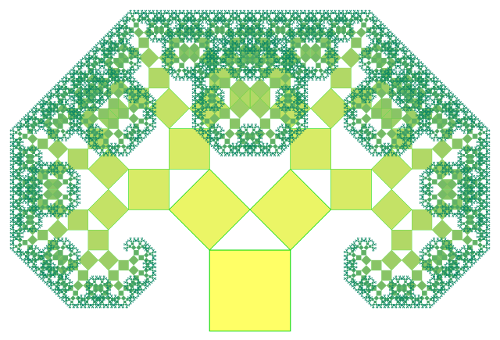
The Pythagoras Tree
From the website "Futility Closet":
Draw a square and perch two smaller squares above it, forming a right triangle:

Now perch still smaller squares upon these, and continue the pattern recursively:

Charmingly, if you keep this up you’ll grow a tree:

It was dubbed the Pythagoras tree by Albert Bosman, the Dutch mathematics teacher who discovered the figure in 1942. (Each trio of squares demonstrates the Pythagorean theorem.)
At first it looks as though the tree must grow without bound, but in fact it’s admirably tidy: Because the squares eventually begin to overlap one another, a tree sprouted from a unit square will confine itself to a rectangle measuring 6 by 4.
Sunday, October 28, 2018
The Shining Path: Anthroposophy

Rudolf Steiner: "There is nothing into which Anthroposophy cannot shed its light as an impulse, nothing into which it is not called upon to shine."
"Ye are the salt of the earth: but if the salt have lost his savour, wherewith shall it be salted? it is thenceforth good for nothing, but to be cast out, and to be trodden under foot of men.
Ye are the light of the world. A city that is set on an hill cannot be hid.
Neither do men light a candle, and put it under a bushel, but on a candlestick; and it giveth light unto all that are in the house.
Let your light so shine before men, that they may see your good works, and glorify your Father which is in heaven." — Matthew 5:13-16
"I through the law am dead to the law, that I might live unto God. I am crucified with Christ: nevertheless I live; yet not I, but Christ liveth in me: and the life which I now live in the flesh I live by the faith of the Son of God, who loved me, and gave himself for me. I do not frustrate the grace of God: for if righteousness come by the law, then Christ is dead in vain." — Galatians 2:19-21
Catch!
"The bird a nest, the spider a web, man friendship" — William Blake
"A noiseless patient spider" by Walt Whitman
A noiseless patient spider,
I mark’d where on a little promontory it stood, isolated,
Mark’d how to explore the vacant vast surrounding,
It launch’d forth filament, filament, filament, out of itself,
Ever unreeling them, ever tirelessly speeding them.
And you O my Soul where you stand,
Surrounded, detached, in measureless oceans of space,
Ceaselessly musing, venturing, throwing, seeking the spheres to connect them,
Till the bridge you will need be form’d, till the ductile anchor hold,
Till the gossamer thread you fling catch somewhere, O my Soul.
Christ Triumphant, Christ the Lord of Karma
![]() |
| Karma: The Fiat of the Logos, the Word of God. "The Revelation of Jesus Christ, which God gave unto him, to shew unto his servants things which must shortly come to pass" —Revelation 1:1 |
| Human and Cosmic Thought. Lecture 4 of 4 |
Rudolf Steiner, Berlin, January 23, 1914:
We have been concerned with the possible varieties of world-outlooks, of world-outlook-moods and so on, which can find place in the human soul, and, since I can take only single points of view from this wide field, I should like to illustrate one of these points of view by means of a special example.
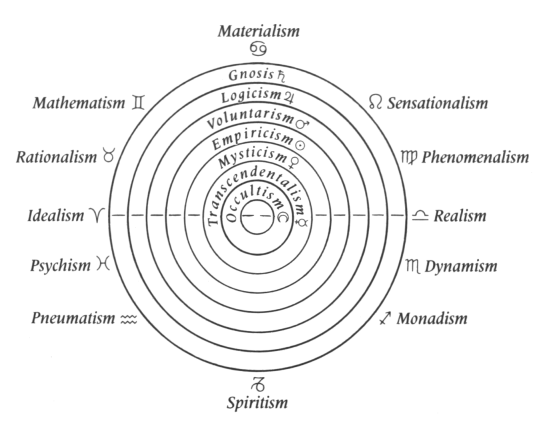
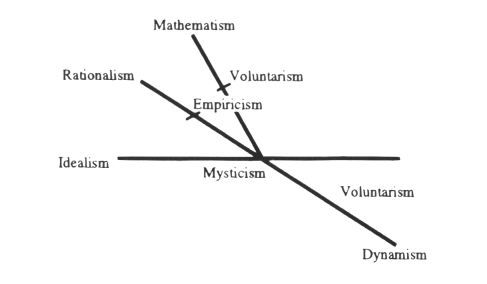
Let us suppose that a person so lives in the world that among his natural predispositions we find the special forces through which he is influenced by the world-outlook of Idealism. We will say that he makes this world-outlook into a dominating factor in his inner life, so that the soul-mood which I designated yesterday as Mysticism, and called the Venus mood, flows towards Idealism and is nourished by its powers. Hence, if one speaks in the symbols of astrology, one would say that the spiritual constellation of such a man, according to his natural predispositions, is that Venus stands in Aries.
I remark expressly, so that no misunderstanding may arise, that these constellations are of much greater importance in the life of the person than the constellations of the external horoscope, and do not necessarily coincide with the “nativity” — the external horoscope. For the enhanced influence which is exerted on the soul by this standing of Mysticism in the sign of Idealism waits for the propitious moment when it can lay hold of the soul most fruitfully. Such influences need not assert themselves just at the time of birth; they can do so before birth, or after it. In short, they await the point of time when these predispositions can best be built into the human organism, according to its inner configuration.
Hence the ordinary astrological “nativity” does not come into account here. But one can say: A certain soul is by nature such that, spiritually speaking, Venus stands in Aries — Mysticism in the sign of Idealism. Now the forces which arise in this way do not remain constant throughout life. They change — that is, the person comes under other influences, under other spiritual signs and also under other moods of soul. Let us suppose that a man so changes that in the course of his life he comes into the soul-mood of Empiricism; that Mysticism has moved on, as it were, into Empiricism, and Empiricism stands in the sign of Rationalism. You see, as I drew it in the preceding lecture, going from inwards outwards in the symbolic picture, that Empiricism stands in relation to Mysticism as does the Sun to Venus. With regard to its mood the soul has progressed to Empiricism and has at the same time placed itself in the sign of Rationalism. The result is that such a soul changes its world-picture. What the soul formerly produced, perhaps as a specially strong personality in the time when in its case Mysticism stood in the sign of Idealism, this will pass over into another nuance of world-outlook. What the soul asserts and says will be different when in this way its world-outlook-mood has passed over from Mysticism to Empiricism, and the latter has placed itself in the sign of Rationalism. However, from what I have now explained, you can gather that human souls can have an inclination to change the sign and mood of their world-outlook. (See Diagram 11.) For these souls the tendency to change is already given. Let us suppose that such a soul wants to carry this tendency further in life. It wants to swing forward from Empiricism to the next soul-mood, i.e. to Voluntarism; and if it wants to swing forward also in the zodiacal signs, then it will come into Mathematism. It would then pass over to a world-outlook which in this symbolical picture leads away at an angle of 60 degrees from the first line, where Mysticism stood in the sign of Idealism; and such a soul, in the course of the same incarnation, would bring to expression a mathematical world-structure permeated by and based upon the will.
And now I ask you to notice how I work out this matter. It will be seen that two such constellations as are here present in the soul disturb each other in the course of time; they influence each other unfavourably when they are at an angle of 60 degrees with regard to each other. In physical astrology this a favourable constellation; in spiritual astrology this so-called sextile aspect is unfavourable. We can see this because this last position — Voluntarism in Mathematism — comes up against a severe hindrance in the soul. The soul is not able to develop, because it cannot find anything to lay hold of, since the person in question has no natural gift for Mathematism.

This is how the unfavourable character of the sextile aspect expresses itself. Hence this configuration, Voluntarism in the sign of Mathematism, cannot establish itself. The consequence is that the soul does not try to move forward in this way. But because it cannot take the path to Voluntarism in Mathematism, it turns away from the configuration it now has — Empiricism in Rationalism — and seeks an outlet by placing itself in opposition to the direction it cannot take. Such a soul, accordingly, would not swing forward to Voluntarism in the direction of Mathematism, but would place itself with Voluntarism in opposition to its Empiricism. The result is that Voluntarism would stand in opposition to Rationalism in the sign of Dynamism. And in the course of its life, such a soul would have as its possible configuration one in which it would defend a world-outlook based on a special pressing in of forces, of Dynamism permeated by will — a will that wants to effect its purpose by force. In spiritual astrology things are again different from what they are in physical astrology; in physical astrology “opposition” has a quite different significance. Here, “opposition” is brought about by the soul being unable to proceed further along an unfavourable path; it veers round into the opposing configuration.
I have shown you here what the soul of Nietzsche went through in the course of his life. If you try to understand the course he takes in his early works, you will find that the placing of Mysticism makes it comprehensible. From this period we have “The Birth of Tragedy”; “David Strauss, the Confessor and the Writer”; “The Use and Abuse of History”; “Schopenhauer as Educator”; “Richard Wagner in Bayreuth”. Then the soul of Nietzsche moves on; a second epoch begins. Here we find “Human, all too Human”; “The Dawn of Day”; “The Joyful Wisdom” — all proceeding from the oppositional configuration. These are writings based on the will to power, on the will saturated with force, with power.
Thus you see how an inner conformity to law exists between the spiritual cosmos and the way in which man stands within it. If we employ the symbols of astrology, but taking them to express something different, we can say: In the case of Nietzsche, up to a certain time in his life Venus stood in Aries, but when for his soul this configuration passed over into “Sun in the sign of Taurus”, he could get no further. He could not go with Mars into the sign of Gemini, but went in the oppositional position; thus he went with Mars into the sign of Scorpio. His last phase was characterized by his standing with Mars in Scorpio. But one can sustain this configuration only if one penetrates into the lower position (below the line Idealism — Realism in Diagram 11) where one plunges into a spiritual world-outlook, Occultism or something similar; otherwise these configurations must work back unfavourably upon the person himself. Hence the tragic fate of Nietzsche. One can go through with the upper configurations if one is able, owing to external circumstances, to place oneself in the world in a corresponding way. The configurations below the line from Idealism to Realism can be sustained only if one dives down into the spiritual world — a thing that Nietzsche could not do. By “placing oneself externally in the world” I mean placing by means of education, by means of external conditions; they come into account for all that lies above the line running from Idealism to Realism. Meditative life, a life devoted to the study and understanding of Spiritual Science, comes into account for all that lies below the line.
In order to grasp the importance of what has been sketched out in these lectures, we must know the following things. We must make it clear to ourselves what thinking really is; how it enters into human experience.
The uncompromising materialist of our day finds it suits his purpose to say that the brain forms the thought — more exactly, that the central nervous system forms the thought. For anyone who sees through things, this is about as true as to say when one looks into a mirror that the mirror has “made” the face. In fact, the face is outside the mirror; the mirror only reflects the face, throws it back. The experience a man has of his thoughts is quite similar. (We will leave aside for the moment other aspects of the soul.) The experience of real, active thinking no more arises from the brain than the image of a face is created by the mirror. The brain, in fact, works only as a reflecting apparatus, whereby it throws back the soul-activity and this becomes visible to itself. The brain has as little to do with what a man perceives as thoughts as a mirror has to do with your face when you see it in a glass. But there is something more than that. When someone thinks, he really perceives only the last phases of his thinking-activity, of his thinking experience. And now, in order to make this clear, I want to take up once more the comparison with the mirror.
Imagine that you are standing there and want to see your face in a mirror. If you have no mirror, then you cannot see your face. You may look as long as you like, but you will not see your face. If you want to see it, you must work up some material so that is reflects your face. That is, you must first prepare the material so that it can produce the reflection. Then, when you gaze at the surface, you see your face. The soul has to do the same with the brain. The actual perceiving of a thought is preceded by a thinking activity that works upon the brain. For example, if you want to perceive the thought “lion”, your thinking activity first sets in motion certain parts of the brain, deep within it, so that they become the “mirror” for the perception of the thought “lion”. And the agent who thus makes the brain into a mirror is you yourself. What you finally perceive as thoughts are the reflections, the mirror-pictures; what you first have to prepare so that the right reflection may appear is some part or other of the brain. You, with your soul-activity, are the very thing that gives the brain the form and capacity for reflecting your thinking as thoughts. If you want to go back to the activity on which the thought is based, then it is the activity which, from out of the soul, takes hold of the brain and gets to work there. And when from out of your soul you set up a certain activity in your brain, this brings about a reflection such that you perceive the thought “lion”. You see, a soul-spiritual element has to be there first. Then, through its activity, the brain is made into a mirror-like apparatus for reflecting the thought. That is the real process, but such a muddled idea of it prevails that many people nowadays cannot grasp it at all.
A person who makes a little progress in occult perception can separate the two phases of his soul-activity. He can trace how it is that when he wants to think something or other, he has first not simply to grasp the thought, but to prepare his brain for it. If he has prepared it so that it reflects, then he has the thought. When one wants to investigate occultly, so that one can picture things, one always has, first, the task of carrying through the activity which prepares the picturing. It is this that is so important for us to notice. For it is only when we keep these things well in mind that we have before us the real activity of human thinking. Now for the first time we know how human thinking-activity is carried out. First, this activity lays hold of the brain, in connection somewhere with the central nervous system. It sets in motion — let us say if we wish — the atomistic portions in some way, brings them into some sort of movement; by this means they become a mirror-apparatus; the thought is reflected, and the soul becomes conscious of the thought. Thus we have to distinguish two phases: first the work on the brain from out of the psychic-spiritual in preparation for the external physical experience; then the perception takes place, after the work on the brain has prepared the ground for this act of perceiving by the soul. In the ordinary way this preparatory work on the brain remains entirely unconscious. But an occult researcher must start by actually experiencing it. He has to go through the experience of how the soul-activity is poured in, and the brain made ready to reflect the thought as an image.
What I have now explained happens continually to a person between waking up and going to sleep. The thinking activity is always working on the brain, and so, throughout the waking state, it makes the brain into a mirror-apparatus for the thoughts. But it is not sufficient that the only thinking-activity worked up in us should be that worked up by ourselves. For one might say it is a narrowly limited activity that is here worked up in this way by means of the psychic-spiritual. When we wake up in the morning and are awake through the day, and in the evening fall asleep again, then the psychic-spiritual activity which belongs to the thinking is working all day long upon the brain, and thereby the brain becomes a reflecting-apparatus. But the brain must first be there; then, the soul-spiritual activity can make little furrows in the brain, or, one might say, its memoranda and engravings. The main substance and form of the brain must first be there. But that is not enough for our human life.
Our brain could not be worked upon by our daily life if our whole organism were not so prepared that it provides a basis for this daily work. And this work of preparation comes from the cosmos. Thus as we work daily at the “engraving” of the brain, which makes it into a mirror-apparatus for our daily thought, so, in so far as we cannot ourselves do this engraving, this giving form, form has to be given to us from the cosmos. As our little thoughts work and make their little engravings, so must our whole organism be built up from out of the cosmos, according to the same pattern of thought-activity. For example, that which appears to us finally in the sign of Idealism is present in the spiritual cosmos as the activity producing Idealism, and it can so work upon a man that it prepares his whole organism so that he inclines to Idealism. In like manner are the other varieties of moods and signs worked in upon men from out of the spiritual cosmos.
Man is built up according to the thoughts of the cosmos. The cosmos is the “great thinker” which down to our last finger-nail engraves our form in us, just as our little thought-work makes its little imprints on our brain every day. As our brain — I am referring only to the small portions where imprints can be made — stands under the influence of the work of thinking, so does the whole man stand under the influence of cosmic thinking.
Take the example I gave you, the example of Nietzsche — what does it mean? It means that through an earlier incarnation Nietzsche was so prepared in his karma that at a certain point of time, by virtue of his earlier incarnation, the forces of Idealism and of Mysticism (working together because Mysticism stood in the sign of Idealism) so worked upon his whole bodily constitution that he was in the first place capable of becoming a mystical Idealist. Then his constellation altered in the way indicated.
We are thought out from the cosmos — the cosmos thinks us. And just as we, in our little daily thought-work, make little engravings in our brain, and then the ideas “lion”, “dog”, “table”, “rose”, “book”, “on”, “right”, “left”, come into our consciousness as reflections of that which we have prepared in our brain — i.e. just as we, through the working-up of the brain, finally perceive, lion, dog, table, rose, book, on, off, right, write, read — the Beings of the cosmic Hierarchies work in such a way that they carry out the great thought-activity which engraves upon the world things far more significant than our daily thought-activity can accomplish. So it comes to pass that not only the tiny little markings arise and are then reflected singly as our thoughts, but that we ourselves, in our whole being, appear again to the Beings of the higher Hierarchies as their thoughts. As our little brain-processes mirror our little thoughts, so do we mirror the thoughts of the cosmos which are engraved upon the world. When the Hierarchies of the cosmos “think”, they “think”, for example, men. As our little thoughts emerge from our little brain-processes, so do the thoughts of the Hierarchies arise from their work, to which we ourselves belong. As parts of our brain are for us the reflecting-apparatus which we first work up for our thoughts, so are we, we little beings, the substance which the Hierarchies of the cosmos prepare for their thoughts. Thus we might say, in a certain sense, that we can feel ourselves with regard to the cosmos as a little portion of our brain might feel with regard to ourselves. But as little as we, in our soul-spiritual nature, are our brains, so little are the Beings of the Hierarchies “we”. Hence we have an independent status in relation to the Beings of the higher Hierarchies. And we can say that while in a certain manner we serve them so that they may be able to think through us, yet at the same time we are independent beings with identities of our own, as indeed, in a certain way, the particles of our brain have their own life.
Thus we find the connection between human and cosmic thoughts. Human thought is the regent of the brain; cosmic thought is such a regent that we belong with our whole being to that which it has to accomplish. Only, because in consequence of our karma it cannot direct its thoughts on to us all equally, we have to be constituted in accordance with its logic. Thus we men have a logic according to which we think, and so have the Spiritual Hierarchies of the cosmos their logic. And their logic was indicated in the diagram I drew for you (see lecture three, Diagram 11). As when we think, for example, “The lion is a mammal”, we bring two concepts together to make a statement, so the Spiritual Hierarchies of the cosmos think two things together, Mysticism and Idealism, and we then say: “Mysticism appears in Idealism.” Imagine this first as the preparatory activity of the cosmos. Then resounds the Creative Fiat, the Creative Word. For the Beings of the Spiritual Hierarchies the preparatory act consists in the choice of a human being whose karma is such that he can develop a natural bent for becoming a mystical Idealist. Into the Hierarchies of the cosmos there is rayed back something that we should call a “thought”, whereas for them it is the expression of a man who is a mystical Idealist. He is their “thought”, after they have prepared for themselves the cosmic decision — ”Let Mysticism appear in Idealism.”
We have now, in a certain sense, depicted the inner aspect of the Cosmic Word, of Cosmic Thought. What we drew in a diagram as “cosmic logic” represents how the Spiritual Hierarchies of the cosmos think. For example: “Let Empiricism appear in the sign of Rationalism!” and so on. Let us try to realize what can be thought in the cosmos in this way. It can be thought: “Let Mysticism appear in the sign of Idealism! Let it change! Let it become Empiricism in the sign of Rationalism!” Opposition! The next move on would represent a false cosmic decision. After verification, the thought is changed round. The third standpoint must appear: “Voluntarism in the sign of Dynamism.” These three decisions, through being spoken over a period in the cosmic worlds, give the “man Nietzsche”. And he rays back as the thought of the cosmos.
Thus does the collectivity of the Hierarchies speak in the cosmos! And our human thinking-activity is a copy, a tiny copy, of it.
Worlds are related to the Spirit or to the Spirits of the cosmos as our brain is to our soul. Thus we may have a glimpse into something which we ought certainly to look upon only with a certain reverence, with a holy awe. For in contemplating it we stand before the mysteries of human individuality. We learn to understand — if I may express myself figuratively — that the eyes of the Beings of the higher Hierarchies roam over the single individualities among men, and that individuals are to them what the individual letters of a book are to us when we are reading. This we may look upon only with holy awe: we are overhearing the thought-activity of the cosmos.
In our day the veil over such a mystery as this must be lifted to a certain degree; for the laws which have here been shown as the laws of the thinking of the cosmos are active in man. And the knowledge of them can help us to understand life, and then to understand ourselves; so that even when, for one reason or another, we have to be placed one-sidedly in life, we know that we belong to a great whole, for we are links in the thought-logic of the cosmos. And in learning to grasp these relations, Spiritual Science acts as our guide. It teaches us to understand our one-sided predispositions as much as it enlarges our all-round knowledge. Thus we can find the frame of mind which is necessary precisely in our time. For today, when in many leading minds there is no trace of insight into the relationships we have touched on here, we experience the effects of these relations or connections but do not know how to live under them. And thus they create conditions which call for adjustment.
Let us take the example of Wundt, whom I mentioned yesterday. His one-sidedness is brought about through a quite definite constellation. Let us suppose that he could ever struggle on to an understanding of Spiritual Science, then he would look upon his one-sidedness in such a way that he would say to himself: “Now because I stand here with my Empiricism, etc., I am in a position to do good work in certain fields. I will remain in these, and will make up for it in other ways through Spiritual Science.” To such a decision as this he would come. But he refuses to know anything about Spiritual Science. What does he do in consequence? Whereas he could carry out something good and productive in the constellation which is his, he turns what lies within his range into a complete philosophy. Otherwise he could probably do something greater, much greater; indeed he would be most useful if he would leave philosophizing alone and go in for experimental psychology — a thing he understands — and if he would inquire into the nature of mathematical conclusions — which he also understands — instead of making a concoction of all kinds of philosophy; for then he would be on the right lines.
But this must be said of many. Therefore Spiritual Science, while it must evoke the feeling by which we recognize how there should be peace between world-outlooks, must also point sharply to cases where persons go beyond the necessary limits set for them by their constellations. These persons do great harm by hypnotizing the world with opinions that get by without any attention being paid to the constellation behind them. All forms of one-sidedness that try to claim universal validity must be strongly repulsed. The world does not admit of being explained by a person who has special predilections for this or that. And when he wants to explain it on his own, and so to found a philosophy, then this philosophy works harmfully, and Spiritual Science has the task of rejecting the arrogance of this pretentious claim to universality. In our time, the less feeling there is for Spiritual Science, the more strongly will this one-sidedness appear. Hence we see that knowledge of the nature of human and cosmic thought can lead us to understand rightly the significance and the task of Spiritual Science, and to see how it can bring into a right relationship other so-called spiritual streams, especially philosophic currents, in our time. It must be wished that knowledge of the kind that we have tried to bring together for ourselves in these four lectures should inscribe itself deeply into the hearts and souls of our friends, so that the course of the anthroposophical spiritual stream through the world would take a quite definite and right direction. It would thereby be recognized more and more how a man is formed through that which lives in him as cosmic thought.
With the aid of such an explanation as this we see more depth that we could otherwise do in a thought of Fichte's, where he says: “What kind of a philosophy a man has depends on the kind of man he is.” Yes, indeed, the kind of philosophy a man has does verily depend on the kind of man he is! The fact that Fichte (in the first period of the incarnation he was then living through as Fichte) could say, as the basic nerve of his philosophy of life: “Our world is the sensualised material of our duty” [see footnote 2], shows even as does the previously quoted saying (which he gave out later) how his soul changed its constellation in the spiritual cosmos. That is, it shows how richly this soul was endowed, so that the spiritual Hierarchies could remould it so that through it they could think various things for themselves. Something similar could be said of Nietzsche, for example.
Many different ways of viewing the world emerge if one keeps before one's soul such things as have been described in these four lectures. The best we can gain from these descriptions is that with their aid we should come to look ever more and more deeply, with perceptive feeling, into the spiritual features of the world.
If only one thing were to be achieved by means of such a lecture-course as this, it would be that as many as possible of you should say to yourselves: “Yes, if anyone wants to enter into the spiritual world — i.e. into the world of truth, and not into the world of error — he must really set out upon the path! For much, much must be taken into consideration along this path in order to come to the sources of truth. And if at the beginning it might seem to me as if a contradiction appears here or there, if in one place or another I could not understand something, I will still say to myself that the world is not there in order to be grasped by every condition of human understanding, and that I would rather be a seeker than a man whose sole attitude towards the world is such that he only inquires ‘What can I understand?’ ‘What can I not understand?’”
If one becomes a seeker, if one earnestly sets to work along the path of the seeker, then one learns to know that one must bring together impulses from the most varied sides in order to gain an understanding of the world. And then one unlearns every kind of attitude towards the world that asks “Do I understand that?” “Do I not understand that?”, and instead one seeks and seeks and goes on seeking. The worst enemies of truth are cosmic conceptions that are exclusive and strive after finality; the conceptions of those who want to frame a couple of thoughts and suppose that with them they can dare to build up a world-edifice.
The world is boundless, both qualitatively and quantitatively. And it will be a blessing when there are individual souls who wish for clear vision with regard to that which is appearing in our day with such terrible overweening narrow-mindedness, and wants to be “universal”. I might say: “With bleeding heart I declare that the greatest hindrance to knowledge of how a preparatory work of thought-activity is carried out in the brain, how the brain is thereby made into a mirror and the life of the soul reflected from it — a fact which could throw endless light on much other physiological knowledge — the greatest hindrance to the knowledge of this fact is the crazy modern physiology which speaks of two kinds of nerves, the ‘motor’ and the ‘sensory’ nerves.” (I have touched on this in many lectures already.) In order to produce this theory, which crops up everywhere in physiology, it is a fact that physiology had first to lose all understanding. Hence it is a theory now recognized all over the earth, and it acts as a hindrance to all true knowledge of the nature of thought and the nature of the soul. Never will it be possible to understand human thought if physiology sets up such an obstacle to true knowledge. But things have gone so far that an indefensible physiology forms the introduction to every textbook of psychology and teaching about the mind, and makes it dependent on this falsity. Therewith the door is bolted also against knowledge of cosmic thought.
One first learns to recognize what thought is in the cosmos when one comes to feel what human thinking is: that in its true nature it has nothing to do with the brain except that it is the master of the brain. But when one has thus recognized thought in its essence, when one has come to know oneself in thinking, then one feels oneself inwardly within the cosmic, and our knowledge of the true nature of cosmic thought. When we learn to know rightly what our thinking is, then we learn also to know how we are “thought” by the Powers of the cosmos. Indeed we may gain a glimpse into the logic of the Hierarchies. The single components of the decisions of the Hierarchies, the concepts of the Hierarchies, I have written down for you. In the twelve spiritual signs of the Zodiac, the seven world-outlook-moods, and so on, lie the concepts of the Hierarchies; and human beings are constituted in accordance with the verdicts of the cosmos which result from these concepts. Thus we feel ourselves within the logic of the cosmos — that is (if we really grasp it) within the logic of the Hierarchies of the cosmos. We feel ourselves as souls embedded in cosmic thought, just as we feel our thoughts, the little thoughts we think, embedded in our soul-life.
Meditate sometimes on the idea: “I think my thoughts,” and “I am a thought which is thought by the Hierarchies of the cosmos.” My eternal part consists in this — that the thought of the Hierarchies is eternal. And when I have once been thought out by one category of the Hierarchies, then I am passed on — as a human thought is passed on from teacher to pupil — from one category to another, so that this in turn may think me in my true, eternal nature. Thus I feel myself within the thought-world of the cosmos.
Subscribe to:
Posts (Atom)