Wednesday, September 7, 2022

Becoming the Prodigal Son and receiving our crown of thorns : Our etheric body — resonant with wisdom, streaming with gratitude and shame — becomes the Holy Grail


The Effects of Esoteric Development

Lecture 5 of 10

Rudolf Steiner, The Hague, March 24, 1913:


This course of lectures should rightly be considered as an explanation of certain experiences passed through by the student as changes produced in him by his esoteric development, or, shall we say, Theosophy; so that what is described is really to be looked upon as something that can actually be experienced during development. Naturally, only outstanding experiences, typical experiences, as it were, can be explained; but from the description of these characteristic experiences we may gain an idea of many other things we have to notice in the course of development.

In the last lecture we spoke principally of the fact that the student acquires a great sensitivity with respect to what goes on in the external life-ether, or in the ether as a whole. These experiences are connected with many other things, and one which we should particularly notice is the experience we have with respect to our power of judgment. As human beings, we are so placed in the world that in a certain way we judge the things that come before us, we form ideas about things; we consider one thing to be right, another wrong. A person's capacity for judging depends upon what is known as shrewdness, cleverness, discernment. This shrewdness, this cleverness, this discernment, is in course of his development gradually placed in a different light. This was briefly indicated in the last lecture. The student finds more and more that for the actual affairs of the higher, spiritual life, this shrewdness or cleverness is not of the slightest value, although he must bring as much of it as possible at his starting point on the physical plane if he wishes to enter upon the path to the higher worlds. And thus he comes inevitably into a position which may easily seem unendurable to the utilitarian; for while of necessity he needs something at first for his higher development, yet when he has acquired the needful quality it loses its value. To a certain extent the student must do everything possible to develop a sound power of judgment here on the physical plane, one that weighs the facts carefully; but having done so he must quite clearly understand that during his sojourn in the higher worlds this power of judgment has not the same value as it possesses here below on the physical plane. If the student wishes his higher senses to be sound he must proceed from a healthy power of judgment; but for the higher vision healthy judgment must be transformed into healthy vision.

But however highly we may develop, as long as we have to live on the physical plane we are still human beings of this plane, and on this physical plane we have the task of developing our power of judgment in a healthy way. Therefore we must take care to learn betimes not to mix the life in the higher worlds with that of the physical plane. One who wishes to make direct use on the physical plane of what he experiences in the higher worlds will easily become a visionary, an incompetent man. We must accustom ourselves to be able to live clearly in the higher worlds, and then, when we pass out of that condition, to hold again as firmly as possible to what is suitable for the physical plane. We must carefully and conscientiously maintain the twofold attitude demanded by the twofold nature of the spiritual and physical life. We accustom ourselves to the right attitude towards the world in this respect by accustoming ourselves not to bring what belongs to the higher worlds into the everyday course of life; to bring into everyday affairs as little as possible of that which may easily tempt us to say, for instance, when something in a person is unsympathetic to us, that we cannot bear his aura. In ordinary life, when speaking of this or that as unsympathetic, it is better to keep to the ordinary terms; it is better in this respect to remain like one's fellows on the physical plane, and to be as sparing as possible in ordinary life of expressions which only have their true application when used for the higher life. We ought carefully to refrain from mixing into daily life words, ideas, conceptions, belonging to the higher life. This may perhaps seem a sort of pedantic requirement to anyone who, from a certain enthusiasm for the spiritual life, shall we say, finds it necessary to permeate his whole being with it. And yet, that which in an ordinary way in ordinary life may perhaps seem pedantic, is an important principle of training for the higher worlds. Therefore, even if it should seem more natural to describe the ordinary life in words belonging to the higher life, let us translate them into the language most fitted for the physical plane. It must be emphasised again and again that these things are not without consequence, but are full of significance and possess active power. This being admitted, we may also speak without prejudice of the fact that, as regards the life in the higher worlds, the ordinary power of judgment ceases to be of use, and we learn to feel, to a certain extent, that the sort of cleverness we had before is now at an end. And here again the student notices — this is an experience which grows more and more frequent — he notices his dependence upon the etheric life of the world, that is, upon time. How often do we find in our particular age that people, even quite young people, approach everything in the world upon which judgment can be passed, and think that when they have acquired a certain power of judgment they can pronounce opinion about everything in existence, and speculate on everything possible. In esoteric development the belief that one can speculate on all things is torn out of the soul by the roots; for we then notice that our opinions are capable of growth and, above all, that they need to mature.

The student learns to recognise that if he wishes to arrive at an opinion with which he is himself able to agree, he must live for some while with certain ideas which he has acquired, so that his own etheric body can come to an understanding with them. He learns that he must wait before he can arrive at a certain opinion. Only then does he realise the great significance of the words: ‘Let what is in the soul mature.’ He really becomes more and more modest. But this ‘becoming modest’ is a very special matter, because it is not always possible to hold the balance between being obliged to form an opinion and being able to wait for maturity to have an opinion upon a subject, though delusion about these things is possible to a high degree, and because there is really nothing but life itself which can explain these things. A philosopher may dispute with a person who has reached a certain degree of esoteric development concerning some cosmic mystery, or cosmic law; if the philosopher can only form philosophic opinion he will believe himself necessarily in the right concerning the matter, and we can understand that he must have this belief; but the other person will know quite well that the question cannot be decided by the capacity for judgment possessed by the philosopher. For he knows that in former times he also used the conceptions upon which the philosopher bases his opinion, but allowed them to mature within him, which process made it possible for him to have an opinion on the subject; he knows that he has lived with it, thereby making himself ripe enough to form the opinion which he now pronounces at a higher stage of maturity. But an understanding between these two persons is really out of the question, and in many cases cannot be brought about directly; it can only come to pass when in the philosopher there arises a feeling of the necessity of allowing certain things to mature in his soul before he permits himself to give an opinion about them. Opinions, views must be battled for, must be won by effort — this the student recognises more and more. He acquires a profound, intense feeling of this, because he gains the inner feeling of time which is essentially connected with the development of the etheric body. Indeed, he gradually notices a certain opposition arise in his soul between the way he formerly judged and the way he now judges after having attained a certain maturity in this particular matter; and he notices that the opinion he formed in the past and the opinion he now holds confront each other like two powers, and he then notices in himself a certain inner mobility of the temporal within him; he notices that the earlier must be overcome by the later. This is the dawn in the consciousness of a certain feeling for time, which arises from the presence of inner conflicts, coming into existence through a certain opposition between the later and the earlier. It is absolutely necessary to acquire this inner feeling, this inner perception of time, for we must remember that we can only learn to experience the etheric when we acquire an inner idea of time. This develops into our always having the feeling that the earlier originates in ourselves, in our judgment, in our knowledge; but that the later flows into us, as it were, streams towards us, is vouchsafed to us. More and more clearly comes the feeling of what was described in the last lecture, viz., that the cleverness which springs from oneself must be separated from the wisdom which is acquired by surrender to the stream flowing towards one from the future. To feel ourselves being filled by thoughts, in contradistinction to our former experiences of consciously forming the thoughts ourselves — this shows progress. When the student learns more and more to feel that he no longer forms thoughts, but that the thoughts think themselves in him — when he has this feeling it is a sign that his etheric body is gradually developing the necessary inner feeling of time. All that went before will have the attribute of being something formed egotistically; all that is attained by maturing will have the characteristic of burning up and consuming what the student has made for himself. Thus the gradual change in his inner being results in a very remarkable experience; he becomes increasingly conscious that his own thinking, his own thought processes must be suppressed because they are of little value, compared with his devotion to the thoughts which stream to him from the cosmos. The individual life loses, as it were, one of its parts — that is extremely important — it loses the part we usually call personal-thinking, and there only remains personal-feeling and personal-willing. But these too undergo a change at the same time as the thinking. The student no longer produces his thoughts, but they think themselves within his soul. With the feeling that the thoughts have their own inner power through which they think themselves, comes a certain merging of feeling and will. Feeling, we might say, becomes more and more active, and the will becomes more and more allied to feeling. Feeling and will become more closely related to each other than they were before on the physical plane. No impulse of the will can be formed without accompanying development of feeling. Many of the student's deeds produce within him a bitter feeling, others produce an uplifting feeling. As regards his will, he feels at the same time that his own will-impulses must be adjusted in conformity with his feelings. He gradually finds that feelings which are there merely for the sake of enjoyment give rise to a kind of reproach; but feelings which are so perceived that he says: ‘The human soul must furnish the field of work for such feelings, they must be experienced inwardly, otherwise they would not exist in the universe’ — such feelings he gradually finds more justifiable than the others. An example shall be given at once, a characteristic example, in order that what is meant may be made quite clear; it is not intended to decry anything, but only to express the essential nature of this difference. Someone may find his pleasure in having good meals. When he experiences this pleasure, something happens within him — this is indisputable. But it does not make much difference in the universe, in the cosmos, when an individual experiences this pleasure in a good meal; it is not of much consequence to the general life of the world. But if someone takes up St. John's Gospel and reads but three lines of it, that is of immense consequence to the whole universe; for if among all the souls on earth none were to read St. John's Gospel, the whole mission of the earth could not be fulfilled; from our taking part in such activities there stream forth spiritually the forces which ever add new life to the earth in place of that which dies within it. We must distinguish a difference in experience between ordinary egotistic feeling and that in which we are but providing the field for experience of a feeling necessary for the existence of the world. Under certain circumstances a man may do very little externally, but when in his developed soul, for no personal pleasure, he is aware that through his feeling the opportunity is given for the existence of a feeling important to the universal existence — then he is doing an enormous amount.

Strange as it may seem, the following may also be said: There was once a Greek philosopher named Plato. He wrote many books. As long as a person only lives with his soul on the physical plane, he reads these books for his own instruction. Such outer instruction has its significance for the physical plane, and it is very good to make use of every means of instruction on the physical plane, for otherwise we remain stupid. The things achieved on the physical plane are there for the purpose of our instruction. But when a soul has developed esoterically, he then takes Plato, shall we say, and reads him again for a different reason; that is, because Plato and his works only have a meaning in the earthly existence if what he has written is also experienced in other souls; and the student then reads not only to instruct himself, but because something is accomplished thereby.

Something must be added to our feeling, enabling us to recognise a difference between egotistic feeling, which leans more towards enjoyment, and selfless feeling, which presents itself to us as an inner spiritual duty. This may extend even into external life and the external conception of life; and here we come to speak on a point which shines, it might be said, out of individual into social experience.

When a person acquainted with the secrets of esotericism observes what goes on in the world — how so many people waste their spare time instead of ennobling their feelings with what comes into the earthly existence from spiritual creations — he might weep over the stupidity which ignores all that in human life flows through human feeling and sentiment. And in this connection it should be noticed that when these experiences begin a certain more delicate egoism appears in human nature. In the following lectures we shall hear how this finer egoism is assumed for the purpose of overcoming itself; but at first it merely appears as a finer egoism, and during our theosophical development we shall find that a sort of higher thirst for enjoyment appears, a thirst for the enjoyment of spiritual things. And, grotesque as it may sound, it is nevertheless true that a man who is undergoing an esoteric development may at a certain stage declare, even though he may not allow this consciousness to grow into pride and vanity, that all that lies before him on the earth in the way of spiritual creations must be enjoyed by him; it is there for his enjoyment — so it belongs to him. And gradually he develops a certain urge towards such spiritual enjoyments. In this respect esotericism will not cause any mischief in the world, for we may be quite sure that when such a desire for the spiritual creations of humanity appears it will not be a drawback.

As a result of this something else appears. Gradually the student feels in a sense the awakening of his own etheric body, by becoming aware that feeling his own thinking is of less value, and by feeling the inflow of thought from the cosmos, interwoven as it is with the Divine. He feels more and more how will and feeling arise from himself; he begins to feel egoism only in his will and feeling, while he perceives the gifts of the wisdom, which he feels streaming through, as connecting him with the whole cosmos.

This experience is connected with another. He begins to feel inner activity of feeling and will, interwoven with inner sympathy and antipathy. A more subtle and delicate feeling tells him that when he himself does this or that it is a disgrace, for he has within him a certain amount of wisdom. Of something else he may feel that it is right to do it, according to his amount of wisdom. An experience of self-control appearing in feeling comes about naturally. We are overcome with feelings of bitterness when we feel a will arising from within, impelling us to do something or other which does not seem to be right in view of the wisdom in which we have now learned to share. This bitter feeling is most clearly perceived with respect to the things we have said; and it is well for one who is developing theosophically not to pass by inattentively without noticing how the whole of the inner life of feeling may be refined in this respect. While in the case of a person in exoteric life, when he has uttered certain words, when he has said something or other, that is the end of the matter, in the case of a person who has undergone a theosophical development there comes a clear after-feeling regarding what he has said; he feels something like an inner shame when he has expressed what is not right in a moral or intellectual sense; and something like a sort of thankfulness — not satisfaction with himself — when he has been able to express something to which the wisdom he has attained can give assent. And if he feels — and for this, too, he acquires a delicate sensitiveness — that something like an inner self-satisfaction, a self-complaisance with himself arises when he has said something that is right, that is a sign that he still possesses too much vanity, which is no good in his development. He learns to distinguish between the feeling of satisfaction which follows when he has said something with which he can agree, and the self-complaisance which is worthless. He should try not to allow this latter feeling to arise, but only to develop the feeling of shame when he has said anything untrue or non-moral, and, when he has succeeded in saying something suitable to the occasion, to develop a feeling of gratitude for the wisdom he now has part in, and to which he does not lay claim as his own, but receives as a gift from the universe.

Little by little the student feels in this way with respect to his own thinking. As has already been said, he must remain a man on the physical plane; and while not attaching too much value to the self-formed thoughts, he must still form them; but this self-thinking itself now alters, so much that he holds it under the self-control we have just described. Regarding a thought of which he may say: ‘I have thought that and it is in keeping with the Wisdom’ — regarding this thought he develops a feeling of gratitude towards the Wisdom. A thought which arises as a wrong, ugly, non-moral thought leads to a certain inner feeling of shame, and the student feels: ‘Can I really still be like this? Is it possible that I have still sufficient egotism to think this, in the face of the Wisdom that has entered into me?’ It is extremely important for him to feel this kind of self-control in his inner being. The peculiarity of this self-control is that it never comes through the critical intellect, but always appears in feeling, in perception. Let us pay great attention to this, my dear friends: A man who is only clever, who only possesses the judgment of the outer life, who is critical, can never arrive at what we are now speaking of; for this must appear as feeling. When he has acquired this feeling — when it arises as if from his own inner being — he identifies himself with this feeling either of shame or thankfulness, and feels that his own self is connected with this feeling. And if I were to make a diagram of what is thus experienced, it is as though one felt wisdom streaming in from above, coming towards one from above, streaming into one's head in front and then filling one from above downwards. On the other hand, a student feels that, as though coming from his own body, there streams towards that wisdom a feeling of shame, so that he identifies himself with this feeling, and addresses the wisdom as something given from outside; and feels within himself a region wherein this feeling, which is now the ego, meets the instreaming wisdom bestowed.
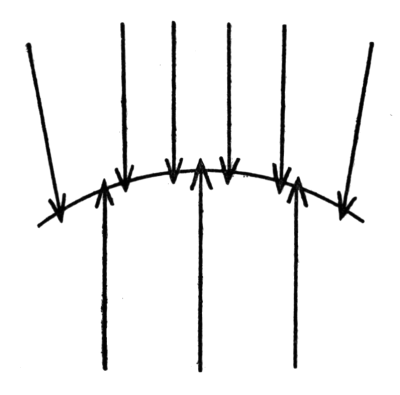

Diagram 1


The pupil can inwardly experience the region where these two meet. To feel this meeting, proves a right inner experience of the etheric world; he experiences the thoughts pressing in from the external etheric world — for it is the wisdom streaming towards him from the external etheric world that presses in and is perceived by means of the two feelings — that is the rightly-perceived etheric world. And when he perceives it thus he ascends to the higher Beings which only descend as far as to an etheric body and not to a physical human body. On the other hand, he may experience this etheric world wrongly, in a certain sense. Rightly, the etheric world is experienced between thinking and feeling, in the manner just described. The experience is purely an inner process in the soul. The elementary or etheric world may be experienced wrongly, if it is experienced on the boundary between breathing and our own etheric body. If the student performs breathing exercises too soon, or in an incorrect way, he gradually becomes a witness of his own breathing-process. With the breathing-process of which he is then aware (the act of breathing being usually unnoticed), he may acquire a breathing which perceives itself. And this feeling may be associated with a certain perception of the etheric world. By means of all kinds of breathing-exercises a person may gain the power of observing certain etheric processes which really are in the external world, but which belong to the lowest external psychic processes, and which, if experienced too soon, can never give the right idea of the true spiritual world.

Of course, from a certain point in the esoteric practice a regulated breathing-process may also begin; but this must be properly directed. It then comes about that we perceive the etheric world, as has been described, on the border between thinking and feeling, and what we thus learn to recognise is only strengthened by our also coming to know the grosser etheric processes which take place on the border between the etheric world and our breathing-processes. For the matter is as follows: — There is a world of genuine higher Spirituality; this we attain through the interaction which takes place — as we have described — between wisdom and feeling; there we come to the deeds accomplished in the etheric world by the beings belonging to the higher hierarchies. But there are a great number of all sorts of good and bad and hostile and horrible and dangerous elementary beings, which, if we become acquainted at the wrong time, obtrude themselves upon us as if they really were a valuable spiritual world, while they are nothing more, in a certain sense, than the lowest dregs of the beings of the Spiritual world. He who wishes to penetrate into the Spiritual world must indeed become acquainted with these beings, but it is not well to become acquainted with them at the beginning. For the peculiarity is this: that if a person becomes acquainted with these beings at first, without traversing the difficult path of his own inner experience, he grows fond of them, has astonishing partiality for them; and it may then occur that a man who thus raises himself into the spiritual world in a wrong way, especially through such physical training as may be called a changing of the breathing-processes, will describe certain things pertaining to this spiritual world, as they appear to him. He describes them in such a way that many people may think them extremely beautiful, while to the occultist who perceives them in the inward experience, they may be horrible and loathsome. Such things are quite possible in the experience of the spiritual world.

We need not here speak of other processes which a person may undertake as a training, and through which he may enter evil worlds, because in Occultism it is the custom not to speak of that which one comes to know as the dross of the spiritual world. It is not necessary that we should enter spiritually into that world; hence it is not the practice to speak of the methods which go still lower than the breathing processes. Even the breathing-process, when it is not done in the right way, really leads to the dross-beings, which we must indeed come to know, but not at first, as they then make us enamoured of them, which ought not to be. We shall only obtain a true, objective standpoint regarding their value when we have penetrated into the spiritual world from the other side.

If the student now begins in this way to feel streaming out of himself, as it were, responsive feelings towards wisdom — the feeling of shame, and the feeling of thankfulness  if these responsive feelings spring up, as it were, from his own organism, then he thereby becomes first acquainted in the most elementary way with something of which he must learn more in the course of his further occult development. In the last lecture we pointed out that in the course of our gradual experience of the etheric we become aware of what is active in the etheric part of our brain, the Amshaspands, referred to in the teaching of Zarathustra. As regards our ideas we may also say: There we learn at first to form an idea of the active archangel beings and what they have to do in us. Through what is here stored up, through what here arises within us as the feeling of thankfulness or shame, which feeling has a personal character because it comes forth from ourselves — through this we gain the first elementary true conception of what are called the Archai or Primal forces; for we experience in the first most elementary way in the manner described what the Primal forces bring about in us. While the student — when he begins to experience in the etheric — first experiences the Archangels in his head in a shadowy way, one might say, in their activities, in their etheric working, he experiences in that with which the wisdom comes in contact in him, and which reacts to it, the Primal forces permeated with something like will, not entirely of its nature, but the Primal forces which have entered into him and work in the human personality. When he learns to feel in this way, he gradually obtains an idea of what the occultist means when he says: On that primeval embodiment of our earth, Ancient Saturn, dwelt the Primal Forces or the Spirits of Personality at their human stage, so to speak. At that time these Primal Forces or Spirits of Personality were human. They have now developed further, and in so doing they have attained the capacity of working from the supersensible world. And how do they manifest at the present time, in our earth-period, this power which they have acquired through the progress of their evolution as far as the earth? They have attained the capacity of being able to work from the supersensible upon our own bodily nature, and so to work on our sheath that they produce forces in our etheric body manifesting in the manner described. They have placed these forces in us, and if we feel today we are so organised that we can develop within ourselves the above-mentioned feelings of gratitude and shame as an inner natural process (and this can become our own experience), we must admit: That this can become an inward experience, that our etheric body should pulsate in this way, and respond in this manner to the Wisdom — to this end have the Primal forces poured forces into it. In the same way man himself in future incarnations of our earth will attain to the ability to imprint capacities such as these into a corresponding covering in other beings, who will be below him; he will imprint them into their inner being. What man is to know regarding the higher worlds will gradually be gained by inner experience, by our ascending, by our passing over from physical to etheric experience.

Let us try to make these matters still clearer. On ancient Saturn — as you know — heat was the densest physical condition, as it were, the only physical condition which had been reached by the middle of the Saturn period. And as you may read in my book An Outline Of Occult Science, the Saturn activities in the physical were currents of heat and cold. We may also speak of these currents of heat and cold from the psychic, soul-aspect, and say: Heat flowed in streams, but this heat was the flowing gratitude of the Spirits of Personality; or this flowing heat which moved in a different direction was the flowing feeling of shame of the Spirits of Personality. What we must gradually acquire is the capacity of connecting the physical with the moral activity; for the further we go into the higher worlds the more closely are these two things connected — the physical occurrence, which then ceases to be physical, and the moral, which then flows through the world with the power of the laws of nature.

All that has just been described as something which appears in inner experience through the altered etheric body brings about something else in the human soul. This human soul gradually begins to feel discomfort in being this individual man at all, this single, personal human being. It is important for us to learn to notice this; and it is well to make a rule of noticing it. The less interest one has developed previously to this stage of esoteric development in what concerns humanity in general, in what is common to humanity, the more disquieting does one find this on pressing forward. A person having developed no interest in mankind in general, and yet wishing to undergo an esoteric development, would feel himself more and more as a burden. For example, a person to whom it is possible to go through the world without sympathy and fellow-feeling with what another may suffer and enjoy, who cannot well enter into the souls of others, nor transpose himself into the souls of other human beings, such a person, when he progresses in esoteric development, feels himself to be a kind of burden. If in spite of remaining unmoved by human sorrow and human joy he undergoes a theosophical development, the student drags himself about with him as a heavy weight; and we may be quite sure his theosophical development will merely remain external, an intellectual affair only, that such a person is merely taking up theosophy like learning a cookery-book or some external science, unless he feels that he is a mere weight if in spite of his development he cannot develop a heart that truly feels with all human sorrow and all human gladness. Hence it is very good if, during a theosophical, occult development, we extend our human interests; and really nothing is worse during this esoteric progress than not to try to gain an understanding of every kind of human feeling and human sensation and human life. Of course, this does not postulate the principle — this must be emphasised again and again — that we should pass over all the wrong that is done in the world without criticism, for that would be an injustice towards the world; but it postulates something else; whereas before esoteric development we may have felt a certain pleasure in finding fault with some human failing, this pleasure in finding fault with other people entirely ceases in the course of esoteric development. Who does not know in external life people who like to deliver very pertinent criticisms of other people's faults? Not that the pertinence of judgment over human faults has to cease, not that under all circumstances, such an act as was committed, let us say, by Erasmus of Rotterdam when he wrote his book, The Praise of Folly, should be condoned; no, it may be quite justifiable to be stern against the wrongs done in the world; but in the case of one who undergoes an esoteric development every word of blame he utters or sets in motion pains him, and prepares more and more pain for him. And the sorrow at being obliged to find fault is something which can also act as a barometer of the esoteric development. The more we are still able to feel pleasure when we are obliged to find fault or when we find the world ludicrous, the less we are really ready to progress; and we must gradually gain a sort of feeling that there is, developing more and more within us, a life which makes us see these follies and errors in the world with eyes of which one is critical and the other filled with tears, one dry and the other wet. This inner dividing into parts, this becoming more independent, as it were, of that which was previously intermingled, also forms part of the change undergone by the human etheric body.


Source: https://wn.rsarchive.org/Lectures/GA/GA0145/19130324p02.html

N.B. My birthday is March 24.

Related posts: 

https://martyrion.blogspot.com/2021/09/my-yoke-is-easy-my-dharma-is-penance.html

https://martyrion.blogspot.com/2021/11/if-everything-is-maya-then-cause-of-our.html

https://martyrion.blogspot.com/2021/10/how-does-one-attain-capacity-to-lift.html

https://martyrion.blogspot.com/2021/10/the-effects-of-esoteric-development-on.html

https://martyrion.blogspot.com/2021/10/i-am-light-of-world.html

https://martyrion.blogspot.com/2021/10/anthroposophia-our-very-own-being-our_17.html


https://martyrion.blogspot.com/2021/10/the-paradise-legend-and-holy-grail.html


https://martyrion.blogspot.com/2022/09/nobody-expects-steiner-disquisition.html?fbclid=IwAR3TiW7-yEIrke_E6BXtShsPwjMo1h0T8iNyRxg3DIbGuQPpciEPBz3ykAU


Regarding Karma and Reincarnation


Rudolf Steiner, Dornach, Switzerland, September 7, 1924:


As I have said, theoretical explanations about karma and repeated earthly lives cannot but remain unliving and inadequate, until our thought in this direction really flows into our understanding of the life around us. We must contemplate life itself in the light of karma and repeated earthly lives. But such a contemplation requires the very greatest earnestness, for it may indeed be said that the temptation is very great for man to spin out all manner of ideas about karmic connections and repeated earthly lives. The temptation is great; the source of illusions in this sphere is exceedingly great. And indeed, real investigations in this sphere can be made only by one to whom the spiritual world has in a sense been opened through his own soul-development.

Hence it must also be said that in these matters especially the investigator must rely on those foundations of conviction in his audience which may follow from other things he has brought to light. Indeed we ought not to have any confidence in one who begins without more ado to speak about repeated earthly lives in detail. What is derived from such occult depths as these must be confirmed and supported by the fact that many other things have already been produced which give a real basis for confidence in the spiritual investigator.

Now I think I may say that in the twenty-three to twenty-four years during which we have cultivated Anthroposophy, enough occult material has been gathered to warrant the description at this present time even of these bold researches into karma and repeated earthly lives, for the benefit of those who may have gained true confidence through the other realms of spiritual life which have been unfolded before them in the course of time. True, many are present here to-day who have been in the society for a comparatively short time. But the evolution of the society would be made impossible if we always had to begin at the beginning for those who enter newly; and on the other hand, to our great joy and satisfaction, large numbers of our oldest Anthroposophical friends have come here at this busy time when so many lecture-courses are to be given. Many Anthroposophists are gathered here who have witnessed nearly the whole period of Anthroposophical development and as time goes on opportunities must be created in the Anthroposophical Society for those in the earlier stages of membership to be properly introduced to all that must now be cultivated for the further course of the society's development.

I had to make these preliminary remarks, because what I shall say to-day will be given more in the form of a simple communication, and much of it may well appear exceedingly bold. It will however form the starting-point for what will follow in the succeeding lectures.

A human life after all only appears in its true nature when we consider how it passes through repeated lives on earth. Serious and responsible research in this domain is however by no means easy, for the results we gain do in a certain way contradict our habitual ideas on the subject.

At first sight, when considering the life of a man on earth with all the contents of his destiny, most people will be struck by those events of destiny which are connected with his outer profession or inner calling, with his social position and the like. As to the essential content of his earthly life, a human being will naturally appear to us in the light of these characteristics, nor need they by any means be superficial, for they may signify much for his inner life of soul. Nevertheless, to look into those depths in which repeated lives on earth are seen, it is necessary to look aside from many of these obvious and outer things that stamp themselves upon the destiny of a human being in his earthly life.

In effect, we must not imagine that the outer or inner calling of a man has a very great significance for his karma that passes through repeated lives on earth. True, even if we take a comparatively external and typical calling, that of a civil servant for example, we can conceive how much it is connected, even outwardly, with his destiny. Nevertheless, for the deepest relationships of karma or destiny those things that we can describe in a man as proceeding from his external calling are sometimes of no significance at all. And so it is with inner callings too. How easily we are tempted, in the case of a musician, to think that at any rate in one former earthly life he was, if not a musician, an artist of some kind. But it is by no means always so. Nay, I must go farther — it is so only in the rarest cases. For when we investigate these things in reality, we find that the continued thread of karma or destiny goes far deeper into the inner being of man and is little connected with his outer profession or inner calling. It is far more concerned with the inner forces of soul and resistances of soul, with moral relationships which can, after all, reveal themselves in any and every calling whether it be an outer or an inner one.

For this very reason, the investigation of karma — of the thread of destiny — requires us to concentrate on circumstances in the life of a human being which may often appear outwardly trivial or of small importance. In this connection I must refer again and again to a fact that once occurred to me.

I had to investigate the karmic connections of a certain human being. He had many characteristics in this his present life. He had a certain task in life, he had indeed his profession. But to intuitive vision, from all that he did out of his profession, or that he did as a philanthropist and the like, no indication of his former earthly lives could be found. Not that these things were unconnected with his former lives on earth, but for spiritual vision they gave no clue. One could penetrate no farther when concentrating on these facts of his profession or of his philanthropic work. On the other hand, curiously enough, a quite unimportant peculiarity of his life gave a result. He frequently had to lecture. Every time before he began he quite habitually took out his pocket handkerchief and blew his nose! I often heard him lecture, and without exception whenever he began to speak (I do not mean when he began to speak in conversation, but whenever he had to speak continuously) he first took out his pocket-handkerchief and blew his nose. Now this gave a picture from which there radiated out the power to look into his former lives on earth.

I give this as a particularly grotesque example. It is not always so grotesque; but the point is, we must be able to enter into the whole human being if we wish to look in any valid way into his karma.

You see, from a deeper point of view, the special calling of a man is, after all, something that results from education and other circumstances. On the other hand, it is deeply connected with his inner spiritual configuration if every time before he begins to make a speech he simply cannot help taking out his pocket-handkerchief and blowing his nose! That is a thing far more intimately connected with the being of a man. Still, I admit, this is a radical and extreme example. It is not always quite like this. I wanted only to awaken in you the idea that for the investigation of karma, that which lies on the obvious surface of a man's life is as a rule of no use. We have to enter into certain intimate features of his life — I do not mean into things that one pries into unjustifiably — but into the finer qualities and characteristics that nevertheless appear quite openly.

Having said this by way of introduction, I will now relate a certain instance perfectly frankly and straightforwardly, and of course with all the reservations which are necessary in the case. I mean with the reservation that everyone is free to believe or disbelieve what I now say, though I must assure you that it is based on the deepest and most earnest spiritual-scientific research.

These things do not by any means come to one if one approaches them with the deliberate intention to investigate, like a modern scientist in his laboratory. In a certain way, researches on karma must themselves result from karma.

I had to mention this fact at the end of the new edition of my book Theosophy, for among the various strange requirements that have been made of me from time to time during my life, this too occurred not long ago. — It was suggested that I should submit myself to examination in some psychological laboratory, so that they might ascertain whether the things I have to say on spiritual science are well founded. It is of course just as absurd as if someone were to produce mathematical results and, instead of testing their accuracy, you were to challenge him to submit to an examination in a laboratory, to see whether or not he was a real mathematician. Absurdities of this kind go under the name of scholarship to-day and are taken seriously by learned people!

I said quite definitely at the close of the new edition of my Theosophy, that experiments in this spirit can of course give no result. And I also mentioned that all the paths of approach which lead to the discovery of a certain occult result must themselves be prepared in a spiritual, in a super-sensible way.

Now I once had occasion to meet an eminent doctor of our time, who was well known to me by reputation and especially by his literary career. I had a very high regard for him. You see, I am mentioning the karmic details which led to the investigation, the results of which I shall now describe. The investigation itself took a very long time and only reached its conclusion during the last few weeks. Only now has it reached a stage which enables me conscientiously to speak of it. I am mentioning all these details in order that you may see some at least of the inner connections, though of course not all of them.

Thus I made the acquaintance of this doctor, a man of our own day. When I met him I was in the company of another person whom I had known very well for a long time. This other person had always made, I will not say a deep, but a very thorough impression on me. He was exceedingly fond of the society of men who were interested in occultism in the widest possible range, though an occultism somewhat externally conceived. He was fond of relating the views of his many acquaintances on all kinds of occult matters, and especially on the occult connections of what the modern artist should strive for, as a lyric and epic poet, or as a dramatist. Around this person there was what I might call a kind of moral, ethical aura. I am applying the word ‘moral’ to all that is connected with the soul-qualities under the command of the will.

I was paying a visit to him, and in his company I found the other man first mentioned, whom I knew by reputation and respected very highly for his literary and medical career. Everything that took place during this visit made a deep impression on me and impelled me to receive the whole experience into the realm of spiritual research.

Then a very remarkable thing happened. By witnessing the two persons in the company of one another, and by the impression which my new acquaintance made on me — (I had known him for a long time as an eminent literary and medical man and had a great regard for him, but this was the first time that I saw him in the flesh) — by these impressions I gained certain perceptions. To begin with however, it enabled me, not to investigate in any way the connections in life and destiny of my new acquaintance. On the contrary, my seeing them together shed light as it were upon the other one, whom I had long known. And the result was this. — He had lived in ancient Egypt, not in his last, but in one of his former lives on earth. And (this is the peculiar thing) he had been mummified, embalmed as a mummy. Soon afterwards I discovered that the mummy was still in existence. Indeed a long time afterwards I saw the actual mummy. This, then, was the starting-point. But once the line of research had been kindled in connection with the person whom I had long known, it shed its light still farther, and eventually I was enabled to investigate the karmic connections of the other man, my new acquaintance, the doctor. And the following was the result.

As a general rule one is led from one earthly life of a human being to the preceding one. But in this case intuition led far back into ancient Egypt, to a kind of chieftain in ancient Egypt. It was a chieftain who in a certain sense, indeed in a very interesting way, possessed the ancient Egyptian Initiation, but had become somewhat decadent as an Initiate. In the further course of his life, he began to take his Initiation not very seriously, indeed he even treated it with a certain scorn. Now this man had a servant, who in his turn was extremely serious. This servant was of course not initiated; but both of them together were given the task of embalming mummies and procuring the substances for this purpose, which was no easy matter.

Now especially in the more ancient periods of Egypt, the process of embalming mummies was very complicated and demanded an intimate knowledge of the human being, of the human body. Nay more, of those who had to do the embalming — if they did it legitimately — deep knowledge of the human soul was required. The chieftain of whom I spoke had been initiated for this very work, but he gradually became, in a manner of speaking, frivolous in relation to this, his proper calling. So it came about that in the course of time he betrayed (so they would have put it in the language of the Mysteries) the knowledge he had received through his Initiation to his servant, and the latter gradually proved to be a man who understood the content of Initiation better than the Initiate himself. Thus the servant became the embalmer of mummies, and at length his master did not even trouble to supervise the work, though of course he still took advantage of the social position, etc., which this honourable task involved. But at length his character became such that he no longer enjoyed great respect, and he thus came into various conflicts of life. The servant, on the other hand, worked his way up by degrees to a very, very earnest conception of life, and was thus taken hold of, in a remarkably congenial way, by a kind of Initiation. It was no real Initiation, but it lived within him instinctively. Thus a large number of mummies were mummified under the supervision and co-operation of these two people.

Time went on. The two men passed through the gate of death and underwent the experiences of which I shall speak next time — the experiences in the super-sensible which are connected with the development of karma or destiny. And in the Roman epoch they both of them came back to earthly life. They came back at the very time when the dominion of the Roman Emperors was founded, in the time of Augustus — not exactly, but approximately, in the time of Augustus himself.

I said above that this is a matter of conscientious research, no less exact in its methods than any researches of physics or chemistry, and I should not speak of these things unless for some weeks past it had become possible for me to speak of them so definitely.

The chieftain, who had gradually become a really frivolous Initiate, and who, when he had passed through the gate of death, had felt this as an extraordinarily bitter trial of earthly life, experiencing it in all the bitterness of its effects — we find him again as Julia, the daughter of Augustus. She married Tiberius, the step-son of Augustus, and led a life which to herself seemed justified but was considered, in the Roman society of that time, so immoral that at length both she and Tiberius were banished.

The other man — the servant who had worked his way from the bottom upwards nearly to the grade of an Initiate — was born again at the same time, as the Roman historian Titus Livius, or Livy.

It is most interesting how Livy came to be an historian. In the ancient Egyptian times he had embalmed a large number of mummies. The souls who had lived in the bodies of these mummies — very many of them — were reincarnated as Romans. And certain ones among them were actually reincarnated as the seven Kings of Rome. For the Seven Kings were no mere legendary figures. Going back into the time when the chieftain and his servant had lived in Egypt, we come into a very old Egyptian epoch. Now through a certain law which applies especially to the reincarnation of souls whose bodies have been mummified, these souls were called back again to earth comparatively soon. And the karmic connection of the servant of the chieftain with the souls whose bodies he had embalmed was so intimate, that he had to write the history of the very same human being whom in a previous life he had embalmed, though naturally, he also included the history of many others whom he had not embalmed. Thus Titus Livius became an historian. Now I would like some, indeed as many of you as possible, to take Livy's Roman History, and, with the knowledge that results from these karmic connections, to receive a real impression of his style. You will see that his peculiar penetration into the human being and his tendency at the same time towards the style of the myth, is akin to that intimate knowledge of man which an embalmer could attain.

We do not perceive such connections until the corresponding researches have been made. But once this has been done, a great light is shed on many things. It is difficult to understand the origin of the peculiar style of Titus Livius, who as it were embalms the human beings whom he describes. For such is his style. Real light is thrown upon it when we point to these connections.

Thus we have the same two people again as Julia and Titus Livius. Then Julia and Livy passed once more through the gate of death. The one soul had had the experience of being an Initiate to a considerable degree, and having then distorted his Initiation by frivolous conduct. He had discovered all the bitterness of the after-effects of this in the life between death and a new birth. He had then undergone a peculiar destiny in his new life on earth as Julia, of which life you may read in history. The result was, that in his next life between death and a new birth (following on the life as Julia) he conceived a strong antipathy to this his incarnation as Julia. And in a curious way this antipathy of his was universalised. For spiritual intuition shows this individuality in his life between death and a new birth as though perpetually crying out: “Would that I had never become a woman! It was the evil that I did in yonder life in ancient Egypt which led me thus to become a woman.”

We can now trace the life of these two individualities still farther. We come into the Middle Ages. We find Livy again as the glad poet and minstrel in the very centre of the Middle Ages. We are astonished to find him thus, for there is no connection between the external callings. But the greatest possible surprises that a human being can possibly have are those that result from a real study of successive lives on earth. The Roman historian, with his style that proceeded from a knowledge of man acquired in embalming mummies, with his style so wonderfully light — we find him again as the poet Walther von der Vogelweide. His style is carried upwards, as it were, upon the wings of lyric poetry.

Walther von der Vogelweide lived in the Tyrol. He had many patrons; and among his many patrons there was one very peculiar man, who was on familiar terms with alchemists of every kind, for there were scores of alchemists at that time, in the Tyrol. This man was himself the owner of a castle, but he frequented all manner of alchemists' dens and hovels. In so doing he learned extraordinarily much, and (as happened in the case of Paracelsus too) by spending his time in the dens of alchemists he was impelled to study all occult matters very intensely, and gained an unusually intense feeling for occult things. He thus came into the position of rediscovering in the Tyrol what was then only known as a legend, namely, the Castle in the Mountain — the Castle in the Rocks — (which indeed no one would have recognised as such, for it consisted of rocks, it was hollowed out of the rocks) — I mean, the Castle of the Dwarf King Laurin. The daemonic nature in the district of the Castle of the Dwarf King Laurin made a profound impression on him. Thus there was a remarkable combination in this soul — Initiation which he had carried into frivolity, annoyance at having been a woman and having thus been drawn into the sphere of Roman immorality and, at the same time, Roman cant and hypocrisy about morals; and lastly, an intimate knowledge, though still only external, of all manner of alchemical matters, which knowledge he had extended to a clear feeling of the nature-daemons and of other spiritual agencies in nature.

These two men — though it is not recorded in the biography of Walther, nevertheless it is the case — Walther von der Vogelweide and this other man often came together, and Walther received many an influence and impulse from him.

Here we have an instance of what is really a kind of karmic law. We see the same people drawn together again and again, called to the earth again and again simultaneously, complementing one another, living in a kind of mutual contrast. It is interesting once more, to enter into the peculiar lyrical style of Walther. It is as though at last he had grown thoroughly sick of embalming dead mummies and had turned to an entirely different aspect of life. He will no longer have anything to do with dead things, but only with the fullness and joy of life. And yet again, there is a certain undercurrent of pessimism in his work. Feel the style of Walther von der Yogelweide, feel in his style the two preceding earthly lives: feel too, his restless life. It is extraordinarily reminiscent of that life which dawns upon one who spends much of his time with the dead, when many destinies are unburdened in the soul. For such indeed was the case with an embalmer of mummies.

Now we go on. — My further researches into this karmic chain led me at length into the same room where I had visited my old acquaintance, whom I had recognised as an Egyptian mummy. And now I perceived that this very mummy had been embalmed by the other man whom I now met in his room. The whole line of research led me back to this same room. In effect, I found the soul who had passed through the servant of the old Egyptian embalmer, through Titus Livius, through Walther von der Vogelweide — I found him again in the doctor of our time, in Ludwig Schleich.

Thus astonishingly do the connections in life appear. Who, with the ordinary consciousness alone, can understand an earthly life? It can only be understood when we know what is there in the foundations of a soul. Theoretically, many people know that deep in the foundations of the soul there are the layers of successive earthly lives. But it becomes real and concrete only when we behold it in a specific instance.

Then inner vision was directed out of this room once more. (For in the case of the other man, who had been mummified by this one, I was led to no more clues — at any rate to no important ones.) On the other hand I now perceived the further soul-pilgrimage of the old chieftain, of Julia, of the discoverer of Laurin's Castle. For he came back to earth as August Strindberg.

Now I would like you to take the whole life and literary work of August Strindberg and set it against the background which I have just described. See the peculiar misogyny of Strindberg, which is no true misogyny, but proceeds from quite different foundations. Look, too, at all the strange daemonic elements that occur in his works. See his peculiar attraction to all manner of alchemistic and occult arts and artifices. And at length, look at the adventurous life of August Strindberg. You will find how well it stands out against the background which I have described.

Then read the Memoirs of Ludwig Schleich, his relations to August Strindberg, and you will see how all this arises once more against the background of their former earthly lives. Indeed, from the Memoirs of Ludwig Schleich a very remarkable light may suddenly arise, a light truly astonishing. For the man in whose company I first met Ludwig Schleich — the man of whom I said that in his ancient Egyptian life he was mummified by Schleich — it is he of whom Schleich himself tells in his Memoirs that he led him to Strindberg. In a past life, Strindberg and Schleich had worked together upon the corpse. And the soul who dwelt in that body, led them together again.

Thus, all that we have to explain to begin with about repeated earthly lives and the karmic connections in general, becomes real and concrete. Only then do the facts that appear in earthly life become transparent. A single human life on earth is an entire mystery. What else can it be, until seen against the background of the former lives on earth?

My dear friends, when I explain such things as these I always have an accompanying feeling. If these things which it has become possible to set forth since the Christmas Foundation Meeting are to be regarded in a true sense they demand real earnestness in the listener. They demand an earnest spirit. They require us to stand with real earnestness in the Anthroposophical Movement. For they might easily lead to all manner of frivolities. But they are brought forward here because it is necessary for the Anthroposophical Society to-day to take its stand on a basis of real earnestness and to become conscious of its tasks in modern civilisation.

Having thus laid the foundation, I wish to speak in the next lecture about the karma of the Anthroposophical Society. And in the following lecture which I shall then announce, I shall pass on to describe what these studies of karma may become for the human being who wishes to understand his own life in its deeper meaning.


Source: September 7, 1924. GA 238

Tuesday, September 6, 2022

Weaving the Web of Karma


Rudolf Steiner, Dornach, Switzerland, September 5, 1924:


Many friends have come here to-day for the first time since the Christmas Foundation Meeting and I must therefore speak of it, even if only briefly, by way of introduction. Through this Christmas Foundation the Anthroposophical Society was to be given a new impulse, the impulse that is essential if it is to be a worthy channel for the life which, through Anthroposophy, must find embodiment in human civilisation. Since the Christmas Foundation an esoteric impulse has indeed come into the Anthroposophical Society. Hitherto this society was as it were the administrative centre for Anthroposophy. From its beginning onwards, Anthroposophy was the channel for the spiritual life that has been accessible to mankind since the last third of the 19th century. Our conception of the Anthroposophical Movement, however, must be that what takes its course on earth is only the outer manifestation of something that is accomplished in the spiritual world for the furtherance of the evolution of humanity. And those who wish to be worthily connected with the Anthroposophical Movement must also realise that the spiritual impulses are also at work in the sphere of the Anthroposophical Society itself.

What does it really amount to when a man has a general, theoretical belief in a spiritual world? To believe in theory in a spiritual world means to receive it into one's thoughts. But although in their own original nature thoughts represent the most spiritual element in modern man, the thoughts themselves are such that in their development as inner spirit during the last four to five centuries, they are adapted only to receive truths relating to material existence. And so people to-day have a spiritual life in thoughts, but as members of contemporary civilisation they fill it with a material content only. Theoretical knowledge of Anthroposophy also remains a material content until there is added to it the inner, conscious power of conviction that the spiritual is concrete reality; that wherever matter exists for the outer eyes of men, not only does spirit permeate this matter, but everything material finally vanishes before man's true perception, when this is able to penetrate through the material to the spiritual.

But such perception must then extend also to everything that is our own close concern. Our membership of the Anthroposophical Society is such a concern; it is a fact in the outer world. And we must be able to recognise the spiritual reality corresponding to it, the spiritual movement which in the modern age unfolded in the spiritual world and will go forward in earthly life if men do but keep faith with it. Otherwise it will go forward apart from earthly life; its link with earthly life will be maintained if men find in their hearts the strength to keep faith with it.

It is not enough to acknowledge theoretically that spiritual reality hovers behind mineral, plant, animal and man himself; what must penetrate as deep conviction into the heart of every professed Anthroposophist is that behind the Anthroposophical Society too — which in its outward aspect belongs to the world of maya, of illusion — there hovers the spiritual archetype of the Anthroposophical Movement. This conviction must take real effect in the work and activity of the Anthroposophical Society. Such a conception will in the future contribute in many ways to the provision of the right soil for that spiritual Foundation Stone which was laid for the Anthroposophical Society at the time of the Christmas Meeting.

And this brings me to speak of what I shall have to say to you in the coming days, for which this introductory lecture is intended to provide guiding lines. I want to show how at this serious point in its existence the Anthroposophical Movement is actually returning to its own germinal impulse. When at the beginning of the century the Anthroposophical Society came into being out of the framework of the Theosophical Society, something very characteristic was foreshadowed. While the Anthroposophical Society — then the German Section of the Theosophical Society — was in process of formation, I gave lectures in Berlin on Anthroposophy. Therewith, at the very outset, my work was given the hallmark of the impulse which later became an integral part of the Anthroposophical Movement.

Apart from this, I can remind you to-day of something else. — The first few lectures I was to give at that time to a very small circle were to have the title, “Practical Exercises for the Understanding of Karma.” I became aware of intense opposition to this proposal. And perhaps Herr Guenther Wagner, now the oldest member of the Anthroposophical Society, who to our great joy is here to-day and whom I want to welcome most cordially as an Elder of the society, will remember how strong was the opposition at that time to much that from the beginning onwards I was to incorporate in the Anthroposophical Movement.

Those lectures were not given. In face of the other currents emanating from the Theosophical Movement it was not possible to proceed with the cultivation of the esotericism which speaks unreservedly of the reality of what was always there in the form of theory.

Since the Christmas Foundation, the concrete working of karma in historical happenings and in individual human beings has been spoken of without reserve in this hall [The temporary lecture-hall in the “Schreinerei” (workshop) at the Goetheanum.] and in the various places I have been able to visit. And a number of Anthroposophists have already heard how the different earthly lives of significant personalities have run their course, how the karma of the Anthroposophical Society itself and of the individuals connected with it has taken shape. Since the Christmas Foundation these things have been spoken of in a fully esoteric sense; but since the Christmas Foundation, also, our printed Lecture-Courses have been accessible to everyone interested in them. We have thus become an esoteric and at the same time a completely open society.

Thus we return in a certain sense to the starting-point. What must now be reality was then intention. As many friends are here for the first time since the Christmas Foundation, I shall be speaking to you in the coming lectures on questions of karma, giving a kind of introduction to-day by speaking of things which are also indicated, briefly, in the current News Sheet for members of the society.

As is clear from our anthroposophical literature, the development of human consciousness is bound up with the attainment of those data of knowledge which point to facts and beings of the spiritual world and with penetration into these facts. We shall hear how this spiritual world, the penetration into which has become possible through the development of human consciousness, can then be intelligible to the healthy, unprejudiced human intellect. It must always be remembered that although actual penetration into the spiritual world requires the development of other states of consciousness, the understanding of what the spiritual investigator brings to light requires only the healthy human intellect, the healthy human reason that endeavours to put prejudice aside.

In saying this, one immediately meets stubborn obstacles in the modern life of thought. When I once said the same thing in Berlin, a well-meaning article appeared on the subject of the public lecture I had given before a large audience. This article was to the following effect: Steiner maintains that the healthy human intellect can understand what is investigated in the spiritual world. But the whole trend of modern times has taught us that the healthy human intellect can know nothing of the super-sensible world, and that if it does, it is certainly not healthy!

It must be admitted that in a certain sense this is the general opinion of cultured people at the present time. What it means, translated into bald language, is this: If a man is not mad, he understands nothing of the super-sensible world; if he does, then he is certainly mad! That is the same way of speaking about the subject, only put rather more plainly.

We must try to comprehend, therefore, how far the healthy human intellect can gain insight into the results of spiritual investigation achieved through the development of states of consciousness other than those we are familiar with in ordinary life. For centuries now we have been arming our senses with laboratory apparatus, with telescopes, microscopes and the like. The spiritual investigator arms his outer senses with what he himself develops in his own soul. Investigation of nature has gone outwards, has made use of outer instruments. Spiritual investigation goes inwards, makes use of the inner instruments evolved by the soul in steadfast activity of the inner life.

By way of introduction to-day I want to help you to understand the evolution of other states of consciousness, first of all simply by comparing those that are normal in present-day man with those that were once present in earlier, primitive — not historic but prehistoric — conditions of human evolution.

Man lives to-day in three states of consciousness, only one of which, really, he recognises as a source of knowledge. They are:

Ordinary waking consciousness;

Dream consciousness;

Dreamless sleep consciousness.

In ordinary waking consciousness we confront the outer world in such a way that we accept as reality what can be grasped through the senses, and allow it to work upon us; we grasp this outer, material world with the intellect that is bound to the brain, or at any rate to the human organism, and we form ideas, concepts, emotions and feelings, too, about what has been taken in through the senses. Then in this waking consciousness we grasp the reality of our own inner life — within certain limits. And through all kinds of reflection, through the development of ideas, we come to acknowledge the existence of a super-sensible element above material things. I need not further describe this state of consciousness; it is known to everyone as the state he recognises as pertaining to his life of knowledge and of will here on earth.

For the man of the present time, dream consciousness is indistinct and dim. In dream consciousness he sees things of the outer world in symbolic transformations which he does not always recognise as such. A man lying in bed in the morning, still in the process of waking, does not look out at the rising sun with fully opened eyes; to his still veiled gaze the sunlight reveals itself by shining in through the window. He is still separated as by a thin veil from what at other times he grasps in sharply outlined sense-experiences and perceptions. Inwardly, his soul is filled with the picture of a great fire; the heat of the fire in his dream symbolises the shining in of the rising sun upon eyes not yet fully opened.

Or again, someone may dream that he is passing through lines of white stones placed along each side of a roadway. He comes to one of the stones and finds that it has been demolished by some force of nature or by the hand of man. He wakes up; the toothache he feels makes him aware of the decayed state of a tooth. The two rows of teeth have been symbolised in his dream-picture; the decayed tooth, in the image of the demolished stone.

Or we become aware of being, apparently, in an overheated room where we feel discomfort. We wake up: the heart is thumping vigorously and the pulse beating rapidly. The feverish movement of the heart and pulse is symbolised in the overheated room. Inner and outer conditions are symbolised in dream; reminiscences of the life of day, transformed and elaborated in manifold ways into whole dream-dramas, absorb the sleeper's attention. Nor does he by any means always know to what extent things are elaborated in the miraculous arena of his life of soul. And concerning this dream-life, which may play over into waking life when consciousness is dimmed in any way, he often labours under slight illusions.

A scientist is passing a bookshop in a street. He sees a book about the lower animal species — a book which in view of his profession has always greatly interested him. But now, although the title indicates a content of vital importance to a scientist, he feels not the faintest interest: and then, suddenly, as he is merely staring at what otherwise he would have seen with keen excitement, he hears a barrel-organ in the distance playing a melody which at first entirely escapes his memory ... and he becomes all attention. — Just think of it: the man is looking at the title of a scientific treatise; he pays no attention to it but is gripped by the playing of a distant barrel-organ which in other circumstances he would not have listened to for a moment. What is the explanation? Forty years ago, while still quite young, he had danced for the first time in his life, with his first partner, to the same tune; he is reminded of this by the tune which he has not heard for forty years, played on the barrel-organ! Because he has remained very matter-of-fact, the scientist remembers the occasion pretty accurately.

The mystic often comes to the stage of inwardly transforming a happening of this kind to such an extent that it becomes something entirely different. One who with deep and sincere conscientiousness embarks upon the task of penetrating into the spiritual life must also keep strictly in mind all the deception and illusion that may arise in the life of the soul. In deepening his life of soul a man can very easily believe that an inner path has been discovered to some spiritual reality, whereas in fact it is no more than the transformed reminiscence of a barrel-organ melody! This dream-life is full of wonder and splendour, but can be rightly understood only by one who is able to bring spiritual insight to bear upon the appearances of human life.

Of the life of deep, dreamless sleep, man has in his ordinary consciousness nothing more than the remembrance that time continues to flow between the moment of falling asleep and the moment of waking. Everything else he has to experience again with the help of his waking consciousness. A dim, general feeling of having been present between the moments of falling asleep and waking is all that remains from dreamless sleep.

Thus we have to-day these three states of consciousness: waking consciousness, dream consciousness, dreamless sleep consciousness. If we go back into very early ages of human evolution — not, as I said, in historic times but prehistoric times accessible only to those means of spiritual investigation of which we shall be speaking here in the coming days — then we also find three states of consciousness, but essentially different in character. What we experience to-day in our waking hours was not experienced by the men of those primeval times; instead of material objects and beings with clear shapes and sharp edges, they saw all the physical boundaries blurred.

In those times a man who might have looked at you all sitting here would not have seen the sharp outlines demarcating you as human beings to-day; he would not, like a man to-day, have seen these contours bound by so many lines, but for his ordinary waking consciousness the forms would have been blurred; they would have lacked definition. Everything would have been seen with less precision, would have been pervaded by an aura, by a spiritual radiance, a glimmering, glistening iridescence extending far beyond the circumference that is perceived to-day. The onlooker would have seen how the auras of all of you sitting here are interwoven. He would have gazed into these glimmering, sparkling, iridescent auras of the soul-life of those in front of him. It was still possible in those days to gaze into the life of soul because the human being was bathed in an atmosphere of soul-and-spirit.

To use an analogy: if in the evening of a bright, dry day we are walking through the streets, we see the lights of the street-lamps in definite outlines. But if the evening is misty, we see these same lights haloed by all sorts of colours — colours which modern physics interprets quite wrongly, regarding them as subjective phenomena, whereas in truth they give us an experience of the inmost nature of these lights, connected with the fact that we are moving through the watery element of the fog. The men of ancient times moved through the element of soul-and-spirit; when they looked at other men they saw their auras — which were not subjective phenomena but a real and objective part of the human being. Such was one state of consciousness in these men of old.

Then they had a state of consciousness which linked on to this, just as with us the sleep that is invaded by dreams links on to the waking state; again it was not the same as our present dream condition, but everything that was material around it disappeared, vanished away. For us, sense-impressions become symbols in the state of dream consciousness: sunshine becomes fiery heat, the rows of teeth become two lines of stones, dream-memories become earthly or also spiritual dramas. The sense-world is always there; the world of memories remains. It was different for the consciousness of one who lived in primeval times of human evolution — and we shall realise by and by that this applies to all of us, for those sitting here were present then in earlier earthly lives. In those times, when the sun's light by day grew weaker, man did not see symbols of physical things, but the physical things vanished before his eyes. A tree standing before him vanished; it was transformed into the spiritual and the spirit-being belonging to the tree took its place. — The legends of tree-spirits were not the inventions of folk-fantasy; the interpretation of these legends, however, is an invention of the fantasy of scholars who are groping in a morass of fallacy. — And it was these spirits — the tree-spirit, the mountain-spirit, the spirit of the rocks — who in turn directed the eyes of the human soul into that world where man is between death and a new birth, where he is among spiritual realities just as here on earth he is among physical realities, where he is among spiritual beings as on earth he is among physical beings. — This was the second state of consciousness. We shall presently see how our ordinary dream consciousness can also be transformed into this other consciousness in a man of modern time who is a seeker for spiritual knowledge.

And there was a third state of consciousness. Naturally, the men of ancient times also slept; but when they awoke they had not merely a dim remembrance of having lived through time, or a dim feeling of continuous life, but a clear remembrance of what they had experienced in sleep. And it was precisely out of this sleep that there came the impressions of past earthly lives with their connections of destiny, together with the knowledge, the vision, of karma.

Modern man has waking consciousness, dream consciousness, dreamless sleep consciousness. Early humanity had also three states or conditions of consciousness: the state of consciousness in which he perceived reality pervaded by spirit; the state in which he had insight into the spiritual world; and the state in which he had the vision of karma. In primeval humanity, consciousness was essentially in a condition of evening twilight.

This evening twilight consciousness has passed away, has died out in the course of the evolution of mankind. A morning dawn consciousness must arise — into which modern spiritual investigation has already found its way. And by strengthening his own soul-forces man must learn to look at every tree or rock, every spring or mountain, or at the stars, in such a way that the spiritual fact or spiritual being behind every physical thing is revealed to him.

It can become an exact science, a source of exact knowledge (although people scoff at it to-day as if it were craziness or sheer delusion) so that when a genuine knower looks at a tree, the tree, although it represents a physical reality, becomes a void, as it were leaving the space free before his gaze, and the spirit-being of the tree comes to meet him. Just as the sun's light is reflected to our physical eyes from all outer, physical objects, so will humanity come to perceive that the spiritual essence of the sun, pervading the world with its life, is also a living reality in all physical beings. As the physical light is reflected back to our physical eyes, so from every earthly being there can be reflected back as a reality to our eyes of soul, the divine-spiritual, all-pervading essence of the sun. And as man now says: “The rose is red” ... the underlying truth being that the rose is giving back to him the gift he himself receives from the physical-etheric sun-nature ... he will then be able to say that the rose gives back to him what it receives from the soul-and-spiritual essence of the sun which streams through the world with its quickening life.

Man will again find his way into a spiritual atmosphere, will know that his own being is rooted in this spiritual atmosphere. He will come to realise that within the dream consciousness, which to begin with can yield only chaotic symbolisations of the outer life of the senses, there lie the revelations of a world of spirit through which we pass between death and a new birth; furthermore, that in the consciousness of deep sleep there weaves and lives in us as an actual and real nexus of forces that which, after waking, leads us into connection with the working out of our destiny, of our karma. What we live through in our waking hours as destiny, notwithstanding all freedom, is spun during our life of sleep, when with the soul and spirit, which have left the physical and etheric, we lead a life together with divine Spirits; with those divine Spirits, too, who carry over the fruits of earlier lives into this present life. And one who through the development of the corresponding forces of soul succeeds in penetrating with vision into the life of dreamless sleep, discovers therein the connections of karma. Moreover it is only in this way that the historical life of humanity acquires meaning, for it is woven out of what men carry over from earlier epochs, through the life between death and rebirth, into new life, into new epochs. When we look at some personality of the present or some other age, we understand him rightly only when we include his past earthly lives.

During the coming days, then, we shall be speaking of that spiritual investigation which, while concerning itself first with personalities in history but then also with everyday life, leads from the present life, or a life in some other age to earlier earthly lives.


Source: September 5, 1924. GA 238