Saturday, October 4, 2025

Old and new methods of initiation. Lecture 2 of 2


Rudolf Steiner, Dornach, Switzerland

February 12, 1922


Considerations such as those we embarked on yesterday are, of course, not necessarily set out for the purpose of inviting anyone to start practising what is needed for attaining super-sensible knowledge. To a certain extent this intention is, of course, also present. But the main reason is to make known what kind of higher knowledge can be attained by such means. A declaration stating that one thing or another is possible in man's development is, at the same time, a declaration about the intrinsic nature of the human being. It can be stated that the human being seeking initiation is capable of extricating his soul and spirit element from his physical body, either by the means described yesterday with reference to the ancient Mysteries, or by means suitable for today, which I am about to discuss briefly. A statement such as this shows that the element of soul and spirit is an independent entity which has its own existence over and above that of the body. So a discussion about higher knowledge is, at the same time, a revelation about the being of man; this is, in the first instance, what is important for the dissemination of anthroposophical wisdom.

Yesterday I described how in the ancient Mysteries the bodily nature of man was treated so that it became able to free its soul nature in both directions. I said that the two main aspects of this in the ancient Mysteries were, on the one hand, the draught of forgetfulness, and, on the other hand, the occasioning of states of anxiety, fear, shock. The draught of forgetfulness, I said, wiped from memory everything pertaining to ordinary earthly life. But this negative effect was not the main point. The main point was that during the process of coming to Mystery knowledge the brain was actually made physically softer, as a result of which the spiritual element which is usually held off was no longer held off by the brain but allowed through, so that the pupil became aware of his soul and spirit element and knew that this had been in him even before birth, or rather, even before conception.

The other aspect was the shock which caused the organism to become rigid. When the organism grows rigid it no longer absorbs the soul and spirit element in the way it usually does with regard to its expression in the will. On the one hand the rigid bodily organism withdraws from the element of soul and spirit, and on the other hand the element of soul and spirit becomes perceptible to the pupil. Through the softening of the brain the thought aspect of the soul became perceptible to the pupil of the ancient Mysteries, and through the rigidifying of the rest of the organism the will aspect became perceptible. In this way, initiation gave the pupil a perception, a picture of the element of soul and spirit within him. But this picture was dreamlike in character. For what was it that was freed on the one hand towards the thought aspect, and on the other hand towards the will aspect? It was that part which descends from realms of spirit and soul to unite with the physical, bodily nature of man. Only by taking possession of the body can it become capable of making use of the senses and of the intellect. It needs the body for these things. Without the use of the body these things remain dreamlike, they remain dull, twilit. So by receiving his detached soul and spirit element as a result of the processes described, the pupil received something dreamlike, which, however, also contained a thought element.

As I said yesterday, if people were to follow these procedures today, the condition induced in consequence would be a pathological condition. For since the Mystery of Golgotha human beings have progressed in such a way that their intellect has become stronger by comparison with their earlier, more instinctive manner of knowing. This strengthening of intellectual life has come over mankind particularly since the fifteenth century. It is extremely significant that throughout the Middle Ages people still knew that in order to attain higher knowledge, or indeed to lead a higher kind of life, it was necessary to extricate the soul from the body.

If Schiller had managed to write a great drama he had planned, Die Malteser (The Knights of Malta), German literature would probably have been all the richer for a work on this medieval knowledge about the super-sensible world, a work on the relationship of the Middle Ages to super-sensible matters. It is a most interesting aspect of German culture that, precisely in the years when Napoleon destroyed the Order of the Knights of Malta,1 Schiller was planning to write a drama about them, about the siege of Malta by the Turks and its defence by the grand master of the Order, de La Valette. Schiller was obviously prevented from writing this drama. He left it on one side and wrote Wallenstein (Wallenstein's Camp) instead. The Order of the Knights of Malta originated at the time of the Crusades. Schiller's drama would have shown clearly that the members of such an Order, which had the external task of working for the community and caring for the sick, considered that they could only do such work if they at the same time strove towards the attainment of a higher life.

At the time when the Order of the Knights Templar and the Order of the Knights Hospitaller of St John—which later became the Order of the Knights of Malta—were founded, and indeed throughout the Middle Ages, people had the certain feeling that human beings must first transform themselves before they can undertake such tasks in the right way. This is a feeling about the nature of the human being which has become entirely lost in more recent times. This can be put down to the fact that the human intellect has grown so much more intense and strong, with the result that modern man is totally intellectual because the intellectual aspect predominates entirely.

Now, in our own time, there is once more a great longing amongst mankind to overcome the intellectual aspect. Though literature and, above all, journalism, still express the opposite, nevertheless amongst the broad masses of mankind there is a longing to overcome the intellectual element. One thing that shows this especially is the fact that talks about spiritual matters are extremely well received in the widest circles. Another thing, even though it is not yet fully understood, is the way our eurythmy impresses the widest circles—not intellectually, but in what comes from the imaginative foundation of human beings. This became very obvious during my more recent lecture tours and especially the recent eurythmy tour. Eurythmy makes a very strong impression, even in circles where it cannot be understood in its deepest sense when it is seen for the first time. Nevertheless, it is felt to be something which has been called up out of the profoundest foundations of human nature, something that is more than what comes out of the intellect.

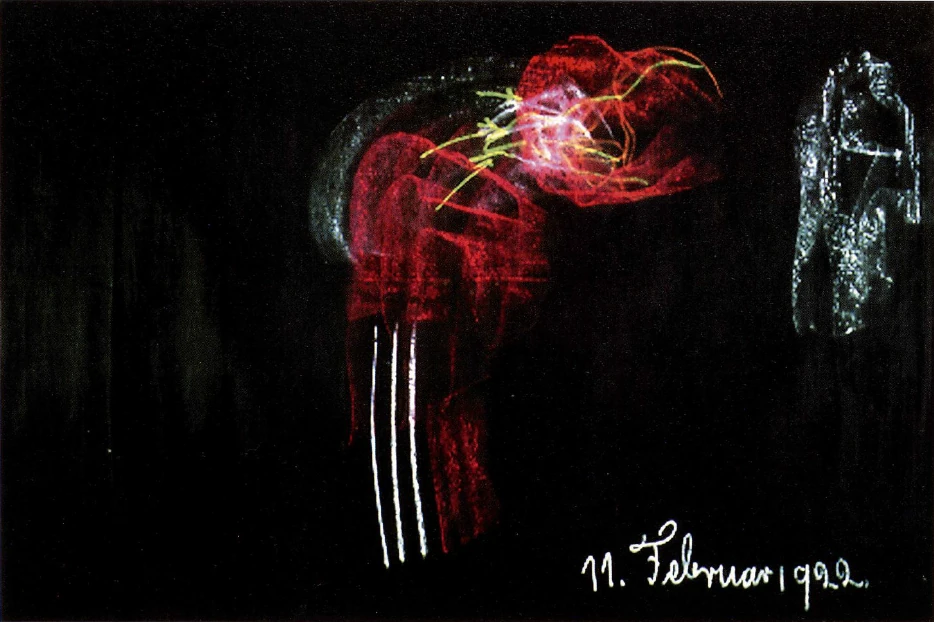
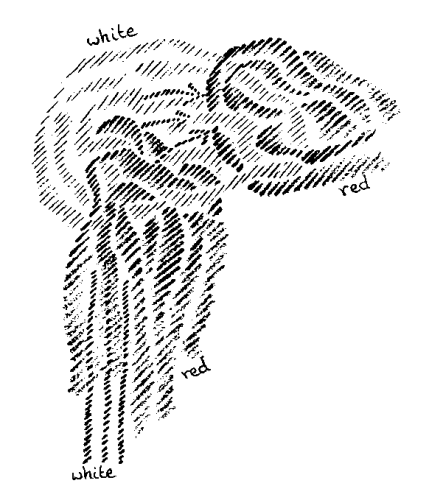
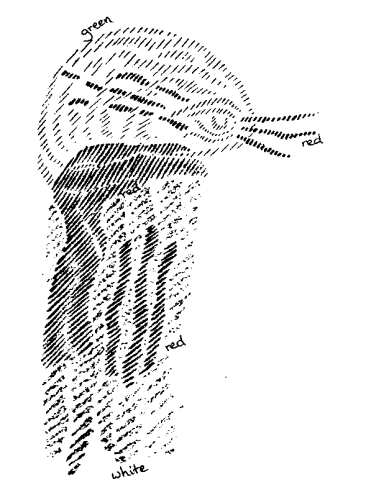
Now what is this intellectual element which is so much a part of the human being today? Let me draw you another diagram. As I said yesterday, with regard to the human brain (white), we can imagine how, as a result of the draught of forgetfulness, the element of spirit and soul, which usually came to a halt before penetrating too far inwards, now penetrated the brain (red). In the pupil of the ancient Mysteries the element of spirit and soul then rose up through the brain which had been thus prepared. Compared with ancient times, let us say prior to the Mystery of Golgotha, today's intellectual faculties are as they are because the element of soul and spirit is inwardly much stronger and more intense. The people of ancient times were far less intellectual. Their soul and spirit element was not etched with such sharp lines of thought as is the case today. Intellectuals think in straight lines, which is not how people thought in more ancient times. In those days thoughts were more like pictures, they were dreamlike and softer. Now, thoughts are endowed with sharp edges, clear contours. Yet, even though the element of soul and spirit is much stronger than it used to be, human beings today are still nevertheless incapable of grasping these thoughts with their soul and spirit element.
Please do not misunderstand me, my dear friends. Human beings today are considerably stronger in their soul and spirit than were people of old. They dream less than did people of old, and their thoughts are firmer. But their thoughts would be just as dull today as they used to be, if the element of soul and spirit alone were at work in them. Even today, human beings cannot think out of their soul. It is their body which relieves them of the power of thought. Sense perceptions are received by the element of soul and spirit. But to think these sense perceptions we need the help of our body. Our body is the thinker. So nowadays the following takes place: The sense perception works on the human being; the element of soul and spirit (red, top) penetrates and mingles with the sense perception; but the body acts like a mirror and keeps on throwing back the rays of thought (arrows). By this means they become conscious. So it is the body which relieves human beings of the effort of thinking, but it does not relieve them of the effort of perceiving with their senses. So today, if human beings want to strive for initiation with regard to the thought aspect, they must turn their exercises towards strengthening their element of soul and spirit even more. We know these exercises from Knowledge of the Higher Worlds and from the second part of Occult Science. Thus will they gradually make their soul and spirit element so independent that it no longer needs the body.

So let us understand one another: When we think in ordinary life today, our element of soul and spirit does participate. Above all it takes in the sense perceptions. But it would be incapable by itself of developing the thoughts which are developed today. So the body comes along and relieves us of the effort of thinking. In ordinary life we think with our body, our body is our thinking apparatus. If we pursue the exercises described in the books mentioned, our soul will be strengthened to such an extent that it would no longer need the body for thinking but would itself be able to think. This is, basically, the first step on the path towards higher knowledge; it is the first step when the soul and spirit element begins to dismiss the body as the organ that does the thinking so far as higher knowledge is concerned. And it cannot be stressed often enough that a person who ascends to higher knowledge—that is, to Imagination—must remain at his own side with his ordinary good sense, keeping a watch on himself and being his own critic. In other words, he must remain the same person he always is in ordinary life. But out of the first person that second one develops, capable now of thinking without the help of the body, instead of with it.

The element of spirit and soul which revealed itself to the pupil of the ancient Mysteries came out of the body and penetrated through the brain, and as it oozed forth the pupil perceived it. Today what is perceived in initiation is a strengthened thinking which does not in any way make use of the brain. The pupil in ancient times drew what he saw in the way of spirit and soul out of his own bodily organization. Today the human being perceives the soul and spirit element, as far as thoughts are concerned, in such a way that they penetrate into him in the same way as sense perceptions penetrate into him. In taking this first upward step towards higher knowledge the human being must accustom himself to saying: I am beginning to perceive myself with regard to my eternal element of soul and spirit, for this comes in through my eyes, it comes in from outside in every way.
In a public lecture2 in the Bernoulli Hall in Basel I said: Anthroposophical spiritual science has to regard perception through the senses as its ideal. We have to take our start from perceiving with our senses. We must not return to dreamlike perception, but have to go forward to even clearer perception than that of perceiving with our senses. Our own being must come towards us, just as colours and sounds come towards our senses.

I showed two things in the last diagram. Both this (top) and this (bottom), the element of soul and spirit, are supposed to be one and the same thing. And they are one and the same, but seen from different sides. When a human being descends from the world of spirit and soul to physical incarnation, his element of soul and spirit, in a way, dies from the point of view of the soul and spirit world. When a human being is conceived and prepares to be born he dies as regards the spiritual world. And when he dies here in the physical world and goes through the portal of death he is born in the spiritual world. These concepts are relative. We die in respect of the spiritual world when we are born. And when we die in respect of the physical world we are born in the spirit. Death in the physical world signifies spiritual birth, birth in the physical world signifies spiritual death. Birth and death, then, are relative concepts. There is something which makes its appearance when the soul is on its way to birth, something that would not be capable of surviving in the spiritual world; it would disintegrate in the spiritual world, and so it streams towards a physical body in order to preserve itself.

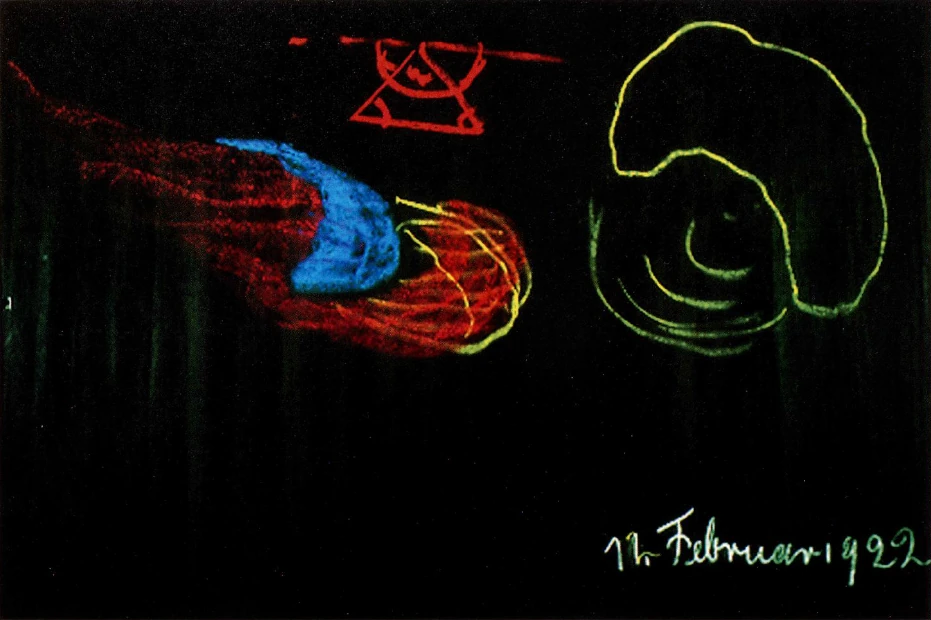
In a diagram it can be depicted like this: The element of spirit and soul (red coming from the left) descends from the spirit and soul world. It arrives, you might say, in a cul-de-sac; it can go no further and is forced to equip itself with physical matter (blue). But the physical matter actually only works in the way I have described—from the brain, but not from the rest of the organism. As regards the rest of the organism the spirit and soul element does indeed travel onwards, having recovered through not being allowed to pass by the brain, through finding resistance and support in the brain. It is able, after all, to come to meet itself (red, right) throughout the rest of the organism, especially the system of limbs and metabolism. This blue part in the drawing is the head organism. Here (yellow) is the system
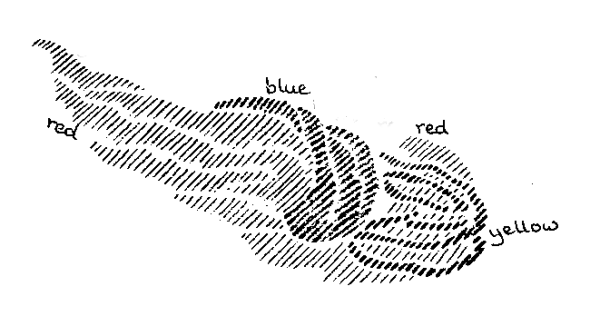
of limbs and metabolism; under normal conditions it absorbs the element of soul and spirit, but only to a certain extent.
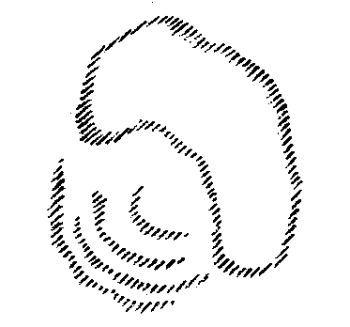
As we grow up from childhood our spirit and soul element keeps making an appearance. At the moment of conception, and all through the embryonic stage in the mother's womb, the element of spirit and soul descending from the spiritual world is absorbed into matter. But because it finds a support it recovers again. Because of the shape of the embryo, at first that of the head, the element of spirit and soul finds a support (see drawing). Then the rest of the organism begins to grow, and once again the element of spirit and soul oozes through, as I have shown in the diagram.

As we grow up through childhood our element of spirit and soul gradually becomes ever more independent. I have often described this in detail and also shown how at major points of transition, such as the change of teeth and puberty, the element of spirit and soul becomes increasingly independent. As we grow up our physical body recedes more and more as we attain an independent spirit and soul element. This independent element is more intense today than it was in ancient times. But it would still be incapable of thinking. As I have said, it needs the help of the body if it wants to think. If this were not there, whatever grew towards us would remain forever dreamlike.

Initiates in ancient times strove to make their brain porous, so that what was then the element of spirit and soul could ooze through as it descended; in a certain way they could still see their life before birth through their softened brain. Today initiates are not concerned with that; they are concerned with what evolves during the course of life. This awakens a higher intensity with regard to the thought aspect. Initiates in ancient times would not have been capable of this. They would have been unable to take such a firm hold of the new spirit and soul element that begins to develop in the child—to begin with in an unclear way, and which later passes through the portal of death. In a way they slew the physical aspect, they paralysed it, so that the element of spirit and soul could emerge that had existed before conception.

Today we take a firmer hold of what we develop—at first in a weak way—through childhood and into adulthood, strengthening and reinforcing the new element of spirit and soul that has been developing since birth. We endeavour to achieve independence of our spirit and soul element over against our physical body, as far as our thought life is concerned. The pupil in ancient times made manifest the element of spirit and soul belonging to him before birth by toning down his physical body. We today endeavour to make manifest that element of spirit and soul which develops more and more from birth onwards. But we do not make it manifest to a degree which would be necessary in order to be able to see independently into the spiritual world. This is the difference.

As regards the will, the situation is as follows. The initiate in ancient times endeavoured to paralyse his will organization. This made it possible for him to perceive the element of spirit and soul he had from before his birth and which was normally absorbed by his will organization. If the body is rigid it does not absorb the element of spirit and soul, and so it is revealed independently. As modern initiates we do not do this; we do it differently. We strengthen our will by transforming the power of will in the manner described in the books already mentioned. It would be quite wrong to bring about a cataleptic condition by means of shocks or anxiety states as was the case in the ancient Mysteries. For modern man, with his highly-developed intellect, this would be something quite pathological. This must not be allowed to happen. Instead we use retrospective exercises—remembering backwards what has happened through the day—and also other will exercises to transform our will in a way which might be described as follows:

Consider the human eye. What must be its constitution if we are to be able to see? A cataract comes about when the physical matter of the eye makes itself independent so that it dresses itself up in physical matter which is not transparent. The eye must be selfless, it must be selflessly incorporated in our organism if we are to use it for seeing; it must be transparent. Our organism is most certainly not transparent for our will. As I have often said, we can think that we want to raise our hand. We form the thought: I want to raise my hand. But what then happens in our organism as this thought slips over into it and performs the action—this is as obscure for us as are the events which take place between going to sleep and waking up. The next thing we see is our raised hand, another perception. We perceive something at the beginning and we perceive something at the end, but what lies in between is a state of sleep. Our will unfolds in the unconscious just as much as the events of sleep unfold in the unconscious. So we can rightly say that for ordinary consciousness our organism is as untransparent as regards perceiving how the will functions as is an eye afflicted with cataract.

Of course I do not mean that the human organism is ill because of this. For ordinary, everyday life it has to be untransparent. This is its normal condition. But it cannot remain so for higher knowledge; it has to become transparent, it must become transparent for soul and spirit. This is achieved by means of the will exercises. Our organism then becomes transparent. We then no longer look down into something indeterminate when our will works, for our organism becomes as selfless as the eye, which is set selflessly into our organism so that we may perceive external objects properly. Just as the eye is in itself transparent, so our organism becomes transparent with regard to the element of spirit and soul; our whole organism becomes a sense organ. Thus, with regard to the will, we perceive the spiritual beings as objectively as we perceive external physical objects through our external eyes. Our will exercises are not aimed at making our body rigid in order to free our element of spirit and soul. They are aimed at developing the element of soul and spirit to such an extent that it becomes capable of seeing through the physical body. This is the main point. We see into the spiritual world only if we look through ourselves. We see external objects with our eyes only by looking through our eyes. And we do not see into the spiritual world directly, but only by looking through ourselves.

This is the other side: development with regard to the will. The whole of evolution in recent times depends, firstly, on our developing our thinking to an extent which makes it independent of the brain, and secondly, on our developing our will to an extent that the whole human being becomes transparent. It is impossible to see into the spiritual world through a vacuum, just as it is impossible to see the world of colours without looking through the eye. We have to look through ourselves, and this is brought about by means of the will exercises.

This, then, is for modern man what can be carried out by initiation. On the one hand, with regard to thinking, the element of soul and spirit can be made independent of the body, and on the other hand the material nature of the body can be overcome so that it becomes transparent for spirit and soul. Thus the element of spirit and soul has become independent through its own strength. This is the great difference between ancient and modern initiation. Ancient initiation transformed the physical body—the brain on the one hand, and the rest of the organism on the other—and, because the body was transformed in this way, the element of soul and spirit became faintly perceptible. Modern initiation transforms the element of spirit and soul, strengthening it with regard to the thought aspect on the one hand, and the will aspect on the other; thus it becomes independent of the brain, and at the same time so strong that it can see through the rest of the organism.

What the initiate saw in olden times appeared in ghostly form. Whatever beings of the spiritual world were able to reveal themselves when the procedure had been completed, appeared in a ghostly form. I could say that the spiritual world was seen in etheric shapes. The great anxiety of the teachers in the ancient Mysteries was that the pupils, despite the fact that what they saw of the spiritual world was ghostly, would learn to disregard this ghostly aspect. Ever and again they warned their pupils: What you are seeing appears to be material, but you must regard it as a picture; these ghostly things that you are seeing are only pictures of the spiritual world; you must not imagine that what you see around you in a ghostly form is actual reality. In a similar way, when I draw on the blackboard the chalk marks are not reality but only an image. Of course this expression was not used in olden times, but in modern terms it is a good way of putting it. It was the great concern of the teachers in the ancient Mysteries that their pupils should regard as pictures what they saw in a dreamlike, ghostly form.

In modern initiation there must be anxiety on a different score. Here, knowledge of the higher worlds can only be achieved at all by means of Imagination. Here we have to live in a world of pictures; the pictures have a picture character from the start. There is no danger of mistaking them in their picture character for anything else. But we have to learn to assess them correctly. In order to know how to relate these pictures to the spiritual reality they represent, we have to apply to them the exact thought processes we have acquired as modern human beings. We really have to think within this world of pictures in the very way we have learnt to think in the ordinary physical world. Every thoughtless glance is damaging to modern initiation. All the healthy ways of thinking we have developed as modern human beings must be brought to bear on higher knowledge. Just as we can find our way about the ordinary physical world if we can think properly, so can we only find our way about in the world of the spirit—which we enter through modern initiation—if we are able to penetrate with the thinking we have gained here in the physical world into all the knowledge we attain through Imagination, Inspiration, Intuition. In my book Theosophy,3 as well as in Occult Science and Knowledge of the Higher Worlds, I have always stated categorically that this is a characteristic of modern initiation.

That is why it is so important that anyone who desires to enter into the higher worlds in a modern way should learn to think with exactitude and practise thinking with exactitude. This is not as easy as people suppose. To help you understand what I mean let me say the following: Think of something really startling: Suppose our present respected company were to be surprised tomorrow here in the Goetheanum by a visit from, say, Lloyd George4 of course this is only hypothetical, but I want to give an extreme example. If Lloyd George were to turn up here tomorrow you would all have certain thoughts and certain feelings. These thoughts and feelings would not be the result of simply observing all that went on from the moment of his appearance until the moment of his departure. In order to simply follow all this, you would not need to know that it was Lloyd George. If you did not know who it was, you would simply note whatever can be noted with regard to somebody who is entirely unknown to you. Until you learn to disregard everything you already know and feel from elsewhere about something you are observing, as long as you cannot simply follow what is going on without any of this, you are not thinking with exactitude. You would only be thinking with exactitude if you were capable—should Lloyd George really appear here tomorrow—of entertaining thoughts and feelings which applied solely to what actually went on from the moment you first noticed him to the moment when he disappeared from view. You would have to exclude every scrap of prior knowledge. You would have to exclude everything that had irritated you and everything that had pleased you about him and take in only whatever there was to take in at that moment. Only in this way is it possible to learn to think in accordance with reality.

Just think how far human beings are from being able to think with exactitude as regards reality! Only let something stir in your soul and you will see what feelings, living hidden and unconscious in your soul, you allow to rise up. It is extremely difficult to confine oneself solely to what one has seen. Read a description of something and then ask: Is the writer merely describing what he saw or is he not also calling up hundreds and hundreds of prejudices, both in feeling and in thinking, which are bound up with it? Only if you are capable of restricting yourself solely to what you have seen will you be in a position gradually to attain to thinking with exactitude.

It is necessary to lay aside everything we have been taught or have learned from life with regard to what we see, and follow solely what life presents to us. If you consider this and meditate on it a little you will gradually come to understand what I mean by thinking with exactitude. In ordinary life we have little opportunity under today's conditions to practise thinking with exactitude except in geometry or, over and above that, in mathematics. Here we really do restrict ourselves to what we see.

We have not many prejudices about a geometric form, a triangle for instance. Here is a triangle. Let me draw a parallel line here. This angle equals that angle, and the other one is equal to this one, and the one in the middle equals itself. This is a straight angle, so all three
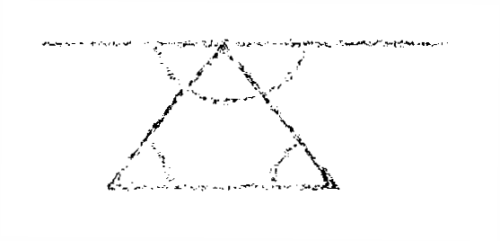
angles of the triangle equal a straight angle. I am simply taking account of what I see before me, without applying the colossal prejudices I would bring to bear if Lloyd George were to arrive here tomorrow and I were to know about it in advance. In saying what I have just said, I was, of course, merely endeavouring to point out that thinking with absolute exactitude is a good preparation for seeing properly in the higher spiritual world. A kind of thinking in which you have firm control of the beginning of the thought, as well as a clear view of every step of thought along the way, is necessary in order to enter the higher worlds, that is, in order enter there with understanding. Above all a clearly-defined conscientiousness in thinking is necessary, a calling-oneself-to-account about one's thoughts. Ordinary life is very remiss in this, too. In most cases, people have no interest in thinking with exactitude; they prefer to think in a way in which they can enjoy the thought and feel comfortable with it.

For a Catholic priest, for instance, it is frightfully uncomfortable to entertain the thought that there might be something right about Anthroposophy. In such a case there can be no question of developing any exact thoughts. Instead, the matter is approached with all sorts of misconceptions and prejudices, and judgements are formed on the basis of these. Most things in life are decided on the basis of prejudices. Consider, for instance, what a strange impression is created sometimes when a simple attempt is made to describe something entirely objectively. Here we live in the Goetheanum. Nobody would consider me to be less of an admirer of Goethe than anyone else, and yet have I not said a good many things against Goethe? How often have I not attempted to describe Goethe from a narrow, overseeable point of view, whereas usually when Goethe is mentioned a whole host of prejudgements arises in response to his name alone. Merely to mention the name of Goethe sets up an excitement in the soul. It is impossible to approach any new phenomenon without prejudgement if one brings along a colossal collection of prejudices before even starting.

For the most part these things are not taken into account, and people therefore frequently say: Oh well, we can't get any further with our project of entering the spiritual worlds! Indeed, if elementary matters are not attended to first then, naturally enough, there is no way of entering those worlds. People just feel that unreasonable demands are being made of them if it is suggested that they take account of even the most elementary things.

Here is an example: In the nineties5 I happened to be in Jena when Bismarck gave a grand speech after his forced resignation. He appeared on the platform in the wake of Haeckel and Bardeleben and other Jena professors. Imagine the huge crowd in the market square in Jena. They were expected to follow Bismarck's speech as they would a speech made by someone they had previously never heard of! Such a thing is unthinkable under normal conditions. And yet for someone who really desires to undergo a kind of initiation it is certainly necessary to develop an impartiality which enables him to take everything he sees as something entirely new, however many prejudices his soul might previously have harboured in that respect. Everything must be treated as though it had arrived like a bolt from the blue. For it is a special characteristic of the spiritual world that we have to win it afresh at every moment if we desire to enter it. And to do this we have to prepare ourselves in a suitable way.

It can be said that the general drift of civilization indicates that mankind is indeed headed in this direction. But for the moment this still appears in a light that is not all that pleasing, namely, in opposition to any kind of authority, and to any kind of received judgement, and so on. These things will have to be ennobled. But meanwhile mankind is indeed moving in the direction of impartiality and freedom from prejudice. But, for the moment, the more negative, the uglier sides of this are more prevalent. We must, therefore, judge the evolution of civilization with regard to the future in the very manner I have just been describing.


Source: The Rudolf Steiner Archive


"The world will have to come to the conviction that what is wanted can be achieved only on the anthroposophical path."


Old and New Methods of Initiation

Lecture 1 of 2


Rudolf Steiner, Dornach, Switzerland

February 11, 1922


Today1 I should like to discuss a theme which can perhaps lead to some points of view from which to assess present-day cultural and spiritual life in connection with what has gone before in human evolution. As I have often said, cultural life since the first third of the fifteenth century is entirely different from that of earlier times, and now we are faced with the necessity to return, but in full consciousness and with deep thought, to an understanding of the spiritual part of our life in the cosmos. The spiritual part of our life in the cosmos was understood in ancient times by an instinctive clairvoyance, and this was the case most of all in the most ancient ages of earthly civilization. Then the capacity to push through to the spirit receded more and more, until a time came when mankind needed a new impetus, whereupon the Mystery of Golgotha took place.

Today I should like to mention that, before the Mystery of Golgotha, people who were concerned with spiritual life looked to those institutions known in general human cultural life as the Mysteries. In those most ancient days of human evolution it was unthinkable that spiritual vision and spiritual knowledge could have any other source than the Mysteries. When we try to observe the consciousness of those who turned to the Mysteries in those ancient days, if knowledge was what they desired, we arrive at the following picture: All external knowledge not stemming from the Mysteries, all intellectual knowledge gained by human beings by themselves, did not come into being until the later part of the Greek era. Only then did people want to discover certain truths out of themselves, without the help of the Mysteries. That is why the course of scientific development is reckoned, by those who understand these things, to have started in the time of Thales.2 I have discussed this in my book Riddles of Philosophy.3 Before that time knowledge was sought with the help of the Mysteries. When we examine the consciousness on which this was founded, we discover that those who conducted the Mysteries, and also their pupils, saw something most important in what they called ‘the prince of this world’—they meant the earth—as opposed to the princes—that is, the spiritual beings—of other worlds.

In today's language, ‘the prince of this world’, as he lived in the consciousness of ancient times, would be called the being of Ahriman. The being of Ahriman would more or less be equivalent to this prince of earthly life. The spiritual revelations which can be derived from ‘the prince of this world’ are none other than those of intellectual knowledge. The leaders of the Mysteries would certainly have considered all that lived in the knowledge that grew up in Greece outside the Mysteries to have been inspired by ‘the prince of this world’. In contrast, they saw it as the task of the Mysteries to lead human beings towards a spiritual vision which tends away from ‘the prince of this world’, which tends to lead human souls into realms which are not ruled by ‘the prince of this world’. We cannot help but make use of such expressions in order to show properly what is meant, and no one should think that there is anything superstitious about using these expressions.

Let me give you a picture of what someone initiated in the ancient Greek, or the Egyptian, or Persian Mysteries would have thought in those old days about ‘the prince of this world’. We have to understand that these people also spoke about the Christ-being, though they used other names. Using the name of Christ is not the only way of speaking about the Christ-being. We naturally use the name of Christ when we want to speak about the Christ-being, for Christ to us actually means that Being who underwent the Mystery of Golgotha and united himself with earthly civilization. Before the Mystery of Golgotha this Being was not yet united with earthly civilization. He still lived as the great Sun-being outside the earthly world. The Mystery of Golgotha denotes the uniting with the earthly world of this Being who lived outside the earthly world. But those initiated in the Mysteries certainly knew this Being who lived outside the earthly world. And the being known as ‘the prince of this world’—that ahrimanic being—also knew him. That being—I am describing what lived in the consciousness of the initiates—felt himself to be the lord of the earth. He considered that whatever human beings possessed through the forces of the earth was something they had from him. But he knew that the Christ-being lived outside the earth and also had an influence on human life by way of the Mysteries, whose teachings were then popularized and brought amongst the peoples.

To describe more closely what lived in their consciousness, we may say that the initiates in the Mysteries thought as follows: The chief influence of ‘the prince of this world’ is on the physical bodies of human beings. These wholly do his bidding and he feels he is the lord of human physical bodies. But he could not feel himself to be the lord of the etheric and astral natures of human beings, of their life-bodies and their souls. The life-body and the soul were seen to be under the influence of a Being who lived outside the earth; the forces of the Christ-being had always been seen to flow into these. But with the forces of their own soul human beings were quite unable to receive what ought to flow into them from the Christ-being. They could only do so by turning to what the Mystery initiate received after the proper preparation. The Mysteries were seen to take hold of what came from outside the earth and pass it on to human beings. So ‘the prince of this world’ said to himself: Here on earth I am the master. From the earth the physical bodies of human beings draw their forces, and one of these forces is the human earthly intellect. Here I am the master and nothing can contest this here on earth. By way of the Mysteries, something from outside the earth flows into it. This I will tolerate.

But ‘the prince of this world’ rebelled against the Mystery of Golgotha because from then on he would have had to share his supremacy with the Christ who descended to the earth through the Mystery of Golgotha. ‘The prince of this world’ felt the Christ to be a rival in his mastery of the earth. He would have tolerated the sharing of the rulership with another being from outside the earth, but he would not tolerate a rival here within the earthly realm.

Here, then, out of the spirit of the ancient Mysteries, we have an indication of the real opposition of ‘the prince of this world’ towards the Christ. Among those with knowledge about such things this opposition was strongly felt throughout the Middle Ages until well into the fifteenth century. Any mention of ‘the prince of this world’ and of the Christ took it into account. There was a certain awareness of two dominions. One of these had rightfully ruled the bodily nature of man before the Mystery of Golgotha, but since then this sovereignty over the bodily nature of man has had to be shared with the other, with the Christ. For now Christ no longer influences only man's soul element, that is, his astral and etheric bodies; his purpose is now to influence also man's physical bodily nature, or rather whatever is expressed by this physical bodily nature, namely, everything to do with the intellect and with man's own capacities in the widest sense. Christ should live in every aspect of human nature. This is what entered into mankind through the Mystery of Golgotha.

Prior to the Mystery of Golgotha it never occurred to those who knew about such things to seek knowledge of external matters in any sphere which the human head or even the other soul or heart forces can reach on their own. Such things were left to the Mysteries. So before the Mystery of Golgotha there was certainly a strong awareness of the distinction between earthly wisdom and earthly sensing on the one hand, and a sensing of super-earthly forces on the other. The unique spiritual configuration of the early medieval centuries is only comprehensible in the light of a clear understanding of this fact.

Now this fact can be greatly clarified by something that was regarded as being of paramount importance in very many Mystery centres. The preparation and subsequent trials undergone by the Mystery pupils on the path of initiation varied, of course, in the different centres. But these variations were only really like the different paths up a mountain which, despite their different routes, all lead to one and the same summit in the end. They all led to one and the same Mystery goal. Despite the modifications, there were two measures within the Mysteries which every pupil had to undergo and which could be termed as being of paramount importance. These were, on the one hand, the draught of forgetfulness and, on the other hand, something which worked on the human being during the Mystery procedures like a powerful shock—like entering into a powerful fear. It is no longer permissible to use either of these for the purpose of achieving higher super-sensible knowledge. Today everything has to take place in the realm of soul and spirit, whereas the Mystery pupils in ancient times underwent procedures which always had to call on their physical body. What is achieved today is similar, but higher knowledge must now be striven for in the sphere of consciousness only, whereas in earlier times it took place in the sphere of instincts and dreams. Because all the Mysteries included something akin to the draught of forgetfulness and also something akin to the physical shock, the pupils’ external intellect was damped down. This intellect was less clear than it is today, but it nevertheless held sway in connection with everything relating to the external world.

So the pupil was led into a dulled consciousness both by the draught of forgetfulness and by the shock, which might be compared with the inducement of a state of fear. What was the significance of the draught of forgetfulness? The point was not the forgetting, though the pupil did forget. The effect it was to have came from its ceremonial preparation, from the special way it was mixed, to the accompaniment of certain preparations before it was drunk by the pupil. It was definitely a physical draught which, through the way it was served, brought it about that the pupil forgot the whole of his life since birth. This is something which is achieved nowadays through development in the realm of soul and spirit. Nowadays a clear consciousness of a great tableau of life encompassing everything that has occurred since birth is first conjured up. This is then suppressed and, in consequence, the human being is led into the spiritual form of his life before birth, or before conception. The same was achieved in a more physical way through the ancient draught of forgetfulness.

But the forgetting was not the essential point. Negative things are never the essential point. The positive thing achieved was that the pupil's thinking became more mobile and more intense. At the same time it became less clear. It became dreamy because the effect was achieved by influencing the physical organism. The effect of the draught of forgetfulness on the physical organism—it can be exactly described—was that the brain, if I may put it this way, became more fluid than it is in everyday life. Because the brain was made more fluid, because the pupil began to think more with his cerebral fluid than with the solid parts of the brain, his thoughts became more mobile and more intense.

Nowadays this must be achieved more directly, by means of developing soul and Knowledge of the Higher Worlds and in the second part of Occult Science. But in those days the brain was made more fluid by external influences. The goal was to make the spirit and soul element of the pupil—as it was before he made the connection with a physical body through conception: in other words, as it is in the spiritual world—capable once more of penetrating through the brain. This is the essential point.

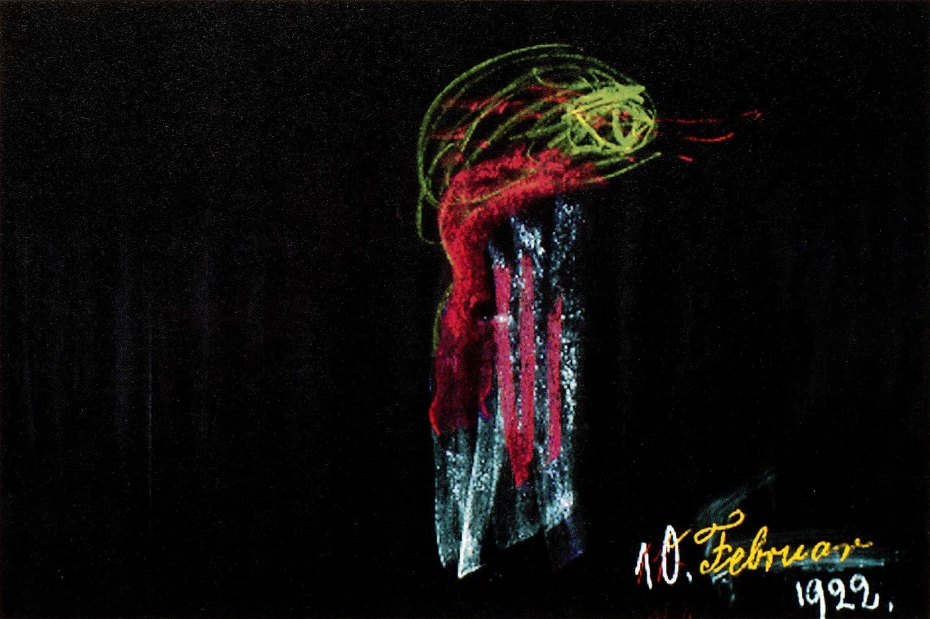
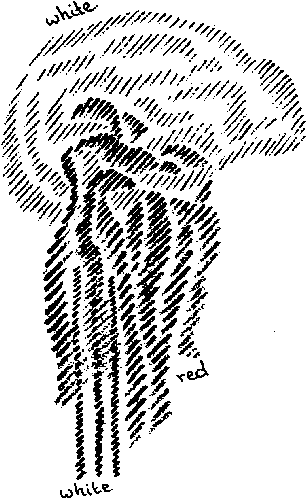
In a drawing it would look like this. Suppose this is the mass of the brain (green). Once the human being has been born his spirit and soul element stops short before it (red). The brain is so constituted that the human being's inner spirit and soul element cannot pass through the brain. In his brain the human being is not filled with his spirit and soul element. Instead, external perceptions can enter and make themselves felt in the brain through the senses—let me draw an eye here. Put another way, the constitution of the brain is such today that the eternal aspect of the human being cannot rise up into it. Instead, external impressions can enter. By being given the draught of forgetfulness the pupil gained the possibility of receiving into his brain what was his spiritual and soul element before conception or before birth (red). That is the one side.

The other side is the shock which was administered to the pupil. Think how a shock affects human beings. They are as though paralysed. There can be shocks which bring about the paralysis of the whole human being. A paralysed person, a cataleptic person, cannot move about because his muscles are rigid. But in a human being who can go about his life in the ordinary way, his body absorbs this eternal aspect (white with red). In our blood, in our muscles down below, the element of spirit and soul, the eternal element, is absorbed. But because of this it cannot be perceived. It cannot penetrate the brain, but lower down it is absorbed. It cannot be perceived, but when the muscles go rigid it steps out freely as a matter of course.

The rigidity of the muscles was brought about by the effect of the shock. As a result, the element of spirit and soul was not absorbed by the rest of the organism—apart from the brain—but was freed. So now the spirit and soul element was in the brain because the brain had been softened by the draught of forgetfulness, while the rest of the organism was at the same time prevented from absorbing it. Thus the element of spirit and soul came to be perceived. From two sides came the possibility of perceiving the element of spirit and soul. In ordinary life the human being was incapable of perceiving it because the brain, with which everything else was perceived, was unable to take it in; it could not enter the brain. Neither could it be perceived from the rest of the organism, the will and so on, for the rest of the organism had absorbed it. But now the pupil's brain was softened—of course, only for the moment at which knowledge was to enter. So his element of spirit and soul rushed into his brain. Meanwhile, the rest of his body became rigid so that it could not absorb the spirit and soul element. There the pupil stood, with his softened brain on the one side and a rigidified organic system on the other, as though encased in a capsule. There he stood in his spirit and his soul which had been given to him from two sides.

This is the aim of these procedures which are described in such a practical manner. I must expressly point out, though, that these things cannot be imitated nowadays. People would, anyway, be at a loss as to how to imitate them and, if they tried, the result would not be agreeable. These days all such things have to be attained by working with soul and spirit. But of the past it can certainly be said: Having been enabled to perceive their element of spirit and soul by partaking of the draught of forgetfulness and by being shocked into physical rigidity, the pupils in the Mysteries became ‘Christians’. In the Mysteries they became Christians.

The early fathers of the church were certainly aware of this. But today people are not told about it, or it is even denied. But the early church fathers knew that human beings had been made Christians through the Mysteries. There are passages in the writings of the early church fathers4 which state that Heraclitus and Socrates, though they lived before the time of the Mystery of Golgotha, were Christians, even though they were called atheists in their own time. I have often quoted from such passages in the writings of the early church fathers. It was the view of the ancient Mystery leaders and initiates that ‘the prince of this world’ was not interested in that human being who came forth out of the other; he left this human being to Christ. But he did not want Christ to come down to the earth in order to take hold of the human being in his entirety. This is described in the gospels in the way it is said that the demons, the lower servants of ‘the prince of this world’, when they heard that Christ had come, began to rebel. They recognized him and were furious.

We have to understand, when speaking about earthly evolution, that the spiritual powers whose influence on the human physical body was perfectly legitimate before the Mystery of Golgotha had, after the Mystery of Golgotha, to share this influence with the Christ. This is an essential aspect of the Mystery of Golgotha. That is why in the Middle Ages ‘the prince of this world’ came to be called ‘the unlawful prince of this world’. This expression would not have been justified in the ancient heathen world but when it came to be used in the Middle Ages it was a correct title, befitting the circumstances.

The essential aspect of all this, with regard to the spiritual evolution of mankind, is that in more ancient times the physical body was withdrawn from the element of spirit and soul. The working of the brain was counteracted because the brain was softened by the draught of forgetfulness, and the powers of absorption of the rest of the organism were counteracted by the hardening of the rest of the organism by means of the shock. So in these older times the body was withdrawn from the element of spirit and soul.

Today, our aspiration is not to withdraw the body but to draw out the spirit, by strengthening and enhancing our forces of spirit and soul. The opposite of what used to take place must happen now; now the spirit must be drawn out. No changes must be allowed to take place in the physical, bodily aspect. Since the fifteenth century the human being has been organized in such a way that changes in the physical body, of the kind that were customary in those of Mystery pupils, would denote a condition of sickness. It would be a pathological condition, which must not be allowed to come about in normal development.

I am describing all this in order to give you an idea of what is to be understood by the concept of ‘the prince of this world’, which keeps recurring in olden times. ‘The prince of this world’, who in the Middle Ages became ‘the unlawful prince of this world’, is an Ahriman-like being. We can find such a being everywhere, in external nature and in the inner being of man. Indeed, only when we are in a position to find such a being in its manifestation both in external nature and in the inner being of man can we gradually come to an understanding of its essence.

Look at external nature. You will find there two contrasts, but what matters is to be able to sense the essence of these contrasts. Think of the blue sky. Of course in southern climes the blue sky must be seen rather differently than is the case here. When the envelope of air round the earth is filled by the effect of the sun, this is not the pure essence of the blue sky, for it is then overcast with something else. But the pure effect of the blue sky is that of coldness. The blue sky as such is cold. What you sense in the coldness of the blue sky, unmitigated by earthly sultriness—this is an all-embracing ahrimanic influence. The ahrimanic influence causes space to be petrified, congealed into blueness. Take note of this expression! It is unusual, but if you gradually come to sense what it means to say that space is petrified, congealed into blueness, you will have discovered the ahrimanic tendency in external nature.

The contrasting effect is that of the reddish, yellowish clouds sailing past. The effect is one of warmth, exactly the opposite. This, too, can be disguised by the coldness of the earth's environment but, all in all, a cloud lined with red, a yellowish cloud, has something warm about it. This is the contrasting effect, the effect of air. Between these two polar opposites something takes place, and that is what benefits the earthly life of man. We can say, then, that the effect on the earth of space petrified, congealed into blueness was seen in the Middle Ages to be the cosmic working of ‘the prince of this world’.

And when we look into human beings we find that they can be in a condition which makes them pale. You know how there is something livid, something blueish about palor in human beings. When human beings turn pale, when they feel their way into coldness, they are then sensing something ahrimanic working in them. Flushed redness, on the other hand, shows something luciferic at work in their nature. Out of all these details together we can gradually build up a full picture of what this ahrimanic being, ‘the prince of this world’, really is. People's pallid, often so clever, thoughts, running along always in straight lines—the whole intellectual aspect of man—this is the ahrimanic influence, the influence of ‘the prince of this world’, on the working of the human head.

These things must be understood from the point of view of spirit and soul. In the livid blueness, in the way human beings grow pale, in the way they devour themselves inwardly and feel their way into coldness, in the way they are filled with pale, abstract thoughts—in all this we have to feel the ahrimanic influence, the rulership of ‘the prince of this world’. And then we have to feel the warming influence of the Christ-impulse.

For the present time it is rather revealing and also necessary to recognize how different was initiation in ancient times compared with the principle of initiation today. There are certainly people today who still lack the courage to approach the Anthroposophical Movement but who have a deep longing for what, in the end, only the Anthroposophical Movement can give. They long for a transformation of their soul, after which they would find their way to the knowledge they seek. Obviously the greater part of mankind today rejects this transformation of the soul and imagines that any knowledge man is capable of reaching can be achieved through the ordinary state of soul which is brought about by our ordinary education and through our ordinary life. On my last tour I met a man who was greatly concerned to achieve some knowledge through the philosophical possibilities offered today, but not through Anthroposophy. He said that it would be interesting and important to ascertain in Anthroposophy how this higher knowledge might be achieved, for everywhere—this ‘everywhere’ is very relative, of course—the different world views were recognizing that the achievement of real knowledge was a matter not only of the intellect but also of the will. And in the ancient Mysteries, too, it was a matter of transforming the will.

In the description of the ancient Mysteries in my book Christianity as Mystical Fact5 you will find that the decisive, radical difference between the ancient striving for knowledge and that of today lies in the fact that in ancient times it was necessary to prepare the will. The will had to be turned in a direction different from that of ordinary life. The will had to be purged, purified; it had to be transformed and lifted to a higher stage. The pupil had to give a new direction to his everyday will, which was dominated by ‘the prince of this world’. Through cultivation of his will, the pupil had to reach the point at which knowledge can be attained. Today, on the other hand, people imagine that we can stop at whatever point we have reached through our ordinary studies. And our intellectual life is merely the product of the ordinary configuration of our brain. If it is softened, as I have indicated, there is a strong possibility that thoughts can be willed, that everywhere thoughts can be willed. And when will becomes conscious through the rigidifying of the body, then thoughts appear in the will itself. This can also happen today when, on the path I have described, knowledge of higher worlds has become possible.

It is a very important sign today that once more there are people who know that the intellect alone is not enough and that it is necessary to cultivate the will in order to reach whatever knowledge is possible for man. So by looking at what is going on in a general way we come to see that a great many people are approaching who want to hear about spiritual matters. Also, from things which are shown to us as we go along, we see that there are people who once again realize that the will must be cultivated, if knowledge is to be achieved. All this goes to show that there is an urgent need for spiritual life today. Unfortunately, though, because people lack the courage to approach Anthroposophy, because they think Anthroposophy is something peculiar, they imagine that they can achieve what they are searching for along some other path. The world will have to come to the conviction that what is wanted can be achieved only on the anthroposophical path. Please do not misunderstand me. It is not my intention to maintain that what Anthroposophy has revealed so far is necessarily generally valid or particularly obvious. But I want to point out the importance of the direction in which Anthroposophy is going. This is what can lead to the satisfaction of the powerful longing that exists today, a longing which must be satisfied if human civilization is to move forward at all.


Source: The Rudolf Steiner Archive


Friday, October 3, 2025

Per Spiritum Sanctum Reviviscimus : "Behold, I make all things new" : What the world needs now is anthroposophy


Rudolf Steiner, Breslau

February 1, 1922


It gives me profound pleasure to be among our Breslau friends. We have been through grave times which have made it all too obvious that mankind today is in need of something which can enable further development to take place. These catastrophic times are the consequence of a loss of upward momentum in human evolution. But in the soil of Anthroposophy we are tilling forces which can serve us in building up a spiritual life. Therefore I shall not speak too much today about contemporary events, but rather about the knowledge which human beings need, knowledge which they must absorb into their moral impulses. A great deal lives in our soul of which we are hardly aware. But because it is there, and because our soul element is linked to our existence on the earth, it is very important for our life.

What weighs on human beings today is the discordance between what the soul really needs and what present-day science can supply. Scientific knowledge is very demanding, and we ought to ask ourselves what it is that it demands of human beings. One thing it demands, for instance, is that we should accept its view of the beginning and end of the earth. Take the Kant-Laplace explanation of how the world began. A glowing ball of gas was formed by chemical and mechanical forces; it cooled, and when it was cool enough the same mechanical forces brought about the further solidification of everything that later became the kingdoms of plant, animal and man. And as for the future of earthly life and existence, we are told of an end to all life brought about by a gradual re-warming of the earth. Scientists say that physical laws will lead to the death of the earth through overheating. The end of the earth stretches before us like a gigantic churchyard. Between the two extremes, of the chemical and mechanical beginning of the world and its death by warmth at the end, lie all our human aspirations and ideals, all the moral purposes we have ever had or are going to have. The question is, why do such ideals and aspirations arise by chemical and physical means in the first place, if all they are destined for is to perish in the general death by overheating? Of course we can retort that these are theoretical considerations which have little influence on ordinary life. But even if we prefer to evade such questions, they still remain as disharmonies which work right into the depths of our unconscious soul life. They lead to the anxious question: What is the point of our moral impulses, what is the point of our religious ideals, if the whole of earth evolution is doomed to destruction?

The way this question is put shows what I am getting at. For all our moral impulses and all our religious ideals would benothing but an immense fraud perpetrated on mankind, they would be a terrible illusion, if they were destined to be buried in the cemetery of the earth. Eloquent examples already exist of the terrible effect of such soul moods brought about by purely scientific knowledge, but we are often not properly conscious of them. So the anxious question lives on in human hearts. Asking it from the point of view of natural science we have to say: We human beings grew out of nature and our moral ideals rose up in us; but they will perish with the earth. These moral ideals will perish in natural science. Natural science does not allow us to concede that our ideals have an independent, actual, reality. And even though this is no more than a theory, it nevertheless weighs heavily on the human soul.

This fatalistic world view is based, in the final analysis, on faith in the imperishability of material forces. But anyone trying to topple this dogma is considered mad. If this dogma were true, there would be no escape for moral ideals; they would simply be a picture of something that human beings have thought up and figured out. There would be no escape for these ideals if spiritual research could not find the means to give back to people a super-sensible content for their consciousness. This is relevant today. And in this relevant matter we are living at an important turning-point of evolution. Those of you who know me are aware that I do not like saying such a thing, because any moment in time can be called a turning-point. We have to consider in what respect a certain moment is a turning-point.

Let us consider where the knowledge given by natural science can lead us. Look first at the human being in his external manifestation living in the physical, sense-perceptible world. If we do this in an absolute sense, we see no more than a corpse. If we leave everything aside except the physical, sense-perceptible being and if we allow only chemical and physical laws to work on this being, then, by following only the external laws of nature, the human being begins to disintegrate, to dissolve. The forces we recognize with ordinary knowledge destroy the human being.

This alone is enough to refute the materialistic world view. If we say that the external forces destroy the human being, this must mean that from birth onwards people have been gathering forces which resist this destruction. As it dissolves, the corpse is absorbed into the world which we perceive with our senses. It is amalgamated into the sense-perceptible world by the death forces of chemical and physical laws. But what takes place at death inwardly at the level of the soul cannot be perceived by external sense-perception. These inward processes of soul can only be experienced by direct vision in the realm where higher knowledge has its source. This vision shows that outside the body the inward soul element is united with the spirit, with all the spiritual forces that stream through the world, giving it strength. The soul which unites with the spirit after death is then bound up in the spirit in the super-sensible world.

This is a fact which takes its place beside the fact of the corpse. In life the physical body was filled by the soul; in death it unites with the forces of nature. Anthroposophy leads us to a fact of life which is diametrically opposed to the fact of death. The merely theoretical statement of the eternal life of man can never be satisfying. But Anthroposophy introduces the fact that the soul unites with the spirit. The knowledge of natural science, on the other hand, leads only to the fact of death.

The higher sources of knowledge given by spiritual science lead us to what is revealed to the spiritual seeker in Imagination, Inspiration and Intuition. These stages of knowledge are described in my book Knowledge of the Higher Worlds1 and also in Occult Science. In the first instance you will find that here are descriptions of stages of knowledge. However, more is given to the spiritual seeker than mere stages of knowledge. Just as natural-scientific knowledge is not just knowledge but also possesses other sides and aspects, so it is with higher knowledge.

Today I shall consider with you something that goes beyond Imagination, Inspiration and Intuition as stages of knowledge, something that I discussed, for instance, in the Vienna lecture cycle of 19142 about life after death, but now from a somewhat different point of view. The part of the human being that lives here on earth is a corpse which is united with external physical nature. And just as he is united with the mineral forces below, so is he also united with the higher hierarchies above. Just as in the corpse he grows together with the mineral forces, so above he slowly grows together with, and enters into, the hierarchies. Sometimes people say that they might as well wait until they die to find out what happens then. And they might as well wait to grow together with the hierarchies. This is all very well, but it is not actually the point. It is very important for the human being to grow into the hierarchies in the right way, for we have to admit that to start with he stands in the world in a manner which allows him no inkling of his relationships with the higher hierarchies. Much depends on our becoming aware of these relationships.

The first hierarchy with whom human beings have a relationship we may call the world of the angels. But those who do not recognize the spiritual world—for whatever reason—cannot establish a relationship with the world of the angels, any more than someone who lacks physical sense organs can establish a relationship with the physical world. Angels are the beings next above man, closest to man, yet under certain circumstances we cannot approach them. Only by endeavouring to make a picture of the angel world while we are here on earth can we prepare to form relationships with it. The portal of death leads to the world of the angels if human beings can become conscious after death of what is confronting them.

The second group of higher beings is that of the folk spirits, or archangels. Angels are not folk spirits. Real folk spirits have no individual links with human beings, as is the case with angels. Folk spirits are related to communities and groups of human beings. Even natural science sometimes speaks of the national spirit, but this does not denote an actual being, let alone a spiritual one. From higher knowledge the spiritual seeker knows that folk spirits are real spiritual beings whose position is one step above that of the angels. The human being can grow into this hierarchy, too. But if our inner spiritual experience is not intense enough, our angel cannot lead us with our consciousness to the folk spirit. But since we have to be led to the folk spirit, this happens unconsciously by means of the laws of karma. Either we grow into the folk spirit consciously and with love, or we are forcibly led into the sphere of the folk spirits. When, after death, the moment is reached at which we turn to descend once more to the sense-perceptible world for a new incarnation, then it makes a great difference, as our soul is led down, whether we have consciously united in love with the folk spirit, or whether, unaware of what is going on, this takes place forcibly, under coercion.

This finds expression in a spiritual, a soul, fact. We can be born into a nation because we are related by coercion to that folk spirit, or because we are related by inner love. Those who are able to perceive such things find it outstandingly characteristic of our time that a great many people today lack a sufficiently loving relationship to their folk spirit. This statement hints at the cause for what today brings about disorder among nations. The conflict prevailing among nations today stems from the fact that many people are born with little love for their folk spirit and therefore find themselves in a forced relationship to it. The love which leads us to a particular folk spirit can never bring about a conflict with other nations. We must do everything we can to help people regain a love-filled relationship with their folk spirits. This is most urgent.

As we stand here in life, we have Imagination, Inspiration and Intuition as stages of knowledge which can lead to real vision in the spiritual and soul realm. But in the realm of spirit and soul, when our soul is to return once more to the physical world, Imagination, Inspiration and Intuition are facts governing events, they are facts of action. There our soul stands in a relationship with whatever it is that it has to achieve out of the cosmos. If we are to manage our life properly it must grant us conditions which make the achievement of its aims as nearly feasible as possible. Thus the discarnate, spiritual human being works through Imagination, Inspiration and Intuition towards his reincarnation in the physical world, while the incarnated, sense-bound human being can gain through Imagination, Inspiration and Intuition a vision of the world of soul and spirit.

Natural-scientific knowledge is not in a position to recognize the profoundest secrets of life. Such knowledge starts, for instance, with the consideration of a chemical compound. Proceeding to the consideration of a more complicated chemical compound, and so on, it arrives in the end at the living cell, which it regards as nothing more than a particularly elaborate chemical compound. Spiritual science shows that externally the cell is indeed a particularly elaborate chemical structure; but when the living cell, the germ of a new life, arises in the mother's womb in such an elaborate fashion, the chemical laws are reversed and become chaotic. In the germ of the embryo in the mother's womb, in the germ of life, the chemical laws are suspended, reversed, and in the realm of nature this means chaos. Because the germ is chaos, the cosmos can work into it.

Between death and a new birth the human being has an inkling of this. In the first step on the way to a new incarnation Imagination is realized and leads towards reincarnation. In the second stage Inspiration is realized, and this is a far clearer consciousness than our brain consciousness, for Inspiration is a cosmic force. A part of this cosmic force is breathed in, as it were, and streams towards the bodily nature without coming fully to consciousness, rather as is the case with the will. We are unaware of how our will moves our hand, yet our hand moves in the manner required. The spiritual human being approaching incarnation through realized Inspiration stands in relation to this realized Inspiration as does the incarnated human being to the air. When we think about our physical body in the ordinary way, we imagine it to consist of muscles, nerves, vessels, bones. We imagine the same of a corpse. The airy part of our organism we assume to be outside it rather than within. Although we know that we cannot live without air, we still do not consider it as so intimately a part of ourselves as, say, our skeleton. Yet it is a part of our organism. The air as it is outside us, and at the next moment within, only to be outside again at the next, is a part of our organism. It lives rhythmically in us. In a far more extended rhythm we live with the element of soul and spirit. Just as we breathe air in and out, so we also breathe the element of soul and spirit in and out, though for the most part this takes place unconsciously. Physically, too, part of what happens through breathing takes place unconsciously. When the human being consisting of soul and spirit breathes in realized Inspiration, he takes a picture into his soul. He takes it into the dampened down part of his consciousness. And what he takes in is the world of moral and religious impulses. He takes this in as his conscience.

The third stage in the descent to a new incarnation is when the human being makes the transition to what his parents give him. In doing this he is enacting a realized Intuition. So you see that what can be achieved, while incarnated, by way of three higher stages of knowledge, is something that is accomplished as a real occurrence in the realm of soul and spirit on the way to incarnation. Here on earth we ascend to the spiritual world through Imagination, Inspiration and Intuition. And on our return from the spiritual world to incarnation we descend from the spiritual world through Imagination, Inspiration and Intuition. This is the counter-image, in the spiritual world, of the three higher stages of knowledge.

What does this show us? It shows us that Anthroposophy is not merely knowledge but something which is alive. Through Anthroposophy we strive for higher knowledge in order to grasp the reality of the higher realms of life and in order to fill our souls with the content of what lives in the spiritual worlds. Those whose common sense has helped them to understand what the spiritual seeker has to say, experience something else as well. They can say to themselves that human beings in the state of incarnation between birth and death are constantly counteracting the death forces at work in their body. The forces of death are forever present in the human body, but so are those forces which counteract the forces of death. They are there. If we did not bear the forces of death within us we should never have developed our understanding for our physical environment.

One of the most important facts given to us by higher knowledge is that our forces of intellect are bound up with our forces of dying. Death is in a way nothing but a summary of all the forces of dying which are forever at work in us. But a moral ideal, which can intensify until it becomes a religious ideal, lives in us in quite a different way. It is said that certain natural forces exist which bring it about that plants grow upwards; and these forces are taken to be quite real. But when, on looking into the human being, people find there the driving forces of moral and religious ideals, they are not inclined to accept these as having any reality. Yet there they are, working not only in every human being but also in the cultures of all mankind. Higher knowledge teaches us that moral ideals live in man through the burning up of matter. Matter is destroyed when a person makes moral resolves. The breaking down of matter is the precondition for the building up of moral ideals. What is crucial is the manner in which a human being breaks down matter and the manner in which he can build it up again. External research is still caught up in the prejudice about the indestructibility of matter. But spiritual science shows that man can break through external natural forces. Once we are in possession of an anthroposophical world view we can comfort ourselves in face of the idea of the death of the earth through overheating. For it is this very destruction of matter which ensures for the human being the possibility of building up his moral personality.

If you look deeply into your soul you will find something which consumes and gnaws at the soul of modern man. This something, which consumes and gnaws at the soul, is the fact that modern natural science excludes the moral element from the realm of what is real. Anthroposophy shows how human beings break through natural laws; how the moral element destroys matter, which is then built up again as matter which can be the bearer of a moral world order. All that is contained within the confines of our skin is connected with the dying forces of matter. But what the world builds up again—this has been forgotten by the natural sciences.

In order to discover new moral worlds we must proceed to the question of where matter can be built up. Death is in us at every moment, but so is resurrection. This is where we should look. This, out of the anthroposophical world view, is the perspective we must place before human souls, since the natural sciences have turned their attention for far too long and far too one-sidedly to the forces of dying. It is important to develop the courage to attend to what must be done in order to build up new worlds.

I am assuming that these suggestions will give encouragement and lead to meditations on how to see more clearly what is felt and talked about a great deal, but what ought also to be strongly willed.


Source: The Rudolf Steiner Archive