Friday, October 3, 2025

Understanding Society Through Spiritual-Scientific Knowledge : What the world needs now is anthroposophy


Lecture 1 of 15

Rudolf Steiner, Dornach, Switzerland

October 3, 1919


Recently, the most diverse views, including those from various quarters here in Switzerland, have been expressed regarding the relationship between what has been cultivated for many years in our circles as anthroposophically oriented spiritual science, led to the building of this structure here, the Goetheanum, and ultimately to what is to be brought into the world by us in another direction, linking up with the social movements and aspirations of the present day. The fact that we had to add this social endeavor to our anthroposophical striving has met with the most diverse assessments, both approving and disapproving. Of course, this cannot be decisive for the way we have to pursue our path; but it is necessary to draw attention to a number of facts that have come to light in this regard.

Anthroposophists often say that the anthroposophical movement should not have burdened itself with the task of realizing the threefold social organism. And some of those people who have taken an interest in the social movement that is to lead to the threefold social order find it disturbing that the idea of threefold order has taken as its starting point anthroposophical knowledge, which is often perceived as mystical, dark and unclear. Thus the threefolders are often criticized by the anthroposophists, and the anthroposophists by the threefolders. And on both sides, the community is sometimes not welcome.

As I said, this cannot deter us; but it is important to be fully aware of such a fact and to remember the inner connection that we have often had to bring before our souls in the considerations that have been practiced here.

But another thing has also come to light more and more, and this other thing is, I would like to say, something that perhaps needs to be considered more intensively for our task; because ultimately, if people with a social mindset criticize our association with anthroposophy, there is nothing we can do about it, just as there is nothing we can do about anthroposophists emphasizing that it would be better if we had not burdened ourselves with social thinking. We cannot do anything special about that either, but must continue unwaveringly on the path we have recognized as the right one. But what is perhaps more urgently to be taken into account is that more and more people are also speaking out and saying that it is necessary to create an anthroposophical foundation for the personal understanding of the idea of threefolding. The idea of threefolding would be much better understood if an anthroposophical basis were created. And, for example, especially in proletarian circles, there is more and more demand for such an anthroposophical basis. This is something that may come as a surprise to some, although basically it is not too surprising.

The way in which anthroposophical striving was often regarded in the past was already regarded by our friends — which was also due to class differences — in such a way that little anthroposophy could be brought into proletarian circles. And now it is inevitable that every person who encounters the threefold order will somehow also hear something about anthroposophy, and initially become acquainted with it in an external way. And it is very strange that a vivid need for anthroposophy arises precisely at this point.

For example, after the idea of threefolding had been cultivated for some time in Stuttgart without any anthroposophical discussion, we needed to give lecture cycles on purely anthroposophical subjects. This had become necessary for good reasons, and they will be continued.

This is a matter that should be given special consideration here, and it is this thought that I would like to present to you today. Here in Switzerland, we are in a very special position with regard to these two currents, the social current and the anthroposophical current that is connected with it, at least for us. The question of social striving born of anthroposophical thinking is indeed quite different for Central Europe than it is for Switzerland. For Central Europe, the situation is such that it is a matter of life and death, the life and death of the nation. There may be many people today who do not realize the seriousness of the situation; but it is a matter of the life and death of the nation. People think far too superficially about such things. When you say “death of the nation,” they think: you can't kill eighty million people in a short period of time, so it can't be about the death of the nation.

Anyone who thinks like that does not understand at all what is actually at stake. It is quite natural that you cannot physically kill eighty or ninety million people in a short time. But the death of a nation means something quite different. We only need to remember that when Jerusalem was destroyed, it was not a matter of the death of individual Jews living in Jerusalem at that time. Nevertheless, in a certain sense it was a matter of the death of the nation, and this death of the nation can occur in a completely different way than it occurred at that time. It is a matter of life or death! And life can truly — one could think of many other things about the threefold social order — be saved only by the inauguration of the threefold social order. In the immediate future, it is a matter of either-or: an understanding of the threefold social order or the death of the national culture. Today this may seem immodest and perhaps even foolish to people. But it is so. So that one can say: There is much reason to reach out to threefolding out of a certain compulsion. It may take longer or shorter, but there is reason for compulsion. This compulsion also exists towards the East of Europe, towards this East, indescribably crushed by its karma.

The situation here is different. Here there is — or would be — the possibility of voluntarily reaching out for something like the threefold social order; for here, as in the West, it is not a matter of life and death, but of the continuation of events in a more or less spiritual or unspiritual sense. Of course, life in Switzerland and in the West can continue in a materialistic sense for a long time without a spiritual impulse; or one can come voluntarily to see in an eminently spiritual movement, such as the threefold social order movement, that which must give a new impulse. There is no need to think that it is a matter of life or death.

But it is quite a different matter to carry out a task out of free will or under compulsion. And one could also say that for the overall development of the world, it would mean something quite different to arrive at the stream of threefolding out of free insight, especially in a place like Switzerland. Today it is extremely difficult, even for me, to formulate and express these things objectively. I believe it would be a great blessing if someone belonging to the West, or especially to a neutral country, would have the courage to express this openly; for outwardly it would mean something quite different. In particular, the following would have to be taken into account: What would come from the few countries that have remained neutral would also be of the greatest significance inwardly. If, therefore, something like the impulse of the threefold social organism could come out of a country or neutral territories in relation to the earlier warlike conditions, then something very significant would actually be done for the world-historical movement. To understand this is also an anthroposophical question. For only anthroposophy can answer the question: What does the integration of such an impulse mean in the overall development of humanity? And here it is not unimportant that this impulse should be formulated in an abstract form, but it is significant from which fact it arises: whether it arises from the fact of free knowledge or whether it arises from the fact of necessity, as it can only arise in Central Europe because nothing else can arise there now but that which arises out of the bitterest need.

So I think that here in Switzerland, in particular, we should consider what could provide enthusiasm for the idea of the threefold social organism. And the question then arises in the soul: how do you get over a certain dilemma? Among you there are many who have been participating in our anthroposophical movement for quite a long time and have been able to see for themselves how slowly or how quickly — mostly how slowly — what is meant in this anthroposophical movement penetrates people's souls. It is happening slowly. And if it were to depend on people first becoming anthroposophists in order to then be able to think socially in the right way, then it could, under certain circumstances, be much, much too late. Therefore, it had to be borne in mind that the idea of threefolding, even if it appears less strongly founded, has to be presented to the world in its own right, because it is not possible to wait until it emerges as a matter of course from anthroposophically oriented thinking. However, it will probably be necessary for this idea of threefolding to receive a certain amount of support. Since it cannot receive this support quickly enough from the real spread of anthroposophy, which is slow, it should be able to receive this support from the way the members of the anthroposophical movement act. In other words, the members of the anthroposophical movement should try to gain trust by acting socially.

In any case, this is a question that cannot be answered theoretically, but only practically, in line with life, because it is a question of appearance. We must try to represent the social aspect in such a way that people can see something inspiring in the way it is represented, even if the foundation from the anthroposophical side cannot be laid quickly enough.

Now you will ask me: Yes, how is it possible to find the right tact, so to speak, in representing the social movement? — Of course, no catechism-like instruction can be given about this either. But something can be said that, if sufficiently taken into account, will help a great deal: each and every one of us should make more and more effort to really get to know the so-called social movement in a way that is appropriate to life. When a socially oriented movement was started in our circles, it was obvious that this was not the case. Among the most well-meaning and benevolent co-workers in our anthroposophically oriented spiritual science movement, there were quite a few who had completely overlooked the fact that there was and is a modern social movement in the second half of the 19th century and into our own days. That is, I do not mean that all members did not know that there is a social movement. But it does not do anything to know that there is a social movement; nor does it do anything to follow what the newspapers report about the social movement. Rather, it is a matter of really knowing the concrete expressions and aspirations of this movement. Not so long ago I met people in our midst who did not know when threefolding began, that there are trade unions and what trade unions are. We have become too accustomed to ignoring people in life and not caring about what people actually do and do. We must learn to truly care about the souls of people, to really take an interest in the souls of people. There is a major obstacle to this, which I would like to mention without wanting to hurt anyone: “bourgeois goodwill” for the working population. This bourgeois goodwill for the working population, which often oozes with social impetus, is basically a serious obstacle to social effectiveness in the present day. We have experienced what I actually mean by this in a wide variety of areas. Just think of how we have experienced a certain getting to know the so-called 'people'. We have experienced historical novels, folk novels, folk novellas in which people who understood nothing about the people For example, Berthold Auerbach or similar authors – who understood nothing about the people – described the way the people were or are, and what came from this side was then accepted as an occupation, a cognitive occupation with the people. One even felt that it was something belonging to the social question when one saw Gerhart Hauptmann's “Weavers”. Of course, in Gerhart Hauptmann's “Weavers” one sees the misery of the proletarian masses in such a way that one is shown on stage how a poor family has to feed on a dead dog. But it is a strange conception of the understanding of social life when people sit in the stalls or in the gallery in some large city and watch how the poor family has to feed itself on a dead dog, and then go home to, say, have one of the usual soups. I do not want to say that it is perhaps possible in our time to bridge the class divide overnight. But what it comes down to is that we really have to get a sense of what is happening; that we have to stop walking past people and not knowing the contexts of their lives. What is really at issue today is whether each individual can visualize a broad context of world history, a context that only opens up when we look back to earlier times, which have left behind much that lives in our present, and when we look at new things that are emerging in this present as if from the depths of the earth to the surface of life.

One question that comes up again and again when talking about modern public life is that of organization. Our living conditions have become complicated. Work has become more and more compartmentalized. The individual is involved in a narrowly defined area of work and activity. We can only work, we can only be effective as modern people through organizations. There have always been organizations. But people do not take into account that older organizations were quite different from the organizations that have to arise today. Today we live almost exclusively in such organizations, which in part continue the old, but in part already have the new within them, and are constantly experiencing inner upheavals. However, the awareness has not penetrated that something truly radically new must emerge from the depths of human evolution.

When we inquire about older organizations, we can actually identify one thing as the impulse behind such organizations: human blood, the bond of blood. When we look at older times, we see tribes that belonged together, extended families that belonged together. What belongs together is actually organized out of human depths through blood. This means that the organizing principle is often subconscious and does not fully emerge into consciousness. People are organizing, but it does not emerge into consciousness. Higher spirits than man are involved in this organization.

Today we are faced with the necessity to do what used to happen unconsciously, that is, in many cases, to be carried out by higher spirits than man is, out of human consciousness itself. We consciously want to join together in associations, in organizations to promote social work. That which has united people out of blood is gradually losing its significance.

The observed, the recognized thing, the objective must provide the reasons for the union. Subconscious or unconscious union must give way to conscious union. We live in the midst of this interweaving of these two currents: conscious organizing and unconscious organizing, and the convulsions of the present are in many ways connected with the confluence of these two currents. Take, for example, the efforts of socialist parties of various shades that are currently in the public eye. In these socialist parties, there is a certain urge to organize consciously, even if it is still instinctive today. They want to organize. But on the other hand, they have not yet progressed to finding the object for conscious organizing.

You can, by wanting to make this clear to yourself, simply, I would like to say, look at the archetypal phenomenon of today's social striving. Suppose someone were to appear here – let us speak quite impartially – and say: Social striving should be done! – What would he mean by that? He would mean: Social striving should be done in Switzerland. If you were to expect him to think differently, he would naturally feel that this was an unreasonable demand. Or do you think that someone in France would act in this way: he would naturally think that social efforts should be made within French borders. It has also been stated in theory that socialist programs should use the old state borders as a framework for large socialist cooperatives. The state is to be transformed into a large socialist cooperative. But the state is, after all, what is left of the old, consanguineous associations, the old blood associations. So it is simply to be imposed on what comes out of the old consanguineous relationships.

We expect a great deal of people today when we expect them to think clearly about this matter. And people will not be able to think clearly about these things at all unless they become anthroposophists. As strange as it may seem, what I am saying now is true: people will not be able to think clearly about this at all. For what is the call that is going through this world? The call that is going through our world is: the liberation of peoples. That is, the old blood ties that come from the old days are to be reorganized in some way. Liberation of the peoples! As this call goes through the world, it completely ignores what organization out of consciousness should be. Things collide so violently in our present time. Therefore, only a truly anthroposophical, a general understanding of humanity will be able to lead to where we want to go.

But there are good reasons for this. For the anthroposophical understanding, namely the earlier so-called theosophical understanding, has always stopped at this question. It is true that people have said: fraternal understanding of people without distinction of race, color and so on. — But has this become real anywhere in our modern times? It has become theory, abstract theory; it has not become real in our time. And now it is least real of all.

As a result, this anthroposophical-theosophical striving has participated in the general love for the abstract, which has been spoken of so often here, that general love for the abstract that lives in the mental and emotional existences, which are separate from life. We live as modern people, as people of the present, the life that we are not allowed to live, the double life: on the one hand, life in our external work, where we have our profession, where we have many other things as well, and the life where we consider, where we feel. A life of everyday, a life of Sunday. We do not want to hear when the spirit is spoken of, something that intervenes in the life of Monday and Tuesday and Wednesday and Thursday and Friday and Saturday; we want to have a life when the spirit is spoken of, a life in which we feel comfortable when it is spoken of on Sunday , morning or afternoon, from the pulpit, where we do not need to think about what will happen on Monday, Tuesday, Wednesday, Thursday, but where we only feel a certain pleasure at the words: brotherhood, love of neighbor, and so on. This extends to the life of science. And there it shows itself in particular how it has been effected; this historical effect must be considered.

You see, our profane sciences no longer allow themselves to know anything about the spirit, and not even about the soul. It is taken for granted that the profane sciences do not allow themselves to know anything about the spirit and the soul. Scholars today proclaim that science must be free from that which is belief, and in so doing they think they are serving unprejudiced science. They think one is prejudiced if one still has something to say about the soul and the spirit in the field of science, because, so people think, only subjective faith decides about such things. But where does this actually come from? In reality it comes from the fact that the age has developed in such a way that religious creeds have monopolized the tendency towards the soul and the spiritual. The religious creeds have formed a monopoly for the soul and for the spiritual. And today it is taken for granted that when something like anthroposophy is judged from this point of view, people simply say: This must not be cultivated; science must remain free of these things, science has no say in the soul and spirit, because the relationship to the soul and spirit should be a monopoly of the denominations. That is why it is so humoristically serious – forgive me for using the expression in the face of a very serious fact, but just as there can be tragicomedy, there can also be humoristically serious, and the tragicomic is sometimes more significant for the development of the world It is humorous to hear from the lecterns today that science must be so and so objective, without getting involved in the things of the soul or the spirit, because that would break the exactness of science. It is therefore humorous to hear such things, because it comes from the fact that people who do not have to defend the faith were forbidden to speak about spirit and soul for so long. And those who believe today, as scientific scholars, that they have to keep science pure for the sake of its exactness, they really want to keep it pure because they have been forbidden by dogmatics to think about soul and spirit. It is the dregs, the residue, the residue of the old ecclesiastical prohibitions, which are proclaimed to us today as exact scientific demands from the lecterns. People simply do not know how historically what they proclaim today as a self-evident and sometimes, in their opinion, high truth has developed. And these things should not be slept through, but people should wake up to them. But without waking up to these things, we will not get anywhere. No matter how many beautiful things we pass down about the social question, we will not get anywhere if we succumb to any illusions about the greatest lie that actually exists, about the scientific lie of the present. We do not yet feel it, this scientific lie, but we must learn to feel it.

What I have just said is not meant emotionally, it is meant quite theoretically, and can only be understood correctly if it is taken up in this theoretical sense. You see, I only feel called upon to speak the word scientific lie because, just as I speak this word and unreservedly criticize present-day science from this point of view, I also defend it just as much ; for it has grown great through all that it has been able to achieve by the mere fact that for some time men have been investigating only the physical and bodily through science, without particularly turning to the soul and spirit. But this may only be regarded as a utilitarian and pedagogical principle of human development, not as something epistemological.

Thus, even today, the necessity must be recognized to permeate again the profane science with real knowledge of the soul and the spiritual. Only from this will the strength arise to tackle the social problems deeply enough. In our time, the human being is now faced with the necessity of recognizing differently than is recognized today in our schools. I would like to say that things are now coming to fruition in knowledge that did not need a long time to come to fruition. For a long time, the Copernican worldview was quite sufficient. It was useful for people to imagine it this way: here is the sun, the earth moves around in an ellipse, around the earth in turn moves the moon, between the sun and the earth Mercury and Venus, further away Mars and so on. — It was nice to present this whole picture of the movement of the planets around the sun in ellipses for humanity. This picture was enough until the present.
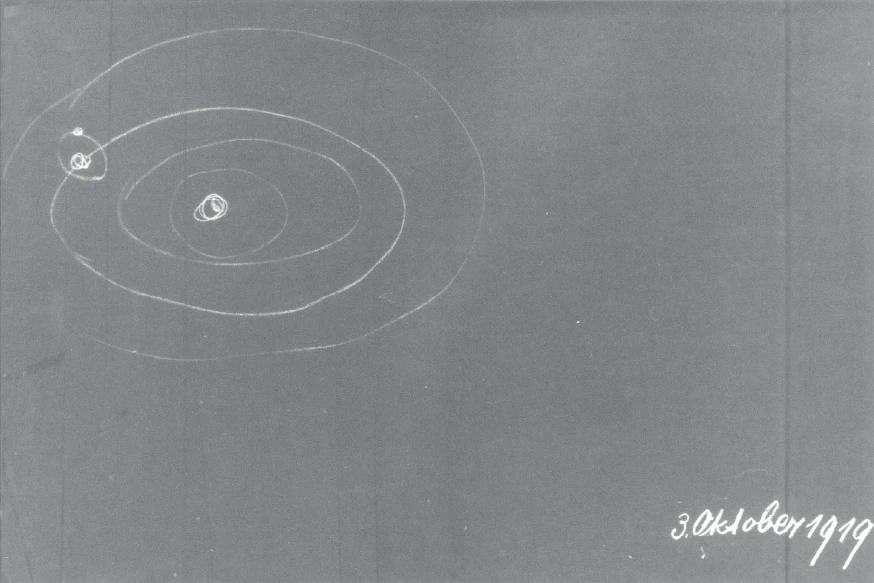
Blackboard 1

But how did this picture come into being historically? I have mentioned this often enough. Historically, this picture came into being because the great Copernicus once wrote his book about the revolution of the heavenly bodies. Right at the beginning there are three sentences. If you pay attention to all three, then it is good. But they were not all three observed, only the first two. The third was ignored. If you only consider the first two Copernican sentences, then the Copernican system, continued in the Keplerian and Newtonian sense, emerges. But this system is not correct. If, according to the calculations of this system, a planet should be at a certain point and you point the telescope in that direction, it is not there! But according to this system, it should be there. Therefore, for some time now, the so-called “Bessel Reductions” have been used; the position is always corrected. Before setting up the telescope, one does not point it towards the point for which one would have to point it according to this system, but towards the point for which one would have to point it after applying the Bessel corrections. But what do these Bessel corrections actually mean? They mean that we must always apply anew what we would apply at once if we were to observe all three Copernican laws, that is, if we had not left the third out of account. But if we take this third Copernican law into account, then history is again at odds with the beautiful revolutions of the planets around the sun. Then we must think of a different world system. But people will not think of this other world system either before they are properly prepared for such a rethinking through anthroposophically oriented spiritual science. For how do people look at the world today? People look at it today as if they were sitting inside a train, never looking out the window and never getting off, but always sitting inside and only living with the passengers of the train. But a person could also travel through the world with a train in such a way that he travels a distance, then he leaves the train, gets off, experiences what is in a city; it may be that another train then comes along, it does not matter, in which he gets back on. He travels further, experiences something in another city. These are the stages that one experiences there. One then carries this with oneself.

Today's astronomical science experiences the Earth's journey through space as if one were sitting in a train and experiencing nothing but the experiences of one's fellow passengers, never getting off. Now you will say: How can you get off the Earth? Is it possible to get off the Earth? — You can, but it is different to get off the Earth than to get off a train. To get off a train means to walk out of the door of the carriage and then go somewhere. To get off the earth means to penetrate into the human soul. When you really penetrate into the soul, when you reach what is inside the soul, then you have gotten off the earth; then you have undergone the same procedure in relation to the earth as you do when you get off a train and get back on. But now the peculiar thing is that when you get off, that is, when you really delve inwardly, concretely delve, not through illusions, but concretely delve, then you experience something different with each getting off, really experience something different with each getting off. Reciting mysticism that delves into the human interior, that experiences God in the soul, that is just mere reciting. To really experience something inwardly, that turns out to be different in different ages, that it is always a renewed experience. If someone has really experienced something inwardly in 1870, and again inwardly in 1919, the two things are experienced differently inwardly. Why are they different? Because man experiences the universe, always at a different place.

It was through such an inner experiencing that the ancients found their system of the heavens, not through a purely outer experiencing. It was through an experiencing like that in the train that the Copernican system arose. The system of the future will again have to be experienced inwardly, in that man measures the journey through the world in inner experiences. Then something different will come out. Above all, we will learn to experience the world concretely, not in the abstract way that people love today.

Something special happened to me recently in Berlin that basically gave me great satisfaction. Some time ago, a disgraceful article was published in the German magazine “Die Hilfe” (“False Prophet” was the title of the article). Now, such articles are read, even overslept. But a few weeks ago, when I was in Berlin, an American visited me and said that he had actually come to see me because he had read the article in 'Die Hilfe' in which you railed so terribly and in such a way that one had to take an interest. I just want to say that by way of an introduction. What actually satisfied me was a question that this man asked, which was highly objective. He said that he had grasped very quickly what the threefold social order is about, but he would now like to ask: Do you think that this threefold social order is an eternal truth that, once found, creates social conditions that must now always remain, or is it a truth for a period of time that only replaces old things; is it a truth that will in turn be replaced by something else? I was positively amazed that there are still such reasonable people in the present day who do not believe in millenarianism, in the 'thousand-year Reich', where an absolute is once found and remains, only one truth over the whole earth and into all eternities. If someone today thinks in socialist terms, he thinks: tomorrow the social state must be realized; when it is there, it will never need to change.

I then formulated my answer in such a way that I said: Of course the last few centuries have striven for the unified state; now we have come so far in concrete terms that we must build it in three parts. After some time, the other, the synthesis, will come again; then the opposite will have to occur again. — You see, it is not so convenient to always have to follow the concrete circumstances, it is not as convenient as thinking up an absolute system. But today it is necessary to follow the concrete circumstances, to be aware that what we have to create, we have to create for the present world situation. But this can already be understood “astronomically” today, in that we see, firstly, that mystical experiences differ depending on whether they are gained in this decade or that decade, in this century or in that century, and that one can follow the movements of the earth itself, experience them inwardly in a mystical way. But today the “great astronomical” must be seen and felt together with the social. We must gain the possibility of advancing in such a way that we today cross a threshold that can only be compared with thresholds of earlier times, which were not only transitions but also leaps in development.

Take the ancient Greeks. They had their land area. As far as the Pillars of Hercules, the earth was still something concrete for them. Then came the indefinite, the completely indefinite. They had a land consciousness. The newer times emerged, the discovery of America, sailing to the East Indies, similar things. Earth consciousness emerged. The land consciousness of the Greeks became the earth consciousness of modern times. Just as for the Greeks, what lay beyond the Pillars of Hercules was indeterminate, so today what is outside of earth consciousness is indeterminate for man, merely mathematical fantasy, Galilean, Newtonian fantasy, and so on. This imagination must be replaced by real facts. We must transform terrestrial consciousness into cosmic consciousness, as one transformed the terrestrial consciousness of the Greeks into terrestrial consciousness. We are at this point today, and we will not make social progress if we do not find the way to develop the world consciousness of the future out of the earth consciousness of modern times, just as the land consciousness of the Greeks was transformed into the earth consciousness of modern times.

If we do not educate through the teachings of anthroposophically oriented spiritual science the great astronomical world view of that which is outside as outer space, then we do not grasp the truth of outer space. But if we do not grasp the truth of outer space, we cannot become citizens of the world. But we will not become social citizens until we have become citizens of the world in our consciousness.


What the world needs now — most urgently! — is anthroposophy : "An entirely different treatment of life must rise up out of the depths of the soul" : "Behold, I make all things new"


Rudolf Steiner, Mannheim

January 19, 1922


Some time has passed since we met here, and the opportunity to discuss a number of things with you after such a long while gives me the profoundest pleasure. Behind, us lie extremely grave times, difficult times, of which the gravity is certainly felt, though in wider circles it is still insufficiently understood. It is true to say that people who have experienced the second decade of the twentieth century have gone through more than is otherwise experienced over a span of centuries. We are asleep in our souls if we fail to notice how everything to do with human evolution is different now than it was ten years ago. The whole great turnabout that has taken place will no doubt only be fully realized by mankind at large after some time has passed. Then we shall come to see how the events that took place so catastrophically at the surface of life reach deep down into the roots of human souls, and how what has happened came about in the first instance as errors of soul affecting the widest circles of mankind. Not until the decision is made to seek in human souls the true reasons for this great human misfortune will it be possible to reach a real understanding of this time of trial undergone by mankind. Then also an attitude will develop towards a spiritual stream such as Anthroposophy which will differ from that prevailing at present.

This anthroposophical spiritual stream wants to give to mankind the very thing that has been lacking over the last three, four, five hundred years, the thing whose lack is so intimately bound up with the wretchedness of culture and civilization we have experienced and are experiencing. Both the greatest and the smallest matters and events in the world come out of the spiritual realm, out of life in the spirit. Universal questions face mankind today, questions which can only be tackled out of the depths of spiritual life, yet they are being dealt with in the most superficial manner all over the world. There is no possibility of seeing what it is that is struggling to rise up from the depths of human soul- and spiritual life. Yet it is just this possibility which Anthroposophy wants to bring to mankind.

Today I shall speak out of the realm of the anthroposophical world view about some intimate aspects of human soul- and spiritual life. Then, from the point of view this will give us, perhaps we shall be able to conclude with a brief consideration of some recent historical events.1 Anthroposophical spiritual science wants to speak about those worlds which for the moment are hidden from external sense perceptions and also from the intellect which is attached to these sense perceptions. It wants to speak primarily about everything connected with the eternal aspect of the human soul. We say of the realms into which this anthroposophical world view wishes to penetrate that they can only be reached if human beings step over the threshold of consciousness. What is meant is that the step over the threshold must be taken consciously, if knowledge about these super-sensible realms is to be gained. For human beings step unconsciously over the threshold every time they go to sleep. We say of the threshold we cross daily, in connection with going to sleep and waking up, that it is guarded by the Guardian of the Threshold. In doing so we speak of a spiritual force known by the spiritual researcher to be as real as are the human beings we meet. We speak of the Guardian of the Threshold because in the present phase of mankind's development human beings really do need to be protected in their consciousness from crossing unprepared into the spiritual realms.

It is quite remarkable that something which human beings have to value above all else, something to which they belong with the deepest roots of their existence and without which they would lack true human worth, namely the spiritual world, has to be hidden from them at the moment. This is profoundly linked to the whole purpose of human evolution. Human beings would not be able to achieve their true nature during the course of evolution if they did not themselves have to work for and win the strength with which to approach the spiritual world. If unearned grace alone were to allow them to step over the threshold, then perhaps they would be lofty spiritual beings, but they would not be human beings in the true sense of the word. They would not be beings who win their way towards their own value. For to be a true human being in the universe means to be the instigator of one's own worth. To step over the threshold unprepared would lead to a kind of burning up of the human being, a kind of extinguishing of the human being. However, what spiritual science has to say about man's relationship to the spiritual world can certainly be grasped by normal understanding. It is quite possible to understand what has to be said about this out of the foundations of spiritual science.

Observe how someone sinks into a kind of unconscious state on going to sleep. Out of this unconscious state individual waves rise up into the world of dreams as though from the depths of the ocean. Even for those who are free of any kind of superstition or nebulous mysticism, this dream world is mysterious, enigmatic, and it has to be sensed as belonging to the inmost being both of the world and of man's existence. So the period human beings spend between going to sleep and waking up is a kind of lowered consciousness out of which is revealed the picture world of dreams. And even if we only follow the dreams in an external manner, we still have to say: They contain picture echoes of that life which is not only given to us through our sense perceptions by way of our intellect, but also through our feelings. But they contain that otherwise familiar world in a way that is different. On the whole, they do not contain any abstract thoughts; they change everything into pictures. While the sense-perceptible world we know has a certain coherence and order which satisfies our understanding, so that everything has its place in space and time, dreams appear to shake everything up. Events which took place yesterday are mingled with others which happened decades ago. Dreams impose an order on things that differs from the order of space and time into which we look with our daytime consciousness.

Examining dreams more closely, we find that what is missing in them is our power of thinking. On waking up we feel that we step from dreamless sleep into the world in which human ideas and thoughts arise. We feel that we pour the picture world of dreams into our bodily nature. And as we do so our body sends out the power of thought which once more brings order into what the dreams have jumbled up. Our body takes us in hand when we wake up; our body gives us the power of ideas, and in dealing with this power we become fully awake. Then the world of dreams fades and its place is taken by the world of thoughts and ideas in the normal order of place and time.

Those who pay attention to these phenomena can observe in ordinary life how something, at first indeterminate, slips into our bodily nature. They can also understand this to the point where they can say: The power of thoughts is given to me by my body when I plunge down into it with my soul- and spirit-being. This everyday observation will bear out what Anthroposophy has to say: The ideas and thoughts we know in ordinary daily life are bound to our external physical body, which remains in bed at night when our being of spirit and soul steps over the threshold into another world. As consciousness is extinguished it leaves behind at the threshold the power and capacity to form a world of thoughts in the ordinary way. What steps over the threshold is whatever the human soul contains by way of feeling and will.

This content of feeling and will resembles the sleeping state even during ordinary day consciousness. We are properly awake only in our thoughts and ideas. Just think how dark is all that lives in our feelings, and how utterly obscure is everything living in our impulses of will. If we try to gain an idea of how we accomplish even the simplest decision of will, then what takes place in our muscles and bones when we put an idea into realization remains as obscure as our sleeping state. First we think: I lift my arm. Then we see our arm rising up. Nothing but impressions. The mysterious processes that take place remain as hidden from our consciousness as sleep itself. What we take with us across the threshold is, basically, something that is asleep and dreaming, even in our waking state. The dream pictures are no clearer than the feelings which attach to our world of thoughts and ideas. The forms in which soul life expresses itself—in the waking state through feelings and in the sleeping state through dreams—differ, but our life of feeling is no clearer than the pictures of our dreams. If it were clearer, we would lead an extraordinarily abstract life. Consider how we speak quite rightly of cold, sober thoughts and glowing feelings! But what lives in our feelings remains in a kind of darkness similar to that of our dream pictures.

When we go to sleep we carry our feelings over the threshold, and it is our feelings which, in a way, even light up to some extent in our dream pictures. We also carry our will into that world; it is as deeply asleep during our daytime as it is when we sleep. So we can say that what carries human beings through the threshold of consciousness is the feeling and will element of their soul being. Feeling and will belong to sleep consciousness. The life of thoughts and ideas and also a part of the life of feelings—because dreams light up—belong to the waking consciousness of daytime; they lie on this side of the threshold. We speak of the Guardian of the Threshold because it is necessary, at their present stage of consciousness, that human beings do not step consciously but unprepared over the threshold which they cross unconsciously every time they fall asleep. When we come to recognize the forces within which human beings find themselves on the other side of the threshold, we also learn to experience why they have to be guarded—prevented by a Guardian, by something which watches over them—from stepping unprepared over the threshold into the spiritual world.

When we enter the world beyond the threshold it certainly looks very different at first glance from what we have been in the habit of expecting. However, if we enter after having undergone sufficient preparation, it gradually changes and we come to new experiences, different from those we encountered initially, which are bewildering even for those who enter the spiritual world after some preparation. For what is it that appears to us first in the spiritual world? Forces, beings, are what first appear to us. And they behave—I cannot express it otherwise—in a very inimical manner towards the ordinary world of sense perceptions. As we step over the threshold into the spiritual world we are met with a burning, scalding fire which seeks to devour everything the world of sense perceptions has to offer. We enter, without a doubt, the world of destructive forces. This is the first sight that meets us on the other side. From the facts as they are I want to give you an idea of what it is like when we first step over.

Look at the human physical body which clothes us from birth to death. Now look, first with regard to the physical body, at the moment in which the human being approaches death and steps across the threshold. Looking simply at the world of space we find that, after the individual has crossed the threshold, the physical body appears externally much the same as it did before. But very soon we notice that this physical body, which has maintained its natural form for decades, is dissolved, destroyed by the forces of the external world, the external cosmos. It is the destiny of this body that it should be dissolved, destroyed by the forces of the cosmos. Simply by looking without prejudice at the fact, once the soul has departed, the body is destroyed and dissolved by the forces of nature, we must become convinced that between birth and death something not belonging to the world of sense perception lives in it which prevents its destruction. For if it belonged to this same world it would destroy the body instead of preserving it. If people would only take account of this obvious fact they would not find it so difficult to enter into anthroposophical spiritual science. There is the corpse; the external forces of nature destroy it. If what we bear within us were of a kind with the forces of nature it would destroy this body all the time. These simple thoughts are for ever disregarded.

Now bear in mind that we are permanently surrounded by a world which destroys our physical body. The moment our body is deserted by our soul it is destroyed. When we leave this body on going to sleep, we enter the world which destroys our corpse. This we have to come to recognize [Gaps in the shorthand report.]. We enter the world of destructive forces when we go to sleep, and yet this is the spiritual world. Why? Those who expect to find something beyond the threshold which resembles what is to befound here in the physical world of the senses are simply expecting to find another physical world beyond the threshold. But if spirit is to be found there, then the physical world of sense perceptions cannot also be there. What we experience there will have to be forces which have the inclination to destroy the physical world of the senses. This we experience in full force when we cross the threshold consciously. We experience with full force that in this spiritual world we find what is for ever inclined to destroy the physical world.

Now if we were to cross the threshold unprepared and unguarded, we should like it very much in that world—if I may put it simply. Especially would our lower instincts be most satisfied, and we would grow into this world we immediately meet, this world of destructive forces; we would become the allies of these destructive forces. We would no longer want to share in the work of maintaining the physical world which surrounds us. We have to learn to love this physical world as one which is filled with wisdom, in order to be well prepared to enter into the spiritual world. Before taking up our place, so to speak, at the side of the creators, we have to learn to love their creation and thoroughly understand that the world as it has been created has not been brought forth meaninglessly by divine, creative forces. In order to enter well prepared into the spiritual world we must first have thoroughly understood the meaning of earthly life. Otherwise on waking up every morning we would return to the world of sense perceptions filled with a terrible hate for this world and with an urge to destroy it. Simply out of the necessity of human existence we would wake up full of hate and anger if we spent the time between going to sleep and waking up in a state of consciousness such as that.

You can pursue this train of investigation further by looking at dreams in an unprejudiced way. Dreams are filled with terribly destructive forces. What comes to the surface in the form of dream pictures destroys every shred of logic. Dreams say: That's it, logic is finished, I don't want any logic! Logic is for the external world of sense perceptions; there it dogmatically arranges everything. Away with logic—a different world order is what is required! That is what dreams say. And if they were not only strong enough to caress our brain but were also able to submerge themselves into our whole body, then they would seize not only our logical instincts but also all our other instincts and our emotional life. Just as they destroy logic, so would they also destroy the whole life of physical human beings. We should be reluctant to enter once more into our physical body, and in doing so we would gradually destroy it. Because what lives in dreams is overcome by what meets it from the body, it comes about that logic is only destroyed momentarily. This can be observed in every detail. What continues during sleep are the forces which belong to our rhythmic system. Breathing continues, heartbeat and pulse continue. But thoughts cease, the will ceases. What belongs to our middle region continues, though in a subdued form. The moment the pulse grows a little weaker in the brain, dreams rush in and set about destroying the forces of the body—of logic—until these forces of the body once more overcome the dreams as the pulse gains in strength.

When it is a matter of really understanding these forces Anthroposophy knows very well how to be materialistic. Materialists do not really know how to be materialistic because they do not know how the spiritual realm works together with the physical. They fail to notice how the spirit enters into the physical and there continues to work. It is most interesting to observe how the spirit enters in and first wants to make itself felt and destroy logic. For then the forces of the physical body, its powers of thought and ideas, enter the fray and overcome it again. Dreams are rendered harmless to physical, earthly life. If you consider this properly you will gain deep insight into the relationship between waking and sleeping, for it shows that we have to remain aware of our spiritual origin, that we have to sink down again and again into sleep, but that on the other hand, in the present stage of our evolution, we have to be prevented from following in full consciousness what takes place in the state we enter between going to sleep and waking up.

We live on our earth. It is, in the first instance, a physical and a cosmic creation. A time will come when this earth will suffer death by fire. It will go through actual physical fire when the forces of destruction will seize hold of every earthly form, not only the corpses. Spiritual forces are leading this earth towards this death by fire, spiritual forces which are connected with the earth and which we meet in the first stage into which we enter when we step past the Guardian of the Threshold into the spiritual world.

Let us consider what we have gained with regard to stepping through the portal of death. Our physical body is entirely discarded. Our spirit and soul element now enters the spiritual world in such a way that it straight away develops the wish to return to the physical body. The element of spirit and soul, once it has laid down the physical body, can now begin to form a thought life without the physical body. While it lived in the body it was too weak to endure the forces of destruction. Now, as it passes through the portal of death, it has to be strong enough not to yearn for a return to the physical body. Since it no longer remains unconscious but, instead, enters a genuine consciousness as it passes through the portal of death it has to take up a certain kind of thought life, for only in the life of thoughts is it possible to become really conscious. This is the tremendous difference between crossing the threshold on going to sleep and passing through the portal of death. When we go to sleep our thought world is merely damped down until it returns when we re-enter our physical body on waking up. When we die we take up the thought life with our soul and spirit element without the mediation of our physical body. What does this mean?

Human beings would never return to their physical body in the morning if they knew the spiritual world, if they had grown to be part of it and did not have the wish, which is in them unconsciously, to return to their physical body, that is, to the physical world. Wishes, however, are something which is not connected with clear consciousness but which damp down this clear consciousness into a twilight. Human beings return to their body in the morning because of a wish, but it is these very wishes, pulling towards the physical body, which damp down their thought world. So they only find their thought life once again when they have returned to their body. But, in death, wishes have also died. Human beings enter the world-thoughts. As beings of spirit and soul they now have a thought life, but if they were to enter death entirely unprepared they would enter the same world as the one we enter when we go to sleep in the evening. To express this in extreme terms we have to say: If human beings enter death unprepared they find themselves in a terrible situation; for they have to watch what happens to their physical body. Their physical body is pulverized in the world-all, for if we do not cremate the body then it is cremated by the cosmos. And human beings would have to watch this happening if they were unprepared.

What is the consequence of this, and what has to happen so that human beings see not only destruction after death, so that they live not only in the midst of destructive forces? By absorbing spiritual content, by developing a world view which is consistent with the spirit, they must carry an inward relationship with the divine, spiritual world through the portal of death. If they are aware solely of a physical, material world, then they certainly enter after death in a state of terrible unpreparedness into the world of destructive forces as though into a world of scorching flames. But if they fill themselves with ideas and thoughts about the spiritual world, then the flames become the birthplace of the spirit after death so that they see not destruction alone; in the falling away of earthly dust from their human orbit they see the spirit rising up. No one should say what ordinary materialistic ideas are so prone to saying: I can wait until death comes to me! No, we must bear our consciousness of the spiritual world with us through the portal of death. Then with our soul and spirit we can overcome the destructive cosmic forces which take over our body, so that our element of spirit and soul rises up with new creativity above the destruction.

I am telling you this on the basis of anthroposophical spiritual science, but you have all, surely, heard of the fear experienced in former times in a sense of doom with regard to death, a sense of doom about which the Apostle Paul2 taught when he spoke about man's soul being saved from falling a prey to death. In former times people knew that they could not only die physically with their corpse, but also spiritually with their soul. Human beings dislike speaking about the possible death of their soul. When speaking of death Paul does not mean physical death. He means something that can happen because physical death wants to lead on to the death of soul and spirit. Human beings must become aware once more that they have to do something during their physical earthly life in order to join their consciousness to their soul and spirit, so that these may carry something through death, in order that the spirit may arise for them out of the devouring flames which are always present after death.

Considerations like this must make it clear that to live within the whole universal order is an immensely serious matter. No view of the world is worthy of the human being if it does not lead through inner strength to a world of moral values, if it does not put before our souls the utter seriousness of life. To speak of physical and chemical forces building up the earth and of living creatures and, finally, man developing along the way, is not merely a one-sided world view; it is a world view which ignores the seriousness of life and which arises, actually, simply out of human laziness. A world view, on the other hand, which achieves a proper attitude to the spirit, leads to a seriousness about life because it puts before the soul the possibility that on passing through the gate of death the human being might become united with the forces of destruction. Throughout their physical life human beings are given the opportunity to prepare themselves suitably, because every evening as they go to sleep they are shielded from seeing the world of destructive forces to which they are related. They are given time to take in something that can guide them through the portal of death in a manner which enables them to discern the spirit within the forces of destruction. It is impossible to overemphasize the fact that feelings and perceptions about life must follow as a matter of course from a world view, and that a world view must not be allowed to remain mere abstract theory but must become something living, something which seizes hold of feelings and will. Civilized mankind must wrestle again for a world view such as this. Then, once more, what is imperishable will be seen within everything perishable; and, furthermore, out of everything that does not pursue its course egoistically within man it will be possible to push forward to eternity and immortality.

From this point of view look at life as it is carried on today. And do not take offence when someone who has to speak honestly is forced to say such disagreeable things. Look, for instance, at religious education. What is it built on? On egoism! Because people want to live beyond death, immortality—the possibility of going through death consciously—is spoken about. People long for this, and so to satisfy them—because it is disagreeable to appeal to knowledge—knowledge is omitted and mere belief is called into play. In this way, human egoism alone is approached, human egoism that wants to see what it will be like after death, instead of waiting till it happens. What it is like before birth is not found to be interesting. This can only be learnt through knowledge. Indeed, eternity—what comes after death and what stretches back beyond conception—can only be found through knowledge.

Even our language shows that we only have a half knowledge about the eternity of man. We speak only about immortality, ‘undyingness’. What we need in addition is a word denoting ‘unbornness’. Only when we can grasp both will we finally understand the eternity of the human being. Right down into language, human beings of our time have abjured their links with the spiritual world. These links must be found once more. If they cannot be found it will betotally impossible to carry on living in a proper way, and today's culture and civilization could fall into absolute decline.

In Stuttgart we have founded the Waldorf school3 and Waldorf education. All sorts of things are said about this. Recently somebody said: Why does Waldorf education take so little account of fatigue in the children? Fatigue ought to be carefully studied nowadays. In so-called experimental psychology it is pointed out with pride how children tire after repeating unconnected words or following lessons about a sequence of subjects. And then it is said: Waldorf education is not up to date because it does not take the fatigue of the children into account. Why is this? The Waldorf school does not speak much about fatigue. But it does speak about how children ought to be tended and educated after the change of teeth, namely by basing the education mainly on the rhythmic system—which means that the artistic element is cultivated, since this is what stimulates the rhythmic system. Abstract writing comes later, and abstract reading later still. Demands are made, not of the head but of the artistic realm. But those who work with children only at those things which make demands on the head will, of course, have to reckon with fatigue. When, however, we make claims on the rhythmic system, on the artistic element, then we are justified in asking: Does our heart tire throughout life? It has to go on beating, and we have to go on breathing. So Waldorf education need not concern itself too much with fatigue because it aims to educate children in a way which tires them very little. Experimental education has arrived at a system which tires the children dreadfully; by its very method it brings about this tiredness. [Gaps in the shorthand report.] Waldorf education is concerned with body, soul and spirit, and account is taken of what comes from the spiritual and soul worlds to unite with the body and what departs again at death. Anthroposophy is the very thing which can help us to understand the material, physical realm.

What is most lively of all in the child? Its brain activity! From the brain the forces which mould the whole body stream out. These are most lively until the change of teeth. At the change of teeth this moulding capacity is transferred to the system of breathing and heart, and until puberty this is what we have to work with, which means that artistic work, not theoretical work, is what is required. Between the seventh and the fourteenth year the muscles are formed inwardly in a way which is adapted to the rhythmic system. Not until the fourteenth year approaches do soul and spirit take hold of the whole human being, and it is interesting to observe how until this moment the muscles have taken their cue from heartbeat, pulse and breathing. Now, through the sinews, they begin to make friends with the bones, with the skeleton, and to adapt themselves to external movements. You should learn to observe how young people change at this age. [Gaps in the shorthand report.] The process starts from the head; the soul element grows further and further towards the surface of the human being and takes hold of the bones last of all; it fills the whole human being and uses him up, making friends ever more closely with the forces of death, until these forces of death win through to victory at the moment of death.

Anthroposophical spiritual science follows up the spiritual processes right into the minutest detail, showing how they become immersed in material life and how they take hold of the whole human being, starting with the head. Not until knowledge such as this is taken into account, will it become possible to educate people properly once again. We need intellect and understanding so that we may find freedom, but they drive away the certainty of our instincts. A friend of mine was quite a nice person when we were young. Later in life he invited me to visit him. I had never partaken of a midday meal with scales and weights on the table. My friend first weighed everything he ate! By his intellect he had discovered how much he needed in order to maintain his body, and this exact amount was what he ate. Intellect drives out instincts in small things, but also on a larger scale. Now it is necessary for us to find our way back to them. A sure sense for life, a firm stand in life, is needed once more. This is found by seeking our eternal element within the temporal sphere; we need to understand how the eternal finds its place in the temporal. This is what our contemporary civilization needs.

Such things must be treated on a global scale. No account is taken these days of the contrasts that exist between people of the West and people of the East. External matters are broached in an external manner; congresses are called to discuss ways of balancing out the world's difficult situation, but no account is taken of the fact that East and West can only achieve economic balance if they have trust in one another. Asians will never be able to work together properly with the West if they cannot understand each other. But understanding can only come about through the soul. Understanding out of the soul is needed for the economic realm in the world; and understanding out of the soul can only be achieved through a deepening of soul life.

This is why today the most intimate matters of individual soul life are at the same time matters of worldwide import. Comprehension of what the world today needs, in external public matters too, will not be achieved unless an effort is made to listen to what the science of the super-sensible has to say, for the world has changed during the course of evolution. The human race, in particular, has changed.

Looking at the span of human evolution, let us turn to that event without which the whole of human and earth evolution would have no meaning: the Mystery of Golgotha. In this Mystery of Golgotha something divine entered into the conditions of the earth by means of an earthly body. Christ entered the body of Jesus of Nazareth in order from then on to work with the earth. The earth would have perished, would have decayed in the world order, if a new fructification had not been brought about by the entering-in of the Christ. You know also that in the distant past an instinctive knowledge, a primeval wisdom, existed, of which only remnants remained in western civilization at the time of the Mystery of Golgotha. Enough remained, however, to make it possible for the Mystery of Golgotha to be at least instinctively comprehended for four centuries. In the early centuries of Christianity the understanding of the super-sensible significance of the Mystery of Golgotha was such that the leading Christian teachers knew about the entering-in of Christ, the Sun Spirit, into the human being, Jesus of Nazareth.

Who today has a living awareness of what it means to ask whether the human being Jesus of Nazareth bore two natures, a human one and a divine one, or only one? Yet in the early Christian centuries this was a vital question, a question which had a bearing on life. There was a vivid awareness of how, coming from the cosmos, the Christ Spirit had united with Jesus; two natures in one personality; God in man.

You have often heard that the fourth post-Atlantean period lasted from 747 before the Mystery of Golgotha to about 1413 after the Mystery of Golgotha. In the first third of the fifteenth century intellectualism proper began. Now, we look at physical forces, we calculate, we study physics, but we no longer know that spiritual forces are at work out there, that the spirit which was known in earlier times really exists out there. Look at this fourth post-Atlantean, period lasting from 747 BC until 1413 AD. If you halve this period you come to a point that lies in the fourth century AD, the point when the wisdom which still contained a spiritual comprehension of the Mystery of Golgotha finally faded away. From then on, intellectual discussion was all that took place. And finally, as the fifteenth century approached, the human intellect became the sole ruler of human civilization. Because of this, anything that represented a living connection between the human being and the Christ was drawn more and more into merely materialistic human thinking. In the most advanced theology in the nineteenth century the Christ was entirely lost, and the most enlightened view was taken to be that of Christ as nothing more than the ‘man of Nazareth’. If we can really feel this in all its gravity, we cannot but develop a yearning to find the Christ Being once again. And this yearning to find Christ once more is what the anthroposophical world view wants to satisfy with regard to the major global questions. In Central Europe people are particularly well prepared for this, as all kinds of symptoms show.

One of Western Europe's great thinkers, Herbert Spencer,4 wrote about education in a way which pleases materialists very much. He said that all education is useless if it does not educate human beings to educate others. On what does he base this? He says: The greatest achievement in a human being's life is to beget other human beings. So therefore education must also be greatly important. From one point of view western thinking is correct. But what does an eastern thinker say? Out of the eastern spirit, something very ancient still lives in Vladimir Soloviev.5 For western culture, primeval wisdom has disappeared. In the East it remains as a feeling. Soloviev still bears something of true Christian wisdom. Here in Central and Western Europe we have only a God-consciousness. There is virtually no knowledge of the Son. Harnack,6 for instance, speaks of God in a way which makes it seem as though Christ, the Son, has no place in the Gospels. Consciousness of the Father, consciousness of God, is all that is left. What is said of the Son must also be said of the Father. But Soloviev still has something of the Christ-consciousness, and when he speaks it can sometimes be felt as if we were listening to the old Church Fathers from before the time of the Council of Nicaea.7 Even the titles of his works are quite different. For instance there is a treatise on ‘Freedom, Necessity, Grace and Sin’. You would be unlikely to find a treatise on grace or sin written by one of the western philosophers—Spencer, for instance, or Mill, or Bergson, or Wundt! No such thing exists in the West; it would be quite unthinkable and indeed is not to be found.

The eastern philosopher, though, still speaks like that, saying: Alife given to man on earth, a life in which there was no striving for perfection in truth, would not be a genuinely human life. It would be valueless, as indeed would the striving for perfection in truth, if human beings had no part in immortality. Such a life would be a fraud on a global scale. Thus speaks Soloviev, the eastern philosopher. And he goes on: The spiritual task of man only starts when he reaches puberty. This is the very opposite of what Spencer says! Spencer makes the begetting of offspring the goal of development. For the eastern philosopher, development only begins at that point. It is the same with every matter, including questions of economic life. This is how the western economist speaks today, without having any sense for what eastern people feel about economic life. Today's major questions require consideration on a historical scale, and we ought to realize that the great misfortune of mankind in the second decade of the twentieth century, the great challenge and the great trial, is that involving considerations of this kind. An entirely different treatment of life must rise up out of the depths of the soul. The great questions of life, those that lie beyond birth and death, must come to play a part in ordinary human life. The questions of the present time must be illumined by the light of eternity, otherwise people will hasten from congress to congress and sink ever further and further into misfortune.


Source: The Rudolf Steiner Archive


Understanding the Holy Spirit


Rudolf Steiner, The Fifth Gospel, lecture 3

October 3, 1913


When I said yesterday that the personalities who we usually call the apostles of Christ Jesus experienced a certain awakening which began at the so-called Pentecost, I didn't mean to claim that it happened in full consciousness. Nevertheless, when clairvoyant consciousness immerses itself in the souls of those apostles, it recognizes the images in those souls. But in the apostles themselves it was less images than – if I may say so – life, as a direct experience, as feeling and force of soul.

And what the apostles were then able to say, by which they even attracted the Greeks of those times, by which they gave the impulse for what we call Christian development, that which they carried within them as power of the soul, of the mind, flowed from what lived in their souls as the living force of the Fifth Gospel. They were able to speak as they spoke, act as they acted, because they bore in their souls the things we are now deciphering as the Fifth Gospel, although they didn't tell these things with the same words which one must use to relate the Fifth Gospel now. For they had received like an awakening the fecundation through all-embracing cosmic love, and under the influence of this fecundation they continued to act. And here we are at the point where we must speak of the earthly life of Christ in the sense of the Fifth Gospel.


It isn't easy to describe all this in words using contemporary concepts. But we can approach that greatest of earthly secrets by using many of the concepts and ideas with which we are already familiar through our spiritual scientific considerations. If we want to understand the Christ-being, we must use the concepts we already have through our spiritual scientific analyses in a somewhat different form.

Let us consider, in order to gain some clarity, what is usually called the baptism by John in the Jordan. It is compared in the Fifth Gospel, in relation to the earthly life of Christ, with the act of conception in a human being. The life of Christ from then until the Mystery of Golgotha is understood when we compare it with the life of an embryo in the mother's body. It is in a sense the embryonic life of the Christ-Being which this being lived through from the baptism in the Jordan till the Mystery of Golgotha.

We must understand the Mystery of Golgotha itself as an earthly birth — that is, the death of Jesus as the earthly birth of Christ. And we must look for his actual earth-life after the Mystery of Golgotha, when Christ was in contact with the apostles, when they were in another state of consciousness, as I indicated yesterday. That is what followed the actual birth of the Christ-being, and what is described as the Ascension and the immediately following outpouring of spirit, which in respect to the Christ-Being we must understand as corresponding to what we are accustomed to see as the entrance into the spiritual world upon human death. And the life of Christ in the earthly sphere since the Ascension, or since Pentecost, we must compare with what the human soul experiences when it is in the so-called Devachan, or Spirit-land.

We also see, my dear friends, that in the Christ-Being we have a being before us about which we must completely change all the concepts we have acquired about the successive stages of human life. The human being goes, after a short interval called purification-time, Kamaloka-time, to the spiritual world in order to prepare for the next life on earth. The human being lives though a spiritual life after death. From Pentecost on, the Christ-being experiences immersion in the earth-sphere — what for the human being is the transition to the Spirit-land. Instead of going to a Davachan, to a spiritual region, as man does after death, the Christ-Being made the sacrifice to seek the earth as his heaven. The human being leaves the earth in order — if we may use a common expression — to change his place of residence to heaven. Christ left heaven in order to change his place of residence to earth.

I beg you to see this in the right light, and to combine it with the feeling about what happened through the Mystery of Golgotha, in which his actual sacrifice consisted: namely in leaving the spiritual spheres in order to live with the earth and the human beings on the earth and to consolidate the impulse he gave for further human evolution on earth. This means that before the baptism in the Jordan this being did not belong to the earthly sphere. He descended from the over-earthly sphere to the earthly sphere. And what was experienced between the baptism by John and Pentecost had to be lived out in order to transform the heavenly being of Christ into the earthly being of Christ.

It is saying infinitely much when this secret is revealed here with the words: Since the Pentecost event the Christ-being is with human souls on the earth; previously he had not been with human souls on the earth. What the Christ-Being underwent between the baptism by John and Pentecost happened in order for the place of residence in the spiritual world could be exchanged for the place of residence in the earthly sphere. That happened so the divine-spiritual Christ-being could take on the necessary form in order to be able to be in community with human souls. Why did the events of Palestine take place? In order for the divine-spiritual being of Christ to be able to take on the form needed to be in community with human souls on the earth.

That this event in Palestine was unique is something which I have previously often indicated: the descent of a higher, unearthly being into the earthly sphere and the remaining of this unearthly being together with the earthly sphere until the earthly sphere undergoes the corresponding transformation. Since that time the Christ-Being is active on the earth.

If we want to clearly understand the Pentecost event in the sense of the Fifth Gospel, we must use the concepts we have developed in spiritual science. It has been brought to your attention that in ancient times there were Mysteries, initiations, through which the human soul was raised to participation in spiritual life. This pre-Christian initiation process can be seen most clearly when one observes the so-called Persian or Mithras mysteries. There were seven stages of initiation. The person who was to be raised to the higher stages of spiritual experience was led first to what was symbolically called the “Raven” stage; he became an “occulter”, a “hidden one”. In the third degree he became a “Fighter”, in the fourth a “Lion”, in the fifth he took on the name of the people to whom he belonged. In the sixth degree he became a “Sun-Hero”, in the seventh a “Father”. For the first four degrees it is sufficient today to say that he was gradually led deeper and deeper into spiritual experience. In the fifth degree the person reached the capacity for an expanded consciousness, which enabled him to become a spiritual guardian of his people. Therefore he was assigned the name of the corresponding people. When someone at that time was initiated into the fifth degree, he had a certain participation in the spiritual life.

We know from a lecture cycle that I gave here that the nations of the earth are led by what we call in the hierarchies of spiritual beings archangeloi or archangels. The person initiated in the fifth degree participated in the life of the archangels. Initiates in the fifth degree were needed in the cosmos. Therefore an initiation in this fifth degree existed on earth. When such a person was initiated in the mysteries and received the soul-content which corresponded to the fifth degree, the archangel looked at the soul of such a person and read in that soul as we read in a book that informs us of certain things which we must know in order to accomplish something. The archangel read in the person who was initiated in the fifth degree what a nation [an ethnic group] needed. Initiates of the fifth degree must be formed on earth in order for the archangeloi to lead correctly. Those initiates are the intermediaries between the leaders of the ethnic group and the people of the nation. They carry up to the sphere of the archangels what is needed in order for the nations to be correctly led.

How could this fifth degree be attained in pre-Christian times? It could not be attained while the soul remained in the body. The human soul had to be elevated out of the body. The initiation consisted of the soul being elevated out of the body. And while out of the body the soul experienced what gave it the content I have just described. The soul had to abandon the earth and enter the spiritual world in order to attain what it had to attain.

When the sixth degree of the old initiation was reached, the Sun-Hero degree, then in the soul of such a Sun-Hero reigned not only what is necessary to lead a people, but what is higher than that. If, my dear friends, you observe the evolution of humanity on the earth, you will see how nations arise and disappear, how they develop. Nations are born and die as individuals are. What a nation has accomplished for the earth must, however, be retained in the earth's evolution. Not only must a nation be led and guided, but also what that nation [or people] accomplishes on earth must be preserved beyond that nation. In order for this to happen the Sun-Heroes were necessary. In the higher worlds it is possible to read what lives in the soul of a Sun-hero and gain the strength which carries over the achievements of a nation into the work of humanity as a whole. And just as he who was to be initiated in the fifth degree of the ancient mysteries had to leave his body in order to accomplish what was necessary, he who would be a Sun-hero had to leave his body and take as residence in the sun.

These are things which for contemporary consciousness sound almost incredible, perhaps even foolish. But the Pauline words are appropriate — that wisdom, which can be divine, can be thought foolish by men. The Sun-Hero lived together with the whole solar system during the time of his initiation. The sun was his dwelling, as the earth is for the normal man. As mountains and streams surround us, the planets of the solar system surrounded the Sun-Hero during his initiation. The Sun-Hero had to be carried out to the sun during his initiation. That could only be achieved when he was out of the body in the ancient mysteries. And when he returned to his body he remembered what he had experienced and could use it as the ability to further the evolution of humanity, for the benefit of humanity as a whole. The Son-Heroes left their bodies during the initiation and reentered them when they returned and had the strength which could transfer a nation's work to the evolution of humanity as a whole.

And what did those Sun-Heroes experience during the three-and-a-half days of their initiation? What did they experience when they were on the sun? Togetherness with Christ, who was not yet on the earth before the Mystery of Golgotha! All the ancient Sun-Heroes had gone to the higher spiritual spheres. For it was only there that one could experience togetherness with Christ in ancient times. It was from that world, to which the initiates had to ascend, that Christ descended to the earth.

We can therefore say that what was achieved by a few through the initiation procedure in ancient times was achieved as a natural event by Christ's apostles during Pentecost. Whereas previously one had to ascend to Christ, he now descended to the apostles. And the apostles had become in a certain sense men who carried within themselves the same content which the ancient Sun-Heroes had had in their souls. The spiritual power of the sun had streamed into the souls of men and was subsequently active in human evolution. In order for that to happen, the events of Palestine were necessary.

From what source did Christ's sojourn on earth grow? It grew from deepest suffering, from a suffering which exceeds all human understanding of suffering. In order to conceive of all this correctly, it is again necessary to overcome certain obstacles of contemporary consciousness.

Recently a book was published which I can enthusiastically recommend, because it was written by a very intelligent man and proves what nonsense even intelligent people can say about spiritual things. I mean Maurice Maeterlinck's Vom Tode (“About Death”). Among many nonsensical things, he affirms that when a person dies he is a spirit, and can no longer suffer because he has no physical body. Maeterlinck, a very intelligent man, suffers under the illusion that only the physical body can suffer and a dead person can therefore not suffer. He doesn't notice the phenomenal, almost incredible nonsense it is to affirm that only the physical body, which consists of physical forces and chemical elements, can suffer. As if a stone could suffer! The physical body cannot suffer; it is the soul that suffers. It has come to the point where people think the opposite of what makes sense about the simplest things. There would be no kamaloca-suffering if the spirit could not suffer. It is just because it has been relieved of the physical that suffering exists in kamaloca. Whoever believes that a spirit cannot suffer cannot have a correct idea of the infinite suffering of Christ during his time in Palestine.

Before I speak of this suffering however, I must bring something else to your attention. We must be aware that with the baptism in the Jordan by John a spirit descended to the earth, lived on the physical plane for three years and experienced death on Golgotha, a spirit who, before the baptism in the Jordan, had lived in circumstances which were completely different from earthly ones. What does that mean? It means, anthroposophically speaking, that that spirit had no earthly karma. I beg you to keep this in mind. A spirit lived for three years in the body of Jesus of Nazareth without having an earthly karma in his soul. Therefore all of Christ's earthly experiences have a completely different meaning than that of a normal human soul. When we suffer, when we have this or that experience, we know that the suffering is founded in karma. That was not the case for the Christ spirit. He had to go through a three-year earthly experience without a karmic burden. What did that mean for Him? Suffering without karmic meaning, truly unearned suffering, innocent suffering! The Fifth Gospel is the anthroposophical Gospel and shows us the only three-year earthly life for which the concept of karma in the human sense is not applicable.

A further consideration of this Gospel teaches us something else about those three years, which we have compared to the life of an embryo, created no karma, was not charged with guilt. A life was lived on the earth that was not conditioned by karma and also created no karma. One must assimilate all these concepts in the profoundest sense in order to correctly understand those extraordinary events of Palestine, which are otherwise inexplicable. For how greatly have they been misunderstood over the ages! And what impulses have they nevertheless given! Their profound meaning is often ignored.

How thoughtless one passes over things which are profoundly meaningful. Perhaps many of you have heard of the book Leben Jesu (“The Life of Jesus”) by Ernest Renan, which was published in 1863. One reads this book without recognizing its significance. Perhaps one day people will wonder at how many people read this book without realizing how peculiar it is. What is peculiar about it is that it is a mixture of a sublime description and cheap novel. Read “The Life of Jesus” with this idea in mind, read what he makes of Christ, who for him is of course mainly Christ Jesus. He makes him out to be a hero who originally had good intentions, who was a great benefactor of humanity, who however was seduced by the mob's enthusiasm and more and more surrendered to it and tells them what they want to hear.

In great style Renan uses for Christ what is often used by lesser talents. It often happens that when people see something spreading, Theosophy for example, they use the following criticism: At the beginning you had good intentions, but then came those evil followers to hear what they wanted to hear and little by little you were seduced. That is how Renan handles Christ Jesus. He doesn't hesitate to describe the resurrection of Lazarus as a kind of fraud which Christ Jesus allowed to happen as a means of impressing the masses. He doesn't hesitate to lead Christ Jesus into a kind of raging fury and finally be seduced by the people's instinctual desires. Thus a cheap novel is mixed with a sublime presentation. What is remarkable is that someone with healthy feelings should be shocked upon hearing of a person who originally had the best intentions but is finally seduced by the mob's instincts and allows all kinds of fraud to be perpetrated. Renan is not shocked however, but has only beautiful words for that person. Curious, isn't it? But is an indication of how attracted people are to Christ even though they don't understand him. It can go so far that such a person makes the life of Christ into a cheap novel and then can't find enough admiring words to draw people's attention to him. It's only possible with a being in whom something entered as entered into the Christ Jesus. Oh, much karma would have been amassed in the three years of Christ's life on earth if his life had been as Renan describes it. In the future, however, it will be recognized that such a description collapses with the knowledge that a life was lived on earth without karma having been created. That is the message of the Fifth Gospel.

The Fifth Gospel tells us that on the occasion of the baptism in the Jordan the words which appear in the Gospel of Luke are an accurate rendition of what a highly developed clairvoyant consciousness would have heard: “This is my beloved son, today I have begotten him.” [Luke, 3, 22] And it is an accurate description of what occurred: the begetting, the conception of Christ on earth.

It the following days we will speak of the Being who descended into the body of Jesus; now we will only emphasize that Jesus of Nazareth had come [to the Jordan], and gave his body to the Christ being. The Fifth Gospel tells us – what we can read with retroactive clairvoyant vision – that at the beginning of Christ's wandering on earth he was not fully incorporated in the body of Jesus, that only a loose connection existed between the Christ being and the body of Jesus of Nazareth. It was not like that of a normal person's connection between soul and body, rather that, when necessary, the Christ-Being could leave Jesus of Nazareth's body. While Jesus of Nazareth's body was as sleeping, the Christ being went wherever it was necessary.

The Fifth Gospel shows us that the body of Jesus of Nazareth was not always present when the Christ being appeared to the apostles, but that Jesus of Nazareth's body stayed somewhere else and the spirit, the Christ-Spirit, appeared to the apostles. But the appearance was such that it could be confused with Jesus of Nazareth's body. They probably noticed a difference, but the difference was too small for them to clearly recognize. The four gospels don't say much about it, but the Fifth Gospel does. The apostles could not always clearly differentiate and say: Now Christ Jesus stands physically before us, or now only the Christ-Spirit. They mostly took the appearance to be the Christ-Spirit (to the extent they recognized him) in the body of Jesus of Nazareth. But during the three years the spirit gradually bound itself ever more closely to the body of Jesus of Nazareth, so that the etheric Christ-Being came to closely resemble the body of Jesus of Nazareth.

Please note how different all this was with respect to a normal human being. The normal person is a microcosm related to the macrocosm, an image of the whole macrocosm. What is expressed in the human physical body can be understood in this way. What the human being on earth becomes is a reflection of the cosmos. The reverse is the case with the Christ-Being. The macrocosmic Sun-Being formed itself according to the image of the human microcosm, contracted and pressed more and more until it resembled the human microcosm. Just the reverse!

At the beginning of the Christ's earthly life, just after the baptism in the Jordan, the connection with the body of Jesus of Nazareth was loosest. The Christ-Being was still almost completely outside the body of Jesus of Nazareth. Therefore what the Christ-Being did as he walked on the earth was completely over-earthly. He healed in a way which no earthly force could heal; he spoke to the people with such intensity that it was a divine intensity. But gradually he became more and more similar to the body of Jesus of Nazareth, contracted, pressed more and more into earthly conditions until the divine power deserted him. The Christ-Being went through this process as he came more and more to resemble the body of Jesus of Nazareth, something which, in a certain sense, can be considered to be a devolving evolution. The Christ-Being had to feel the godly power weakening as he became similar to the body of Jesus of Nazareth. A god gradually became a man.

As someone who sees his body weaken and die under extreme pain, so the Christ-Being saw his divine content disappear in that he became ever more similar, as an etheric being, to the body of Jesus of Nazareth, to the point where he was so similar that he could feel fear like a man. The other Gospels describe this when Christ Jesus goes up to the Mount of Olives with his disciples and the Christ-Being in the body of Jesus of Nazareth has the sweat of fear on his brow. It was the humanizing, the gradual humanizing of Christ and the increasing similarity to the body of Jesus of Nazareth. In the same measure as the etheric Christ-Being approached similarity to the body of Jesus of Nazareth, Christ became man. Divine miraculous power left him. Here we see the Passion from the point when he came to the Jordan, to where the astonished crowds saw what he could do and said: no being on earth has ever done these things. That was when the Christ-Being had little similarity to the body of Jesus of Nazareth. From that moment of amazed bystanders it took the three years to come to the point where the Christ-Being was so similar to the body of Jesus of Nazareth that in that wasted body he could no longer answer Pilate's, Herod's or Caiphas's questions. So identical had he become to the weak, wasting body of Jesus of Nazareth, that he remained silent to the question by the high priest of the Jews: Did you say that you will destroy the temple and in three days rebuild it? The Christ-Being no longer spoke from the decaying body of Jesus of Nazareth and stood dumb before Pilate, who asked: Did you say that you are the king of the Jews? The way of the Passion went from the baptism in the Jordan to powerlessness. And soon the masses, who had previously been amazed at the Christ-Being's over-earthly miraculous power, no longer admired him, but stood in front of the cross mocking the weakness of the god who became man with the words: You helped others, now help yourself! That was the Passion path — endless suffering, to which was added sorrow for humanity at that moment of the mystery of Golgotha.

That pain and suffering, however, gave birth to the spirit which poured out on the apostles at Pentecost. From that pain was born the all-embracing cosmic love which descended with the baptism in the Jordan from the over-earthly, heavenly spheres into the earthly sphere – which became similar to a human body and realized the moment of highest divine powerlessness in order to give birth to the impulse which we know as the Christ-Impulse in the subsequent evolution of humanity.

These are things we must keep in mind if we want to understand the full meaning of the Christ-Impulse, as it will have to be understood in the future in order for humanity to advance in its path of evolution and culture.


Source: The Rudolf Steiner Archive

http://wn.rsarchive.org/Lectures/FifthGosFTS/19131003p01.html

Thursday, October 2, 2025

Anthroposophy: The Redemption of Thinking


Rudolf Steiner:


It is as if everything were being done in the middle of the nineteenth century to beguile human beings into believing that thinking must remain subjective and shadow-like, that it must not interfere in the world outside so that they could not possibly imagine that there might be reason, nous, in the cosmos, something that lives in the cosmos itself.

This is what caused this second half of the nineteenth century to be so unphilosophical. Basically, this is also what made it so devoid of deeds. This is what caused the economic relationships to become more and more complicated while commerce became enlarged into a world economy so that the whole earth in fact turned into one economic sphere, and particularly this shadow-like thinking was unable to grasp the increasingly complex and overwhelming reality. This is the tragedy of our modern age. The economic conditions have become more and more complex, weighty, and increasingly brutal; human thinking remained shadowy, and these shadows certainly could no longer penetrate into what goes on outside in the brutal economic reality.

This is what causes our present misery. Unfortunately, if a person actually believes that he is more delicately organized and has need of the spirit, he may possibly get into the habit of making a long face, of speaking in a falsetto voice and of talking about the fact that he has to elevate himself from brutal reality, since the spiritual basically can be grasped only in the mystical realm. Thinking has become so refined that it has to withdraw from reality, that it perishes right away in its shadowy existence if it tries to penetrate brutal reality. Reality in the meantime develops below in conformity with the instincts; it proliferates and brutalizes. Up above, we see the bloated ideas of mysticism, of world views and theosophies floating about; below, life brutally takes its course. This is something that must stop for the sake of mankind. Thinking must be enlivened; thought has to become so powerful that it need not withdraw from brutal reality but can enter into it, can live in it as spirit. Then reality will no longer be brutal. This has to be understood.

What is not yet understood in many different respects is that a thinking in which universal being dwells cannot but pour its force over everything. This should be something that goes without saying. But it appears as a sacrilege to this modern thinking if a form of thinking appears on the scene that cannot help but extend to all different areas. A properly serious attitude in life should be comprised of the realization: In thinking, we have been dealing with a shadow image, and rightly so, but the age has now arrived when life must be brought once again into this shadow image of thought in order that from this form of thought life, from this inner life of soul, the outer physical, sensory life can receive its social stimulus.


Source: April 29, 1921, in Materialism and the Task of Anthroposophy, pp. 188-90.