"Spirit Triumphant! Flame through the impotence of fettered, faltering souls! Burn up selfishness, kindle compassion, so that selflessness, the lifestream of humanity, may flow as the wellspring of spiritual rebirth!" — Rudolf Steiner
— Gabriel Garcia Marquez, Love in the Time of Cholera
"In the destructive element immerse."
— Joseph Conrad, Lord Jim
Rudolf Steiner: "Why are we born out of the spiritual worlds into this physical world? Well, we are born into this physical world (tomorrow and the next day I will develop in greater detail what I shall sketch today) — we are born into this physical world because here on this Earth there are things to be learned, things to be experienced, which cannot be experienced in the spiritual worlds; in order to experience these things we must descend into this physical world, and from this world we must carry up into the spiritual worlds the results of this experience. In order to attain that, however, we must really plunge down into this physical world; our very spirit in its quest for knowledge must dive down into this physical world. For the sake of the spiritual world, we must immerse ourselves in this physical world."
In our age it has become of ever increasing importance that those souls who, by reason of their karma, have been led to Spiritual Science should acquire a deep understanding of that which we call “The Mystery of Golgotha.” Those friends who were present at our recent Group meetings have already heard much concerning this Mystery: that it had a spiritual pre-history and that it was, as it were, the conclusion of a series of events. It was also explained that at that time in our Earth-evolution there took place the union of the Christ-Being with the body of Jesus of Nazareth, and that thereby a being walked upon the Earth of whom it may be said, “By virtue of this being moving on the physical plane, the Cosmic Christ was present in our Earth-existence.”
It is important for the whole future of human evolution that through a deeper understanding of this Mystery men should develop more and more reverence and loving and true heartfelt devotion for what occurred through that event for the evolution of mankind.
It has been said repeatedly, and is well known to you, that in preparation for the Mystery of Golgotha two Jesus children were born. The one was the Jesus who descended from the line of Solomon and bore the ego of Zarathustra. The other, coming from the Nathan line of the House of David, was a very special being. In the twelfth year of the life of the latter the ego of Zarathustra passed over into him from the child of the line of Solomon, and from that time until his thirtieth year the Nathan child with the ego of Zarathustra made himself ready to receive the Christ-Being. This event is indicated through the Baptism in Jordan when Jesus of Nazareth was permeated by the Christ-Being. At His death the Christ-Being poured Himself out into the spiritual Earth-sphere, so that mankind may become more and more able to participate in that which, proceeding from the Mystery of Golgotha, can pour forth spiritual forces into the souls and hearts of all men.
In a certain sense as preparation this Mystery, as I have already pointed out, had already been accomplished three times before for the salvation of mankind: once in the old Lemurian epoch, then in the Atlantean, and once again at the end of Atlantean times. That is, three times — and then a fourth time in the post-Atlantean epoch at the beginning of our own era. That which we know as the Mystery of Golgotha, however, was the only one enacted on the physical plane. The other events, which were preparatory, took place wholly in the spiritual world; but the forces which were thus developed flowed down into the earthly souls and bodies for the salvation of mankind. In all three of these preparatory events that same being was present who was born later as the Nathan-Jesus and who was permeated by the Christ-Being. This is the essential fact in the Mystery of Golgotha: that the Jesus being who grew up as the Nathan boy was permeated by the Christ-Being. He who was later the Nathan-Jesus had been present in the three earlier events, but not incarnated as physical man; he lived in the spiritual worlds as a spiritual being of the nature of the archangels; and in the spiritual worlds, in the preparatory stages of the Mystery of Golgotha, in the Lemurian age and twice in Atlantis, he was permeated by the Christ-Being.
It may be said, therefore, that there were three archangel-lives in the spiritual world, and that the being who lived those lives was the same as he who was later incarnated as man and is described in the Gospel of St. Luke as the Jesus-child. Three times had this angelic being, who later sacrificed himself as man, offered himself for permeation by the Christ-Impulse. As in Christ Jesus we have a man permeated with the Christ-Impulse, so it may be said that three times previously we have an angel permeated with that Impulse. And as that which was accomplished by the Mystery of Golgotha streamed forth into the spiritual atmosphere of the Earth, so did that which was brought about by the first three events pour into the Earth from out the Cosmos. Looking at the course of our human evolution we note that the Mystery of Golgotha stands in its very center. Everything that went before was in preparation for and pointed to this Event, which was the center-point of human development, and everything that has since happened is a gradual advance in the streaming of the forces of the Mystery into the hearts and souls of men.
The human principle into which these forces stream, if it makes itself receptive, is that which is able to develop its consciousness in the world of the physical plane. We cannot speak to a newborn infant about Christ Jesus; there are no means whereby we can make him understand what He is. We may show him a picture such as the Sistine Madonna with the Jesus Child, or a representation of the Crucifixion, but could we look into his soul we should know that he cannot possibly be approached in these first stages of his life by means of our external methods of education on the physical plane. We may indeed, when he first begins to lisp, accustom him to pronounce the name of Christ, and we can surround him with ideas about Christ, but we find that the deeper understanding of the heart is not yet ready. One thing is clear to everyone able by means of Spiritual Science to look into the child's mind: only when he has reached an age when he can look back in memory, and his ego-consciousness has awakened, is it at all possible for us to convey to him by our external education even the faintest glimmerings of a feeling for Christ. Nor during the first few years after the awakening of the ego-consciousness will there be any great understanding. Nevertheless all that we can give him in the way of ideas about Christ without dogma, and all we can convey by means of words and ideas containing something of the Christ-Impulse, will be of advantage throughout the whole of his later life. After the awakening of the ego-consciousness, though it be only a glimmer, and when we are still unable to work on the child by physical means, he will look upon a picture of the Madonna and Child or at the Cross on which hangs the Christ in quite a different way from before. For just as the Mystery of Golgotha has entered the earthly evolution of man, so is it also destined to work in the advancement of spiritual life on the physical plane. Man, in fact, only enters the physical plane consciously when his ego awakens. What occurs before this? Three things, which I have pointed out in former lectures, precede the awakening of the ego in the child — three things of immense importance.
The child learns to walk; that is to say, he learns to raise himself from the position in which he was incapable of lifting his body from the Earth level toward the heavenly heights of the Cosmos. He is now in that position which, above all, distinguishes man from the animals. Having learnt by his own inner forces to assume it, he turns his gaze away from the Earth at which the animal is compelled to look by reason of its nature and form. (There are exceptions in the animal world, but they are only apparent.)
It is this upright position that the child learns to acquire before the awakening of his ego-consciousness. In our present post-Atlantean life we recapitulate those things which, as man, we have acquired only in the course of the ages. This power to stand and to walk in an upright position was acquired by slow stages in the old Lemurian epoch, and we now recapitulate it in infancy before our ego awakens to consciousness. This pre-knowledge is crowded into a time of life when the process does not yet depend upon our consciousness but works as an unconscious impulse toward the upright position.
In the case of the animals which have an approximately upright walk the whole organism is so arranged that they assume this attitude by nature. But like so many of the comparisons which are made, this one is incomplete. Man, in the early stages of his life and before his ego-consciousness has awakened, is destined by means of the rudiments of this ego to bring himself to a vertical position, to raise himself out of the condition he still occupied during the old Moon period when the line of direction of his spine was practically horizontal, parallel with the Moon's surface. During the old Lemurian time he learnt to alter the Moon direction to that of the Earth. This came about because, during the Earth development, the Spirits of Form poured the ego into man out of their own substance. And the first manifestation of this inflowing of the “I” was that inner force by means of which man raised himself into an upright position. Thus, through this position, he is wrested from the Earth. The Earth contains within itself spiritual forces capable of streaming through the spine as in the case of the animal body where in its natural growth it remains horizontal. But the Earth has no forces enabling it directly to serve the human being who, through his ego when it awakens later to consciousness, can raise himself upright. In order that man may develop harmoniously with an upright position and vertical walk, forces had to stream into the Earth from the Cosmos, the extra-Earthly.
If, during the old Lemurian epoch, the first Christ-Event had not taken place, Lucifer and Ahriman would have been able to bring about disaster to the whole of humanity since man, through his upright position, was wrested from the spiritual forces of the Earth. In that old Lemurian epoch, in the realm which is the nearest spiritual sphere to our Earth, the being — at that time, however, of an angelic nature — who later on became the Nathan-Jesus was permeated with the Christ-Being.
This was a first stage of the Mystery of Golgotha. The consequence was that in that old Lemurian epoch — but in etheric spiritual heights — the being who later became the Nathan-Jesus, and who otherwise would have had the form of an angel, took on human form (not of flesh, but a human etheric form). In the super-earthly region Jesus of Nazareth is to be found as an etheric angel-form. Through permeation with the Christ he then assumed etheric human form. Thereby something new entered the Cosmos and rayed down upon Earth and made it possible for man, the physical earthly human form, into whom streamed the force of the etheric super-earthly Christ-Being, to protect himself from that destruction which must have overtaken him had not the Formative Force, which enabled him to become an upright harmonious being, permeated and lived on in him. Disorder must inevitably have entered had not this form-giving force, which was able to stream into mankind because of the first Christ Event, poured in with the forces of the physical Sun. This which man received into himself in the old Lemurian epoch has since lived on in the evolution of humanity. We take the right view of a growing child when we see him emerging from the crawling, wriggling, helpless state and managing for the first time to stand upright or walk, when we realize that his being able to do so has only become possible because the first Christ-Event took place in the old Lemurian time for the help and salvation or mankind; because he who, as the Nathan-Jesus, was permeated by Christ, took on as a spiritual etheric being the human etheric form as the result of that permeation.
Yes, my dear friends, Spiritual Science is here that we may enrich our feelings. Such a feeling as can live in our souls when we see a little child learning to stand upright and to walk has most certainly a deep religious background. We should often call to mind why the child walks and realize how we must thank the Christ-Impulse for it. Then we have enriched our conception of the world through Spiritual Science and acquired a feeling for our environment which we could not possess otherwise. Through Spiritual Science we take note, as it were, of the protectors and guardians of a child's growth and development and see how the Christ-Force radiates around his being.
You will have seen from my descriptions of Atlantean times taken from the Akashic Records that our Atlantean forefathers were dumb. The Atlantean man was actually the first to learn to speak, and the Akashic Records show how that came about. Learning to speak is the second capacity which a child acquires before the actual ego-consciousness awakens, the awakening coming after he has learnt to speak. Learning to speak depends altogether on a kind of imitation, the aptitude for which, however, is deeply embedded in human nature. Speech came to man as a consequence of progressive development. The Spirits of Form poured themselves into man and permeated him, and thereby he became able to speak a language, to live his Earth life on the physical plane.
Thus, by means of two principles, viz., the upright position and speech, he wrests himself free from those spiritual forces that are active upon the Earth. Animals are permeated by those forces; they do not in reality speak. Speech through gestures is not the speech of man. If, by means of training or other methods, animals were to be taught a speech similar to man's, special conditions would arise external to their bodily structure. These conditions must some day be dealt with by Spiritual Science, but they are outside our subject today. We will restrict ourselves to the normal development of man by saying that human speech was established in man from out of divine heights through that which the Spirits of Form poured into him, and we will consider how he has transformed himself from a dumb into a speaking being.
Man has made himself independent of those forces which spiritually flow through the Earth, just as through acquiring the power to stand upright he made himself independent of the first stream. If he had been abandoned entirely to the Earth, if Cosmic-spiritual influences had not come down to Earth and poured into him, everything connected with his speech must have become debased through the Luciferic and Ahrimanic influences. If nothing had been brought about by Christ, man in the Atlantean epoch would so have developed his whole life-culture — all his bodily organs: larynx, tongue, throat, etc., and indeed even the organs lower down such as the heart in so far as they are connected with the former — that he would only have been capable of expressing his own selfish joy or pain, desire or bliss, in poor babbling sounds somewhat like the utterances of Sibyls or mediums. Certainly he would have been able to utter much more artistic or intelligent sounds than an animal can produce, but these sounds would only have been expressive of that which lived within him, of the bodily processes taking place in his organism. He would have found expressive interjections for these only; his speech would have consisted entirely of interjections. Whereas we now limit our interjections to a few words, the human art of speech with all its subtleties would have developed at that time only as far as a language of such interjections. This disorder in the power of speech in so far as it would have affected man's inner being was averted; the second Christ-Event prevented it from entering human evolution. Through the fact that for the second time the being in the etheric heights, who later became the Nathan-Jesus child, received into himself the Christ-Being who henceforward permeated the bodily organs of man, man became capable of uttering more than interjections. The power of grasping the objective was brought about through the second Christ-Event.
But the human capacity for expressing the working of the mind in words was again faced with danger. Through the second Christ-Event it might indeed have come to pass that man would have found not only sounds, interjections, and words to express the feelings of his inner being; in a certain sense he might also have been able to give out what he had called forth as an inner speech movement. But the power of so describing outer things in words, in order that the words should rightly indicate them, was still in danger from the Luciferic and Ahrimanic influences right into the Atlantean epoch. Then came the third Christ-Event. For the third time that being in the spiritual heights, later to be born as the Nathan-Jesus, united himself with the Christ-Being and again poured the forces so received into the human power of speech. The force of this Christ-Jesus Being now permeated once more the organs of the human body in so far as those organs come to expression in the power of speech. In this way it was made possible for the power of speech to create, by means of words, actual signs representative of the external environment, thus enabling mankind to create language as a means of communication between the different inhabited regions. A child learns to speak, but he could never do so if these two Christ-Events had not taken place during the Atlantean epoch. Through Spiritual Science we can enrich anew our inner feelings if we remember, when we see a child beginning to speak and gradually improving his power of expression, that the Christ-Impulses rule within the unconscious nature and that the Christ-Force lives in the child's power of speech, guarding and stimulating it.
After the occurrence of the three Christ-Events, which have again been described today from a certain standpoint in their influence on human evolution, came the post-Atlantean epoch. In this evolution the mission of the peoples belonging chiefly to that stage of man's development known to us as the Egyptian-Chaldean was to recapitulate what had happened for humanity in the Lemurian epoch; but at the same time to permeate it with consciousness. Quite unconsciously man learnt to stand upright in the Lemurian epoch, and to become a speaking being in the Atlantean epoch. Quite unconsciously he took in the Christ-Impulse at that time because his power of thought had not been awakened. In the post-Atlantean times he has had to be led slowly to understand what it was that he had thus taken in unconsciously in prehistoric ages. It was the Christ-Impulse which enabled him to stand upright and look up into the cosmic heights. In the Lemurian epoch man lived as he was obliged to do. Later the peoples of Egypt, who were not yet fully conscious but in a condition preparatory to the attainment of full consciousness, had to be led to revere what dwells in the human power of erectness. The initiates whose mission it was to influence the culture of Egypt taught the people to revere that power by causing them to build the pyramids which reach up from the Earth toward the Cosmos. Even now we cannot but marvel at the way in which, through the working of the cosmic forces into the whole form and position of these structures, this power of the upright is brought to expression. The obelisks were erected so that man might begin to penetrate into the power of the perpendicular. The wonderful hieroglyphics in the pyramids and on the obelisks, which were intended to point to the Christ, awakened to consciousness the super-Earthly forces of the Lemurian epoch.
As regards the power of speech, however, the Egyptians could not even acquire that dim comprehension which they had for the power which enables man to stand upright. Their souls had first to undergo the right schooling, so that in later times they might be able to understand the riddle — how the Christ lives in man's gift of speech. That riddle was to be received with the most sacred reverence by the maturing human soul. This was provided for in the most wonderful way by the hierophants, the initiates of the Egyptian civilization, when they erected the enigmatic Sphinx with its dumb, granite form which only produced sound under the influence of the Cosmos when the human beings of that day were in an exalted state of consciousness. In the contemplation of the silent Sphinx, from which sound only proceeded at sunrise under certain cosmic conditions and in certain relations, there came to man that deep reverence by which the soul was prepared to understand the language which must be spoken when it would be brought to higher consciousness how the Christ-Impulse gradually enters into the evolution of earthly humanity. That which the Sphinxes themselves could not yet say, although they prepared the way for it, had to be said to mankind. In the forming of the word-movement lies the Christ-Impulse.
This was announced to mankind in the words: —
In the Primal Beginning was the Word
And the Word was with God
And a God was the Word.
The same was in the Primal Beginning with God.
It was there where all things came into being,
And nothing came into being but through the Word.
In the Word was the Life, and the Life was the Light of men.
“In the Word was the Life, and the Life was the Light of men.” These words are to be found where the Gospel was born out of the fourth post-Atlantean age; when man, prepared by the Greco-Latin civilization, had reached the stage when he was to recapitulate in the fourth post-Atlantean age what had taken place before. Just as the reverence for the upright position was recalled in the Egyptian epoch, so now the reverence for the Word was recalled. Thus do the super-human spiritual forces work into the evolution of humanity.
A third thing which the child has to learn before he actually awakens to the ego-consciousness is to form ideas, to think. This power of thinking was reserved for the humanity of the post-Atlantean epoch; and, indeed, for the humanity of the fourth age in that epoch. Before that men thought in pictures. I shall treat of this subject further in my book Riddles of Philosophy, which is about to be published. The child, too, thinks in pictures. It was only gradually given to humanity to think in thoughts, this faculty not being aroused in man until the sixth and seventh centuries before Christ. From that time onward the thinking of thoughts has developed more and more; we now stand in the middle point. It is through the development of this power that the ego can be grasped. In order that thinking, too, might be united with the Christ-Impulse, that thinking as such might not come into disorder in its activity on the ego, there came the fourth Christ-Event, the Mystery of Golgotha.
If our thinking is gradually to be brought more and more into order, to develop on the right lines so that our thoughts shall no longer be chaotic and confused but filled, permeated, with inner feeling, if there is to be an increasing development of healthy thinking based upon truth — it will be because thinking has acquired, through the Mystery of Golgotha, the fourth Christ-Event, the impulse which it could only acquire as a result of the Christ-Impulse having poured itself out into the spiritual atmosphere of the Earth.
This outpouring occurred for the first time in the Lemurian epoch when the upright position of man was threatened by Lucifer.
It occurred for the second time in the Atlantean epoch when man's power of speech which, as an expression of his inner being, was in danger of being disordered, was saved.
Toward the end of the Atlantean epoch it occurred for the third time. When the Christ permeated the spiritual being of the later Jesus of Nazareth, the gift of speech, inasmuch as words are signs which represent things in the outer world, was delivered by Christ from danger.
The fourth danger was to man's thinking, the inner representation of his ideas. From this danger man is saved by permeation with thoughts on such forms as live within him — forms such as that which flowed out into the spiritual sphere of the Earth through the Mystery of Golgotha. This can be the case even now if man will prepare himself for it through Spiritual Science.
My dear friends, we have progressed so far in the evolution of humanity that the first words of the Gospel of St. John may be set forth in another form, in the following form: —
In the Primal Beginning is the Thought,
And the Thought is with God,
And a God-like being is the Thought.
In it is Life,
And the Life shall become the Light of my Ego.
And may the Divine Thought shine into my Ego
That the darkness of my Ego may grasp the Thought Divine.
It was not expressed quite clearly, but human evolution strove forward in this direction.
The fourth post-Atlantean civilization began in the eighth century before Christ. About three and a half centuries later thought had ripened sufficiently to be expressed by the Greek philosophers with such clarity that it led to the Platonic Philosophy. Then the life of man was permeated with the Christ-Impulse. With the dawn of the fifteenth century after Christ the fifth post-Atlantean age began. There was exactly the same length of time between the beginning of the fourth post-Atlantean age and the understanding of thought as there was between the beginning of the fifth post-Atlantean age and the conscious utterance of the nature of thought, that is to say, until Hegel. Human thought attained its highest point with Hegel: “The living and weaving of thought in truth is the causative Spirit.” What Hegel says, in a form so apparently quite incomprehensible, can really be expressed as follows: —
In the Primal Beginning is the Thought,
And Infinite is the Thought.
And the Life of the Thought is the Light of the Ego.
May light-giving Thought fill the Darkness of my Ego,
That the Darkness of my Ego may grasp the Living Thought
And live and weave in its Divine Primal Beginning.
Thus with rhythmical steps the evolution of humanity goes forward. Humanity has not yet advanced very far; even Hegel was much maligned. It may well be said that “The Light-giving Thought did indeed shine into the Darkness, but the Darkness wished to know nothing of it.” When man learns to understand the Life of Thought he will understand what devolves upon humanity in its further existence.
And now there is still something more to be said, as we are standing on the ground of Spiritual Science. Later epochs are always being prepared for during those that precede them. And inasmuch as we stand within the fifth Post-Atlantean epoch, inasmuch as we foster Spiritual Science and have continuously more to contribute to the understanding of living thought, of the thinking which is becoming clairvoyant — we have at the same time the sixth Post-Atlantean epoch.
Just as the Christ-Impulse now streams into the thoughts of life, so will it stream later into something which is indeed one of the qualities of the human soul but must not be confused with mere thinking. The child develops his capacities out of the unconscious. When he attains to ego-consciousness he enters the sphere in which he can acquire, in which he must develop, all that can come to him from outside through the Christ-Impulse. When the child has learnt to walk, when he has learnt to speak, and when with learning to think he has begun to work through to the ego, we can see how the conscious Christ-Impulse, which entered through the Mystery of Golgotha, begins gradually to work upon him. At the present time there is something else among the powers of the human soul which is not yet able to take in the Christ-Impulse. It is possible to introduce the Christ-Impulse into the power of walking upright, and into speaking and thinking; these things are possible because of that which has been done for the civilization of mankind for centuries.
We have now to prepare for the introduction of the Christ-Impulse into a fourth element, a fourth human capacity, if we truly stand on the foundation of Spiritual Science. We must consider this, too! The soul-capacity into which the Christ-Impulse cannot yet be directed, but into which we must prepare to direct it, is the human memory. For in addition to the walking and standing upright, the speaking and thinking, the Christ-Force is now entering the memory. We can understand the Christ when He speaks to us through the Gospels. But we are only now being prepared as human beings for His entrance also into the thoughts which live in us and which then, as remembered thoughts and ideas, live on further in us. And a time will come for humanity which is now being prepared but which will only be fulfilled in the Sixth Great Period of humanity when men will look back upon that which they have lived through and experienced, upon that which lives on within them as memory. They will be able to realize that Christ Himself is present in the power of memory. He will be able to speak through every idea. And if we make concepts and ideas alive within us, Christ will be united with our memories, with that which as our memory is so closely and intimately bound up with us.
Man, looking back at his life, will realize that just as he can remember, just as the power of recollection lives within him, so in this recollection there also lives the Christ-Impulse which has streamed into it. The path which is shown to man is to make the words “Not I, but Christ in me” more and more true. And the way will be made smooth through the Christ-Impulse gradually drawing into man's power of memory. The Christ-Impulse is not yet within the memory. When it actually comes, when it lives not only in the understanding of man but is poured out over the whole length and breadth of his memories, he will not have to turn to external documents to learn history, for then his whole power of memory will be extended. Christ will live in this memory. And when Christ has entered into the power of memory, when Christ lives in that power, man will know that until the Mystery of Golgotha Christ worked outside the Earth; that He prepared for and went through that Mystery, and that He works on further as an Impulse in history. Man will be able to survey this in the same way as he now perceives facts which live in his ordinary life as memory. He will not be able inwardly to survey the earthly evolution of humanity otherwise than by seeing the Christ-Impulse as the central point. The whole power of Memory will be penetrated, and at the same time strengthened, by the entrance into it of the Christ-Impulse. In time to come, if we grasp Christianity in a living way, the following words will also hold good for us: —
In the Primal Beginning is Memory,
And the Memory lives on further,
And Divine is the Memory.
And the Memory is Life.
And this Life is the Ego of Man
Which streams into Man himself,
Not he alone, the Christ in him.
When he remembers the Divine Life
In his Memory is the Christ.
And as the radiant Life of Memory
Christ will pour Light
Into every Darkness of the immediate present.
We shall be able to say that Christ is in our inner soul-life. Many of us will feel it to be so if we learn to unite ourselves with the Christ-Impulse, even as the human child learns to stand upright and to speak because he has united himself with the Christ-Impulse. Looking upon our present faculty of memory as a preparatory stage, many of us also realize that it must fall into disorder in the future unless it has the will to allow itself to be permeated with the Christ-Impulse. Should there be upon the Earth a state of materialism in which the Christ is denied, the power of memory would fall into disorder. More and more people would appear whose memory was chaotic; who would become duller and duller in their dark ego-consciousness if memory were not to shine into this darkness of the ego.
Our power of memory can only develop in the right way if the Christ-Impulse is perceived aright. History will then be a living memory because a true understanding of events has entered the memory; human memory will understand the central point of world-evolution. A perceptive faculty will then arise in man and his ordinary memory, which at present is only directed to one life, will extend over former incarnations. Memory at the present time is in a preparatory stage, but it will be endowed through the Christ. Whether we look without and see how as children we have developed as yet unconsciously, or through an intensive deepening of our soul forces look within to what remains in our memory as our inner being — everywhere we behold the living force and activity of the Christ-Impulse.
The Christ-Event which is now approaching us — not in the physical but in the etheric, and connected with the first kindling of the power of memory, with the first kindling of the Christ-permeated memory — will be such that Christ will approach man as an angel-like being. For this event we must prepare ourselves.
Spiritual Science is not simply to enrich us with mere theories. It is to pour into us something which will enable us to accept that which meets us in the world, and that which we ourselves are, with new feelings and perceptions. Our life of feeling and perception can be enriched if, through Spiritual Science, we penetrate in the right way into the nature of the Christ-Impulse and its sovereignty in man, in the spiritual being of man. It is well for us to think often on the following: —
In the Primal Beginning was the power of Memory.
The power of Memory shall become Divine;
And a Divinity shall the power of Memory become.
All that arises within the Ego shall become
Something which has arisen
Out of the Christ-permeated, God-permeated Memory.
In it shall be the Life;
In it shall be the radiant Light
Which, out of the Thinking which remembers,
Shines into the Darkness of the present time.
May that Darkness as it is today
Comprehend the Light of the Memory which has become Divine!
When we take into our hearts the meaning of such words as these, we take in something which is right for us human beings to receive. Just as the plant forms the seed for the next plant life, so do we learn to perceive and feel within ourselves not only the fruits that come to us from former incarnations, but also how to pass over into our future incarnations. It would go ill with our power of memory in future incarnations if we were not permeated with the Christ-Impulse. Our thinking is as yet permeated with the Christ-Impulse in the barest measure, and already this Impulse is approaching our memory. May we learn, through Spiritual Science, to live not only for the transitory man who exists between birth and death but for that man who passes through ever-recurring incarnations. Let us learn, through Spiritual Science, what it means for the full development of the individual soul to have the right understanding, the right feeling and perception for the most powerful Impulse in the whole evolution of humanity: the Christ-Impulse.
Rudolf Steiner, Dornach, Switzerland, December 12, 1919:
Since our departure has been deferred for a few days more, I shall be able to speak to you here today, tomorrow, and the next day. This affords me special satisfaction, because a number of friends have arrived from England, and in this way I shall be able to address them also before leaving.
These friends will have seen that our Goetheanum Building has progressed during the difficult war years. Up to the present time it could not be completed, it is true, and even now we can hardly predict definitely when it will be finished. But what already exists will show you from what spiritual foundations this building has grown, and how it is connected with the spiritual movement represented here. Hence, on this occasion, when after a long interval I am able to speak again to quite a large number of our English friends, it will be permissible to take our building itself as the starting point of our considerations. Then in the two succeeding days we shall be able to link to what can be said regarding the building a few other things whose presentation at this time may be considered important.
To anyone who observes our building — whose idea at least can now be grasped — the peculiar relation of this building to our spiritual movement will at once occur; and he will get an impression — perhaps just from the building itself, this representation of our spiritual movement — of the purpose of this movement. Suppose that any kind of sectarian movement, no matter how extensive, had felt it necessary to build such a house for its gatherings, what would have happened? Well, according to the needs of this society or association, a more or less large building would have been erected in this or that style of architecture; and perhaps you would have found from some more or less symbolical figures in the interior an indication of what was to take place in it. And perhaps you would have found also a picture here or there indicating what was to be taught or otherwise presented in this building. You will have noticed that nothing of this sort has been done for this Goetheanum. This building has not only been put here externally for the use of the Anthroposophical Movement, or of the Anthroposophical Society, but just as it stands there, in all its details, it is born out of that which our movement purposes to represent before the world, spiritually and otherwise. This movement could not be satisfied to erect a house in just any style of architecture, but as soon as the possibility arose of building such a home of our own, the movement felt impelled to find a style of its own, growing out of the principles of our spiritual science, a style in whose every detail is expressed that which flows through this our movement as spiritual substance. It would have been unthinkable, for example, to have placed here for this movement of ours just any sort of building, in any style of architecture. From this one should at once conclude how remote is the aim of this movement from any kind of sectarian or similar movement, however widespread. It was our task not merely to build a house, but to find a style of architecture which expresses the very same things that are uttered in every word and sentence of our anthroposophically-orientated spiritual science. 1
Indeed, I am convinced that if anyone will sufficiently enter into what can be felt in the forms of this building (observe that I say “can be felt,” not can be speculated about), — he who can feel this will be able to read from his experience of the forms what is otherwise expressed by the word.
This is no externality; it is something which is most inwardly connected with the entire conception of this spiritual movement. This movement purposes to be something different from those spiritual movements, in particular, which have gradually arisen in humanity since the beginning of the fifth post-Atlantean cultural period — let us say, since the middle of the 15th century.
And there is an underlying conviction that now, in this present time, it is necessary to introduce into the evolution of humanity something different from anything that has thus far entered into it since the middle of the 15th century. The most characteristic phenomenon in all that has occurred in civilized humanity in the last three or four centuries seems to me to be the following: The external practical life, which of course has become largely mechanized, constitutes today, almost universally, a kingdom in itself, — a kingdom which is claimed as a sort of monopoly by those who imagine themselves to be the practical people of life. Side by side with this external procedure, which has appeared in all realms of the so-called practical life, we have a number of spiritual views, world conceptions, philosophies, or whatever you wish to call them, which in reality have gradually become unrelated to life, but especially so during the last three or four centuries. These views in what they give to man of feelings, sensations, hover above the real activities of life, so to speak. And so crass is the difference between these two currents that we can say: In our day the time has come when they no longer understand each other at all, or perhaps it is better to say, when they find no points of contact for reciprocal influence. Today we maintain our factories, we make our trains run on the tracks, we send our steamboats over the seas, we keep our telegraphs and telephones busy — and we do it all by allowing the mechanism of life to take its course automatically, so to speak, and by letting ourselves become harnessed to this mechanism. And at the same time we preach. We really preach a great deal. The old church denominations preach in the churches, the politicians preach in the parliaments, the various agencies in different fields speak of the claims of the proletariat, of the claims of women. Much, much preaching is done; and the substance of this preaching, in the sense of the present-day human consciousness, is certainly something with distinct purpose. But if we were to ask ourselves where the bridge is between what we preach and what our external life produces in practice, and if we wished to answer honestly and truthfully, we should find that the trend of the present time does not yield a correct answer.
I mention the following phenomenon only because what I wish to call to your attention appears most clearly through this phenomenon: You know, of course, that besides all the rest of the opportunities to preach, there are in our day all kinds of secret societies. Suppose we take from among these societies — let us say — the ordinary Freemasons' Lodges, whether those with the lowest degrees or with the highest. There we find a symbolism, a symbolism of triangle, circle, square, and the like. We even find an expression frequently used in such connections: The Master-Builder of all worlds.
What is all this? Well, if we go back to the 9th, 10th, 11th centuries and look at the civilized world within which these secret societies, these Masonic Lodges, were spread out as the cream of civilization, we find that all the instruments, which today lie as symbols upon the altars of these Masonic Lodges, were employed for house-building and church-building. There were squares, circles, compasses, levels and plummets, and these were employed in external life. In the Masonic Lodges today speeches are delivered concerning these things that have completely lost their connection with practical life; all kinds of beautiful things are said about them, which are without question very beautiful, but which are completely foreign to external life, to life as it is lived. We have come to have ideas, thought-forms, which lack the impulsive force to lay hold upon life. It has gradually become the custom to work from Monday to Saturday and to listen to a sermon on Sunday, but these two things have nothing to do with each other. And when we preach, we often use as symbols for the beautiful, the true, even the virtuous, things which in olden times were intimately connected with the external life, but which now have no relation to it. Indeed we have gone so far as to believe that the more remote from life our sermons are the higher they will rise into the spiritual worlds. The ordinary secular world is considered something inferior. And today we encounter all kinds of demands which rise up from the depths of humanity, but we do not really understand the nature of these demands. For what connection is there between these society sermons, delivered in more or less beautiful rooms, about the goodness of man, about — well, let us say — about loving all men without distinction of race, nationality, etc., even color — what connection is there between these sermons and what occurs externally, what we take part in and further when we clip our coupons and have our dividends paid to us by the banks, which in that way provide for the external life? Indeed, in so doing we use entirely different principles from those of which we speak in our rooms as the principles of good men. For example, we found Theosophical Societies in which we speak emphatically of the brotherhood of all men, but in what we say there is not the slightest impulsive force to control in any way what also occurs through us when we clip our coupons; for when we clip coupons we set in motion a whole series of political-economic events. Our life is completely divided into these two separate streams.
Thus, it may occur — I will give you, not a classroom illustration, but an example from life — it may occur — it even has occurred — that a lady seeks me out and says: “Do you know, somebody came here and demanded a contribution from me, which would then be used to aid people who drink alcohol. As a Theosophist I cannot do that, can I?” That is what the lady said, and I could only reply: “You see, you live from your investments; that being the case, do you know how many breweries are established and maintained with your money?” Concerning what is really involved here the important point is not that on the one hand we preach to the sensuous gratification of our souls, and on the other conduct ourselves according to the inevitable demands of the life-routine that has developed through the last three or four centuries. And few people are particularly inclined to go into this fundamental problem of the present time. Why is this? It is because this dualism between the external life and our so-called spiritual strivings has really invaded life, and it has become very strong in the last three or four centuries. Most people today when speaking of the spirit mean something entirely abstract, foreign to the world, not something which has the power to lay hold of daily life.
The question, the problem, which is indicated here must be attacked at its roots. If we here on this hill had acted in the spirit of these tendencies of the last three or four hundred years, then we would have employed any kind of architect, perhaps a celebrated architect, and have had a beautiful building erected here, which certainly could have been very beautiful in any architectural style. But that was entirely out of the question; for then, when we entered this building, we should have been surrounded by all kinds of beauty of this style or that, and we should have said in it things corresponding to the building — indeed, in about the same way that all the beautiful speeches made today correspond with the external life which people lead. That could not be, because the spiritual science which intends to be anthroposophically orientated had no such purpose. From the beginning its aim was different. It intended to avoid setting up the old false contrast between spirit and matter, whereby spirit is treated in the abstract, and has no possibility of penetrating into the essence and activity of matter. When do we speak legitimately of the spirit? When do we speak truly of the spirit? We speak truly of the spirit, we are justified in speaking of the spirit, only when we mean the spirit as creator of the material. The worst kind of talk about the spirit — even though this talk is often looked upon today as very beautiful — is that which treats the spirit as though it dwelt in Utopia, as if this spirit should not be touched at all by the material. No; when we speak of the spirit, we must mean the spirit that has the power to plunge down directly into the material. And when we speak of spiritual science, this must he conceived not only as merely rising above nature, but as being at the same time valid natural science. When we speak of the spirit, we must mean the spirit with which the human being can so unite himself as to enable this spirit, through man's mediation, to weave itself even into the social life. A spirit of which one speaks only in the drawing room, which one would like to please by goodness and brotherly love, but a spirit that has no intention of immersing itself in our everyday life — such a spirit is not the true spirit, but a human abstraction; and worship of such a spirit is not worship of the real spirit, but is precisely the final emanation of materialism.
Hence we had to erect a building which, in all its details, is conceived, is envisioned, as arising out of that which lives in other ways as well in our anthroposophically-orientated spiritual science. And with this is also connected the fact that in this difficult time a treatment of the social question has arisen from this spiritual science, which does not intend to linger in Utopia, but which from the beginning of its activity intended to be concerned with life; which intended to be the very opposite of every kind of sectarianism; which intended to decipher that which lies in the great demands of the time and to serve these demands.
Certainly in this building much has not succeeded, but today the matter of importance is really not that everything shall be immediately successful, but that in certain things a beginning, a necessary beginning be made; and at least this essential beginning seems to me to have been made with this building. And so, when it shall some day be finished, we shall accomplish what we shall have to accomplish, not within something which would surround us like strange walls; but just as the nutshell belongs to the nut-fruit and is entirely adapted in its form to this nut-fruit, so will each single line, each single form and color of this building be adapted to that which flows through our spiritual movement.
It is necessary that at the present time at least a few people should comprehend what is intended here, for this act of will is the important matter.
I must go back once more to various characteristics which have become evident in the evolution of civilized humanity in the last three or four centuries. We have in this evolution of civilized humanity phenomena which express for us most characteristically the deeper foundations of that which leads ad absurdum in the life of our present humanity; for it is a case of leading ad absurdum. It is a fact that today a large proportion of human souls are actually asleep, are really sleeping. If one is in a place where certain things which today play their role — I might say, as actual counterparts of all civilized life — if one is in a place where these counterparts do not actually appear before one's eyes but still play a part, as they do in numerous regions of the present civilized world, and are significant and symptomatic of that which must spread more and more — then one will find that the souls of the people are outside of, beyond, the most important events of the time; people live along in their everyday lives without keeping clearly in mind what is actually going on in our time, so long as they are not directly touched by these events. It is also true, however, that the real impulses of these events be in the depths of the subconscious or unconscious soul-life of man.
Underlying the dualism I have mentioned there is today another, the dualism which is expressed — I would cite a characteristic example — in Milton's Paradise Lost. But that is only an external symptom of something that permeates all modern thinking, sensibility, feeling, and willing. We have in the modern human consciousness the feeling of a contrast between heaven and hell; others call it spirit and matter. Fundamentally there are only differences of degree between the heaven and hell of the peasant on the land, and the matter and spirit of the so-called enlightened philosopher of our day; the real underlying thought-impulses are exactly the same. The actual contrast is between God and devil, between paradise and hell. People are certain that paradise is good, and it is dreadful that men have left it; paradise is something that is lost; it must be sought again — and the devil is a terrible adversary, who opposes all those powers connected with the concept of paradise. People who have no inkling of the soul-contrasts to be found even in the outermost fringes of our social extremes and social demands cannot possibly imagine what range there is in this dualism between heaven and hell, or between the lost paradise and the earth. For — we must really say very paradoxical things today, if we wish to speak the truth (actually about many things we can scarcely speak the truth today without its often appearing to our contemporaries as madness — but just as in the Pauline sense the wisdom of man may be foolishness before God, so might the wisdom of the men of today, or their madness, also be madness in the opinion of future humanity) — people have gradually dreamed themselves into this contrast between the earth and paradise, and they connect the latter with what is to be striven for as the actual human-divine, not knowing that striving toward this condition of paradise is just as bad for a man, if he intends to have it forthwith, as striving for the opposite would be. For if our concept of the structure of the world resembles that which underlies Milton's Paradise Lost, then we change the name of a power harmful to humanity when it is sought one-sidedly, to that of a divinely good power, and we oppose to it a contrast which is not a true contrast: namely, the devil, that in human nature which resists the good.
The protest against this view is to be expressed in that group which is to be erected in the east part of our building, a group of wood, 9 ½ meters high, in which, or by means of which, instead of the Luciferic contrast between God and the devil, is placed what must form the basis of the human consciousness of the future: the trinity consisting of the Luciferic, of what pertains to the Christ, and of the Ahrimanic.
Modern civilization has so little consciousness of the mystery which underlies this, that we may say the following: For certain reasons, about which I shall perhaps speak here again, we have called this building Goetheanum, as resting upon the Goethean views of art and knowledge. But at the same time it must be said just here that in the contrast which Goethe has set up in his Faust between the good powers and Mephistopheles there exists the same error as in Milton's Paradise Lost: namely, on the one side the good powers, on the other the evil power, Mephistopheles. In this Mephistopheles Goethe has thrown together in disordered confusion the Luciferic on the one hand and the Ahrimanic on the other; so that in the Goethean figure, Mephistopheles, for him who sees through the matter, two spiritual individualities are commingled, inorganically mixed up. Man must recognize that his true nature can lie expressed only by the picture of equilibrium, — that on the one side he is tempted to soar beyond his head, as it were, to soar into the fantastic, the ecstatic, the falsely mystical, into all that is fanciful: that is the one power. The other is that which draws man down, as it were, into the materialistic, into the prosaic, the arid, and so on, We understand man only when we perceive him in accordance with his nature, as striving for balance between the Ahrimanic, on one arm of the scales, let us say, and on the other the Luciferic. Man has constantly to strive for the state of balance between these two powers: the one which would like to lead him out beyond himself, and the other tending to drag him down beneath himself. Now modern spiritual civilization has confused the fantastic, the ecstatic quality of the Luciferic with the divine; so that in what is described as paradise, actually the description of the Luciferic is presented, and the frightful error is committed of confusing the Luciferic and the divine — because it is not understood that the thing of importance is to preserve the state of balance between two powers pulling man toward the one side or toward the other.
This fact had first to be brought to light. If man is to strive toward what is called Christian — by which, however, many strange things are often understood today — then he must know clearly that this effort can be made only at the point of balance between the Luciferic and the Ahrimanic; and that especially the last three or four centuries have so largely eliminated the knowledge of the real human being that little is known of equilibrium; the Luciferic has been renamed the divine in Paradise Lost, and a contrast is made between it and the Ahrimanic, which is no longer Ahriman, but which has become the modern devil, or modern matter, or something of the kind. This dualism, which in reality is a dualism between Lucifer and Ahriman, haunts the consciousness of modern humanity as the contrast between God and the devil; and Paradise Lost would really have to be conceived as a description of the lost Luciferic kingdom — it is just renamed.
Thus emphatically must we call attention to the spirit of modern civilization, because it is necessary for humanity to understand clearly how it has come upon a declivitous path (it is a historical necessity, but necessities exist, among other things, to be comprehended), and, as I have said, that it can again begin to ascend only through the most radical corrective. In our time people often take a description of the spiritual world to be a representation of something super-sensible but not existing here on our earth. They would like to escape from the earth environment by means of a spiritual view. They do not know that when man flees into an abstract spiritual kingdom, he does not find the spirit at all, but the Luciferic region. And much that today calls itself Mysticism or Theosophy is a quest for the Luciferic region; for mere knowledge of the spirit cannot form the basis of man's present-day spiritual striving, because it is in keeping with the spiritual endeavor of our time to perceive the relation between the spiritual worlds and the world into which we are born and in which we must live between birth and death.
Especially when we direct our gaze toward spiritual worlds should this question concern us: Why are we born out of the spiritual worlds into this physical world? Well, we are born into this physical world (tomorrow and next day I will develop in greater detail what I shall sketch today) — we are born into this physical world because here on this earth there are things to be learned, things to be experienced, which cannot be experienced in the spiritual worlds; but in order to experience these things we must descend into this physical world, and from this world we must carry up into the spiritual worlds the results of this experience. In order to attain that, however, we must really plunge down into this physical world; our very spirit in its quest for knowledge must dive down into this physical world. For the sake of the spiritual world, we must immerse ourselves in this physical world.
In order to say what I wish to express, let us take — well, suppose we say a normal man of the present time, an average man, who sleeps his requisite number of hours, eats three meals a day, and so on, and who also has spiritual interests, even lofty spiritual interests. Because he has spiritual interests he becomes a member, let us say, of a Theosophical Society, and there does everything possible to learn what takes place in the spiritual worlds. Let us consider such a man, one who has at his fingertips, so to speak, all that is written in the theosophical literature of the day, but who otherwise lives according to the usual customs. Observe this man. What does all the knowledge signify which he acquires with his higher spiritual interests? It signifies something which here upon earth can offer him some inner soul gratification, a sort of real Luciferic orgy, even though it is a sophisticated, a refined soul-orgy. Nothing of this is carried through the gate of death, nothing of it whatever is carried through the gate of death; for among such people — and they are very numerous — there may be some who, in spite of having at their finger-tips what an astral body is, an etheric body, and so on, have no inkling of what takes place when a candle burns; they have no idea what magic acts are performed to run the tramway outside; they travel on it but they know nothing about it. But still more: they do indeed have at their finger-tips what the astral body is, the etheric body, karma, reincarnation, — but they have no notion of what is said today in the gatherings of the proletarians, for example, or what their aims are; it does not interest them. They are interested only in the appearance of the etheric body or astral body — they are not interested in the course pursued by capital since the beginning of the 19th century, when it became the actual ruling power. Knowing about the etheric body, the astral body, is of no use when people are dead! From an actual knowledge of the spiritual world just that must be said. This spiritual knowledge has value only when it becomes the instrument for plunging down into the material life, and for absorbing in the material life what cannot be obtained in the spiritual worlds themselves, but must he carried there.
Today we have a physical science which is taught in its most diversified branches in our universities. Experiments are made, research is carried on, and so forth, and physical science comes into being. With this modern science we develop our technical arts; we even heal people with it today — we do everything imaginable. Side by side with this physical science there are the religions denominations. But I ask you, have you ever taken cognizance of the content of the usual Sunday sermons in which, for example, the Kingdom of Christ is spoken of, and so on? What relation is there between modern science and what is said in these sermons? For the most part, none whatever; the two things go on separate paths. The people one group believe themselves capable of speaking about God and the Holy Spirit and all kinds of things — in abstract forms. Even though they claim to feel these things, still they present abstract views about them. The others speak of a nature devoid of spirit; and no bridge is being built between them, Then we have in modern times even all kinds of theosophical views, mystical views. Well, these mystical views tell of everything imaginable which is remote from life, but they say nothing of human life, because they have not the force to dive down into human life. I should just like to ask whether a Creator of Worlds would be spoken of in the right sense if one thought of him as a very interesting and lovely spirit, to be sure, but as being quite incapable of creating worlds? The spiritual powers that are frequently talked about today never could have been world-creators; for the thoughts we develop about them are not even capable of entering into our knowledge of nature or our knowledge of man's social life.
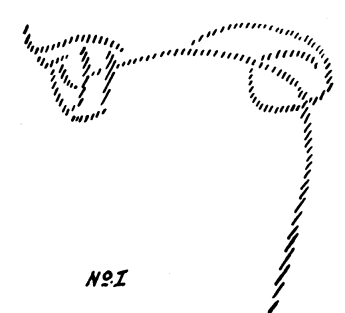
Perhaps I may without being immodest illustrate what I mean with an example. In one of my recent books, Riddles of the Soul, I have brought to your attention — and I have often mentioned it in oral lectures — what nonsense is taught in the present-day physiology, — that is, one of our physical sciences: the nonsense that there are two kinds of nerves in man, the motor nerves, which underlie the will, and the sensory nerves, which underlie perceptions and sensations. Since telegraphy has become known we have this illustration from it: from the eye the nerve goes to the central organ, then from the central organ it goes out to one of the members; we see something make a movement, as a limb — there goes the telegraph wire from this organ, the eye, to the central organ; that causes activity in the motor nerve, then the movement is carried out. We permit science to teach this nonsense. We must permit it to be taught, because in our abstract spiritual view we speak of every sort of thing, but do not develop such thoughts as are able
Figure 1
positively to gear into the machinery of nature. We have not the strength in our spiritual views to develop a knowledge about nature itself. The fact is, there is no difference between motor nerves and sensory nerves, but what we call voluntary nerves are also sensory nerves. The only reason for their existence is that we may be aware of our own members when movements are to be executed. The hackneyed illustration of tubes proves exactly the opposite of what is intended to be proved. I will not go into it further because you have not the requisite knowledge of physiology. I should very much like some time to discuss these things in a group of people versed in physiology and biology; but here I wish only to call your attention to the fact that we have on the one hand a science of the physical world, and on the other a discoursing and preaching about spiritual worlds which does not penetrate any of the real worlds of nature that lie before us. But we need a knowledge of the spirit strong enough to become at the same time a physical science. We shall attain that only when we take account of the intention which I wished to bring to your notice today. If we had intended to found a sectarian movement which, like others, has merely some kind of dogmatic opinion about the divine and the spiritual, and which needs a building, we should have erected any kind of a building, or had it erected. Since we did not wish that, but wished rather to indicate, even in this external action, that we intend to plunge down into life, we had to erect this building entirely out of the will of spiritual science itself. [Cf. Rudolf Steiner, Der Baugedanke des Goetheanum (with 104 illustrations), Not the yet translated.] And in the details of this building it will some day be seen that actually important principles — which today are placed in a very false light under the influence of the two dualisms mentioned — can be established on their sound foundation.
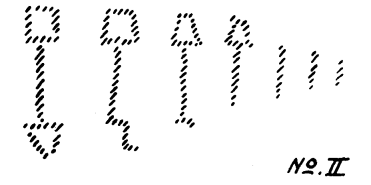
I should like to call your attention today to just one more thing. Observe the seven successive columns which stand on each side of our main building. There you have capitals above, pedestals below. They are not alike, but each is developed from the one preceding it; so that you get a perception of the second capital when you immerse yourself deeply in the first and its forms, when you cause the idea of metamorphosis to become alive, as something organic, and really have such a living thought that it is not abstract, but follows the laws of growth. Then you can see the second capital develop out of the first, the third out of the second, the fourth out of the third, and so on to the seventh. Thus the effort has been made to develop in living metamorphosis one capital, one part of an architrave, and so on, from another, to imitate that creative activity that exists as spiritual creative activity in nature itself, when nature causes one form to come forth from another. I have the feeling that not a single capital could be other than it now is.
Figure 2
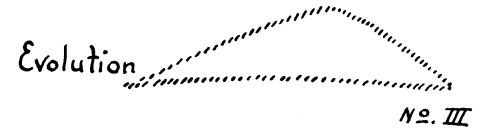
But here something very strange has resulted. When people speak today of evolution, they often say: development, development, evolution, first the imperfect, then the more nearly perfect, the more differentiated, and so on; and the more nearly perfect things always become at the same time more complicated. This I could not bear out when I let the seven capitals originate one from another according to metamorphosis, for when I came to the fourth capital, and had then to develop the next, the fifth, which should be more nearly perfect than the fourth, this fourth revealed itself to me as the most complicated. That is to say, when I did not merely pursue abstract things in thought, like a Haeckel or a Darwin, but when I had to make the forms so that each one came forth from the preceding — just as in nature itself one form after another emerges from the vital forces — then I was compelled to make the fifth form more elaborate in its surfaces, it is true, than the fourth, but the entire form became simpler, not more complicated. And the sixth became simpler yet, and the seventh still more so. Thus I realized that evolution is not a progression to ever greater and greater differentiation, but that evolution is first an ascent to a higher point, and after having reached this point is then a descent to more and more simple forms.
Figure 3
That resulted entirely from the work itself; and I could see that this principle of evolution manifested in artistic work is the same as the principle of evolution in nature. For if you consider the human eye, it is certainly more nearly perfect than the eyes of some animals; but the eyes of some animals are more complicated than the human eye. They have, for example, enclosed within them certain blood-filled organs — the metasternum, the fan — which do not exist in human beings; they have dissolved, as it were. The human eye is simplified in comparison with the forms of some animal eyes. If we study the development of the eye, we find that it is at first primitive, simple, then it becomes more and more complicated; but then it is again simplified, and the most nearly perfect is not the most complicated, but is, rather, a simpler form than the one to be found midway.
And it was essential to do likewise when developing artistically something which an inner necessity enjoined. The aim here was not research, but union with the vital forces themselves. And here in this building we strove to fashion the forms in such a way that in this fashioning dwell the same forces which underlie nature as the spirit of nature. A spirit is sought which is actually creative, a spirit which lives in what is produced in the world, and does not merely preach. That is the essential thing. That is also the reason why many a member here had to be severely rebuked for wanting our building fitted out with all sorts of symbols and the like. There is not a single symbol in the building, but all are forms which imitate the creative activity of the spirit in nature itself.
Thus there has been the beginning of an act of will which must find its continuation; and it is desirable that this very phase of the matter be understood — that it be understood how the springs of human intention, of human creativeness, which are necessary for modern humanity in all realms, are really to be sought. We live today in the midst of demands; but they are all individual demands springing from the various spheres of life; and we need also coordination. This cannot come from something which merely hovers in the environment of external visible existence; for something super-perceptible underlies all that is visible, and in our time this must be comprehended. I would say that close attention should be given to the things that are happening today, and the idea that the old is collapsing will by no means be found so absurd — but then there must be something to take its place! To be reconciled to this thought there is nevertheless needed a certain courage, which is not acquired in external life, but must be achieved in the innermost self.
I would not define this courage, but would characterize it. The sleeping souls of our time will certainly be overjoyed if someone appears somewhere who can paint as Raphael or Leonardo did. That is comprehensible. But today we must have the courage to say that only he has a right to admire Raphael and Leonardo who knows that in our day one cannot and must not create as Raphael and Leonardo did. Finally, to make this clear, we can say something very philistine: that only he has a right today to appreciate the spiritual range of the Pythagorean theorem who does not believe that this theorem is to be discovered today for the first time. Everything has its time, and things must be comprehended by means of the concrete time in which they occur.
As a matter of fact, more is needed today than many people are willing to bring forth, even when they join some kind of spiritual movement. We need today the knowledge that we have to face a renewal of the life of human evolution. It is cheap to say that our age is a time of transition. Any age is a time of transition; only it is important to know what is in transition. So I would not voice the triviality that one age is a time of transition, but I want to say something else: It is continually being said that nature and life make no leaps. A man considers himself very wise when he says: “Successive development; leaps never!” Well, nature is continually making leaps: it fashions step by step the green leaf, it transforms this to the calyx-leaf, which is of another kind, to the colored petal, to the stamen, and to the pistil. Nature makes frequent leaps when it fashions a single creation — the larger life makes constant revolutions. We see how in human life entirely new conditions appear with the change of teeth, how entirely new conditions appear with puberty; and if man's present capacity for observation were not so crude a third epoch in human life could be perceived about the twentieth year, and so on, and so on.
But history itself is also an organism, and such leaps take place in it; only they are not observed. People of today have no conception what a significant leap occurred at the turn of the 14th and 15th centuries, or more properly, in the middle of the 15th century. And what was introduced at that time is pressing toward fulfilment in the middle of our century. And it is truly no weaving of idle fancies but exact truth when we say that the events which so agitate humanity, and which recently have reached such a culmination, disclose themselves as a trend toward something in preparation, which is about to break violently into human evolution in the middle of this century. Anyone must understand these things who does not wish, out of some kind of arbitrariness, to set up ideals for human evolution, but who wills to find, among the creating — forces of the world, spiritual science, which can then enter into life.
Washed in the Blood of the Lamb are We Awash in a Sonburst Sea You—Love—and I—Love—and Love Divine: We are the Trinity
You—Love—and I—We are One-Two-Three Twining Eternally Two—Yes—and One—Yes—and also Three: One Dual Trinity Radiant Calvary Ultimate Mystery
Total Pageviews
"Whosover drinketh of the water that I shall give him shall never thirst; but the water that I shall give him shall be in him a well of water springing up into everlasting life." ~John 4:14
In the last day, that great day of the feast, Jesus stood and cried, saying, If any man thirst, let him come unto me, and drink. He that believeth on me, as the scripture hath said, out of his belly shall flow rivers of living water. ~John 7:37-38




 Posts
Posts

