Friday, September 9, 2022

The Occult Significance of the Bhagavad Gita


The Occult Significance of the Bhagavad Gita

Lecture 1 of 9 
Rudolf Steiner, Helsingsfors, Finland, May 28, 1913:

It is more than a year since I was able to speak here about those things that lie so deeply on our hearts, those things that we believe must enter more and more into human knowledge because, from our time onward, the human soul will feel increasingly that these things belong to its requirements, to its deepest longings. And it is with great pleasure that I greet you here in this place for the second time, along with all those who have traveled here in order to show in your midst how their hearts and souls are dedicated to our sacred work the whole world over.


When I was able to speak to you here last time we let our spiritual gaze journey far into the wide regions of the universe. This time it will be our task to stay more in the regions of earthly evolution. Our thoughts, however, will penetrate to regions that will lead us nonetheless to the portals of the eternal manifestation of the spiritual in the world. We shall speak about a subject that will apparently lead us far away in time and in space from the here and now. It will not on that account lead us less to what lives in the here and now, but rather to what lives just as much in all times and in all the places of the Earth because it will bring us near to the secrets of the eternal in all existence. It will lead us to the ceaseless search of man for the wells of eternity where he may drink for the healing and refreshment of something in him which, ever since they gained understanding of it, men have considered all-powerful in life, namely, love. For wherever we are gathered together we are gathered in the name of the search for wisdom and the search for love. What we seek is extended out into space and can be observed in the far horizon of the Cosmic All, but it can also be observed in the wrestling soul of man wherever he may be. It meets us especially when we turn our gaze to one of those mighty manifestations of the wrestling spirit of man such as are given us in some great work like the one that is to form the basis of our present studies.


We are going to speak of one of the greatest and most penetrating manifestations of the human spirit — the Bhagavad Gita, which, ancient as it is, yet in its foundations comes before us with renewed significance at the present time. A short time ago the peoples of Europe and those of the West generally knew little of the Bhagavad Gita. Only during the last century has the fame of this wonderful poem extended to the West. Only lately have Western peoples become familiar with this marvelous song. But these lectures of ours will show that a real and deep knowledge of this poem, as against mere familiarity with it, can only come when its occult foundations are more and more revealed. For what meets us in the Bhagavad Gita sprang from an age of which we have often spoken in connection with our anthroposophical studies. The mighty sentiments, feelings, and ideas it contains had their origin in an age that was still illumined by what was communicated through the old human clairvoyance. One who tries to feel what this poem breathes forth page by page as it speaks to us will experence, page by page, something like a breath of the ancient clairvoyance humanity possessed.


The Western world's first acquaintance with this poem came in an age in which there was little understanding for the original clairvoyant sources from which it sprang. Nevertheless, this lofty song of the Divine struck like a wonderful flash of lightning into the Western world, so that a man of Central Europe, when he first became acquainted with this Eastern song, said that he must frankly consider himself happy to have lived in a time when he could become acquainted with the wondrous things expressed in it. This man was not one who was unacquainted with the spiritual life of humanity through the centuries, indeed through thousands of years. He was one who looked deeply into spiritual life — Wilhelm von Humboldt, the brother of the celebrated astronomer. Other members of Western civilization, men of widely different tongues, have felt the same. What a wonderful feeling it produces in us when we let this Bhagavad Gita work upon us, even in its opening verses!


It seems that in our circle, my dear friends, perhaps particularly in our circle, we often have to begin by working our way through to a fully unprejudiced position. For in spite of the fact that the Bhagavad Gita has been known for so short a time in the West, yet its holiness has so taken our hearts by storm, so to say, that we are inclined to approach it from the start with this feeling of holiness without making it clear to ourselves what the starting-point of the poem really is. Let us for once place this before us quite dispassionately, perhaps even a little grotesquely.


A poem is here before us that from the very first sets us in the midst of a wild and stormy battle. We are introduced to a scene of action that is hardly less wild than that into which Homer straightway places us in the Iliad. We go further and are confronted in this scene with something which Arjuna — one of the foremost, perhaps the foremost of the personalities in the Song — feels from the start to be a fratricidal conflict. He comes before us as one who is horror-stricken by the battle, for he sees there among the enemy his own blood relations. His bow falls from his grasp when it becomes clear to him that he is to enter a murderous strife with men who are descended from the same ancestors as himself, men in whose veins flows the same blood as his own. We almost begin to sympathize with him when he drops his bow and recoils before the awful battle between brothers.


Then before our gaze arises Krishna, the great spiritual teacher of Arjuna, and a wonderful, sublime teaching is brought before us in vivid colors in such a way that it appears as a teaching given to his pupil. But to what is all this leading? That is the question we must first of all set before us, because it is not enough just to give ourselves up to the holy teaching in the words of Krishna to Arjuna. The circumstances of its giving must also be studied. We must visualize the situation in which Krishna exhorts Arjuna not to quail before this battle with his brothers but take up his bow and hurl himself with all his might into the devastating conflict. Krishna's teachings emerge amid the battle like a cloud of spiritual light that at first is incomprehensible, and they require Arjuna not to recoil but to stand firm and do his duty in it. When we bring this picture before our eyes it is almost as though the teaching becomes transformed by its setting. Then again this setting leads us further into the whole weaving of the Song of the Mahabharata, the mighty song of which the Bhagavad Gita is only a part.


The teaching of Krishna leads us out into the storms of everyday life, into the wild confusion of human battles, errors, and earthly strife. His teaching appears almost like a justification of these human conflicts. If we bring this picture before us quite dispassionately, perhaps the Bhagavad Gita will suggest to us altogether different questions from those that arise when — imagining we can understand them — we alight upon something similar to what we are accustomed to find in ordinary works of literature. So it is perhaps necessary to point first to this setting of the Gita in order to realize its world-historic significance, and then be able to see how it can be of increasing and special significance in our own time.


I have already said that this majestic song came into the Western world as something completely new, and almost equally new were the feelings, perceptions, and thoughts that lie behind it. For what did Western civilization really know of Eastern culture before it became acquainted with the Bhagavad Gita? Apart from various things that have only become known in this last century, very little indeed! If we accept certain movements that remained secret, Western civilization has had no direct knowledge of what is actually the central nerve impulse of the whole of this great poem. When we approach such a thing we feel how little human language, philosophy, ideas, serving for everyday life, are sufficient for it; how little they suffice for describing such heights of the spiritual life of man upon Earth. We need something quite different from ordinary descriptions to give expression to what shines out to us from such a revelation of the spirit of man.


I should like first to place two pictures before you so you may have a foundation for further descriptions. The one is taken from the book itself, the other from the spiritual life of the West. This can be comparatively easily understood, whereas the one from the book appears for the moment quite remote. Beginning then with the latter, we are told how, in the midst of the battle, Krishna appears and unveils before Arjuna cosmic secrets, great immense teachings. Then his pupil is overcome by the strong desire to see the form, the spiritual form of this soul, to have knowledge of him who is speaking such sublime things. He begs Krishna to show himself to him in such manner as he can in his true spirit form. Then Krishna appears to him (later we shall return to this description) in his form — a form that embraces all things, a great, sublime, glorious beauty, a nobility that reveals cosmic mysteries. We shall see there is little in the world to approach the glory of this description of how the sublime spirit form of the teacher is revealed to the clairvoyant eye of his pupil.


Before Arjuna's gaze lies the wild battlefield where much blood will have to flow and where the fratricidal struggle is to develop. The soul of Krishna's disciple is to be wafted away from this battlefield of devastation. It is to perceive and plunge into a world where Krishna lives in his true form. That is a world of holiest blessedness, withdrawn from all strife and conflict, a world where the secrets of existence are unveiled, far removed from everyday affairs. Yet to that world man's soul belongs in its most inward, most essential being. The soul is now to have knowledge of it. Then it will have the possibility of descending again and re-entering the confused and devastating battles of this our world. In truth, as we follow the description of this picture we may ask ourselves what is really taking place in Arjuna's soul. It is as though the raging battle in which it stands were forced upon it because this soul feels itself related to a heavenly world in which there is no human suffering, no battle, no death. It longs to rise into a world of the eternal, but with the inevitable force that can come only from the impulse of so sublime a being as Krishna this soul must be forced downward into the chaotic confusion of the battle. Arjuna would gladly turn away from all this chaos, for the life of Earth around him appears as something strange and far away, altogether unrelated to his soul. We can distinctly feel this soul is still one of those who long for the higher worlds, who would live with the gods, and who feel human life as something foreign and incomprehensible to them. In truth a wondrous picture, containing things of sublime import!


A hero, Arjuna, surrounded by other heroes and by the warrior hosts — a hero who feels all that is spread before him as unfamiliar and remote — and a god, Krishna, who is needed to direct him to this world. He does not understand this world until Krishna makes it comprehensible to him. It may sound paradoxical, but I know that those who can enter into the matter more deeply will understand me when I say that Arjuna stands there like a human soul to whom the earthly side of the world has first to be made comprehensible.


Now this Bhagavad Gita comes to men of the West who undoubtedly have an understanding for earthly things! It comes to men who have attained such a high degree of materialistic civilization that they have a very good understanding for all that is earthly. It has to be understood by souls who are separated by a deep gulf from all that a genuine observation shows Arjuna's soul to be. All that to which Arjuna shows no inclination, needing Krishna to tame him down to earthly things, seems to the Westerner quite intelligible and obvious. The difficulty for him lies rather in being able to lift himself up to Arjuna, to whom has to be imparted an understanding of what is well understood in the West, the sense matters of earthly life. A god, Krishna, must make our civilization and culture intelligible to Arjuna. How easy it is in our time for a person to understand what surrounds him! He needs no Krishna. It is well for once to see clearly the mighty gulfs that can lie between different human natures, and not to think it too easy for a Western soul to understand a nature like that of Krishna or Arjuna. Arjuna is a man, but utterly different from those who have slowly and gradually evolved in Western civilization.


That is one picture I wanted to bring you, for words cannot lead us more than a very little way into these things. Pictures that we can grasp with our souls can do better because they speak not only to understanding but to that in us which on Earth will always be deeper than our understanding — to our power of perception and to our feeling. Now I would like to place another picture before you, one not less sublime than that from the Bhagavad Gita but that stands infinitely nearer to Western culture. Here in the West we have a beautiful, poetic picture that Western man knows and that means much for him. But first let us ask: To what extent does Western mankind really believe that this being of Krishna once appeared before Arjuna and spoke those words? We are now at the starting-point of a concept of the world that will lead us on until this is no mere matter of belief, but of knowledge. We are however only at the beginning of this anthroposophical concept of the world that will lead us to knowledge. The second picture is much nearer to us. It contains something to which Western civilization can respond.


We look back some five centuries before the founding of Christianity to a soul whom one of the greatest spirits of Western lands made the central figure of all his thought and writing. We look back to Socrates. We look to him in the spirit in the hour of his death, even as Plato describes him in the circle of his disciples in the famous discourse on the immortality of the soul. In this picture there are but slight indications of the beyond, represented in the “daimon” who speaks to Socrates.


Now let him stand before us in the hours that preceded his entrance into the spiritual worlds. There he is, surrounded by his disciples, and in the face of death he speaks to them of the immortality of the soul. Many people read this wonderful discourse that Plato has given us in order to describe the scene of his dying teacher. But people in these days read only words, only concepts and ideas. There are even those — I do not mean to censure them — in whom this wonderful scene of Plato arouses questions as to the logical justification of what the dying Socrates sets forth to his disciples. They cannot feel there is something more for the human soul, that something more important lives there, of far greater significance than logical proofs and scientific arguments. Let us imagine all that Socrates says on immortality to be spoken by a man of great culture, depth, and refinement, in the circle of his pupils, but in a different situation from that of Socrates, under different circumstances. Even if the words of this man were a hundred times more logically sound than those of Socrates, in spite of all they will perhaps have a hundred times less value. This will only be fully grasped when people begin to understand that there is something for the human soul of more value, even if less plausible, than the most strictly correct logical demonstrations. If any highly educated and cultured man speaks to his pupils on the immortality of the soul, it can indeed have significance. But its significance is not revealed in what he says — I know I am now saying something paradoxical, but it is true — its significance depends also on the fact that the teacher, having spoken these words to his pupils, passes on to look after the ordinary affairs of life, and his pupils do the same. But Socrates speaks in the hour that immediately precedes his passage through the gates of death. He gives out his teaching in a moment when in the next instant his soul is to be severed from his bodily form.


It is one thing to speak about immortality to the pupils he is leaving behind in the hour of his own death — which does not meet him unexpectedly but as an event predetermined by destiny — and another thing to return after such a discourse to the ordinary business of living. It is not the words of Socrates that should work on us as much as the situation under which he speaks them. Let us take all the power of this scene, all that we receive from Socrates' conversation with his pupils on immortality, the full immediate force of this picture. What do we have before us? It is the world of everyday life in Greek times; the world whose conflicts and struggles led to the result that the best of the country's sons was condemned to drink the hemlock. This noble Greek spoke these last words with the sole intention of bringing the souls of the men around him to believe in what they could no longer have knowledge; believe in what was for them “a beyond,” a spiritual world. That it needs a Socrates to lead the earthly souls until they gain an outlook into the spiritual worlds, that it needs him to do this by means of the strongest proofs, that is, by his deed, is something that is indeed comprehensible to Western souls. They can gain an understanding for the Socratic culture. We only grasp Western civilization in a right sense when we recognize that in this respect it has been a Socratic civilization throughout the centuries.


Now let us think of one of the pupils of Socrates, who could certainly have no doubt of the reality of all that surrounded him, being a Greek, and compare him with Krishna's disciple, Arjuna. Think how the Greek has to be introduced to the supersensible world, and then think of Arjuna who can have no doubt whatever about it but becomes confused instead with the sense-world, almost doubting the possibility of its existence. I know that history, philosophy, and other branches of knowledge may say with apparently good reason, “Yes, but if you will only look at what is written in the Bhagavad Gita, and in Plato's works, it is just as easy to prove the opposite of what you have just said.” I know too that those who speak like this do not want to feel the deeper impulses, the mighty impulses that arise on the one hand from that picture out of the Bhagavad Gita and on the other from that of the dying Socrates as described by Plato. A deep gulf yawns between these two worlds in spite of all the similarity that can be discovered. This is because the Bhagavad Gita marks the end of the age of the ancient clairvoyance. There we can catch the last echo of it; while in the dying Socrates we meet one of the first of those who through thousands of years have wrestled with another kind of human knowledge, with those ideas, thoughts, and feelings that, so to say, were thrown off by the old clairvoyance and have continued to evolve in the intervening time, because they have to prepare the way for a new clairvoyance. Today we are striving toward this new clairvoyance by giving out and receiving what we call the anthroposophical conception of the world. From a certain aspect we may say that no gulf is deeper than the one that opens between Arjuna and a disciple of Socrates.


Now we are living in a time when the souls of men, having gone through manifold transformations and incarnations in the search for life in external knowledge, are now once more seeking to make connection with the spiritual worlds. The fact that you are sitting here is most living proof that your own souls are seeking this reunion. You are seeking the connection that will lead you up in a new way to those worlds so wondrously revealed to us in the words of Krishna to his disciple Arjuna. So there is much in the occult wisdom on which the Bhagavad Gita is founded that resounds to us as something responding to our deepest longings. In ancient times the soul was well aware of the bond that unites it with the spiritual. It was at home in the supersensible. We now are at the beginning of an age wherein men's souls will once more seek access in a new way to the spiritual worlds. We must feel ourselves stimulated to this search when we think of how we once had this access, that it once was there for man. Indeed, we shall find it to an unusual degree in the revelations of the holy song of the East.


As is generally the case with the great works of man, we find the opening words of the Bhagavad Gita full of meaning. (Are not the opening words of the Iliad and the Odyssey most significant?) The story is told by his charioteer to the blind king, the chief of the Kurus who are engaged in fratricidal battle with the Pandavas. A blind chieftain! This already seems symbolical. Men of ancient times had vision into the spiritual worlds. With their whole heart and soul they lived in connection with gods and divine beings. Everything that surrounded them in the earthly sphere was to them in unceasing connection with divine existence. Then came another age, and just as Greek legend depicts Homer as a blind man, so the Gita tells us of the blind chief of the Kurus. It is to him that the discourses of Krishna are narrated in which he instructs Arjuna concerning what goes on in the world of the senses. He must even be told of those things of the sense-world that are projections into it from the spiritual. There is a deeply significant symbol in the fact that old men who looked back with perfect memory and a perfect spiritual connection into a primeval past were blind to the world immediately around them. They were seers in the spirit, seers in the soul. They could experience as though in lofty pictures all that lived as spiritual mysteries. Those who were to understand the events of the world in their spiritual connections were pictured to us in the old songs and legends as blind. Thus we find this same symbol in the Greek singer Homer as in that figure that meets us at the beginning of the Bhagavad Gita. This introduces us to the age of transition from primeval humanity to that of the present day.


Now why is Arjuna so deeply moved by the impending battle of the brothers? We know that the old clairvoyance was in a sense bound up with external blood relationship. The flowing of the same blood in the veins of a number of people was rightly looked upon as something sacred in ancient times because with it was connected the ancient perception of a particular group-soul. Those who not only felt but knew their blood-relationship to one another did not yet have such an ego as lives in men of the present time. Wherever we look in those ancient times we find everywhere groups of people who did not at all feel themselves as having an individual “I” as man does today. Each felt his identity only in the group, in a community based upon the blood-bond.


What does the folk-soul, the nation-soul, signify to a man today? Certainly it is often an object of the greatest enthusiasm. Yet we may say that, compared with the individual “I” of a man, this nation-soul does not really count. This may be a hard saying, but it is true. Once upon a time man did not say “I” to himself but to his tribal or racial group. This group-soul feeling was still living in Arjuna when he saw the fratricidal battle raging around him. That is the reason why the battle that raged about him filled him with such horror.


Let us enter the soul of Arjuna and feel the horror that lived in him when he realized how those who belonged together are about to murder each other. He felt what lived in all the souls at that time and is about to kill itself. He felt as a soul would feel if its body, which is its very own, were being torn in pieces. He felt as though the members of one body were in conflict, the heart with the head, the left hand with the right. Think how Arjuna's soul confronted the impending battle as a battle against its own body, when, in the moment he drops his bow, the conflict of the kinsmen seems to him a conflict between a man's right hand and his left. Then you will feel the atmosphere of the opening verses of the Bhagavad Gita.


When Arjuna is in this mood he is met by the great teacher Krishna. Here we must call attention to the incomparable art with which Krishna is pictured in this scene: The holy god, who stands there teaching Arjuna what man shall and will discard if he would take the right direction in his evolution. Of what does Krishna speak? Of I, and I, and I, and always only of I. “I am in the earth, I am in the water, I am in the air, I am in the fire, in all souls, in all manifestations of life, even in the holy Aum. I am the wind that blows through the forests. I am the greatest of the mountains, of the rivers. I am the greatest among men. I am all that is best in the old seer Kapila.” Truly Krishna says nothing less than this: “I recognize nothing else than myself, and I admit the world's existence only in so far as it is I!” Nothing else than I speaks from out the teaching of Krishna.


Let us once and for all see quite plainly how Arjuna stands there as one not yet understanding himself as an ego but who now has to do so, how the god confronts him like an all-embracing cosmic egoist, admitting of nothing but himself, even requiring others to admit of nothing but themselves, each one an “I.” Yes, in all that is in earth, water, fire, or air, in all that lives upon the Earth, in the three worlds, we are to see nothing but Krishna.


It is full of significance for us that one who cannot yet grasp the ego is brought for his instruction before a being who demands to be recognized only as his own self. Let him who wants to see this in the light of truth read the Bhagavad Gita through and try to answer the question, “How can we designate what Krishna says of himself and for which he demands recognition?” It is universal egoism that speaks in Krishna. It does indeed seem to us as though through the whole of the sublime Gita this refrain resounds to our spiritual hearing: “Only when you recognize, you men, my all-embracing egoism, only then can salvation be for you!”


The greatest achievements of human spiritual life always set us riddles. We only see them in the right light when we recognize that they set us the very greatest riddles. Truly, a hard one seems to be given us when we are now confronted with the task of understanding how a most sublime teaching can be bound up with the announcement of universal egoism. It is not through logic but in the perception of the great contradictions in life that the occult mysteries unveil themselves to us. It will be our task to get beyond what seems so strange and come to the truth within the maya.


When we are speaking within maya we must recognize what it really is that we may rightly call a universal egoism. Through this very riddle we must reach out from illusion into reality, into the light of truth. How this is possible, and how we may surmount this riddle and reach reality, will form the subject of the following lectures.


Source: http://www.webcitation.org/5uotWlWgh

Old Dog, New Ticks


My entire adult laff I've known that the novelist Evelyn Waugh married a woman who was also named Evelyn.

I just now learned that their friends called them Hevelyn and Shevelyn.


Take it outside


Rudolf Steiner:  "Yes, any walk in the world outside is in reality a true education in all questions of nutrition, of healing, and of the spiritual."


Source: November 9, 1923. GA 230. 4th ed. 1991, p. 180

related post: https://martyrion.blogspot.com/2022/06/what-is-so-rare-as-day-in-june.html

Thursday, September 8, 2022

Nobody expects the Steiner disquisition! Rudolf Steiner entered my life 31 years ago today


"If one observes how karma works itself out, it may be said from the human side that this living out of karma can only be described as a kind of hunger and its satisfaction."  — Rudolf Steiner


"The significance of a philosophical poem such as the Bhagavad Gita, or similar works of world literature, can be rightly valued only by one to whom they are not just theory, but destiny."  — Rudolf Steiner


Sunday, September 8, 1991. I walked into the residents' lounge of the Himalayan Institute's headquarters, in Honesdale, Pennsylvania. Darlene and I had been living there for ten years [we live there still]. I had received a mantra initiation from my guru, Swamiji, eleven days before (August 28, Goethe's birthday). I was 44 years old. I was the custodian of the residents' lounge library, and was in the lounge almost every day. I'd been on fire for the Bhagavad Gita since the Seventies; it was my bible. On this day I noticed a new book on one of the shelves: The Occult Significance of the Bhagavad Gita, by Rudolf Steiner. I opened it — and that was that.


"The Lord dwells in the hearts of all creatures


and whirls them round upon the wheel of maya.


Run to him for refuge with all your strength,


and peace profound will be yours through his grace."


                                   — Bhagavad Gita 18:61-62


Guru Gita 76:

Dhyana mulam guror murtih

Puja mulam guroh padam

Mantra mulam guror vakyam

Moksha mulam guroh krpa


The root of meditation is the guru's form

The root of worship is the guru's feet

The root of mantra is the guru's word

The root of liberation is the guru's grace.


Matthew 11:28-30

Come unto me, all ye that labour and are heavy laden, and I will give you rest. 

Take my yoke upon you, and learn of me; for I am meek and lowly in heart: and ye shall find rest unto your souls.

For my yoke is easy, and my burden is light. 


The Himalayan Institute's Meditation Shrine


Psalm 23

The LORD is my shepherd; I shall not want. 

He maketh me to lie down in green pastures: he leadeth me beside the still waters. 

He restoreth my soul: he leadeth me in the paths of righteousness for his name's sake. 

Yea, though I walk through the valley of the shadow of death, I will fear no evil: for thou art with me; thy rod and thy staff they comfort me. 

Thou preparest a table before me in the presence of mine enemies: thou anointest my head with oil; my cup runneth over. 

Surely goodness and mercy shall follow me all the days of my life: and I will dwell in the house of the LORD for ever.


"Ask, and it shall be given you; seek, and ye shall find; knock, and it shall be opened unto you"
— Matthew 7:7


"And the Veda was made flesh, and dwelt among us."


Rudolf Steiner:  "In older languages the self was not specifically designated, for it was contained within the verb. The 'I' was not directly mentioned. The verb was used to show what one was doing, and this was what indicated that one was speaking about oneself. There was no name for the self. It only came about in later times that the human being gave his self a name, and in our German language that name [ich] contains the initials of Jesus Christ, which is an important symbolic fact." [Iesus CHristus: ICH]


Related posts:

https://martyrion.blogspot.com/2022/08/my-dharma-is-penance-life-is-unfolding.html

https://martyrion.blogspot.com/2021/07/consuming-fire-40-years-at-himalayan.html

https://martyrion.blogspot.com/2019/03/13-ways-of-looking-at-my-guru-2-prophet.html

https://martyrion.blogspot.com/2019/12/great-balls-of-fire-this-is-what.html


https://martyrion.blogspot.com/2019/08/heavenly-treasures.html


http://martyrion.blogspot.com/2017/09/the-masters-of-wisdom-and-of-harmony-of.html


https://martyrion.blogspot.com/2020/07/13-ways-of-looking-at-my-guru-11.html


http://martyrion.blogspot.com/2017/07/the-gate-of-humility.html

https://martyrion.blogspot.com/2022/09/becoming-prodigal-son-our-etheric-body.html

July 2, 1921. GA 205


Related Facebook Group: How did Rudolf Steiner enter your life?


Wednesday, September 7, 2022

Becoming the Prodigal Son and receiving our crown of thorns : Our etheric body — resonant with wisdom, streaming with gratitude and shame — becomes the Holy Grail


The Effects of Esoteric Development

Lecture 5 of 10

Rudolf Steiner, The Hague, March 24, 1913:


This course of lectures should rightly be considered as an explanation of certain experiences passed through by the student as changes produced in him by his esoteric development, or, shall we say, Theosophy; so that what is described is really to be looked upon as something that can actually be experienced during development. Naturally, only outstanding experiences, typical experiences, as it were, can be explained; but from the description of these characteristic experiences we may gain an idea of many other things we have to notice in the course of development.

In the last lecture we spoke principally of the fact that the student acquires a great sensitivity with respect to what goes on in the external life-ether, or in the ether as a whole. These experiences are connected with many other things, and one which we should particularly notice is the experience we have with respect to our power of judgment. As human beings, we are so placed in the world that in a certain way we judge the things that come before us, we form ideas about things; we consider one thing to be right, another wrong. A person's capacity for judging depends upon what is known as shrewdness, cleverness, discernment. This shrewdness, this cleverness, this discernment, is in course of his development gradually placed in a different light. This was briefly indicated in the last lecture. The student finds more and more that for the actual affairs of the higher, spiritual life, this shrewdness or cleverness is not of the slightest value, although he must bring as much of it as possible at his starting point on the physical plane if he wishes to enter upon the path to the higher worlds. And thus he comes inevitably into a position which may easily seem unendurable to the utilitarian; for while of necessity he needs something at first for his higher development, yet when he has acquired the needful quality it loses its value. To a certain extent the student must do everything possible to develop a sound power of judgment here on the physical plane, one that weighs the facts carefully; but having done so he must quite clearly understand that during his sojourn in the higher worlds this power of judgment has not the same value as it possesses here below on the physical plane. If the student wishes his higher senses to be sound he must proceed from a healthy power of judgment; but for the higher vision healthy judgment must be transformed into healthy vision.

But however highly we may develop, as long as we have to live on the physical plane we are still human beings of this plane, and on this physical plane we have the task of developing our power of judgment in a healthy way. Therefore we must take care to learn betimes not to mix the life in the higher worlds with that of the physical plane. One who wishes to make direct use on the physical plane of what he experiences in the higher worlds will easily become a visionary, an incompetent man. We must accustom ourselves to be able to live clearly in the higher worlds, and then, when we pass out of that condition, to hold again as firmly as possible to what is suitable for the physical plane. We must carefully and conscientiously maintain the twofold attitude demanded by the twofold nature of the spiritual and physical life. We accustom ourselves to the right attitude towards the world in this respect by accustoming ourselves not to bring what belongs to the higher worlds into the everyday course of life; to bring into everyday affairs as little as possible of that which may easily tempt us to say, for instance, when something in a person is unsympathetic to us, that we cannot bear his aura. In ordinary life, when speaking of this or that as unsympathetic, it is better to keep to the ordinary terms; it is better in this respect to remain like one's fellows on the physical plane, and to be as sparing as possible in ordinary life of expressions which only have their true application when used for the higher life. We ought carefully to refrain from mixing into daily life words, ideas, conceptions, belonging to the higher life. This may perhaps seem a sort of pedantic requirement to anyone who, from a certain enthusiasm for the spiritual life, shall we say, finds it necessary to permeate his whole being with it. And yet, that which in an ordinary way in ordinary life may perhaps seem pedantic, is an important principle of training for the higher worlds. Therefore, even if it should seem more natural to describe the ordinary life in words belonging to the higher life, let us translate them into the language most fitted for the physical plane. It must be emphasised again and again that these things are not without consequence, but are full of significance and possess active power. This being admitted, we may also speak without prejudice of the fact that, as regards the life in the higher worlds, the ordinary power of judgment ceases to be of use, and we learn to feel, to a certain extent, that the sort of cleverness we had before is now at an end. And here again the student notices — this is an experience which grows more and more frequent — he notices his dependence upon the etheric life of the world, that is, upon time. How often do we find in our particular age that people, even quite young people, approach everything in the world upon which judgment can be passed, and think that when they have acquired a certain power of judgment they can pronounce opinion about everything in existence, and speculate on everything possible. In esoteric development the belief that one can speculate on all things is torn out of the soul by the roots; for we then notice that our opinions are capable of growth and, above all, that they need to mature.

The student learns to recognise that if he wishes to arrive at an opinion with which he is himself able to agree, he must live for some while with certain ideas which he has acquired, so that his own etheric body can come to an understanding with them. He learns that he must wait before he can arrive at a certain opinion. Only then does he realise the great significance of the words: ‘Let what is in the soul mature.’ He really becomes more and more modest. But this ‘becoming modest’ is a very special matter, because it is not always possible to hold the balance between being obliged to form an opinion and being able to wait for maturity to have an opinion upon a subject, though delusion about these things is possible to a high degree, and because there is really nothing but life itself which can explain these things. A philosopher may dispute with a person who has reached a certain degree of esoteric development concerning some cosmic mystery, or cosmic law; if the philosopher can only form philosophic opinion he will believe himself necessarily in the right concerning the matter, and we can understand that he must have this belief; but the other person will know quite well that the question cannot be decided by the capacity for judgment possessed by the philosopher. For he knows that in former times he also used the conceptions upon which the philosopher bases his opinion, but allowed them to mature within him, which process made it possible for him to have an opinion on the subject; he knows that he has lived with it, thereby making himself ripe enough to form the opinion which he now pronounces at a higher stage of maturity. But an understanding between these two persons is really out of the question, and in many cases cannot be brought about directly; it can only come to pass when in the philosopher there arises a feeling of the necessity of allowing certain things to mature in his soul before he permits himself to give an opinion about them. Opinions, views must be battled for, must be won by effort — this the student recognises more and more. He acquires a profound, intense feeling of this, because he gains the inner feeling of time which is essentially connected with the development of the etheric body. Indeed, he gradually notices a certain opposition arise in his soul between the way he formerly judged and the way he now judges after having attained a certain maturity in this particular matter; and he notices that the opinion he formed in the past and the opinion he now holds confront each other like two powers, and he then notices in himself a certain inner mobility of the temporal within him; he notices that the earlier must be overcome by the later. This is the dawn in the consciousness of a certain feeling for time, which arises from the presence of inner conflicts, coming into existence through a certain opposition between the later and the earlier. It is absolutely necessary to acquire this inner feeling, this inner perception of time, for we must remember that we can only learn to experience the etheric when we acquire an inner idea of time. This develops into our always having the feeling that the earlier originates in ourselves, in our judgment, in our knowledge; but that the later flows into us, as it were, streams towards us, is vouchsafed to us. More and more clearly comes the feeling of what was described in the last lecture, viz., that the cleverness which springs from oneself must be separated from the wisdom which is acquired by surrender to the stream flowing towards one from the future. To feel ourselves being filled by thoughts, in contradistinction to our former experiences of consciously forming the thoughts ourselves — this shows progress. When the student learns more and more to feel that he no longer forms thoughts, but that the thoughts think themselves in him — when he has this feeling it is a sign that his etheric body is gradually developing the necessary inner feeling of time. All that went before will have the attribute of being something formed egotistically; all that is attained by maturing will have the characteristic of burning up and consuming what the student has made for himself. Thus the gradual change in his inner being results in a very remarkable experience; he becomes increasingly conscious that his own thinking, his own thought processes must be suppressed because they are of little value, compared with his devotion to the thoughts which stream to him from the cosmos. The individual life loses, as it were, one of its parts — that is extremely important — it loses the part we usually call personal-thinking, and there only remains personal-feeling and personal-willing. But these too undergo a change at the same time as the thinking. The student no longer produces his thoughts, but they think themselves within his soul. With the feeling that the thoughts have their own inner power through which they think themselves, comes a certain merging of feeling and will. Feeling, we might say, becomes more and more active, and the will becomes more and more allied to feeling. Feeling and will become more closely related to each other than they were before on the physical plane. No impulse of the will can be formed without accompanying development of feeling. Many of the student's deeds produce within him a bitter feeling, others produce an uplifting feeling. As regards his will, he feels at the same time that his own will-impulses must be adjusted in conformity with his feelings. He gradually finds that feelings which are there merely for the sake of enjoyment give rise to a kind of reproach; but feelings which are so perceived that he says: ‘The human soul must furnish the field of work for such feelings, they must be experienced inwardly, otherwise they would not exist in the universe’ — such feelings he gradually finds more justifiable than the others. An example shall be given at once, a characteristic example, in order that what is meant may be made quite clear; it is not intended to decry anything, but only to express the essential nature of this difference. Someone may find his pleasure in having good meals. When he experiences this pleasure, something happens within him — this is indisputable. But it does not make much difference in the universe, in the cosmos, when an individual experiences this pleasure in a good meal; it is not of much consequence to the general life of the world. But if someone takes up St. John's Gospel and reads but three lines of it, that is of immense consequence to the whole universe; for if among all the souls on earth none were to read St. John's Gospel, the whole mission of the earth could not be fulfilled; from our taking part in such activities there stream forth spiritually the forces which ever add new life to the earth in place of that which dies within it. We must distinguish a difference in experience between ordinary egotistic feeling and that in which we are but providing the field for experience of a feeling necessary for the existence of the world. Under certain circumstances a man may do very little externally, but when in his developed soul, for no personal pleasure, he is aware that through his feeling the opportunity is given for the existence of a feeling important to the universal existence — then he is doing an enormous amount.

Strange as it may seem, the following may also be said: There was once a Greek philosopher named Plato. He wrote many books. As long as a person only lives with his soul on the physical plane, he reads these books for his own instruction. Such outer instruction has its significance for the physical plane, and it is very good to make use of every means of instruction on the physical plane, for otherwise we remain stupid. The things achieved on the physical plane are there for the purpose of our instruction. But when a soul has developed esoterically, he then takes Plato, shall we say, and reads him again for a different reason; that is, because Plato and his works only have a meaning in the earthly existence if what he has written is also experienced in other souls; and the student then reads not only to instruct himself, but because something is accomplished thereby.

Something must be added to our feeling, enabling us to recognise a difference between egotistic feeling, which leans more towards enjoyment, and selfless feeling, which presents itself to us as an inner spiritual duty. This may extend even into external life and the external conception of life; and here we come to speak on a point which shines, it might be said, out of individual into social experience.

When a person acquainted with the secrets of esotericism observes what goes on in the world — how so many people waste their spare time instead of ennobling their feelings with what comes into the earthly existence from spiritual creations — he might weep over the stupidity which ignores all that in human life flows through human feeling and sentiment. And in this connection it should be noticed that when these experiences begin a certain more delicate egoism appears in human nature. In the following lectures we shall hear how this finer egoism is assumed for the purpose of overcoming itself; but at first it merely appears as a finer egoism, and during our theosophical development we shall find that a sort of higher thirst for enjoyment appears, a thirst for the enjoyment of spiritual things. And, grotesque as it may sound, it is nevertheless true that a man who is undergoing an esoteric development may at a certain stage declare, even though he may not allow this consciousness to grow into pride and vanity, that all that lies before him on the earth in the way of spiritual creations must be enjoyed by him; it is there for his enjoyment — so it belongs to him. And gradually he develops a certain urge towards such spiritual enjoyments. In this respect esotericism will not cause any mischief in the world, for we may be quite sure that when such a desire for the spiritual creations of humanity appears it will not be a drawback.

As a result of this something else appears. Gradually the student feels in a sense the awakening of his own etheric body, by becoming aware that feeling his own thinking is of less value, and by feeling the inflow of thought from the cosmos, interwoven as it is with the Divine. He feels more and more how will and feeling arise from himself; he begins to feel egoism only in his will and feeling, while he perceives the gifts of the wisdom, which he feels streaming through, as connecting him with the whole cosmos.

This experience is connected with another. He begins to feel inner activity of feeling and will, interwoven with inner sympathy and antipathy. A more subtle and delicate feeling tells him that when he himself does this or that it is a disgrace, for he has within him a certain amount of wisdom. Of something else he may feel that it is right to do it, according to his amount of wisdom. An experience of self-control appearing in feeling comes about naturally. We are overcome with feelings of bitterness when we feel a will arising from within, impelling us to do something or other which does not seem to be right in view of the wisdom in which we have now learned to share. This bitter feeling is most clearly perceived with respect to the things we have said; and it is well for one who is developing theosophically not to pass by inattentively without noticing how the whole of the inner life of feeling may be refined in this respect. While in the case of a person in exoteric life, when he has uttered certain words, when he has said something or other, that is the end of the matter, in the case of a person who has undergone a theosophical development there comes a clear after-feeling regarding what he has said; he feels something like an inner shame when he has expressed what is not right in a moral or intellectual sense; and something like a sort of thankfulness — not satisfaction with himself — when he has been able to express something to which the wisdom he has attained can give assent. And if he feels — and for this, too, he acquires a delicate sensitiveness — that something like an inner self-satisfaction, a self-complaisance with himself arises when he has said something that is right, that is a sign that he still possesses too much vanity, which is no good in his development. He learns to distinguish between the feeling of satisfaction which follows when he has said something with which he can agree, and the self-complaisance which is worthless. He should try not to allow this latter feeling to arise, but only to develop the feeling of shame when he has said anything untrue or non-moral, and, when he has succeeded in saying something suitable to the occasion, to develop a feeling of gratitude for the wisdom he now has part in, and to which he does not lay claim as his own, but receives as a gift from the universe.

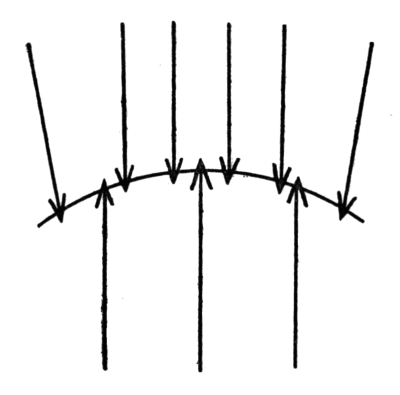
Little by little the student feels in this way with respect to his own thinking. As has already been said, he must remain a man on the physical plane; and while not attaching too much value to the self-formed thoughts, he must still form them; but this self-thinking itself now alters, so much that he holds it under the self-control we have just described. Regarding a thought of which he may say: ‘I have thought that and it is in keeping with the Wisdom’ — regarding this thought he develops a feeling of gratitude towards the Wisdom. A thought which arises as a wrong, ugly, non-moral thought leads to a certain inner feeling of shame, and the student feels: ‘Can I really still be like this? Is it possible that I have still sufficient egotism to think this, in the face of the Wisdom that has entered into me?’ It is extremely important for him to feel this kind of self-control in his inner being. The peculiarity of this self-control is that it never comes through the critical intellect, but always appears in feeling, in perception. Let us pay great attention to this, my dear friends: A man who is only clever, who only possesses the judgment of the outer life, who is critical, can never arrive at what we are now speaking of; for this must appear as feeling. When he has acquired this feeling — when it arises as if from his own inner being — he identifies himself with this feeling either of shame or thankfulness, and feels that his own self is connected with this feeling. And if I were to make a diagram of what is thus experienced, it is as though one felt wisdom streaming in from above, coming towards one from above, streaming into one's head in front and then filling one from above downwards. On the other hand, a student feels that, as though coming from his own body, there streams towards that wisdom a feeling of shame, so that he identifies himself with this feeling, and addresses the wisdom as something given from outside; and feels within himself a region wherein this feeling, which is now the ego, meets the instreaming wisdom bestowed.


Diagram 1


The pupil can inwardly experience the region where these two meet. To feel this meeting, proves a right inner experience of the etheric world; he experiences the thoughts pressing in from the external etheric world — for it is the wisdom streaming towards him from the external etheric world that presses in and is perceived by means of the two feelings — that is the rightly-perceived etheric world. And when he perceives it thus he ascends to the higher Beings which only descend as far as to an etheric body and not to a physical human body. On the other hand, he may experience this etheric world wrongly, in a certain sense. Rightly, the etheric world is experienced between thinking and feeling, in the manner just described. The experience is purely an inner process in the soul. The elementary or etheric world may be experienced wrongly, if it is experienced on the boundary between breathing and our own etheric body. If the student performs breathing exercises too soon, or in an incorrect way, he gradually becomes a witness of his own breathing-process. With the breathing-process of which he is then aware (the act of breathing being usually unnoticed), he may acquire a breathing which perceives itself. And this feeling may be associated with a certain perception of the etheric world. By means of all kinds of breathing-exercises a person may gain the power of observing certain etheric processes which really are in the external world, but which belong to the lowest external psychic processes, and which, if experienced too soon, can never give the right idea of the true spiritual world.

Of course, from a certain point in the esoteric practice a regulated breathing-process may also begin; but this must be properly directed. It then comes about that we perceive the etheric world, as has been described, on the border between thinking and feeling, and what we thus learn to recognise is only strengthened by our also coming to know the grosser etheric processes which take place on the border between the etheric world and our breathing-processes. For the matter is as follows: — There is a world of genuine higher Spirituality; this we attain through the interaction which takes place — as we have described — between wisdom and feeling; there we come to the deeds accomplished in the etheric world by the beings belonging to the higher hierarchies. But there are a great number of all sorts of good and bad and hostile and horrible and dangerous elementary beings, which, if we become acquainted at the wrong time, obtrude themselves upon us as if they really were a valuable spiritual world, while they are nothing more, in a certain sense, than the lowest dregs of the beings of the Spiritual world. He who wishes to penetrate into the Spiritual world must indeed become acquainted with these beings, but it is not well to become acquainted with them at the beginning. For the peculiarity is this: that if a person becomes acquainted with these beings at first, without traversing the difficult path of his own inner experience, he grows fond of them, has astonishing partiality for them; and it may then occur that a man who thus raises himself into the spiritual world in a wrong way, especially through such physical training as may be called a changing of the breathing-processes, will describe certain things pertaining to this spiritual world, as they appear to him. He describes them in such a way that many people may think them extremely beautiful, while to the occultist who perceives them in the inward experience, they may be horrible and loathsome. Such things are quite possible in the experience of the spiritual world.

We need not here speak of other processes which a person may undertake as a training, and through which he may enter evil worlds, because in Occultism it is the custom not to speak of that which one comes to know as the dross of the spiritual world. It is not necessary that we should enter spiritually into that world; hence it is not the practice to speak of the methods which go still lower than the breathing processes. Even the breathing-process, when it is not done in the right way, really leads to the dross-beings, which we must indeed come to know, but not at first, as they then make us enamoured of them, which ought not to be. We shall only obtain a true, objective standpoint regarding their value when we have penetrated into the spiritual world from the other side.

If the student now begins in this way to feel streaming out of himself, as it were, responsive feelings towards wisdom — the feeling of shame, and the feeling of thankfulness  if these responsive feelings spring up, as it were, from his own organism, then he thereby becomes first acquainted in the most elementary way with something of which he must learn more in the course of his further occult development. In the last lecture we pointed out that in the course of our gradual experience of the etheric we become aware of what is active in the etheric part of our brain, the Amshaspands, referred to in the teaching of Zarathustra. As regards our ideas we may also say: There we learn at first to form an idea of the active archangel beings and what they have to do in us. Through what is here stored up, through what here arises within us as the feeling of thankfulness or shame, which feeling has a personal character because it comes forth from ourselves — through this we gain the first elementary true conception of what are called the Archai or Primal forces; for we experience in the first most elementary way in the manner described what the Primal forces bring about in us. While the student — when he begins to experience in the etheric — first experiences the Archangels in his head in a shadowy way, one might say, in their activities, in their etheric working, he experiences in that with which the wisdom comes in contact in him, and which reacts to it, the Primal forces permeated with something like will, not entirely of its nature, but the Primal forces which have entered into him and work in the human personality. When he learns to feel in this way, he gradually obtains an idea of what the occultist means when he says: On that primeval embodiment of our earth, Ancient Saturn, dwelt the Primal Forces or the Spirits of Personality at their human stage, so to speak. At that time these Primal Forces or Spirits of Personality were human. They have now developed further, and in so doing they have attained the capacity of working from the supersensible world. And how do they manifest at the present time, in our earth-period, this power which they have acquired through the progress of their evolution as far as the earth? They have attained the capacity of being able to work from the supersensible upon our own bodily nature, and so to work on our sheath that they produce forces in our etheric body manifesting in the manner described. They have placed these forces in us, and if we feel today we are so organised that we can develop within ourselves the above-mentioned feelings of gratitude and shame as an inner natural process (and this can become our own experience), we must admit: That this can become an inward experience, that our etheric body should pulsate in this way, and respond in this manner to the Wisdom — to this end have the Primal forces poured forces into it. In the same way man himself in future incarnations of our earth will attain to the ability to imprint capacities such as these into a corresponding covering in other beings, who will be below him; he will imprint them into their inner being. What man is to know regarding the higher worlds will gradually be gained by inner experience, by our ascending, by our passing over from physical to etheric experience.

Let us try to make these matters still clearer. On ancient Saturn — as you know — heat was the densest physical condition, as it were, the only physical condition which had been reached by the middle of the Saturn period. And as you may read in my book An Outline Of Occult Science, the Saturn activities in the physical were currents of heat and cold. We may also speak of these currents of heat and cold from the psychic, soul-aspect, and say: Heat flowed in streams, but this heat was the flowing gratitude of the Spirits of Personality; or this flowing heat which moved in a different direction was the flowing feeling of shame of the Spirits of Personality. What we must gradually acquire is the capacity of connecting the physical with the moral activity; for the further we go into the higher worlds the more closely are these two things connected — the physical occurrence, which then ceases to be physical, and the moral, which then flows through the world with the power of the laws of nature.

All that has just been described as something which appears in inner experience through the altered etheric body brings about something else in the human soul. This human soul gradually begins to feel discomfort in being this individual man at all, this single, personal human being. It is important for us to learn to notice this; and it is well to make a rule of noticing it. The less interest one has developed previously to this stage of esoteric development in what concerns humanity in general, in what is common to humanity, the more disquieting does one find this on pressing forward. A person having developed no interest in mankind in general, and yet wishing to undergo an esoteric development, would feel himself more and more as a burden. For example, a person to whom it is possible to go through the world without sympathy and fellow-feeling with what another may suffer and enjoy, who cannot well enter into the souls of others, nor transpose himself into the souls of other human beings, such a person, when he progresses in esoteric development, feels himself to be a kind of burden. If in spite of remaining unmoved by human sorrow and human joy he undergoes a theosophical development, the student drags himself about with him as a heavy weight; and we may be quite sure his theosophical development will merely remain external, an intellectual affair only, that such a person is merely taking up theosophy like learning a cookery-book or some external science, unless he feels that he is a mere weight if in spite of his development he cannot develop a heart that truly feels with all human sorrow and all human gladness. Hence it is very good if, during a theosophical, occult development, we extend our human interests; and really nothing is worse during this esoteric progress than not to try to gain an understanding of every kind of human feeling and human sensation and human life. Of course, this does not postulate the principle — this must be emphasised again and again — that we should pass over all the wrong that is done in the world without criticism, for that would be an injustice towards the world; but it postulates something else; whereas before esoteric development we may have felt a certain pleasure in finding fault with some human failing, this pleasure in finding fault with other people entirely ceases in the course of esoteric development. Who does not know in external life people who like to deliver very pertinent criticisms of other people's faults? Not that the pertinence of judgment over human faults has to cease, not that under all circumstances, such an act as was committed, let us say, by Erasmus of Rotterdam when he wrote his book, The Praise of Folly, should be condoned; no, it may be quite justifiable to be stern against the wrongs done in the world; but in the case of one who undergoes an esoteric development every word of blame he utters or sets in motion pains him, and prepares more and more pain for him. And the sorrow at being obliged to find fault is something which can also act as a barometer of the esoteric development. The more we are still able to feel pleasure when we are obliged to find fault or when we find the world ludicrous, the less we are really ready to progress; and we must gradually gain a sort of feeling that there is, developing more and more within us, a life which makes us see these follies and errors in the world with eyes of which one is critical and the other filled with tears, one dry and the other wet. This inner dividing into parts, this becoming more independent, as it were, of that which was previously intermingled, also forms part of the change undergone by the human etheric body.


Source: https://wn.rsarchive.org/Lectures/GA/GA0145/19130324p02.html

N.B. My birthday is March 24.

Related posts: 

https://martyrion.blogspot.com/2021/09/my-yoke-is-easy-my-dharma-is-penance.html

https://martyrion.blogspot.com/2021/11/if-everything-is-maya-then-cause-of-our.html

https://martyrion.blogspot.com/2021/10/how-does-one-attain-capacity-to-lift.html

https://martyrion.blogspot.com/2021/10/the-effects-of-esoteric-development-on.html

https://martyrion.blogspot.com/2021/10/i-am-light-of-world.html

https://martyrion.blogspot.com/2021/10/anthroposophia-our-very-own-being-our_17.html


https://martyrion.blogspot.com/2021/10/the-paradise-legend-and-holy-grail.html


https://martyrion.blogspot.com/2022/09/nobody-expects-steiner-disquisition.html?fbclid=IwAR3TiW7-yEIrke_E6BXtShsPwjMo1h0T8iNyRxg3DIbGuQPpciEPBz3ykAU