Monday, September 2, 2019

The New Yoga: Anthroposophy

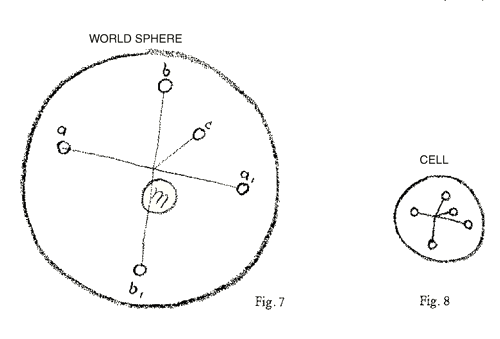
Figure 7 and Figure 8

The Redemption of Astronomy:
Toward the Reunion of Natural Science and Social Science
 Lecture 5 of 18.
Rudolf Steiner, Stuttgart, January 5, 1921:

My dear friends!

For the further progress of our studies I must today insert a kind of interlude, for we shall then understand more easily the real nature of our task. From a particular point of view we will reflect on the cognitional theory of Natural Science altogether. Let us link on to yesterday's lecture by calling to mind once more the provisional conclusions to which we came. The verification of them will emerge in the further course.
We have seen that in the study of celestial phenomena, in so far as these are expressed by our Astronomy in geometrical forms and arithmetical figures, we are led to incommensurable qualities. There is a moment in our process of cognition — in the attempt to understand the celestial phenomena — when we must come to a standstill, as it were, and can no longer declare the mathematical method to be competent. From a certain point onward, we simply cannot continue merely to draw geometrical lines, tracing the movements of the heavenly bodies. We can no longer employ mathematical analysis; we can only admit that analysis and geometry take us up to a certain point, whence we can go no further. At least provisionally, we come to the very significant conclusion that in reflecting on what we see, whether with the naked eye or with the aid of instruments, we can never fully compass it was geometrical figures or mathematical formulae. We do not contain the whole of the phenomena in algebra, analysis and geometry.
Think of the significance of this. If we are claiming to include the totality of the celestial phenomena, we must no longer imagine that we can do so by thinking of the Sun as moving in such a way that its movement can be represented by a definite geometry line, or that the Moon's movement can be so represented. Precise our most ardent wish must be renounced when we confront the phenomena in their totality. This is the more significant, since nowadays, the moment someone says ‘The Copernican System works no more satisfactorily than the Ptolemaic’, someone else will answer, ‘Let us then design another system’. We shall see the in the further course of these lectures, what must be put in the place of mere geometrical designs in order to comprehend the phenomena in their totality.
I must put this negative aspect before you first, before we can enter into the positive, for it is most important that we clear our thought in this respect.
On the other hand, we saw yesterday that what confronts us in Embryology emerges as if from indefinite, chaotic regions, and from a certain point onward can be grasped in picture-form, or even geometrically. As I said yesterday, in studying the celestial phenomena, through the very process of cognition we come to a point where we must recognize that the world is different from what this process of cognition might at first have led us to believe. And in the embryonic phenomena we are led to see that there must be something which preceeds the facts to which we still have access.
Now among other things there recently appeared a certain divergence of outlook among embryologists. (I will only give a rough description.) On the one hand there were the strict followers of biogenetic law, which states, as you know, that the development of the individual embryo is a kind of shortened recapitulation of the development of the race. These people wished to trace the cause of the development of the embryo to the development of the race. On the other hand, others came forward who would not hear of the derivation of the individual from the racial development, but held to a more or less mechanical conception of embryonic development saying that it was only necessary to take into account the forces directly present in what takes place in the embryo itself. For example, Oscar Hertwig left the strict biogenetic school of Haeckel and changed over to the more mechanical school. Now the mechanical needs to be grasped in a way that is at least similar to mathematics even though it be not pure mathematics. We therefore see, from the very history of Science, how front a certain stage onward (something as I said, must be presumed to have gone before this stage) embryological development is taken hold of by a mechanical, mathematical method of research. It is the history of these things to which I now wish to point.
All this appears in the field which one might call the theory of knowledge. On the one hand we are driven to a boundary in the cognitional process, where we can get no further with our favorite modern method of approach. On the other hand, in studying the embryonic life our only possibility of grasping it with ordinary methods is to start from a certain point: what goes before this has to be taken fro granted. We must admit that we find something in the realm of reality, the beginnings of which we must leave vague and unexplored; then from a certain point onward we can set to work, describing what we observe in terms of diagrams, formulas and relationships which are at least similar to those of mathematics and mechanics.
Bearing these things in mind, I deem it necessary in today's lecture to insert a kind of general reflection. As I have often pointed out, it is the ideal of modern scientific research to observe outer Nature as independently of man as possible, — to establish the phenomena in pure objectivity, as it were, excluding man altogether from the picture. We shall see that precisely through this method of excluding, it is impossible to transcend such barriers as we have now observed from two distinct sides.
This is connected with the fact that the principle of metamorphosis, which, as you know,was first conceived and presented in an elementary way by Goethe, ha so far hardly been followed up at all. It has no doubt been used to some extent in morphology, yet even here, as we saw yesterday, one essential principle is lacking. Morphology today cannot yet recognize the form and construction of a tubular or long bone, for example, in its relation to that of a skull-bone. To do this, we should have to reach a way of thinking whereby we should first study what is within, say, the inner surface of a tubular bone and then relate this to the outer surface of a skull-bone. This means a kind of inversion, as when a glove is turned inside-out; but at the same time there is an alteration of the form, an alteration of the surface-tensions through the reversing or turning of inside outward. Only if we follow the metamorphosis of forms in this way, though it may seem complicated, shall we reach true conclusions.
But when we leave the morphological and enter more into the functional domain, there are but the barest indications, in the existing ways of thought, towards a true pursuit of the idea of metamorphosis in this domain. Yet this is what is needed. A beginning was made in my book, “Riddles of the Soul”, wherein I indicated at least sketchily — the three-foldness of the being of man, recognized as a sum-total of interrelated functions. At least in outline, I explained how we must first distinguish those functions and processes in man which may be regarded as belonging to the nerves and senses; how we then have to recognize, as relatively independent processes, all that is rhythmical in the human organism; and how again we must recognize the metabolic processes as distinct. I pointed out that in these three forms of processes all that is functional in man is included. Anything else which appears functional in the human organism is derivable from these three.
It is essential to see that all phenomena in the organic realm although appearing outwardly side by side, are related to one-another through the principle of metamorphosis. People today are disinclined to look at things macroscopically. We must find our way back to the macroscopic aspect. Otherwise, through the very lack of synthetic understanding of what is living, problems will arise which are not inherently insoluble, but are made so by our methodical prejudices and limitations.
You see, in learning to understand man in this threefold aspect we must observe that he is connected with the outer world in a three fold way His life of nerves and senses is one way in which man is related to the outer world; through all rhythmic processes he is related to it in another way. It lies in the very nature of the rhythmical processes that they cannot be considered as isolated within man, apart from the rest of the world, for they depend upon the breathing, — a process of perpetual interchange between the human body and the outer world. Again, in the metabolism there is a very obvious process of interchange between man and the outer world. Also the nerves-and-senses process may be regarded as a continuation of the outer world into the inner man. This becomes easier to understand if the distinction is made between the actual perceptions, given to us through the senses, and the accompanying process of cognition — the forming of ideas and mental pictures. It is unnecessary here now to go into these things more deeply, for it is evident enough. In relation between man and the outer world during sense-perception the emphasis is more on the outer world, while the forming of ideas and mental pictures takes us more into the inner man. (I am referring to the bodily processes, not to the life of soul.)
Again, leaving aside for the moment the rhythmic system — breathing and blood-circulation — the metabolic system brings us to something else, which is in definite contrast to this inward-leading process from sense perception to ideation. A thorough study of the metabolic system establishes a connection between the inner metabolic processes and the functions of the human limbs. The limb-functions are connected with the metabolism.
If people would proceed more rationally than they are wont to be they would discover the essential connection between the metabolism, situated as it is more deeply within the body, and the processes by means of which we move our limbs. These too are metabolic. The actual organic functions which underlie the movements of the limbs are processes of metabolic. Consumption of material substances is what we find if we examine the organic functions here.
But we must not stop short at the metabolic process as such. There is a way in which this process leads as much from man towards the outer world, as sense-perception leads from the outer world towards the interior of the human body. (Such methods of research, which are really fundamental, need to be undertaken, otherwise no progress will be made in certain essential directions.)
What is it that is directed outward from the metabolism even as something is directed inward from sense-perception to the creating ideas and mental pictures? It is the process of fertilization. Fertilization points in the opposite direction, — from the bodily organism outward. Representing it diagrammatically (Fig.1): In sense-perception the direction is from without inward; this in — coming process of sense-perception is then ‘fertilized’ by the organism and we get the forming of ideas. (Please do not take offense at the expression ‘fertilized’; we shall soon replace, what may look like a symbolical way of speaking, by the reality it indicates.) In the metabolic process the direction is from within outward, and we get actual fertilization. In what is manifested therefore at the two poles of threefold human nature, we are led in two opposite directions.
In the middle is all that belongs to the rhythmic system. Now we may ask, what in the rhythmic system is directed outward and what inward? Here it is not possible to find such precise distinctions as between the inner metabolism and fertilization, or between perception and ideation. The processes in the rhythmic system rather merge into one-another. In the in-breathing and out breathing the process is more of a unity. It cannot be distinguished quite so sharply, yet it is still possible to say (Fig.1): As sense perception comes from outside and fertilization goes outward, so too in inspiration and expiration there is a going inward and outward. Breathing is intermediate.
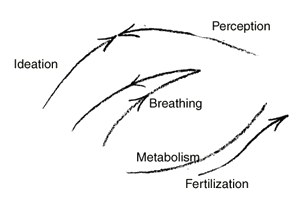
Fig. 1
Here is a true example of metamorphosis: a single entity, underlying threefold human nature, organized now in one way, now in another.
In the upward direction this can be followed to some extent physiologically. (Some of you already know what I Shall now refer to.) Observe the breathing process. The intake of air influences the organism in a certain way; namely, in in-breathing, the cerebro — spinal fluid, in which the spinal cord and brain are stepped, is pressed upward. You must remember that the brain is in fact floating in cerebral fluid, and is thus buoyed up. We should not be able to live at all without this element of buoyancy. We will not go into that now, however, but only draw attention to the fact that here is an upward movement of the cerebral fluid in in-breathing and a downward movement in out-breathing. So that the breathing process actually plays into the skull, into the head. In this process we have a real interplay and co-operation of the nerves-and-senses system with the rhythmic system.
You see how the organs work, to bring about what we may call metamorphosis of functions. Then we can say, however hypothetical or only as a postulate: perhaps something similar will be found as regards metabolism and fertilization. But in this realm of the body we shall less easily reach a conclusion. This is indeed characteristic of the human organism; it is comparatively easy to understand the interpenetrating relation between the rhythmic system and the nerves-and-senses system in process accessible to thought, but we cannot so easily find an evident relation between the rhythmic system and the processes of metabolism and fertilization.
Call to your aid the physiological knowledge at your disposal, and the more exactly you go into the matter the better you will perceive this. Moreover it is quite obvious why it is so. Consider the regular alternation of sleeping and waking. Through sense-perception you are open to the outer world, continuously exposed to the outer world. Then you set to work with your thinking and ideation and bring a certain order and orientation into what you see around you in your waking life. It becomes ordered through an activity which works from within outward; the orientation comes from within. Actually we can say: We confront an external world which is already ordered according to its own laws, and we ourselves bring another order into it out of our own inner being. We think about the outer world, we put together the facts and phenomena according to our own liking — unhappily, often a very bad liking! From our inner being, something is introduced into the outer world which by no means necessarily corresponds to this outer world. If this were not so, we should never fall a victim to error. Out of our own inner being comes an arbitrary remolding of the world around us.
But now, looking at the other pole of human nature, you will agree that the disordering comes from without, both in metabolism and fertilization. For it is left very largely to our own arbitrary choice and free will, how we sustain our metabolism by taking food, and even more so, how we behave as regards fertilization. But here the arbitrary element has much to do with the outer world, which in the first place is foreign to us. We do at least feel at home in the arbitrary element we introduce, out of our own inner being, into the process of perception. But we do not feel familiar with all that we bring into ourselves from the outer world. We have, for instance but a very slight idea — at least, most people have very little idea of what actually happens in our relationship with the world when we eat or drink. And as to what happens in the intervals of time between our meals, — to this we pay very little attention, and even if we did it would not help as much. Here we come into an indefinite, impalpable region, I would say. Thus at the one place of man's being we have the ordered Cosmos which extends its gulfs, as it were, in our sense organs (Fig.2). (The world ‘ordered’ must not be misunderstood, it is only used to characterize the facts; we will not lose ourselves in philosophical arguments as to whether the Cosmos is really ordered or not, we want only o characterize the given facts.) The pole is in contrast to the other, which, we are bound to admit, is an un-ordered Cosmos, considering all that comes into us from without all that we stuff into ourselves, or again, how the process of fertilization is entered into in quite irregular intervals of time and so on. Contemplating this invasion of the metabolism by the outer world, we must admit that we are here confronted by an unordered Cosmos — un-ordered at least to begin with, so far as we are concerned.
And now we may put the question — from the more general aspects of the theory of human knowledge: How and to what extent are we really connected with the starry Heavens? In the first place, we see them. But you will have a vivid feeling by this time of the uncertainties which assail us when we being to think about the starry Heavens. Not only have the men of different ages felt convinced of the truth of the most diverse astronomical world — systems. As we saw yesterday, we have to face the fact that we cannot contain the totality of the starry Heavens in the mathematical and mechanical forms of thought in which we feel most secure.
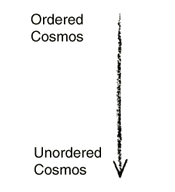
Fig. 2
Not only must we admit that we cannot trust to mere sensory appearances as regards the Heavens, but we must recognize that when we take our start from what we see and then work upon it with the life of thought, which, as we saw, belongs more to the inner man,we cannot ever really get at this world of stars. It is the truth, it is no mere comparison to say: The starry Heavens only present themselves to us in their totality — a relative totality, of course — through sense perception. Taking our start from sense-perception, when we as man try to go farther inward, to understand the starry Heavens, we feel somewhat foreign to them. We get a strong feeling of our inadequacy. And yet we feel that something intelligible must be there in the phenomenon which we behold.
Outside us, then , is the ordered Cosmos; it only presents itself to our senses. It most certainly does not at once reveal itself to our intellectual understanding. We have this ordered Cosmos on the one hand; with it, we cannot enter into man. We try to lead on from outer sense-perception of the Cosmos towards the inner man — the life of thought and ideation — and find we cannot enter. We must admit: Astronomy will not quite go into our head. This is not said in the least metaphorically. It is a demonstrable fact in the theory of knowledge. Astronomy will not go into the human head; it simply will not fit there.
What do we see now at the other pole — that of the unordered Cosmos? Let us but look at the facts; we do not want to set up theories or hypotheses, but only to see the facts clearly.
Look for what is in contrast, in the outer Universe to the astronomical domain, and in man to the processes of perception and ideation (the continuation of the ‘ordered Cosmos’ into man). In man you come into the realm of metabolism and fertilization — and Astronomy (Fig.2) and look downward in an analogous way, into what realm are you led? You are led into Meteorology — all the phenomena of the outer world once more, relating to Meteorology. For if you try to understand meteorological phenomena in terms of ‘natural law’, the amount of law you can bring in is to the ordered Cosmos of Astronomy in just the same proportion as is the temperamental region of metabolism and fertilization in man to the realm of sense perception, into which the whole starry Heaven sheds its light, — which only begins to get into disorder in our own inner life, namely in our forming of ideas.
If therefore we regard man not as an isolated being, but in connection with the whole of Nature, then we can place him into the picture in the following way. Through his head, he takes part in the astronomical, through his metabolism in the meteorological domain. Man is thus interwoven with the Cosmos on either hand.
Let us here add another thought. Yesterday we spoke of those processes which may be looked upon as an inner organic imagining of Moon-events, namely the processes in the female organism. In the female organism there is something like an alternation of phases, a succession of events, taking their course in 28 days. Although, as things are now, these events are not at all dependent on any actual Moon-events, yet they are somehow an inner reflection of the moon. I also drew your attention to the following psycho-physiological fact. If we really analyze human memory and take into account the underlying inner organic process, we cannot but compare it with this functioning of the female body. Only that in the latter the bodily nature is taken hold of more intensely than it is when holding fast in memory some outer experience which it has undergone. What comes to expression in these 28 days as a result of erstwhile our impressions is no longer contained within the individual life between birth and death, whereas the experiencing of outer events and the memory of them comes into a shorter period and takes its course between birth and death, within the single life of the individual. Considered in their psychological-physiological aspect, the two processes are however essentially the same — a functional re-experiencing of an external process or event. (In my ‘Occult Science’ I clearly hinted at this kind of experience in relation to the outer world.)
Now, study the functions of the ovum before fertilization and you will find that they are entirely involved in this 28-day inner rhythm; they belong to this process. But as soon as fertilization takes place, the processes in the ovum immediately fall out of this inner rhythmic life of the human being. A mutual relation with the outer world is at once established. Observing the process of fertilization, we are led to see that what is happening in the ovum from then onward no longer has to do with mere inner processes in the human body. Fertilization tears the ovum out of the purely inner organic process and leads it over into the realm of those processes which belong in common to the inner being of man and to the Cosmos, — a realm in which there are no barriers between what takes place within man and in the Cosmos. Therefore, what occurs after fertilization, — all that happens in the forming of the embryo, — must be studied in connection with external cosmic events, and not merely in terms of developmental mechanisms within the ovum itself in its successive stages.
Think what this means. All that goes on in the ovum before fertilization is, so to speak, within the domain of the human being's own inner organic process. But in what happens after fertilization and is brought about thereby — the human being opens himself to the Cosmos. Cosmic influences here prevail.
Thus on the one hand we have the Cosmos working in upon us up to the point where the life of ideas begins. We have, in sense — perception, a mutual relation, between man and the Cosmos. We investigate this relation, for example, by means of the laws of perception. The physiology of the senses and so on. The way in which we see an object must be investigated through such laws. Suppose we watch a railway-train traveling past us. We see the whole movement lengthwise. If, however, we are at a point directly in front of the train far enough away — however fast the train is going, we see it as if it were stationary. Pictorially, therefore, what takes place in us depends on the relation of the cosmos to us. We are in the midst of pictures and we ourselves belong to the picture. However, we become entangled in something chaotic, — for ultimately, our world systems are chaotic, — if we try to draw conclusions as to the real events from what we see externally.
On the other hand, in regard to fertilization, man is involved not in pictorial but in real cosmic processes.
Thus at the one role man is immersed in the Cosmos in a pictorial, and at the other in a real way. The very thing that eludes him when he looks out into the Cosmos, works in upon him when he undergoes the process of fertilization. Here therefore something, in itself a whole, is drawn apart into two members. In the one case a mere picture is before us and we cannot strike through to the reality. In the other the reality confronts us; through it a new man comes into being. But it does not become clear picture; it remains for us as devoid of law as do the manifestations of the weather, or meteorological conditions generally. Here we are face to face with a duality — here are two poles. From either side we receive half thrilled. It is as though we received the picture from the one side and the reality which underlies it from the other.
You see, the way man confronts the world is not as simple as one might assume in saying: The sensory picture of the world is given; now let us devise the reality by philosophical methods. This problem of finding the underlying reality in sense-perception is, of course, fundamental in the philosophic theory of cognition. But man is curiously balanced between the picture and reality in quite other ways than by mere philosophic speculation.
Now in the course of world-evolution, men have already tried to approach this secret through an experience of the intermediary realm: in-breathing and out-breathing. The ancient Indian wisdom which, as I often say, it would be wrong for us to imitate today — proceeded more or less instinctively from the following hypotheses. Sense-perceptions are of no use in the striving for reality; nor are the sexual processes or those of fertilization, for they give no clear picture. Therefore, let us keep to the middle region, which is metamorphosed at one time towards picture-forming and at another time towards reality. We must keep to the middle region, for through it the approach to reality and yet at one and the same time to the picture must in some way be possible. This is why the special breathing exercises of the Yoga system were perfected by the wisdom of Ancient India. Men sought to reach reality by experiencing the breathing process consciously, thus grasping at the same time both picture and reality. And if one asks why this should be, the answer is given: Breathing unites picture and reality. (The answer may be more or less instinctive, though not entirely so, as you can see if you will study, in the Indian philosophy itself, how this strange system of breathing-exercises arose.) Breathing unites picture and reality. The picture is experienced in its relation to the reality, if once the breathing process is lifted out of the unconscious into consciousness. We shall never understand what thus appeared in the historic evolution of mankind, unless we regard it from the point of view of the inner physiology of man. Looking at it in this light, you can say: There was a time when men sought to comprehend reality by turning to man himself. For pictures of the world, we have the senses; for the reality, something quite different. Therefore men turned to that part of the world human being which is neither shutoff in finished pictures, nor on the other hand in the mere experiencing of reality; they turned to what is not yet differentiated or divided — to the breathing process. And in so doing, they brought man into the Cosmos. They did not contemplate a world separate from man like the world of our Natural Science; they beheld a world for which man, as rhythmic man, became a real organ of perception. This world, they said, can be grasped neither by the nerves-and-senses man, nor by the metabolic man. In his life of nerves and senses, man becomes conscious in such a way that what presented itself to nerves and senses is thinned out to a mere picture; in the metabolism, reality meets him in such a way as not to be raised into consciousness at all. The interweaving of the real but unconscious experience with what is thinned out to a picture was sought by the wise men of ancient India in the regulated breathing process. Nor shall we ever understand the ancient cosmic systems, previous to the Ptolemaic, till we are able to divine how the Universe appears to man when in this was a synthesis, however undifferentiated, is achieved between the process of cognition on the one hand, and on the other the intense realty of the reproduction-process.
Consider now from this point of view the teachings about the creation of the world which are to be met with particularly in the Bible: teachings which, as things are today, are not so easy to see through. Consider the Bible story of the Creation, particularly as interpreted by those who still had the old traditions. Fundamentally, the Biblical story of Creation can only be understood if we are able to combine the genesis of the world which we derive by looking at the outer Universe, with that which we derive by Embryology. What is set forth in the Book of Genesis is in fact compounded of Embryology and of what is seen in the outward glory of the sense world. Hence the repeated attempts to interpret the Biblical story of Creation, even word for word, by embryological facts. Truly, it calls for such interpretation.
I introduced this today, my dear friends, for quite a definite reason.
You see, if our present studies — intended, as they are, to form a bridge between the external Science of today and Spiritual Science — are to have any meaning at all, we must first acquire a quite definite feeling and must permeate ourselves with this feeling otherwise we can get no further. We must become able to feel that certain modern ways of thought are superficial and external, — to feel this in a thoroughly deep way. We must learn to see the superficiality, on the one hand, of setting up pictures of the Universe which only try to make some slight corrections in the Copernican System, and on the other hand, of researching into the embryonic life in the ways which are customary today. One might say that Nietzsche's dictum: “The world is deeply thought and wrought; more deeply than the passing day”, proceeded from such a feeling. The impulses must be acquired not to seek explanations in the mere superficial acceptance of what presents itself directly, even if it be to the enhanced sight of telescope or microscope or X-ray apparatus. We must learn to have respect for explanations of another nature, aspiring to other faculties of knowledge, such as were sought by the old Indian sages in the Yoga System, so as to penetrate into reality and find the means of forming an adequate picture of reality.
Since we have now outgrown the Yoga system, we must feel impelled towards a new way of penetrating into the Universe by processes which still remain to be developed — which are not to be derived so simply from the habitual methods of today. For man is placed in the midst between the picture of the world, — a picture which presents itself to him in an overwhelmingly forceful way in the starry Heavens, the secrets of which will never be disclosed through the mere intellectual faculties, — and what meets him with ever — changing mood and temperament in the processes of reproduction, by virtue of which the human race exists. Into the midst of this great whole which is thus separated for him into two halves, man is placed. to find a connection between the two, he must look for a way of spiritual development, even as he did in an older form in the Yoga system, — a form no longer possible today.
Astronomy, practiced as hitherto, will never lead to a grasp of reality; it will only give us pictures. And Embryology, though in this realm we seize reality, will no enable us to penetrate the reality with ideas and mental pictures. Astronomical pictures of the world are poor in reality; embryological pictures are poor in idea — we fail to penetrate the facts with clear ideas. Thus in the theory of knowledge too we must approach the human being as a whole, instead of merely indulging in philosophical and psychological speculations about sense-perception. We must take our start from the whole of man. We must learn how to place man as a whole into the Universe. That is our task today.
It is very evident today, how on the one hand in Astronomy the ground of knowledge is being lost. And it is evident how on the other hand in Embryology, where knowledge fails to reach the well-springs of reality, all that results is a mere talking round and round the given facts, whether in terms of the biogenetic law or of developmental mechanisms. Amplification of our fundamental methods is quite evidently needed in both of these directions.
I had to put all this before you, so that we might understand each other better in what follows. For it will help you see that it would be no use if I were simply to add another formal picture of the Universe to the existing ones, although admittedly that is the kind of thing which people nowadays desire.




Reality is incommensurable. The Redemption of Astronomy: Lecture 4

Figure 7 and Figure 8

The Redemption of Astronomy:
Toward the Reunion of Natural Science and Social Science
 Lecture 4 of 18.
Rudolf Steiner, Stuttgart, January 4, 1921:

My dear friends!
If I had the task of presenting my subject purely according to the methods of Spiritual Science, I should naturally have to start from different premises and we should be able to reach our goal more quickly. Such a presentation, however, would not fulfill the special purpose of these lectures. For the whole point of these lectures is to throw a bridge across to the customary methods of scientific thought. Admittedly, I have chosen just the material which makes the bridge most difficult to construct, because the customary mode of thought in this realm is very far from realistic. But in contending against an unreal point of view, it will become apparent how we can emerge from the unsatisfying nature of modern theories and came to a true grasp of the facts in question. Today, then, I should like to consider the whole way in which ideas have been formed in modern times about the celestial phenomena.
We must, however, distinguish two things in the formation of these ideas. First, the ideas[1] are derived from observation of the celestial phenomena, and theoretical explanations are then linked on to the observations. Sometimes very far-reaching, spun-out theories have been linked on to relatively few observations. That is the one thing, namely, that a start is made from observations out of which certain ideas have been developed. The other is that, the ideas having been reached, they are further elaborated into hypotheses. In this creating of hypotheses, — a process which ends in the setting up of some definite cosmology, — much arbitrariness prevails, since in the setting-up of theories, any preconceived ideas existing in the minds of those who put forward the theory, make themselves strongly felt.
I will therefore first call your attention to something which will perhaps strike you as paradoxical, but which, when carefully examined, will none the less prove fruitful in the further course of our studies.
In the whole mode of thought of modern Science there prevails what might be called, and indeed has been called, the ‘Regula philosophandi’. It consists in saying: What has been traced to definite causes in one realm of reality, is to be traced to the same causes in other realms. In setting up such a ‘regula philosophandi’ the starting-point is as a rule apparently self-evident. It will be said — scientists of the Newtonian school will certainly say — that breathing must have the same causes in man as in the animal, or again, that the ignition of a piece of wood must have the same cause whether in Europe or in America. Up to this point the thing is obvious enough. But then a jump is made which passes unnoticed, — is taken tacitly for granted. Those who are wont to think in this way will say, for example, that if a candle and the Sun are both of them shedding light the same causes must surely underlie the light of the candle and the light of the Sun. Or again, if a stone falls to Earth and the Moon circles round the Earth, the same causes must underlie the movement of the stone and the movement of the Moon. to such an explanation they attach the further thought that if this were not so, we should have no explanations at all in Astronomy. The explanations are based on earthly things. If the same causality did not obtain in the Heavens as on Earth, we should not be able to arrive at any theory at all.
Yet when you come to think of it, this ‘regula philosophandi’ is none other than a preconceived idea. Who in the world will guarantee that the causes of the shining of a candle and of the shining of the Sun are one and the same? Or that in the falling of a stone, or the falling of the famous apple from the tree by which Newton arrived at his theory, there is the same underlying cause as in the movements of the heavenly bodies? This would first have to be established. As it is, it is a mere preconceived idea. Prejudices of this kind enter in, when, having first derived theoretical explanations and thought — pictures inductively from the observed phenomena, people rush headlong into deductive reasoning and construct world-systems by deductive methods.
What I am now describing thus abstractly has, however, become a historical fact. There is a continuous line of development from what the great thinkers at the opening of the modern age — Copernicus, Kepler, Galileo — concluded from comparatively few observations. Of Kepler — notably of his third Law, quoted yesterday — it must be said that his analysis of the facts which were available to him is a work of genius.
It was a very great intensity of spiritual force which Kepler brought to bear when, from the little that lay before him, he discovered this ‘law’ as we call it, or better, this ‘conceptual synthesis’ of the phenomena of the universe. Then however, by way of Newton a development set in which was not derived from observation but from theoretical constructions, including concepts of force and mass and the like, which we must simply omit if we only want to hold to what is given. The development in this direction reaches a culminating point — conceived, admittedly, with genius and originality — in Laplace, where it leads to a genetic explanation of the entire cosmic system (as you will convince yourselves if you read his famous book “Exposition du Systeme du Monde”), or again in Kant, in his “Natural History and Theory of the Heavens”. In all that has followed in this trend we see the effort constantly made to come to conclusions based on the thought pictures that have thus been conceived of the connections of the celestial movements, and resulting in such explanations of the origin of the universe as the nebular theory and so on.
It must be noted that in the historical development of these theories we have something which is put together from inductions made, once again, with no little genius in this domain — and from subsequent deductions in which the special predilections of their authors were included. Inasmuch as a thinker was imbued with materialism it was quite natural for him to mingle materialistic ideas with his deductive concepts. Then it was no longer the facts which spoke, for one proceeded on the basis of the theories which had emerged from the deductions. Thus, for example, inductively men first arrived at the mental pictures which they summed up in the notion of a central body, the Sun, with the planets revolving around it in ellipses according to a certain law, namely: the radius-vectors describe equal areas in equal periods of time. By observing the different planets of a solar system, it was moreover possible to summarize their mutual relations in Kepler's third law: ‘For different planets the squares of the periods of revolution are proportional to the cubes of the radius-vectors’. Here was a certain picture. The question, however, was not decided, whether this picture completely fitted the reality. It was in truth an abstraction from reality; to what extent it related to the full reality, was not established. From this picture — not from reality, but from this picture — people deduced what then became a whole genetic system of Astronomy. All this must be borne in mind. Modern man is taught from childhood as if the theories which have been reached in the past few centuries by deductive reasoning were the real facts. We will therefore, while taking our start from what is truly scientific, disregard as far as is possible all that is merely theoretical and link on to those ideas which only depart from reality to the extent that we shall still be able to discover in them a connection with what is real. It will be my task, in all that I give to-day, to follow the direction of modern scientific thought only up to those ideas and concepts which still permit one to find the way back again into reality. I shall not depart so far from reality that the concepts become crude enough to allow of the deduction of nebular hypotheses.
Proceeding in this way, — pursuing the modern method of forming concepts in this particular field, — we must first form a concept which presented itself inductively to Kepler and was then developed further I repeat expressly, I will only go so far in these concepts that even if the picture in the form in which it was conceived should be mistaken, it has departed only so far from reality that it will be possible to eliminate the mistake and return to what is true. We need to develop a certain flair for reality in the concepts we entertain. We cannot proceed in any other way if we wish to throw a bridge across from the reality to the spun-out theories of modern scholarship and science.
Here then, to begin with, is a concept which we must examine. The planets have eccentric orbits, — they describe ellipses. This is something with which we can begin. The planets have eccentric orbits and describe ellipses, in one focus of which is the Sun. They describe the ellipses in accordance with the law that the radius — vectors describe equal areas in equal periods of time.
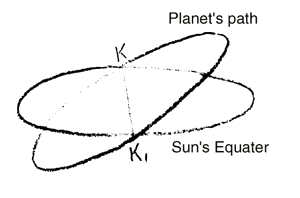
A second essential for us to hold to is the idea that each planet has its own orbital plane. Although the planets carry out their evolutions in the neighborhood of each other, so to speak, yet for each planet there is the distinct plane of its orbit, more or less inclined to the plane of the Sun's equator: If this depicts the plane of the Sun's equator (Fig.1), an orbital plane of a planet would be thus; it would not coincide at all with the plane of the Sun's equator. [2]
Fig. 1
These are two very significant mental pictures, to be formed from the facts of observation. And yet, in the very forming of them we must take note of something in the real world-picture, which as it were, rebels against them. For instance, if we are trying to understand our solar system in its totality, and only base it upon the picture of the planets moving in eccentric orbits, the orbital planes being inclined at varying degrees to the plane of the solar equator, we shall be in difficulties if we also take into account the movements of the comets. The moment we turn our attention to the cometary movements, the picture no longer suffices. The outcome will be better understood from the historical facts than from any theoretical explanations.
Upon these two thought-pictures, — that the orbital planes of the planets lie in the proximity of the plane of the Sun's equator, and that the orbits are eccentric ellipses, — Kant, Laplace and their successors built up the nebular hypothesis. Follow what emerges from this. At a pinch, and indeed only at a pinch, it is a way of imagining the origin of the solar system. But the astronomical system thus constructed contains no satisfactory explanation of the part played by the cometary bodies. They always fall out of the theory. This discordance of the comets with the theories which were formed, as described, in the course of scientific history, proves that the cometary life somehow rebels against a concept formed, not from the whole but only from a part of the whole. We must be clear, too, that the paths of the comets frequently coincide with those of other bodies which also play into our system and present a riddle precisely through their association with the comets. These are the meteoric swarms, whose paths very frequently — perhaps even always — coincide with the cometary paths. Here, my dear friends, taking into account the totality of our system, we are led to say: A sea of ideas has gradually been formed from the study of our planetary system as a whole, — ideas with which we cannot do justice to the seemingly irregular and almost arbitrary paths of the comets and meteoric swarms. They simply refuse to be included in the more abstract pictures that have been reached. I should have to give you long historical descriptions to show in detail how many difficulties have arisen in connection with the concrete facts, when the investigators — or rather, thinkers — approached the comets and meteoric swarms with their astronomical theories.
I wish only to point out the directions in which a sound understanding can be sought. We shall come to such an understanding if we pay attention to yet another aspect.
Starting in this way from concepts which still have a remnant of reality in them, we will now try to go back a little towards what is real. It is indeed always necessary to do this in relation to the outer world, in order that our concepts may not stray too far from reality, — for this is a strong propensity of man. We must go back again and again to the reality.
There is already no little danger in forming such a concept as that the planets move in ellipses, and then beginning at once to build a theory upon this concept. It is far better, after forming such a concept, to turn back to reality in order to see if the concept does not need correcting, or at least modifying. This is important. It is very clearly seen in astronomical thinking. Also in biological and especially in medical thought, the same failing has led people very far astray. They do not take into account, how necessary it is directly they have formed a concept, to go back to reality in order to make sure that there is no reason to modify it.
The planets, then, move in ellipses. But these ellipses vary; they are sometimes more circular, sometimes more elliptical. We find this if we return to reality with the ellipse idea. In the course of time the ellipse becomes more bulging, more like a circle, and then again more like an ellipse. So I by no means include the whole reality if I merely say, ‘the planets move in ellipses’. I must modify the concept and say: The planets move in paths which continually struggle against becoming a circle or remaining one and the same ellipse. If I were now to draw the elliptic line, to be true to the reality I should have to make it of india-rubber, or form it flexibly in some way, continually altering it within itself. For if I had formed the ellipse which is there in one revolution of the planet, it would not do for the next revolution, and still less for the following one. It is not true that when I pass from reality to the rigid concept I still remain within the real. That is the one thing.
The other is: We have said that the planes of the planetary orbits are inclined to the plane of the Sun's equator. Where the planets cross the point of intersection of their orbits (with the Ecliptic) in an upward or downward direction, they are said to form Nodes. The lines, joining the two Nodes (K-K 1 in Fig. 1), are variable. So too are the inclinations of the planes to one-another, so that even these inclinations, if we try to express them in a single concept, bring us to a rigid concept which we must immediately modify in face of the reality. For if an orbit is inclined at one time in one way, and at another time in another way, the concept we deduce in the first instance must afterwards be modified. To be sure, once such a point has been reached, we can take an easy line and say that there are ‘disturbances’ and that the reality is only grasped ‘approximately’ with our concepts. We then go on swimming comfortably in further theories. But in the end we swim so far that the fanciful and theoretic pictures we are constructing no longer correspond to the reality, though they are meant to do so.
It is easy to agree that this mutability of the eccentric orbits, and of the mutual inclination of the planes of the orbits, must somehow or other be connected with the life of the whole planetary system, or shall we say, with its continuing activity. It must be connected in some way with the living activity of the whole planetary system. That is quite evident. Starting from this, one might again try to form the concept, saying: Well now, I will bring such mobility into my thoughts that I picture the ellipses continually bulging out and contracting, the planes of the orbits ascending, descending and rotating, and then from this starting-point I will build up a world-system according to reality. Good. But if you think the idea through to the end, then precisely as the outcome of such logical thought, the result is a planetary system which cannot possibly go on existing. Through the summation of the disturbances which arise especially through the variability of the Nodes, the planetary system would move towards its own ultimate death and rigidity. Here there comes in what philosophers have pointed out again and again. While such a system can be thought out, in reality it would have had ample time to reach the ultimate finale. There is no reason why it should not. The infinite possibility would have been fulfilled; rigidity would long ago have set in.
We enter here into a realm where thought apparently comes to a standstill. Precisely by following my thinking through to the very last, I arrive at a world-system which is still and rigid. But that is not reality.
Now, however, we come to something else, to which we must pay special attention. In pursuing these things further — you can find the theory of it in the work of Laplace; I will only relate the phenomena — one finds that the reason why the system has not actually reached rigidity under the influence of the disturbances — the variability of the Nodes, etc., — is that the ratios of the periods of revolution of the planets are not commensurable. They are incommensurable quantities, numbers with decimals to an infinite number of places. Thus we must say: If we compare the periods of revolution of the planets in the sense of Kepler's Third Law, the ratios of these periods cannot be given in integers, nor in finite fractions, but only in incommensurable numbers. Modern Astronomy is clear on this. It is to the incommensurability of the ratios between the periods of revolution of the several planets (in Kepler's third Law) that the planetary system owes its continued mobility. Otherwise, it must long ago have come to a standstill.
Observe now, what has happened. In the last resort, we are obliged to base our thoughts about the planetary system upon numbers which in the end elude our grasp. This is of no little importance.
We are therefore led, by the very requirements of scientific development, to think of the planetary system mathematically in such a way that the mathematical results are no longer commensurable. We are at the place, where in the mathematical process itself we arrive at incommensurable numbers. We have to let the number stand, — we come to a stop. We can write it in decimals no doubt, but only up to a certain place. Somewhere or other we must leave off when we come to the incommensurable. The mathematicians among you will be clear about this. You will see that in dealing with incommensurable number I reach the point where I must say: I calculate up to here and then I can go no further. I can only say (forgive my using a somewhat amusing comparison for a serious subject) that this coming to an inevitable halt in mathematics reminds me of a scene in which I was once a participator in Berlin. A fashion in Variety-entertainment came about through certain persons, one of whom was Peter Hill. He had founded a kind of Cabaret and wanted to read his own poems there. He was a very lovable person, in heart and soul a Theosophist, he had rather gone to seed in Bohemian circles. I went to a performance in which he read his own poems. The poem had got so far that single lines were finished, and so he read it aloud:
The Sun came up. ... etc. (The first line.)
The Moon rose. ... etc. (That was the second line.)
At each line he said ‘etc.’ That was a reading I once attended. As a matter of fact it was most stimulating. Everyone could finish the line as he chose! Admittedly with incommensurable numbers [you] cannot do this, yet here too you can only indicate the further process. You can say that the process continues in a certain direction, but nothing is given by which you might form an idea as to what numbers may yet be coming. It is important that precisely in the astronomical field we are led into incommensurabilities. We are forced by Astronomy to the very limits of mathematising; here the reality escapes us. Reality escapes us, we can say nothing else; reality eludes our grasp.
What does this mean? It means that we apply the most secure of our sciences, Mathematics, to the celestial phenomena, and in the last resort the celestial phenomena do not submit; the moment comes where they elude us. Precisely where we are about to reach their very life, they slip away into the incommensurable realm. Here then, our grasp of reality comes to an end at a certain point and passes over into chaos.
We cannot say without more ado, what this reality, which we are trying to follow mathematically, actually does when it slides away into the incommensurable. Undoubtedly this is related to its power of continued life. To enter the full astronomical reality we must take leave of what we are able to master mathematically. The calculation plainly shows this; the very history of science shows it.
Such are the points which we must work towards, if we would proceed in a realistic spirit. Now I would like to set before you the other pole of the matter. If you follow it physiologically you can begin from any point you like in embryonic development, whether it be from the development of the human embryo in the third or second month, — or the embryo of some other creature. You can follow the development back as far as ever you can with the means of modern science. (it is in fact only possible to a limited extent, as those of you who have studied it will know.) You can trace it back to a certain point, from which you cannot get much further, namely to the detachment of the ovum — the fertilized ovum. Picture to yourselves how far you can go back. If you wished to go still further back you would be entering the indeterminate realm of the whole maternal organism. This means that in going back you come into a kind of chaos. You cannot avoid this, and the fact that it cannot be avoided is shown by the course of scientific development. Think of such scientific hypotheses as the theory of “Panspermia” for instance, where they speculated as to whether the single germ-cell was prepared out of the forces of the whole organism, which was more the point of view of Darwin, or whether it developed in a more segregated way in the purely sexual organs. You will see when you study the course of scientific development in this field that no little fantasy was brought to bear on the attempt to explain the underlying genesis, when tracing backward the arising of the germ cell from the maternal organism. You come into a completely indeterminate realm. There is little but speculation in the external science of today as to the connection between the germ-cell and the maternal organism.
Then at a certain point in its development this germ appears in a very definite way, in a form which can be grasped at least approximately by mathematical or at any rate geometrical means. Diagrams can be made from a certain point onward. Many such diagrams exist in Embryology. The development of the germ-cell and other cells can be delineated more or less exactly. So one begins to picture the development in a geometrical way, representing it in forms similar to purely geometrical figures. Here we are following up a reality which in a way is the reverse of what we had in Astronomy. There we pursued a reality with our cognitional process and came to incommensurable numbers; the whole thing slips intochaos through the process of knowledge itself. In Embryology we slip out of chaos. From a certain moment onward we can grasp what emerges from chaos through forms that are like purely geometrical forms. Thus in effect, in employing Mathematics in Astronomy we come at one point into chaos. And by pure observation in Embryology we have at a certain point nothing before us but chaos; it all seems chaotic at first, observation is impossible. Then we come out of chaos into the realm of Geometry. It is therefore an ideal of certain biologists — a very justifiable ideal — to grasp in a geometrical form what presents itself in Embryology; not merely to make illustrations of the growing embryo naturalistically, but to construct the forms according to some inherent law, similar to the laws underlying geometrical figures. It is a justifiable ideal.
Now therefore we can say: When in Embryology we try to follow up the real process by observation, we emerge out of a sphere which lies about as near to our understanding as that which is beyond the incommensurable numbers. In Astronomy on the one hand, we proceed with our understanding up to the point where we can no longer follow mathematically. In Embryology on the other hand our understanding begins at a certain point, where we are first able to set to work with something resembling Geometry.
Think the thought through to its conclusion. You can do so, since it is a purely ‘methodological’ thought, that is to say the reality of it is in our own inner life.
If in arithmetic we reach the incommensurable numbers, — that is, we reach a point where the reality is no longer represented by a number that can be shown in its complete form — then we should also begin to ask whether the same thing may not happen with geometrical form as with arithmetical analysis. (We shall speak more of this in the next lecture.) The analytical process leads to incommensurable number. Now let us ask: How do geometrical forms image the celestial movements? Do not these images perhaps lead us to a certain point. Similar to that to which arithmetical analysis is leading when we reach incommensurable number? Do we not in our study of the heavenly bodies — namely the planets — come to a boundary, at which we must admit we can no longer use geometrical forms as a means of illustration; the facts can no longer be grasped with geometrical forms? Just as we must leave the region of commensurable numbers, it may well be that we must leave the region where reality can still be clothed in geometrical (or again arithmetical, algebraic, analytical) forms, such as in drawings of spirals and other figures derived from Geometry. So, in Geometry too, we should be coming into the incommensurable realm. In this sense it is indeed remarkable that in Embryology, though arithmetical analysis is not yet of much use, Geometry makes its presence felt pretty strongly the moment we begin to take hold of the embryological phenomena as they emerge from chaos. Here we are dealing, not indeed with incommensurable number but with something that tends to pass from incommensurable into commensurable form.
We have thus sought to grasp reality at two poles: On the one hand where the process of cognition leads through analysis into the incommensurable, and on the other where observation leads out of chaos to a grasping of reality in ever more commensurable forms. It is essential that we bring these things before our minds with full clarity, if we would add reality to what is presented by the external science of today. In no other way can we reach this end.
I should now like to add a methodical reflection, from which we can tomorrow make our way into more realistic problems.
In all that we have spoken of hitherto, we have been taking it for granted that the cosmic phenomena have been approached from the standpoint of Mathematics. It appeared that at one point the mathematician comes up to a limit — a limit he encounters too in purely formal Mathematics. Now there is something underlying our whole way of thinking in this realm, which perhaps passes unnoticed because it always wears the mask of the ‘obvious’ and we therefore never really face the problem. I mean the whole question of the application of mathematics to reality. How do we proceed? We develop Mathematics as a formal science and it appears to us absolutely cogent in its conclusions; then we apply it to reality, without giving a thought to the fact that we are really doing so on the basis of certain hypotheses. Today however, sufficient ground has already been created for us to see that Mathematics is only applicable to outer reality on the basis of certain premises. This becomes clear when we try to continue Mathematics beyond certain limits. First, certain laws are developed, — laws which are not obtained from external facts, as for example are Kepler's Laws, but from the mathematical process itself. They are in fact inductive laws, developed within Mathematics. They are then employed deductively; highly elaborate mathematical theories are built upon them.
Such laws are those encountered by anyone who studies Mathematics. In lectures given recently in Dornach by our friend Dr. Blumel, significant indications were given of this line of mathematical research. One of the laws in question is termed the Commutative Law. It can be expressed in saying: It is obvious that a + b equals b + a , or a x b equals b x a . This is a self-evident fact so long as one remains within the realm of real numbers: But it is merely an inductive law derived from the use of the implicit postulates in the arithmetic of real numbers.
The second law is the Associative Law. It is expressed as (a + b) + c = a + (b + c). Again this is a law, simply derived by working with the implicit postulates in the arithmetic of real numbers.
The third is the so-called Distributive Law, expressible in the form: a (b + c) = ab + ac. Once more, it is a law obtained inductively by working with the implicit postulates in the arithmetic of real numbers.
The fourth law may be expressed as follows: ‘A product can only equal zero if at least one of the factors equals zero.’ This law again is only an inductive one, derived by working with the implicit postulates in the arithmetic of real numbers.
We have, then, these four laws; the commutative law, the associative law, the distributive law, and this law about the product being equal to zero. These laws underlie the formal Mathematics of today, and are used as a basis for further work. The results are most interesting, there is no question of that. But the point is this: These laws hold good so long as we remain in the sphere of real numbers and their postulates. But no thought is ever given to the question, to what extent the real facts are in accord with them. Within our ordinary formal modes of experience it is true, no doubt that a + b = b + a, but does it also hold good in outer reality? There is no ascertainable reason why it should. We might be very astonished one day to find that it did not work if we applied to some real process the idea that a + b equals b + a. But there is another side to it. We have within us a very strong inclination to cling to these laws; with them therefore. We approach reality and everything that does not fit in escapes our observation. That is the other side.
In other words: We first set up postulates which we then apply to reality and take them as axioms of the reality itself. We ought only to say: I will consider a certain sphere of reality and see how far I get with the statement a + b = b + a. More than that, I have no right to say. For by approaching reality with this statement we meet what answers to it, and elbow aside anything that does not. We have this habit too in other fields. We say for example, in elementary physics: Bodies are subject to the law of inertia. We define ‘inertia’ as consisting in the fact that bodies do not leave their position or alter their state of motion without a definite impelling force. But that is not an axiom; it is a postulate. I ought only so say: I will call a body which does not alter its own state of motion ‘inert’, and now I will seek in the real world for whatever answers to this postulate.
In that I form certain concepts, I am therefore only forming guiding lines with which to penetrate reality, and I must keep the way open in my mind for penetrating other facts with other concepts. Therefore I only regard the four basic laws of number in the right way if I see them as something which gives me a certain direction, something which helps me regulate my approach to reality. I shall [be] wrong if I take Mathematics as constituting reality, for then in certain fields, reality will simply contradict me. Such a contradiction is the one I spoke of, where incommensurability enters in, in the study of celestial phenomena.

Notes:
1. Note by translators: In the first few pages of this lecture, the word Vorstellungen has been translated, either as “mental pictures” or “thought-pictures”, or by the word “ideas” as in Prof. Hoernle's original English edition of Dr. Steiner's Philosophie der Freiheit. In other translations, including the later editions of this book, the word is rendered “representations”, or again, “Mental presentations”. Dr. Steiner's use of Vorstellung corresponds, we believe, to the colloquial, work-a-day meaning of the word “idea” in current English. (Where Idea is meant in its deeper, more spiritual meaning — German Idee — it can be distinguished by the use of a capital.)
2. Note by Editor: This plane is inclined at an angle of about seven degrees to the plane of the ecliptic.


Anthroposophy: The Tree of Life's New Sap


Rudolf Steiner, from a lecture given on January 5, 1920:


"To demand that we become again like people of past millennia is like expecting adults to play like children. No, to satisfy the deepest needs of our soul, we can neither go back to the civilizations of thousands of years ago nor can we call for Ex Oriente Lux without falling into decadence. As Western people we must not call for the light to come to us from the Orient. The light that is there now has undergone many metamorphoses, and we must not fall prey to the illusion that this spirituality we can find in the Orient nowadays can influence our civilization in a beneficial way.


Indeed, it was the worst kind of decadence when a theosophical movement appeared in response to the religious and cultural needs of Western civilization--of the machine age, which has developed a mechanistic worldview that cannot satisfy us--and then turned to the region that can offer us only the decadent remnants of the ancient Oriental cultural-spiritual life. The attempt to incorporate Indian culture now into Western theosophy reveals the extent of the contemporary spiritual barrenness. Our civilization lacks creative forces in its own cultural-spiritual life. It could achieve success only in technology but proves itself unable to find its own way into the realm the soul needs if it is to understand our true soul-spiritual essence.


This, by the way, is an all too prevalent trend today. Many who are dissatisfied with modern Christianity try to find out what it was like in earlier times. They want to know what the first Christians did and want to imitate them. These people want to return to the way things were then, as though we had made no progress since then and as though we did not need a new understanding of Christianity. Indeed, we see everywhere the signs of barrenness and lack of creativity. That is not what spiritual science wants; it does not want to borrow anything from ancient cultures or from their modern successors."


Source: Social Issues: Meditative Thinking and the Threefold Social Order, pp. 28-29

The fruit of the Spirit


“The fruit of the Spirit is love, joy, peace, longsuffering, gentleness, goodness, faith, meekness, temperance.”  — Galatians 5:22-23


Related posts:
https://martyrion.blogspot.com/2019/08/heavenly-treasures.html
https://martyrion.blogspot.com/2018/07/on-good-ground-37-years-at-himalayan.html

Sunday, September 1, 2019

Working for the Community: 'It is as it should be, and I will that it be so.'

Rudolf Steiner:  "If anyone is to work for the community, he must perceive and feel the value, the nature and importance, of this community. He can do this only when the community is quite different from a more or less indefinite sum of individual human beings. It must be informed by an actual spirit, in which each single one has their part. It must be such that each one says 'It is as it should be, and I will that it be so.' The community must have a spiritual mission, and each individual must have the will to contribute toward the fulfilling of this mission."

The Himalayan Institute


Related post: http://martyrion.blogspot.com/2018/07/on-good-ground-37-years-at-himalayan.html