Sunday, January 3, 2016

Hamlet as The Modern Man


"To decide whether life is worth living is to answer the fundamental question of philosophy. Everything else is child's play . . . we must first of all answer the question."  — Albert Camus


"This is the beginning of the Gospel of Jesus Christ"

The Gospel of Mark. Lecture 1 of 10.
Rudolf Steiner, Basel, September 15, 1912:
It is well known that the Gospel of St. Mark begins with the words: “This is the beginning of the Gospel of Jesus Christ.”
A man of today who seeks to comprehend this Gospel of St. Mark is at once, in the very first words, faced with three riddles. The first is to be found in the words: “This is the beginning.” The beginning of what? How can this beginning be understood? The second is: “the beginning of the Gospel ...” In an anthroposophical sense, what does the word “Gospel” mean? The third riddle we have often spoken of: the figure of Christ Jesus Himself.
Whoever is seriously seeking for knowledge and a deepening of himself must recognize that mankind is evolving and progressing. For this reason what we may call the understanding of any revelation is not fixed once and for all, or confined to any particular epoch. It progresses, so that anyone who attaches a serious meaning to the terms “evolution” and “progress” must necessarily believe that as time goes on, mankind's deepest problems will be ever better, and more thoroughly and profoundly, understood. For something like the Gospel of St. Mark, as we shall demonstrate by means of these three riddles, a certain turning point in our comprehension has been reached only at the present time. Slowly and gradually, but distinctly, there has been prepared what can now lead us to a real understanding of the Gospel and enable us to understand that “the Gospel begins.” Why is this the case?
We need only glance back a little to what filled human minds a comparatively short time ago and we shall see how the very nature of comprehension may — indeed must — have altered in relation to a subject like this. If we go back further than the nineteenth century we shall find that in the eighteenth and seventeenth centuries we approach ever closer to a time when those persons whose spiritual life was at all concerned with the Gospels had to start from a very different basis of comprehension than that of the person of today. What could an ordinary man of the eighteenth century say to himself if he wished to place himself in the general line of the evolution of humanity, and was not one of the few who were connected in some way with an initiation or some occult revelation — assuming that he had assimilated within himself everything offered by external exoteric life? Even the most cultivated man, one who stood on the highest pinnacle of the culture of his age, could not look back on more than three thousand years of the life of mankind; and one thousand of those years was before the Christian era and nearly lost in misty dimness. The other two thousand years since the founding of Christianity were not yet quite completed. He might look back three thousand years, shall we say? When one looked back at the earliest of these millennia one was confronted with a completely mythical, dim, prehistoric epoch of humanity, the age of old Persia. This, and what still remained of the knowledge of the ancient Egyptian epoch, preceded what “actual history” related, which began only with Hellenism. This Hellenism, to a certain extent, formed the foundation of the culture of this age. All those who wished to look more deeply into human life started with Hellenism; and within Hellenism appeared all that Homer, the Greek tragedians, and all the Greek writers have written concerning the primeval history of this people and their work for mankind.
Then one sees how Greece began to decline, how it was stifled by Rome, though only externally. Generally speaking, Rome overcame Greece only politically, while in reality it adopted Greek culture, Greek education,and Greek life. It might be said that politically the Romans conquered the Greeks, but spiritually the Greeks conquered the Romans. During this latter process, while Hellenism was conquering Rome spiritually, it poured into Rome through hundreds and hundreds of channels what it had itself acquired. From Rome this streamed forth into all the other civilizations of the world, while during this time Christianity streamed more and more into the Greco-Roman civilization and was to a large extent transformed when the northern Germanic peoples took part in the spreading of the Greco-Roman Christian culture. With this intermingling of Greece, Rome, and Christianity, the second millennium of the world's history passed away, which to the men of the eighteenth century was the first Christian one. Then we see the beginning of the second Christian millennium, the third historical civilization of man. We see how everything goes on apparently in the same way — although, if we have deeper insight, we shall see that in this third millennium everything is really different. Two figures only need be cited, a painter and a poet, who, although they appear some two centuries after the end of the millennium, nevertheless show how something essentially new began for Western civilization with the second Christian millennium, something which these two men carried further. These two figures are Giotto and Dante. [ Note 1 ] Giotto as painter and Dante as poet represent the beginning of all that followed, and what they gave was embodied in later Western cultures. Those were the three thousand years that could at that time be surveyed.
Then came the nineteenth century. Only someone who can look more deeply into the whole formation of the culture of the age is able now to perceive all that took place in the nineteenth century, and how for that reason everything had to become different. It is all contained in the minds and souls of men, but only a very few can as yet understand it.
The perspective of the man of the eighteenth century went back only to Hellenism; the age before that was somewhat nebulous. What happened in the nineteenth century — and this is little appreciated or understood today — is that the East played its part in the culture of the West, indeed very intensely so. This intervention of the Oriental influence in its own peculiar way is what we must bear in mind when considering the transformation that took place in the civilization of the nineteenth century. This penetration by the Orient threw light and shade upon everything that poured into the culture, and will increasingly do so. For this reason a new understanding was required concerning things that up to that time humanity had regarded in a different light.
If we wish to choose single figures and individuals who have influenced the culture of the West, in whom we could find nearly everything that a man felt in his soul at the beginning of the nineteenth century if he concerned himself with spiritual life, we may mention David, Homer, Dante, Shakespeare, and Goethe, [ Note 2 ] who was just beginning to penetrate into life. Future historians writing of the eighteenth and nineteenth centuries will be very clear about one thing, that the intellectual and spiritual life of that era was determined by these five figures. There lived then, more than anyone can imagine now, even in the most delicate stirrings of the soul, what we may call the feelings and truths of the Psalms. There lived also fundamentally what is to be found in Homer as well as what took such magnificent form in Dante; then, even if it did not live in Shakespeare himself, there was what is nevertheless so beautifully expressed by him in the form in which it now lives in men of modern times. Added to this is the striving of the human soul after truth which Goethe expressed in Faust, something that in reality lived in every human soul in such a way that it was often said, “Every man who seeks the truth has something of the Faust nature in him.”
To all this there was added a quite new perspective, which extended beyond the three thousand years covered by these five persons. It came in ways that are at first quite unfathomable by external history. This was the first entry of an inner Orient into the mental and spiritual life of Europe. It was not only that to the poems of those writers mentioned earlier was added what was given in the Vedas and the Bhagavad Gita, nor the fact that by learning to know these Eastern poems a different emotional nuance about the world was aroused, differing fundamentally from that of the Psalms or from what is to be found in the poetry of Dante or Homer, but something appeared in a mysterious manner which became ever more visible during the nineteenth century. One name alone will suffice, a name which made a great stir in the middle of the nineteenth century, and this will convince us that something came from the East to Europe along mysterious paths. We need but mention the name of Schopenhauer. [ Note 3 ] In Schopenhauer what is it that strikes you most of all, if you leave aside the theoretical elements of his system? Isn't it the content of feeling and sentiment that pervades his whole thought? In the profound relationship between this nineteenth-century man and the Oriental-Aryan mode of thought and feeling, in every sentence, we might say, in the emphasis of feeling in Schopenhauer, lives that which we might call the Eastern element in the West; and this passed on to Eduard von Hartmann [ Note 3 ] in the second half of the nineteenth century.
This penetrated along mysterious paths, as we have just said. We gradually come to better understand these mysterious paths when we see that in the course of the developments of the nineteenth century a complete transformation, a metamorphosis, of all human thinking and feeling took place — not however in only one part of the Earth but in the intellectual and spiritual life of the whole Earth. As to what took place in the West, if anyone would take the trouble, it would be enough to compare anything written about religion, philosophy, or any aspect of spiritual life with something that belongs to the eighteenth century. He will then see that a complete transformation took place, that all the questions regarding the highest riddles asked by mankind had become more vague, that men were striving to formulate new questions, to look for new sentiments and modes of perception, that nothing belonging to religion and what it formerly gave to man could still be given through it to the human soul in the same way. Everywhere there was a longing for something deeper and more profoundly hidden in the depths of religion.
This was not true of Europe alone. It is characteristic of the beginning of the nineteenth century that all over the civilized world men, through an inner urge, were compelled to think differently. If we wish to form a more exact conception of what we are discussing, we must see that there was a general convergence of the peoples and their folk cultures and folk beliefs, with the result that people belonging to entirely different creeds began in the nineteenth century to understand each other in a quite remarkable way. We shall quote a characteristic example which lies at the heart of what we are trying to indicate. In the thirtieth year of the nineteenth century, a man appeared in England who was a Brahmin, an adherent of what he considered to be true Brahminism, that is, the Vedanta teaching. Ram Mohun Roy [ Note 4 ], who died in London in 1836, exercised a great influence on those of his contemporaries who were interested in such things, and made a great impression. The remarkable thing about him was that on the one hand he stood there as a reformer of Hinduism, though a misunderstood one, while on the other hand everything he said could be understood by all Europeans who were familiar with the advanced thought of their age. He did not put forth ideas that could be understood only through Orientalism, but ideas that could be understood by ordinary human reason.
What was Ram Mohun Roy's attitude? He said something along these lines: “I live in the midst of Hinduism, where a number of different gods are worshipped. If the people of my country are asked why they worship these gods, they say, ‘It is our custom, we know nothing else. It was done by our fathers and their fathers before them.’ And because the people were influenced in this way,” Ram Mohun Roy continued, “the crassest idolatry became the rule, an appalling idolatry which disgraces the original greatness of the religion of my fatherland. There once was a belief that, although partly contradictory, is to be found in the Vedas. It is the purest form of human thought, and it was brought into the Vedanta system by Vyasa.”
This was the belief professed by Ram Mohun Roy. For this reason he had not only made translations from various incomprehensible idioms into the languages that are understandable in India, but he also made extracts of what he considered the correct teaching and spread them among the people. What was his intention when he did this? He thought he recognized behind all that comes to expression in the various gods and all that is worshipped in the different idols a pure teaching of a primal divine unity, the spiritual God who lives in all things but can no longer be recognized in the idols. This God must once more penetrate into the minds of men. When this Indian Brahmin spoke in detail about what he believed to be the correct Vedanta teaching, the true Indian creed, it did not sound strange. To those who understood him rightly, it was as though he preached a kind of rational belief that can be attained by everyone who by using his rational mind turns to the universal unitary God. And Ram Mohun Roy had followers: Rabindranath Tagore and others [ Note 4 ]. One of these followers, and this is especially interesting, gave a lecture in 1870 about Christ and Christianity. It was indeed extraordinarily interesting to hear an Indian speak about Christ and Christianity. The actual mystery of Christianity was quite remote from the Indian speaker — he did not touch upon that at all. From the whole course of the lecture we can see that he is quite unable to grasp the fundamental fact that Christianity does not proceed from a personal teacher but is founded on the Mystery of Golgotha, a world-historical fact, on death and resurrection. But that which he can grasp and is so clear to him is that in Christ Jesus we have a figure of tremendous significance, one that is of importance to every human heart, a figure that must stand there as the ideal figure for the whole history of the world. It is remarkable to hear this Indian speaking about Christ and to hear him say “If a man goes deeply into Christianity, he will see that Christianity must, even in the West, go through a further evolution, for what the European brings to my fatherland as Christianity does not appear to me to be the true Christianity.”
We see from the examples quoted that it was not only in Europe that people's minds began to look behind the religious creeds, but also in distant India. It is true also of many parts of the Earth where minds began to awake, and men approached in a new way and from an entirely new point of view something they had possessed for thousands of years. This metamorphosis of souls in the nineteenth century will be fully perceptible only in the course of time. Only in later times will history recognize that impulses of this kind, although apparently affecting only a few people, streamed through thousands of channels into our hearts and souls, so that today all those who participate in any way in spiritual life have them within their souls. This had to result in a total renewal. All older questions were transformed, and a new kind of understanding came into being in relation to all views that had hitherto been held. So it is that in the world even today such questions are already taking on a greater profundity. What our spiritual movement desires today is the answering of these questions.
This spiritual movement is convinced that these questions cannot in their present form be answered by the old traditions, by modern natural science, or by that conception of the world which reckons only with the factors of modern natural science. Spiritual science, research into the spiritual worlds, is necessary. In other words, mankind today, in accordance with the whole trend of his evolution, must ask questions that can be answered only through supersensible investigation. Quite slowly and gradually there have emerged from the spiritual life of the West things that are once more in harmony with the most beautiful traditions that have come over from the East. You know that we have always stressed the fact that the law of reincarnation comes out of Western spiritual life itself, and that it need no more be taken as something historical coming from Buddhism than for example Pythagorean doctrine needs to be taken over from historical traditions. This has always been emphasized, but the fact that the idea of reincarnation arose in modern souls formed a bridge which extended across the three thousand years of which we have been speaking (during which the doctrine of reincarnation was not the center of thinking) to the figure of Buddha. The horizon, the perspective of the evolution of mankind, was extended beyond the three thousand years. This gave rise to new questions, which can be answered only through spiritual science.
Let us begin with the question to which the beginning of this Gospel of Saint Mark gives rise, this Gospel which begins with the words “the beginning of the Gospel of Jesus Christ.” Let us remember that these introductory words are immediately followed not only by a characterization of a passage of the old prophets but by the announcement of Christ by John the Baptist. This proclamation was stated by him in such a way that it may be put in these words: “The time is fulfilled; the kingdom of the divine is extending over the whole Earth-existence.” What does all this mean?
Let us endeavor with the light that modern spiritual science can give us to view retrospectively those past ages in the center of which is contained “the fulfillment.” Let us try to understand what it means that “an old era is completed and a new one is beginning.” We shall best be able to understand this if we first turn our attention to something belonging to more remote times and then consider something belonging to the modern era; between the two lies the Mystery of Golgotha. Let us take something before the Mystery of Golgotha and then something later, and then endeavor to enter deeply into the difference between the two epochs, so that we may recognize how far the old epoch had been completed and a new one begun. In this way we shall not enter into abstractions or definitions, but consider the concrete.
I should like you to turn your attention to the first millennium of human evolution, as it was thought to be in earlier times. There in the remotest period of this first millennium stands the towering figure of Homer, the Greek poet and singer. Hardly more than the name remains to mankind of him to whom are ascribed those two great poems which are among the greatest accomplishment of mankind: the Iliad and the Odyssey. Scarcely more than his name is known, and in the nineteenth century doubts were cast even on that — but we need not dwell any further on that now. The more we  know of the figure of Homer, the more we admire him. For a person who studies such things, the characters created by Homer whom we meet in the Iliad and the Odyssey seem more alive than all the purely political figures of Greece. Many different people who have studied Homer over and over again have said that because of the precision of his descriptions and his manner of presentation he must have been a doctor. Others say he must have been an artist, a sculptor, or a craftsman. Napoleon admired the way Homer described tactics and strategy; still others think he must have been a beggar wandering through the land.
However all this may be, it certainly does demonstrate the unique individuality of Homer. Consider one of his characters, Hector. If you have any time available, you ought to study the figure of Hector in the Iliad — how plastically he is described so that he stands as a complete personality before us; how we see his affection for his paternal city, Troy, his wife, Andromache, his relationship to Achilles, and to his armies; and how he commanded them. Try to call up this man before your mind, this man who possessed all the tenderness of a husband, and who clung in the ancient way to his home city of Troy, and who suffered such disillusions as only really great men can. Remember his relation with Achilles. Hector, as presented by Homer, is a towering figure from very ancient times, a man of great all-embracing humanity, for of course what Homer is describing belongs to a period well before his own, in the darkness of the past. Hector stands out above all the others, all those figures who seem mythical enough in the eyes of modern men.
Now take this one figure. Skeptics and all kinds of philologists may indeed doubt that there ever was a Hector at all, in the same way as they doubt the existence of Homer. But anyone who takes into consideration what may be understood from a purely human viewpoint will be convinced that Homer describes only facts that actually occurred. Hector was a living person who strode through Troy, and Achilles and the other figures were equally real. They still stand before us as personages of real earthly life. We look back to them as people of a different kind from ourselves, who are difficult to understand but whom the poet is able to bring before our souls in every detail. Now let us place before our souls a figure such as Hector, one of the chief Trojan commanders, who is defeated by Achilles. In such a personage we have something that belongs to the old pre-Christian age, something by which we can measure what men were before the time when Christ lived on Earth.
I will now draw your attention to another figure, a remarkable figure of the fifth century B.C.: the great philosopher Empedocles [ Note 5 ], who spent a large part of his life in Sicily. It was he who was the first to speak of the four elements — fire, water, air, and earth — and who said that everything that happens in the material realm caused by the mingling and disintegration of these four elements results from the principles of love and hate ruling in them. It was he also who by his activity influenced Sicily by calling into being important political institutions, and he went about trying to lead the people into a life of spirituality. When we look back to Empedocles we find that he lived an adventurous as well as a deeply spiritual life. Perhaps the truth of what I am about to say will be doubted by some, but spiritual science knows that Empedocles went about in Sicily not only as a statesman, but as a magician and initiate, just as Hector, as depicted by Homer, walked in Troy. In order to characterize the remarkable attitude of Empedocles toward the world the fact confronts us — and it is true and no invention — that in order, as it were, to unite himself with all existence around him, he ended by throwing himself into Mount Etna and was consumed by its fire. In this way a second figure of the pre-Christian age is presented to our souls.
Now let us consider such figures as these in accordance with the methods of spiritual science. First of all we know that these individualities will appear again; we know that such souls will return to life. We shall not pay any attention to their intermediate incarnations but look for them in the post-Christian era. We then see something of the change brought about by time, something that can help us to understand how the Mystery of Golgotha intervened in human evolution. If we say that such figures as Hector and Empedocles appeared again, we must ask how they walked among men in the post-Christian era. For we shall then see how the intervention of the Mystery of Golgotha, the fulfillment and beginning of a new age, worked on their souls. As serious anthroposophists assembled here together we need not shrink from the communications of true spiritual science, which can be confirmed by external facts.
I should now like to turn your attention to something that took place in the post-Christian era, and perhaps again it may be said that the person concerned was a poetical personage. But this poetical personage can be traced back to a real individuality who was once alive. I direct your attention to the character created by Shakespeare in his Hamlet. Anyone who knows the development of Shakespeare, insofar as it can be known externally, and especially someone who is acquainted with it through spiritual science, will know that Shakespeare's Hamlet is none other than the transformed real prince of Denmark, who also lived at one time. I cannot go into everything underlying the historical prototype of the poetical figure of Hamlet, but through the research of spiritual science I can offer you a striking example of how a man, a spirit of ancient times, reappears in the post-Christian era. The real figure underlying Hamlet, as presented by Shakespeare, is Hector. The same soul that lived in Hamlet lived in Hector. It is just by such a characteristic example as this, and the striking way the two different souls manifest themselves, that we can interpret what happened in the intervening time. A personality such as that of Hector stands before us in the pre-Christian age. Then comes the intervention of the Mystery of Golgotha in human evolution, and the spark it kindled in Hector's soul causes a figure, a prototype of Hamlet, to arise, of whom Goethe said, “This is a soul that is unable to deal with any situation and is not equal to its position, who is assigned tasks but is unable to fulfill them.” We may ask why Shakespeare expressed it in this way. He did not know. But anyone who can investigate the connections through spiritual science knows that behind these things forces were at work. The poet creates in the unconscious; before him stands, so to speak, first the figure which he creates, and then, as in a tableau of which he himself knows nothing, the whole individuality with which the figure is connected. Why does Shakespeare choose particular qualities in Hamlet and sharply emphasize them, qualities that perhaps Hamlet's own contemporaries would not have noticed? Because he observes them against the background of the era. He feels how different a soul has become in its transition from the old life to the new. Hamlet, the doubter, the skeptic, who has lost the ability to cope with the situations with which he meets in life, the procrastinator and waverer, this is what Hector, once so sure of himself, has become.
Let me direct your attention to another figure of modern times, who was also first presented to mankind in a poetic picture, in a poem whose protagonist will certainly live on in humanity for a long time to come when for posterity the poet, like Homer or Shakespeare, no longer is in existence. About Homer we know nothing at all, and about Shakespeare we know very little indeed. What the various compilers of notes and biographers of Goethe have written will long since have been forgotten. In spite of the printing press and other modern inventions, what interests people in Goethe at the present time will likewise have been long forgotten. But large as life, and modelled from life, there will stand the figure of Faust which Goethe has created. Just as men today know nothing of Homer, so will they some day know but little of Goethe (which will be a good thing); but they will know much about Faust. Faust again is a figure who, as he is presented to us in a literary form by Goethe, can be recognized as one brought to a certain conclusion by Goethe. The poetical picture refers back to a real sixteenth-century figure who lived then as a real person, though he was not as Goethe described him in his Faust. Why then did Goethe describe him in this way? Goethe himself did not know. But when he directed his attention to the traditional Faust that had been handed down to him, a Faust with whom he was already acquainted through the marionettes of his boyhood, then the forces that stood behind Faust, the forces of his previous incarnation, the forces of Empedocles, the old Greek philosopher, worked within him! All these radiated into the figure of Faust. So we might say, since Empedocles threw himself into Etna and united himself with the fire-element of the Earth, what a wonderful spiritualization of pre-Christian nature mysticism was accomplished in fact in the final tableau of Goethe's Faust, when Faust ascends into the fire- element of heaven through Pater Seraphicus and the rest. Slowly and gradually a totally new spiritual tendency entered into the deeper strivings of men. Already some time ago it began to become evident to the more profound spirits of mankind that, without their knowing anything about reincarnation or karma, when they were considering a great comprehensive soul whom they wished to describe from the depths of their inner life, they found themselves describing what radiated over from earlier incarnations. Although Shakespeare did not know that Hamlet was Hector, he nevertheless described him as such, without being aware that the same soul had lived in both of them. So too Goethe portrays his Faust as though Empedocles with all his peculiarities were standing behind him, because in his Faust there lived the soul of Empedocles. It is characteristic that the progress of the human soul should proceed in this way.
I have mentioned two characteristic figures, in both of whom we can perceive that when great men of earlier times reappear in a modern post-Christian age, they are shaken to the very depths of their souls and can only with difficulty adjust themselves to life. Everything that was within them in the past is still within them. For example, when we allow Hamlet to work upon us, we feel that the whole force of Hector is in him. But we feel that this force cannot come forth in the post-Christian era, that it then meets with obstacles, that something now works upon the soul that is the beginning of something new, whereas in the figures of antiquity something was coming to an end. So do these figures stand plastically delineated before us; both Hector and Empedocles represent a conclusion. But what is working on further in mankind must find new paths into new incarnations. This is revealed with Hector in Hamlet and also with Empedocles in Faust, who had within him all the abysmal urges toward the depths of nature. Because he had within him the whole nature of Empedocles he could say “I will lay aside the Bible for a time and study nature and medicine. I will no longer be a theologian.” He felt the need to have dealings with demonic beings who made him roam through the world leaving him marveling but uncomprehending. Here the Empedocles element had an after-effect but was not able to adjust itself to what a man must be after the new age had begun.
I wanted to show you through these explanations how in well-known souls, about whom anyone can find information, a powerful transformation shows itself, and how the more deeply we study them the more perceptible this becomes. If we inquire what happened between the two incarnations of such individualities, the answer always is the Mystery of Golgotha, which was announced by the Baptist when he said “The time is fulfilled: the kingdoms of the spirit, or the kingdoms of heaven, are passing over into the kingdom of man.” Yes, the kingdoms of heaven did indeed powerfully seize the human kingdom, but those who take this in an external sense are unable to understand it. They seized it so powerfully that the great men of antiquity, who had been in themselves so solid and compact, had to make a new beginning in human evolution on Earth. This new beginning showed itself precisely with them, and lasted until the end of the old epoch, with the Mystery of Golgotha. At that time something that had been fulfilled ebbed away, something which had presented men in such a way that they appeared as rounded personalities in themselves. Then came something that made it necessary for these souls to make a new beginning. Everything had to be transformed and altered, so that great souls appeared small. They had to be transformed into the stage of childhood, for something quite new was beginning. We must inscribe this in our souls if we wish to understand what is meant at the beginning of the Gospel of St. Mark by the words “a beginning.” Yes, truly a beginning, a beginning that shakes the inmost soul to its foundations and brings a totally new impulse into human evolution, a “beginning of the Gospel.”
What then is the Gospel? It is something that comes down to us from the kingdoms we have often described, where dwell the higher hierarchical beings, among whom are the angels and archangels. It descends through the world that rises above the human world. So do we gain an inkling of the deeper meaning of the word Gospel. It is an impulse that descends through the realms of the archangels and angels; it comes down from these kingdoms and enters into mankind. None of the abstract translations really covers the matter adequately. In reality the word Gospel should indicate that at a certain time something begins to flow in upon the Earth which formerly flowed only where there dwell the angels and archangels. Something descended to Earth that shook the souls of men, and shook the strongest souls most. It is here noted that this was the beginning, and the beginning has a continuation. The beginning was made at that time, and we shall see that fundamentally the whole development of humanity since then is a continuation of that beginning when the impulse began to flow down from the kingdom of the angeloi, or what we call the “ev-angel” or Gospel.
We cannot seek or investigate deeply enough if we wish to characterize the different Gospels. We shall see that especially the Gospel of St. Mark can be understood only if we understand in the right way the evolution of humanity with all its impulses and all that has happened in the course of it. I do not wish to describe this externally, but to characterize actual souls, showing how it is only the recognition of the fact of reincarnation, when it becomes a matter of real research, that can bear witness to the progress of such souls as those of Hector and Empedocles. Only in this way can the deeper significance of the Christ Impulse be brought before our souls. Otherwise we may discover beautiful things, but they will all be superficial. What lies behind all the outer events in the history of the Christ Impulse is discovered only when we can throw light upon life through spiritual research, so that we can recognize how a single life passes not only in its separate phases but also in the sequence of incarnations. We must look upon reincarnation as a serious matter and apply it to history in such a way that it becomes an element that gives life to it. We shall then perceive the working of the Event of Golgotha, the greatest of all impulses. It is especially in souls that this impulse, which we have described often enough, will become visible.


First things first


"To decide whether life is worth living is to answer the fundamental question of philosophy. Everything else is child's play . . . we must first of all answer the question."  — Albert Camus


Albert Camus as The Modern Man


"To decide whether life is worth living is to answer the fundamental question of philosophy. Everything else is child's play . . . we must first of all answer the question."  — Albert Camus


"He must increase; I must decrease."  — John 3:30

"I through the law am dead to the law, that I might live unto God. I am crucified with Christ: nevertheless I live; yet not I, but Christ liveth in me: and the life which I now live in the flesh I live by the faith of the Son of God, who loved me, and gave himself for me. I do not frustrate the grace of God: for if righteousness come by the law, then Christ is dead in vain."  — Galatians 2:19-21

"ES IST ICH"


Related post:
Rejoice! 34 years at the Himalayan Institute

Martyrion: a structure erected for bearing witness to the truths of the spirit; especially: an incarnated human being viewed as such a structure


"Mary said: My soul doth magnify the Lord, and my spirit hath rejoiced in God my Saviour."
—Luke 1:46-47

The word martyr is a Greek word, meaning "witness" — to bear witness to the truths of the spirit is to experience martyrdom.
Rudolf Steiner: "The whole history of humankind is the entombment of the Godhead."  
"He must increase; I must decrease."  — John 3:30
"I through the law am dead to the law, that I might live unto God. I am crucified with Christ: nevertheless I live; yet not I, but Christ liveth in me: and the life which I now live in the flesh I live by the faith of the Son of God, who loved me, and gave himself for me. I do not frustrate the grace of God: for if righteousness come by the law, then Christ is dead in vain."  — Galatians 2:19-21

Motherlove


"Motherhood: All love begins and ends there."  — Robert Browning


Saturday, January 2, 2016

Stanley Kubrick as The Modern Man

"The very meaninglessness of life forces man to create his own meaning."  — Stanley Kubrick


"He must increase; I must decrease."  — John 3:30

"I through the law am dead to the law, that I might live unto God. I am crucified with Christ: nevertheless I live; yet not I, but Christ liveth in me: and the life which I now live in the flesh I live by the faith of the Son of God, who loved me, and gave himself for me. I do not frustrate the grace of God: for if righteousness come by the law, then Christ is dead in vain."  — Galatians 2:19-21

"ES IST ICH"


Related post:

Rise and Shine! Anthroposophy: The redemption — the resurrection — of thinking through compassionate love


Rudolf Steiner:  "The whole history of humankind is the entombment of the Godhead."


Rudolf Steiner:  'Let us now reflect upon another feeling by means of which we can in another way attune ourselves in moral harmony with external nature. When the trees are bursting into leaf and the meadows are filled with green, let us fix our gaze upon the green which in the most varied manner covers the earth or meets us in the trees; and again we will do this in such a way as to forget all the external impressions which can affect our souls, and simply devote ourselves to that which in external nature meets us as green. If once more we are so circumstanced that we can yield ourselves to that which springs forth as the reality of green, we can carry this so far that the green disappears for us, in the same way as previously the blue as blue disappeared. Here again we cannot say, “a color is spread out before our sight,” but (and I remark expressly that I am telling you of things that everyone can experience for himself if he fulfills the requisite conditions) the soul has instead a peculiar feeling, which can be thus expressed: “I now understand what I experience when I think creatively, when a thought springs up in me, when an idea strikes me: I understand this now for the first time, I can only learn this from the bursting forth of the green all around me. I begin to understand the inmost parts of my soul through external nature when the outer natural impression has disappeared and in its place a moral impression is left. The green of the plant tells me how I ought to feel within myself when my soul is blessed with the power to think thoughts, to cherish ideas.” Here again an external impression of nature is transmuted into a moral feeling. . . . Then the green mantle of plants so works upon us that we feel and perceive in our inner being something spiritually bursting forth into bloom.'


The moral nature of the color green


Rudolf Steiner:  'Let us now reflect upon another feeling by means of which we can in another way attune ourselves in moral harmony with external nature. When the trees are bursting into leaf and the meadows are filled with green, let us fix our gaze upon the green which in the most varied manner covers the earth or meets us in the trees; and again we will do this in such a way as to forget all the external impressions which can affect our souls, and simply devote ourselves to that which in external nature meets us as green. If once more we are so circumstanced that we can yield ourselves to that which springs forth as the reality of green, we can carry this so far that the green disappears for us, in the same way as previously the blue as blue disappeared. Here again we cannot say, “a color is spread out before our sight,” but (and I remark expressly that I am telling you of things that everyone can experience for himself if he fulfills the requisite conditions) the soul has instead a peculiar feeling, which can be thus expressed: “I now understand what I experience when I think creatively, when a thought springs up in me, when an idea strikes me: I understand this now for the first time, I can only learn this from the bursting forth of the green all around me. I begin to understand the inmost parts of my soul through external nature when the outer natural impression has disappeared and in its place a moral impression is left. The green of the plant tells me how I ought to feel within myself when my soul is blessed with the power to think thoughts, to cherish ideas.” Here again an external impression of nature is transmuted into a moral feeling. . . . Then the green mantle of plants so works upon us that we feel and perceive in our inner being something spiritually bursting forth into bloom.'


Related post: http://martyrion.blogspot.com/2016/01/rise-and-shine.html

Source: http://martyrion.blogspot.com/2016/01/the-spiritual-beings-in-heavenly-bodies.html

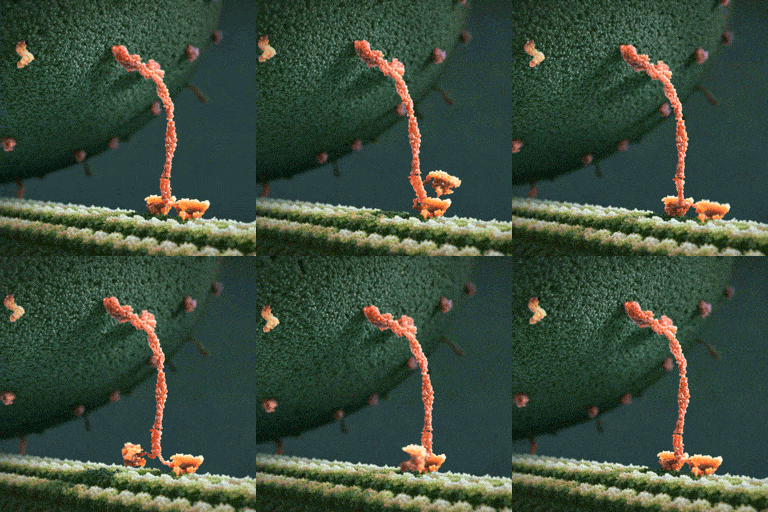
Happy Feet!


Molecules of the protein myosin dragging a ball of endorphins along an active filament into the inner part of the brain's parietal cortex, which produces feelings of happiness.


Source: https://38.media.tumblr.com/ca63616d817b3967a8ac3245d3fda224/tumblr_nc5tlfK9NY1s1vn29o1_400.gif

Thank you, Paul Orsi!

The Spiritual Beings in the Heavenly Bodies and in the Kingdoms of Nature

Figure 8


Rudolf Steiner, Helsinki, Finland, April 3, 1912. Lecture 1.


When our friends here gave me a warm invitation to come to them, they requested me to speak about the spiritual beings we find in the realms of nature and in the heavenly bodies.
Our theme will compel us to touch upon a realm that is very far removed from all the knowledge given to man today by the external world, the intellectual world. From the very beginning we shall have to allude to a domain the reality of which is denied by the external world of today. I shall only take for granted one thing, namely, that as a result of the studies you have hitherto made in spiritual science, you meet me with a feeling and perception for the spiritual world; in respect to the manner in which we shall name things, we shall come to a mutual understanding in the course of the lectures. All the rest will, in certain respects, come of itself when, as time goes on, we acquire an understanding born of feeling and of perception for the fact that behind our sense world, behind the world which we as men experience, there lies a world of spirit — a spiritual world; and that just as we penetrate into the physical world through regarding it not only as a great unity, but as specified into individual plants, animals, minerals, peoples, persons — so can we specify the spiritual world into different classes of individual spiritual beings. So that in spiritual science we do not merely speak of a spiritual world, but of quite definite beings and forces standing behind our physical world.
What then do we include in the physical world? First let us be clear about that. As belonging to the physical world we reckon all that we can perceive with our senses, see with our eyes, hear with our ears, all that our hands can grasp. Further, we reckon as belonging to the physical world all that we can encompass with our thoughts in so far as these thoughts refer to external perception, to that which the physical world can say to us. In the physical world we must also include all that we, as human beings, do within it. It might easily make us pause and reflect when it is said that all that we, as human beings do in the physical world forms part of that world, for we must admit that when we act in the physical world, we bring down the spiritual into that world. People do not act merely according to the suggestions of physical impulses and passions, but also according to moral principles; our conduct, our actions, are influenced by morals. Certainly when we act morally, spiritual impulses play a part in our actions; but the field of action in which we act morally is, nevertheless, the physical world. Just as in our moral actions there is an interplay of spiritual impulses, even so do spiritual impulses permeate us through colors, sounds, warmth, and cold and through all sense impressions. The spiritual is in a sense always hidden from external perception, from that which external man knows and can do. It is the characteristic of the spiritual that man can only recognize it when he takes the trouble, at least to a small extent, to become other than he has been hitherto.
We work together in our groups and gatherings; not only do we hear there certain truths which tell us that there are various worlds — that man consists of various principles or bodies, or whatever we like to call them, but by allowing all this to influence us, although we may not always notice it, our soul will gradually change to something different, even without our going through an esoteric development. What we learn through spiritual science makes our soul different from what it was before. Compare your feelings after you have taken part in the spiritual life of a working group for a few years, the way in which you feel and think, with the thoughts and feelings you had before, or with the way in which people think and feel who are not interested in spiritual science. Spiritual science does not merely signify the acquisition of knowledge; it signifies most pre-eminently an education, a self-education of our souls. We make ourselves different; we have other interests. When a man imbues himself with spiritual science, the habits of attention for this or for that subject which he developed during previous years, alter. What interested him before, interests him no longer; that which had no interest for him previously, now begins to interest him in the highest degree. One ought not simply to say that only a person who has gone through esoteric development can attain to a connection with the spiritual world; esotericism does not begin with occult development. The moment we make any link with spiritual science with our whole heart, esotericism has already begun; our souls begin at once to be transformed. There then begins in us something resembling what would arise, let us say, in a being who had previously only been able to see light and darkness, and who then through a special and different organisation of the eyes, begins to see colors. The whole world would appear different to such a being. We need only observe it, we need only realise it, and we shall soon see that the whole world begins to have a different aspect when we have for a time gone through the self-education we can get in a spiritual science circle. This self-education to a quite definite feeling with regard to the spiritual world, this self-education to a perception of what lies behind the physical facts is a fruit of the spiritual scientific movement in the world, and is the most important part of spiritual understanding. We should not believe that we can acquire a spiritual understanding by mere sentimentality, by simply repeating continually that we wish to permeate all our feelings with love. Other people, if they are good, wish to do that too; this would only be giving way to a sort of pride. Rather should we make it clear to ourselves how we can educate our feelings by letting the knowledge of the facts of a higher world influence us, and transforming our souls by means of this knowledge. This special manner of training the soul to a feeling for a higher world is what makes the spiritual scientist. Above all we need this understanding if we intend to speak about the things which are to be spoken about in this course of lectures.
He who, with trained occult sight, is able to see behind the physical facts, finds at once behind all that is spread out as color, sound, as warmth, cold, all that is embodied in the laws of nature — beings, which are not revealed to the external senses, to the external intellect, but which lie behind the physical world. Then, as he penetrates further and further, he discovers, so to say, worlds with beings of an ever higher order. If we wish to acquire an understanding of all that lies behind our sense-world, then, in accordance with the special task that has been ascribed to me here, we must take as our real starting-point what we encounter first of all behind our sense-world, as soon as we raise the very first veil which our sense perception spreads over spiritual happenings. As a matter of fact, the world which reveals itself to the trained occult vision as the one lying next to us, presents the greatest surprise to the present-day understanding, to the present power of comprehension. I am speaking to those who have to some extent accepted spiritual science, consequently I may take it for granted that you know that behind that which meets us externally as the human being, behind what we see with our eyes, touch with our hands, and grasp with our understanding in ordinary anatomy or physiology concerning man — behind what we call the physical human body, we recognize a supersensible human principle coming immediately next to it. This first supersensible principle of man we call the etheric, or life-body.
We will not today speak of still higher principles of human nature, but will only be clear that occult sight is able to look behind the physical body and to find there the etheric or life-body. Now occult sight can do something similar with regard to Nature around us. Just as we can investigate man occultly to see if there is not something more than his physical body, and then find the etheric body — so we can look with occult vision at external nature in her colors, forms, sounds, and kingdoms — in the mineral, the plant, the animal and the human kingdoms, in so far as they meet us physically. We then find that just as behind the physical body of man there is a life-body, so we can also find a sort of etheric or life-body behind the whole of physical nature. Only there is an immense difference between the etheric body of all physical nature and that of man. When occult vision is directed to the etheric or life-body of man, it is seen as unity, as a connected structure, as one connected form or figure. When the occult vision penetrates all that external nature presents as color, form, mineral, plant, or animal structures, it is discovered that in physical nature the etheric body is a plurality — something infinitely multiform. That is the great difference; there is a single unitary being as etheric or life-body in man — while there are many varied and differentiated beings behind physical nature.
Now I must show you in what way we arrive at such an assumption as that just made, namely that there is an etheric or life-body — strictly speaking an etheric or life-world — a plurality, a multiplicity of differentiated beings, behind our physical nature. To express how we can arrive at this, I can clothe it in simple words:, we are more and more able to recognize the etheric or life-world behind physical nature when we begin to have a moral perception of the world lying around us. What is meant by perceiving the whole world morally? What does this imply? First of all, looking away from the earth, if we direct our gaze into the ranges of cosmic space, we are met by the blue sky. Suppose we do this on a day in which no cloud, not even the faintest silver-white cloudlet breaks the azure space of heaven. We look upwards into this blue heaven spread out above us — whether we recognize it in the physical sense as something real or not, does not signify; the point is the impression that this wide stretch of the blue heavens makes upon us. Suppose that we can yield ourselves up to this blue of the sky, and that we do this with intensity and for a long, long time; that we can so do it that we forget all else that we know in life and all that is around us in life. Suppose that we are able for one moment to forget all the external impressions, all our memories, all the cares and troubles of life, and can yield ourselves completely to the single impression of the blue heavens. What I am now saying to you, can be experienced by every human soul if only it will fulfil these necessary conditions; what I am telling you can be a common human experience. Suppose a human soul gazes in this way at nothing but the blue of the sky. A certain moment then comes, a moment in which the blue sky ceases to be blue — in which we no longer see anything which can in human language be called blue. If at that moment when the blue to us ceases to be blue, we turn our attention to our own soul, we shall notice quite a special mood in it. The blue disappears, and as it were, an infinity arises before us, and in this infinity a quite definite mood in our soul; a quite definite feeling, a quite definite perception pours itself into the emptiness which arises where the blue had been before. If we would give a name to this soul perception, to that which would soar out there into infinite distances, there is only one word for it; it is a devout feeling in our soul, a feeling of pious devotion to infinity. All the religious feelings in the evolution of humanity have fundamentally a nuance which contains within it what I have here called a pious devotion; the impression of the blue vault of the heavens which stretches above us has called up a religious feeling, a moral perception. When within our souls the blue has disappeared, a moral perception of the external world springs to life.
Let us now reflect upon another feeling by means of which we can in another way attune ourselves in moral harmony with external nature. When the trees are bursting into leaf and the meadows are filled with green, let us fix our gaze upon the green which in the most varied manner covers the earth or meets us in the trees; and again we will do this in such a way as to forget all the external impressions which can affect our souls, and simply devote ourselves to that which in external nature meets us as green. If once more we are so circumstanced that we can yield ourselves to that which springs forth as the reality of green, we can carry this so far that the green disappears for us, in the same way as previously the blue as blue disappeared. Here again we cannot say, “a color is spread out before our sight,” but (and I remark expressly that I am telling you of things that everyone can experience for himself if he fulfils the requisite conditions) the soul has instead a peculiar feeling, which can be thus expressed: “I now understand what I experience when I think creatively, when a thought springs up in me, when an idea strikes me: I understand this now for the first time, I can only learn this from the bursting forth of the green all around me. I begin to understand the inmost parts of my soul through external nature when the outer natural impression has disappeared and in its place a moral impression is left. The green of the plant tells me how I ought to feel within myself, when my soul is blessed with the power to think thoughts, to cherish ideas.” Here again an external impression of nature is transmuted into a moral feeling.
Or again we may look at a wide stretch of white snow. In the same way as in the description just given of the blue of the sky and the green of earth's robe of vegetation, so this too can set free within us a moral feeling for all that we call the phenomenon of matter in the world. And if, in contemplation of the white snow mantle, we can forget everything else, and experience the whiteness, and then allow it to disappear, we obtain an understanding of that which fills the earth as substance, as matter. We then feel matter living and weaving in the world. And just as one can transform all external sight-impressions into moral perceptions, so too can one transform impressions of sound into moral perceptions. Suppose we listen to a tone and then to its octave, and so attune our souls to this dual sound of a tonic note and its octave that we forget all the rest, eliminate all the rest and completely yield ourselves to these tones, it comes about at last that, instead of hearing these dual tones, our attention is directed from these and we no longer hear them. Then again we find that in our soul a moral feeling is set free. We begin then to have a spiritual understanding of what we experience when a wish lives within us that tries to lead us to something, and then our reason influences our wish. The concord of wish and reason, of thought and desire, as they live in the human soul, is perceived in the tone and its octave.
In like manner we might let the most varied sense perceptions work upon us; we could in this way let all that we perceive in nature through our senses disappear, as it were, so that this sense-veil is removed; then moral perceptions of sympathy and antipathy would arise everywhere. If we accustom ourselves in this way to eliminate all that we see with our eyes, or hear with our ears, or that our hands grasp, or that our understanding (which is connected with the brain) comprehends — if we eliminate all that, and accustom ourselves, nevertheless, to stand before the world, then there works within us something deeper than the power of vision of our eyes, or the power of hearing with our ears, or the intellectual power of our brain-thinking; we then confront a deeper being of the external world. Then the immensity of Infinity so works upon us that we become imbued with a religious mood. Then does the green mantle of plants so work upon us that we feel and perceive in our inner being something spiritually bursting forth into bloom. Then does the white robe of snow so work upon us that by it we gain an understanding of what matter, of what substance is in the world; we grasp the world through something deeper within us than we had hitherto brought into play. And therefore in this way we come into touch with something deeper in the world itself. Then, as it were, the external veil of nature is drawn aside, and we enter a world which lies behind this external veil. Just as when we look behind the physical body of man we come to the etheric or life-body, so in this way we come into a region in which, gradually, manifold beings disclose themselves — those beings which live and work behind the mineral kingdom, the plant kingdom, and the animal kingdom. The etheric world gradually appears before us, differentiated in its details.
In Occult Science, that which thus gradually appears before man in the way described has always been called the Elemental World; and those spiritual beings which we meet with there, and of which we have spoken, are the Elemental Spirits that lie hidden behind all that constitutes the physical-sense-perceptible. I have already said that whereas the etheric body of man is a unity, that which we perceive as the etheric world of nature is a plurality, a multiplicity. How then can we, since what we perceive is something quite new, find it possible to describe something of what gradually impresses itself upon us from behind external nature? Well, we can do so, if by way of comparison, we make a connecting link with what is known. In the whole multiplicity that lies behind the physical world, we first find beings which present self-enclosed pictures to occult vision. In order to characterize what we first of all find there I must refer to something already known. We perceive self-enclosed pictures, beings with definite outline, of which we can say that they can be described according to their form or shape. These beings are one class of those which we first of all find behind the physical-sense world. A second class of beings which we find there, we can only describe if we look away from that which shows itself in set form, with a set figure, and employ the word metamorphosis — transformation. That is the second phenomenon that presents itself to occult vision. Beings that have definite forms belong to the one class; beings which actually change their shape every moment, which, as soon as we meet them and think we have grasped them, immediately change into something else, so that we can only follow them if we make our souls mobile and receptive — belong to this second class. Occult vision actually only finds the first class of beings, which have quite a definite form, when (starting from such conditions as have already been described), it penetrates into the depths of the earth.
I have said that we must allow all that works on us in the external world to arouse a moral effect, such as has been described. We have brought forward by way of example, how one can raise the blue of the heavens, the green of the plants, the whiteness of the snow., into moral impressions. Let us now suppose that we penetrate into the inner part of the earth. When, let us say, we associate with miners, we reach the inner portion of the earth, at any rate we enter regions in which we cannot at first so school our eyes that our vision is transformed into a moral impression. But in our feeling we notice warmth, differentiated degrees of warmth. We must first feel this — that must be the physical impression of nature when we plunge into the realms of the earthly. If we keep in view these differences of warmth, these alternations of temperature, and all that otherwise works on our senses because we are underground, if we allow all this to work upon us, then thus through penetrating into the inner part of the earth, and feeling ourselves united with what is active there, we go through a definite experience. If we then leave out of count everything that produces an impression, if we exert ourselves while down there to feel nothing, not even the differences of warmth which were only for us a preparatory stage, if we try to see nothing, to hear nothing, but to let the impression so affect us that something moral issues from our soul — then there arises before our occult vision that class of creative nature-beings which, for the occultist, are really active in everything belonging to the earth, especially in everything of the nature of metal, and which now present themselves to his imagination, to his imaginative knowledge, in sharply defined forms of the most varied kind. If, having had an occult training, and having at the same time a certain love of such things — it is especially important to have this here — a man makes acquaintance with miners and goes down into the mines, and below there, can forget all external impressions, he will then feel rising up before his imagination, the first class, as it were, of beings which create and weave behind all that is earthy, and especially in all that pertains to metals. I have not yet spoken to-day of how popular fairy tales and folk-legends have made use of all that, in a sense, is actually in existence; I should like first to give you the dry facts which offer themselves to occult vision. For according to the task set me, I must first go to work empirically — that is, I must give an account, first of all, of what we find in the various kingdoms of nature. This is how I understand the subject which was put before me.
Just as with occult vision we perceive in our imagination clearly outlined nature-beings, and in this way can have before us beings with settled form, for which we see outlines that we could sketch, so it is also possible for occult vision to have an impression of other beings standing immediately behind the veil of nature. If, let us say, on a day when the weather conditions are constantly changing, when, for instance., clouds form and rain falls, and when perhaps a mist rises from the surface of the earth; if on such a day we yield to such phenomena in the way already described, so that we allow a moral feeling to take the place of a physical one — we may again have quite a distinct experience. Especially is this the case if we devote ourselves to the peculiar play of a body of water tossing in a waterfall and giving out clouds of spray; if we yield ourselves to the forming and dissolving mist and to the watery vapor filling the air and rising like smoke, or when we see the fine rain coming down, or feel a slight drizzle in the air. If we feel all this morally there appears a second class of beings, to which we can apply the word metamorphosis, transformation. This second class of beings we cannot draw, just as little as we can really paint lightning. We can only note a shape present for a moment, and the moment after everything is again changed. Thus there appear to us as the second class of beings, those which are ever changing form, for which we can find a symbol for the imagination in the changing formations of the cloud.
But as occultists we become acquainted in yet another way with these beings. When we observe the plants as they come forth from the earth in spring-time, just when they put forth the first green shoots — not later, when they are getting ready to bear fruit — the occultist perceives that those same beings which he discovered in the pulverizing, drifting, gathering vapors, are surrounding and bathing the beings of the budding plants. So that we can say that when we see the plants springing forth from the earth, we see them everywhere bathed by such ever-changing beings as these. Then occult vision feels that that which weaves and hovers unseen over the buds of the plants is in some way concerned with what makes the plants push up out of the ground, draw forth from the ground. You see, ordinary physical science recognizes only the growth of the plants, only knows that the plants have an impelling power which forces them up from below. The occultist, however, recognizes more than this in the case of the blossom. He recognizes around the young sprouting plant, changing, transforming beings which have, as it were, been released from the surrounding space and penetrate downwards; they do not, like the physical principle of growth, merely pass from below upwards, but come from above downwards, and draw forth the plants from the ground. So, in spring, when the earth is robing herself in green, to the occultist it is as though nature-forces, descending from the universe, draw forth that which is within the earth, so that the inner part of the earth may become visible to the outer surrounding world, to the heavens. Something which is in unceasing motion hovers over the plant and what is characteristic is, that occult vision acquires a feeling that that which floats round the plants is the same as is present in the rarefied water, tossing itself into vapor and rain. That, let us say, is the second class of nature-forces and nature-beings. In the next lecture we shall pass on to the description of the third and fourth classes, which are much more interesting; and all this will become clearer. When we set about making observations such as these, which lie so far from the present consciousness of man, we must keep well in mind that “All that meets us is physical, but permeated by the spiritual.”
As we have to think of the individual man as permeated by what appears to occult sight as the etheric body, so must we think of all that is living and weaving in the world as permeated by a multiplicity of spiritual living forces and beings. The course to be followed in our considerations shall be such that we shall first describe simply the facts that an occultly-trained vision can experience in the external world; facts which are evident to us when we look into the depths of the earth or the atmosphere, into that which happens in the different realms of nature, and in the heavenly spaces filled by the fixed stars. And only at the end shall we gather the whole together in a kind of theoretical knowledge, able to enlighten us as to that which lies, as spirit, at the foundations of our physical universe and its different realms and kingdoms.

Friday, January 1, 2016

The Practice of the Presence of God: Brother Lawrence of the Resurrection. Letter 3.


We have a God who is infinitely gracious and knows all our wants. I always thought that He would reduce you to extremity. He will come in His own time, and when you least expect it. Hope in Him more than ever. Thank Him with me for the favors He does you, particularly for the fortitude and patience which He gives you in your afflictions. It is a plain mark of the care He takes of you. Comfort yourself with Him, and give thanks for all.
I admire also the fortitude and bravery of M—. God has given him a good disposition and a good will; but he is still a little worldly and somewhat immature. I hope the affliction God has sent him will help him do some reflection and inner searching and that it may prove to be a wholesome remedy to him. It is a chance for him to put all his trust in God, who accompanies him everywhere. Let him think of Him as much as he can, especially in time of great danger.
A little lifting up of the heart and a remembrance of God suffices. One act of inward worship, though upon a march with sword in hand, are prayers which, however short, are nevertheless very acceptable to God. And, far from lessening a soldier's courage in occasions of danger, they actually serve to fortify it. Let him think of God as often as possible. Let him accustom himself, by degrees, to this small but holy exercise. No one sees it, and nothing is easier than to repeat these little internal adorations all through the day.
Please recommend to him that he think of God the most he can in this way. It is very fit and most necessary for a soldier, who is daily faced with danger to his life, and often to his very salvation.
I hope that God will assist him and all the family, to whom I present my service, being theirs and yours.


This is what reading Rudolf Steiner is like


Anthroposophy: Self-education of the soul


Rudolf Steiner, April 3, 1912:  "We work together in our groups and gatherings; not only do we hear there certain truths which tell us that there are various worlds — that man consists of various principles or bodies, or whatever we like to call them; but by allowing all this to influence us, although we may not always notice it, our soul will gradually change to something different, even without our going through an esoteric development. What we learn through spiritual science makes our soul different from what it was before. Compare your feelings after you have taken part in the spiritual life of a working group for a few years, the way in which you feel and think, with the thoughts and feelings you had before, or with the way in which people think and feel who are not interested in spiritual science. Spiritual science does not merely signify the acquisition of knowledge; it signifies most pre-eminently an education, a self-education of our souls. We make ourselves different; we have other interests. When a man imbues himself with spiritual science, the habits of attention for this or for that subject which he developed during previous years, alter. What interested him before, interests him no longer; that which had no interest for him previously, now begins to interest him in the highest degree. One ought not simply to say that only a person who has gone through esoteric development can attain to a connection with the spiritual world; esotericism does not begin with occult development. The moment we make any link with spiritual science with our whole heart, esotericism has already begun; our souls begin at once to be transformed. There then begins in us something resembling what would arise, let us say, in a being who had previously only been able to see light and darkness, and who then through a special and different organization of the eyes, begins to see colors. The whole world would appear different to such a being. We need only observe it, we need only realize it, and we shall soon see that the whole world begins to have a different aspect when we have for a time gone through the self-education we can get in a spiritual science circle. This self-education to a quite definite feeling with regard to the spiritual world, this self-education to a perception of what lies behind the physical facts, is a fruit of the spiritual scientific movement in the world, and is the most important part of spiritual understanding. We should not believe that we can acquire a spiritual understanding by mere sentimentality, by simply repeating continually that we wish to permeate all our feelings with love. Other people, if they are good, wish to do that too; this would only be giving way to a sort of pride. Rather should we make it clear to ourselves how we can educate our feelings by letting the knowledge of the facts of a higher world influence us, and transforming our souls by means of this knowledge. This special manner of training the soul to a feeling for a higher world is what makes the spiritual scientist."


Spiritual Invincibility: What Michael expects of us


The Altar of Humanity
The Solar Plexus : The Manipura Chakra : The Stronghold of Manu


Rudolf Steiner, from his final lecture given September 28, 1923:

"This ability to rise to the point at which thoughts about spirit can grip us as powerfully as can anything in the physical world, this is Michael power. It is confidence in the ideas of spirit — given the capacity for receiving them at all — leading to the conviction: I have received a spiritual impulse, I give myself up to it, I become the instrument for its execution. First failure — never mind! Second failure — never mind! A hundred failures are of no consequence, for no failure is ever a decisive factor in judging the truth of a spiritual impulse whose effect has been inwardly understood and grasped. We have full confidence in a spiritual impulse, grasped at a certain point of time, only when we can say to ourself: My hundred failures can at most prove that the conditions for realizing the impulse are not given me in this incarnation; but that this impulse is right I can know from its own nature. And if I must wait a hundred incarnations for the power to realize this impulse, nothing but its own nature can convince me of the efficacy or impotence of any spiritual impulse. 

If you will imagine this thought developed in the human heart and soul as great confidence in spirit, if you will consider that man can cling firm as a rock to something he has seen to be spiritually victorious, something he refuses to relinquish in spite of all outer opposition, then you will have a conception of what the Michael power, the Michael being, really demands of us; for only then will you comprehend the nature of the great confidence in spirit. We may leave in abeyance some spiritual impulse or other, even for a whole incarnation; but once we have grasped it we must never waver in cherishing it within us, for only thus can we save it up for subsequent incarnations. And when confidence in spirit will in this way have established a frame of mind to which this spiritual substance appears as real as the ground under our feet — the ground without which we could not stand — then we shall have in our heart and soul a feeling of what Michael really expects of us."


Become a person of initiative


 "Do not go where the path may lead. Go instead where there is no path and leave a trail."  — Thoreau 

"In the karma of every single Anthroposophist is written: Become a person of initiative; observe whether out of the hindrances of your body or any other hindrances that thwart you, you do not discover initiative to be the center of your being. Suffering and joy for you will actually depend on whether or not you can discover personal initiative. As if in letters of gold, there should always stand before the soul of the Anthroposophist: 'Initiative is part of your karma; much of what meets you in life will depend on whether you can bring this initiative to consciousness.'"  —Rudolf Steiner


From the Sutta-Nipata:


Go forward without a path,
Fearing nothing, caring for nothing,
Wandering alone, like the rhinoceros!
Even as a lion, not trembling at noises,
Even as the wind, not caught in a net,
Even as the lotus leaf, untainted by water,
Do thou wander alone, like the rhinoceros!


Related post: http://martyrion.blogspot.com/2015/07/rejoice-34-years-at-himalayan-institute.html

Seek ye first the kingdom of God, and his righteousness


Matthew 6:19-34
Lay not up for yourselves treasures upon earth, where moth and rust doth corrupt, and where thieves break through and steal:
But lay up for yourselves treasures in heaven, where neither moth nor rust doth corrupt, and where thieves do not break through nor steal:
For where your treasure is, there will your heart be also.
The light of the body is the eye: if therefore thine eye be single, thy whole body shall be full of light.
But if thine eye be evil, thy whole body shall be full of darkness. If therefore the light that is in thee be darkness, how great is that darkness!
No man can serve two masters: for either he will hate the one, and love the other; or else he will hold to the one, and despise the other. Ye cannot serve God and mammon.
Therefore I say unto you, Take no thought for your life, what ye shall eat, or what ye shall drink; nor yet for your body, what ye shall put on. Is not the life more than meat, and the body than raiment?
Behold the fowls of the air: for they sow not, neither do they reap, nor gather into barns; yet your heavenly Father feedeth them. Are ye not much better than they?
Which of you by taking thought can add one cubit unto his stature?
And why take ye thought for raiment? Consider the lilies of the field, how they grow; they toil not, neither do they spin:
And yet I say unto you, That even Solomon in all his glory was not arrayed like one of these.
Wherefore, if God so clothe the grass of the field, which to day is, and to morrow is cast into the oven, shall he not much more clothe you, O ye of little faith?
Therefore take no thought, saying, What shall we eat? or, What shall we drink? or, Wherewithal shall we be clothed?
(For after all these things do the Gentiles seek:) for your heavenly Father knoweth that ye have need of all these things.
But seek ye first the kingdom of God, and his righteousness; and all these things shall be added unto you.
Take therefore no thought for the morrow: for the morrow shall take thought for the things of itself. Sufficient unto the day is the evil thereof.