"Spirit Triumphant! Flame through the impotence of fettered, faltering souls! Burn up selfishness, kindle compassion, so that selflessness, the lifestream of humanity, may flow as the wellspring of spiritual rebirth!" — Rudolf Steiner
From Rudolf Steiner's Autobiography: "a conscious knowledge of real Christianity began to dawn within me. Around the turn of the century this seed of knowledge continued to develop. The soul test described here occurred shortly before the beginning of the twentieth century. It was decisive for my soul's development that I stood spiritually before the Mystery of Golgotha in a deep and solumn celebration of knowledge."
13 ways of looking at my guru.
#2: The Prophet
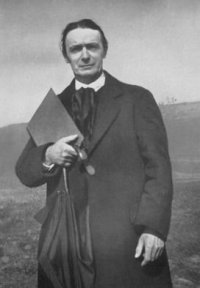
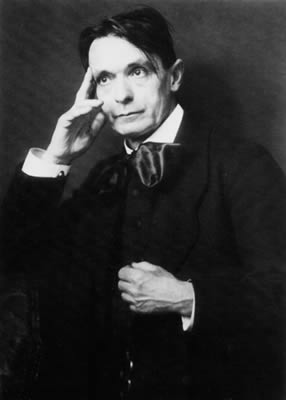
Rudolf Steiner was born February 25, 1861
Rudolf Steiner: "Some people are destined by karma to announce prophetically what all of humanity will gradually, bit by bit, accept as the meaning of an epoch."
Rudolf Steiner: "Whoever does not believe in all humility that his wisdom is the sum of all wisdom – that his judgement represents the highest judgment – will soon be able to observe that there are people apart from himself who have more wisdom and judgment [than himself], and he will listen to these beings and allow himself to be instructed by them. He will, when he gains some insight, become aware that he still has a path to follow that others have gone long before him. The more understanding a person obtains, the humbler he becomes. The clearer the realization how much he still has to learn, the more he will be inclined to find those he can still learn from. Anyone who thinks that he has nothing to learn from others only proves thereby that he or she has still not advanced very far. The more advanced a person is, the more he comes to recognize that human beings are on different levels of development and that there have always been those who were more advanced than their brethren – the spiritual leaders of humanity who are more advanced in their development, the highly developed, the most advanced individualities of humankind."
This is what reading Rudolf Steiner is like
The Gospel of Thomas, Saying 8:
And he said, "The one is like a wise fisher who cast his net into the sea and drew it up from the sea full of small fish. Among them the wise fisher discovered a fine large fish. He threw all the small fish back into the sea, and with no hesitation picked the great good fish. Whoever has ears, listen!"
Here's a thought experiment: If you could send a message to your 12-year-old self, and you were limited to 2 words, what would your message be? For me the answer's easy: "Rudolf Steiner"
Steiner! Steiner! and more Steiner! always more Steiner!
The name of him whom Providence has chosen That wondrous things on Earth he should achieve, Whom I may often praise, though ne'er sufficing, Whose destiny we scarcely can believe, His name — it is Humanus, Saint and wise one, The best of men whom I did e'er perceive: --from "The Mysteries" by Goethe
My dear friends! A whole group of new members of this school have arrived here today, and so I am obliged to say at least a few words once again to convey something of the principles of this school.
The first thing to be said about this school is that it forms the esoteric aspect of the existing Anthroposophical Movement, which with the Christmas Conference here at the Goetheanum has been newly reestablished. Earlier there were a few esoteric circles at the Goetheanum. All these esoteric circles must by and by come into this school, for it certainly has occurred that with the Christmas Conference a new spirit has come into the Anthroposophical Movement, insofar as it streams through the Anthroposophical Society.
I have also just spoken the words abroad, in recapitulation, which should point out the difference between the Anthroposophical Movement before Christmas, and what we now have since Christmas. Previously the Anthroposophical Society was a sort of administrative body for anthroposophical teachings, for the substance of Anthroposophy. Since Christmas it is different. Now it does more than merely foster Anthroposophy in the Anthroposophical Society. Now it is constituted so that Anthroposophy is actually done, which means that all things that flow through the Anthroposophical Society bearing on operations and ideas are constituted so as to be anthroposophical through and through.
What has happened with this renewal, my dear friends, must be taken in with sufficient depth, and fundamentally must be taken in with deepest sincerity. The renewal will then allow a differentiation between the Anthroposophical Society in general, and this esoteric school within the Anthroposophical Society. In keeping with the principle of openness that was established at the Christmas Conference, the Anthroposophical Society will of course require no more of its members than that they stand honestly by whatever Anthroposophy is, that they are, we might say, listeners to Anthroposophy, and that they make of this Anthroposophy whatever they can with their hearts and souls.
It is quite different within the school. Whoever enters this school, declares thereby that as a member he will be a true representative of the Anthroposophical Movement. And in this esoteric school, that eventually will be expanded into three classes, in this esoteric school the freedom implicit for every member of the anthroposophical community most certainly must be made to rule. Also, for the directorate, the Executive Council at the Goetheanum, 1 whose members answer for the school, full freedom must rule.
Being a true member of this school entails that in whatever matters a member is engaged with in daily life, that an anthroposophical approach is displayed to the world. And the Goetheanum Executive Council, as it appears to them, must be able to decide whether a member, not being able to be a representative of the Anthroposophical Movement, should therefore be stricken from the membership of the school. It must be a two-way relationship.
In the future, in the holding and handling of this school, a certain spirit must be engaged, a spirit that is ever more and more serious and in a certain sense stronger. Otherwise, we just cannot progress further with the Anthroposophical Movement. We ourselves must really feel it within the school, especially if we have a chance to enhance and strengthen Anthroposophy. There will be hard times ahead for Anthroposophy, and so the members of the school must know the difficulties that they have taken upon themselves. They are not simply devoted to Anthroposophy, but are members of an esoteric school.
And it must be seen as a commitment, a most inward commitment, that the operation of the Executive Council, as it is presently constituted, is seen in its esoteric substance. This must ever more and more come into the awareness of the members, which has not yet happened. It must happen. It must come to be generally known. And it says a lot, that at this time an Executive Council has come into being out of the esoteric.
What is certainly being pointed out, is that all of those who rightfully regard themselves as members of the school, should see the school as having been founded not by men and women, but rather by the will of the present-day ruling spiritual powers of the world. The school should be seen as having been put in place by the spiritual world, and should be seen as the meaningful work of the spiritual world, the spiritual world that not only feels somewhat responsible for it, but the spiritual world that feels responsible for it in the strongest sense. Therefore, whoever does not take this School seriously, and does not carry it within when involved in daily activities, without fail, for such a member, who does not take the matter seriously, his membership must be stricken.
Actually, lassitude to a very great degree has infiltrated the Anthroposophical Society in the last few years. To remove this forever is to be one of the many functions of this school. We should feel ourselves to be responsible for the words that we speak, we should before all things feel responsible for them, so that every word we speak, in the most serious sense, has been so fully verified by us, that we can represent it as truth. For untruthful statements, even when coming forth with good will, will work destructively within an occult movement. There must be no deceit about this, but rather the fullest clarity must reign. It comes down to this, the intention is not to allow it to wash lightly over a person, but the intention is to arrive at the absolute truth. And among the first responsibilities of a student of the esoteric, is that he not only feel a commitment to relate what he believes to be the truth, but that a commitment is felt to verify that the things that are said are actual objective truths. For only when (in the sense of objective truth) we have won godly spiritual might, the strength of which runs through this school, will we thereby be able to steer our way through all the difficulties that will beset Anthroposophy.
One should also not fail to attend to what is happening in the external world. Now please, my friends, whatever is spoken in the environs of the school should remain within the environs of the school. Yet I tell you that even within the environs of the school, one may not forget the sorts of things that are being discussed by authoritative personalities, such as the following: “Those who represent the principles of the Roman Church will be doing their utmost in the near future to make the individual states of the former German Empire independent,” and I am merely reporting, “so that out of these independent states, with the exclusion of Prussia, the Holy Roman Empire of the German Nation can once more be established, which in turn, having been established out of such a prominent quarter, will of course spread its influence over neighboring regions.” These persons say that they will have to do this in order to destroy, in root and branch, those movements that are most dangerous and frightful. They add that if they fail to reestablish the Holy Roman Empire of the German Nation, then they will find other means by which to destroy in root and branch those most contrary, those most dangerous movements. The movements they are referring to are the Anthroposophical Movement and the Movement for Religious Renewal.
I am quoting them almost word for word. And you should see, from what I say time and again, that the difficulties will not become smaller, but rather every week greater, and that what I say is built through and through on a firm foundation. I would like you to take this to heart at once, by bringing an earnest heart-felt quality to what you become acquainted with as members of this school. Only when we are members of this school openly, fully, in earnest, and actively, will we be able to reach the bedrock that is absolutely necessary, if we are to make it through the difficulties of the future.
You may conclude from this that opponents will take Anthroposophy, and its branch Religious Renewal, much more seriously than many already ensconced as members. For when one becomes aware of the intention of reconstituting the broken-up Holy Roman Empire of 1806, and the implication that it is in order to dispose of our Movement, then one must take the matter very seriously. In a movement grounded in the spirit, it really and truly does not matter, my dear friends, just how many members are in the movement. What does matter is the sort of strength living within, strength that has come out of the spiritual world. The opponents know that this sort of strong force dwells within our Movement, so don't enter into it lightly, but with sufficient strength and firmness.
Now, my dear friends, the content of these class-lessons has essentially been drawn from those things which can be imparted about meeting with the Guardian of the Threshold, and what this meeting with the Guardian of the Threshold on first encounter, on first experience signifies for the attainment of truer, more genuine supersensible insight, of actually knowing. Today I would like to add a few remarks to what we have already been looking into.
It is not easy to present to someone that the meeting with the Guardian of the Threshold can really happen, if the person has not had the experience of knowing what it means for their human nature to be in the "I am” and their astral body to be outside of the physical body. For if a person's essential being is closed up within the physical body, he can only take whatever is in his vicinity as the truth, when it has been verified through the apparatus of the physical body. And through the apparatus of the physical body, the sensory world can only come to be taken as a reflection of the spiritual world, which initially is not disclosed through the senses, but is merely reflected.
Now in general, it is not so difficult to leave one’s body. It is done every time one goes to sleep. A person is then outside of his body. But when outside of his body in the state of sleep, then his awareness is also quenched to the point of unconsciousness. Only illusory dreams, or perhaps also dreams that are not illusory, surge up out of this loss of consciousness. It is part of the subject matter of the attainment of higher awareness, however, to leave the physical body with fully aware-self-possession, so that external to his physical body one may perceive around about himself, just as within his physical body with the help of the physical senses he perceives the physical world. And he partakes then, outside of his physical body, of the spiritual world in truth.
Initially, however, a person just sleeps without awareness. Under ordinary conditions it is not given to us to know what could be seen when outside of one’s body. And this specifically is due to a person being protected from coming upon the spiritual world unprepared.
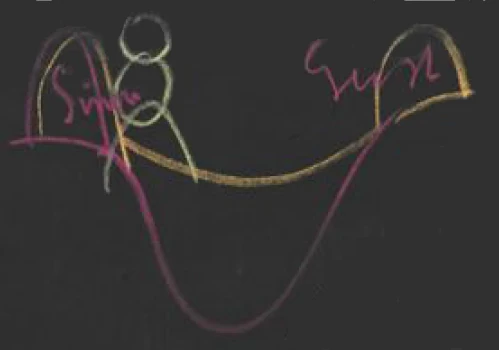
If and when a person is sufficiently prepared, what happens with him then? Then, when the person steps up to the abyss between the sensory world and the spiritual world [It was marked in red.], when the person has been found to be prepared, as has been pointed out in the last lesson, then the Guardian of the Threshold takes the true individuality of the person out and beyond, allowing over-flight of the abyss [It was marked in yellow.], under the agency of what has been delineated in the foregoing mantric verses. And for the first time, from the other side of the Threshold, a person can then observe his own sensory being, his physical being.
Such is the first grand impression of true experience, my dear friends, when the Guardian of the Threshold can say to a person, "Look over there, there you are, so you appear to the outside while within the physical world, but with me, you appear in your innermost being."
And then resounding again and again from the Guardian of the Threshold is a significant word. For now, it resounds from the Guardian of the Threshold out over the abyss, this significant word, in calling out to the person, for him to retain his presence of mind when he looks upon himself quite differently from the other side of the abyss. And he does look upon himself quite differently. He beholds himself as threefold. [It was marked in green.] 2
Mind — Spirit
He beholds himself in his threefold nature, expressed in soul in thinking, in feeling, and in willing. There are actually three people, the thinking person, the feeling person, and the willing person, all of which have been stuck into each person, and for the time being are really only drawn together in the physical world through the physical body. And all this, that the person looks upon, is intoned by the lips of the Guardian of the Threshold in the following manner.
O show the three They are the one, When you bear the stamp of man In existence-awareness on the earth.
Or it could be the human stamp, for one must of course translate the words from the occult speech.
O show the three They are the one, When you bear the stamp of man In existence-awareness upon the earth.
Experience the head’s world-gestalt Feel the heart’s world-beat Think the limb’s world-strength
They are the three, The three, that live as one In existence-awareness upon the earth.
[The mantra was now written on the board.]
O show the three They are the one, When you bear the human stamp In existence-awareness upon the earth.
Experience the head’s world-gestalt Feel the heart’s world-beat Think the limb’s world-strength
They are the three, The three, that live as one In existence-awareness upon the earth.
The Guardian of the Threshold points out here how the three, which separate from one another as soon as the person leaves his physical body, how the three appear in relationship to this physical body. The gaze is directed out upon the physical body, upon the head, the heart, the various members of the body, and as said by the Guardian of the Threshold, "When you in actual truth behold the human head, this human head will be an image of the heavenly universe. You must gaze out upon the far-flung depths that seem to border on and to define the world, and realize it is not so, your physical one-sided envisioning of it, you must gaze out and on, and in your gazing out and on, you must remember that your head, in its roundness, is really a truthful image of the surrounding heavenly world.” And one may connect to this here and now by bringing into awareness the mantric verse.
Experience the head’s world-gestalt
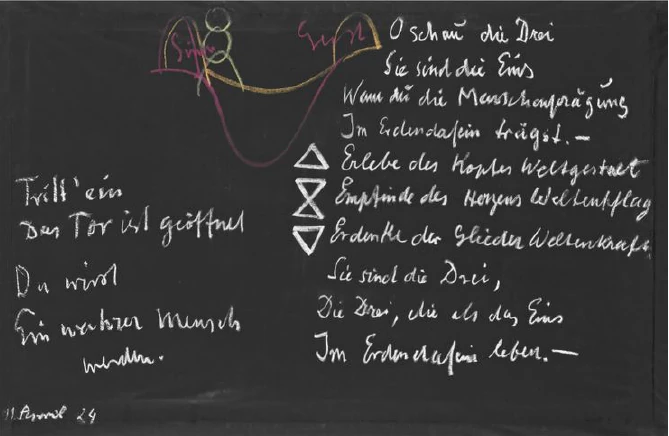
One connects outwardly through the symbol of a triangle pointing up. [It was drawn before the line.]
Through this symbol, as one pauses at this line of the mantric verse, you send your attention to the wide-open space above, and take note that everything around and about the earth is certainly part of this wide-open space above. You send your attention out and make it all an immediate presence.
Feel the heart’s world-beat
Through this cosmic-heavenly presence flows the rhythm of the world, resounding as music of the world. When we feel the human heart beating, it seems as though this human heart is merely beating out upon all that passes before the human organism. In reality, what beats in the heart is a harmonious counterpoint to what has been circling as world-rhythm for not merely a thousand years, but a million years. Hence one again pauses, as the Guardian of the Threshold speaks accordingly the words "Feel the heart’s world-beat" and one senses, finds with empathy, feels what takes effect both in the heart and all around and overhead. [Now the symbol ⧖ of a down-pointing and an up-pointing triangle connected at the tips was drawn before the second line.] The triangles in this diagram join all that is below with all that is overhead.
Think the limb’s world-strength
This world-strength is the one in which gravity and the other earthly forces are concentrated and rise from beneath. In our thinking, that is, insofar as it is earth-thinking, adapted merely to grasping the earthly, we must gaze down and under, then we grasp the things that stream out of the earth working effectively in men and women. Again, one pauses by the "Think the limb’s world-strength” in a triangle facing downward. [▽ was drawn before the third line of the stanza.]
head — heart — limbs
And one will feel the character of the word of the Guardian, how it should work today on the human heart, on the human soul, if one allows this mantric verse in commensurate manner to come alive within and to work effectively.
O show the three They are the one, When you bear the stamp of man In existence-awareness upon the earth.
One says the following verse while rendering the up-pointing triangle symbol △ before the head:
△ Experience the head’s world-gestalt
One says the next verse while rendering the connected up and down symbol ⧖ before the chest.
⧖ Feel the heart’s world-beat
One says the last verse while rendering the down-pointed triangle symbol ▽.
▽ Think the limb’s world-strength
These are the three, The three, that live as one In existence-awareness upon the earth.
And one tries, after having allowed this mantric verse to work on his soul, to blunt the senses, to close the eyes, to hear nothing with the ears, to perceive nothing, and to remain in the dark for a while, that one might live fully and completely in the atmosphere of what sounds through the words. And in this manner, a person will place himself in the sphere in which initiation into all reality can then be experienced. In undertaking this, a person may take the first step beyond the Threshold.
But one must allow the profound word of the Guardian to work upon him fully and in earnest. This profound word of the Guardian speaks of everything, the moment we cross over the Threshold, of everything being different than it is in the sensory world. In the sensory world we think that thoughts, that ideas are predominant in people. This is the way it is in the sensory world. By itself this predominance of envisioning, of thinking, which is perceptible to customary awareness as well, is always intermixed with a bit of willing. Always in stepping from one thought to another, we must be using our will, as we do when we bring an arm into motion, or a leg into motion, or in doing just about anything we wish to do. But it is easy and refined, this willing that carries one thought on to the next. And so it is, when we are in the sensory world, the two are bound together, the predominance mostly of thinking with a little bit of willing, an easy willing. Yet as soon as a person comes across over the Threshold and comes before the Guardian, it will be quite the opposite, for there the bundled predominance is mostly of far-flung will and minimally of thinking. And in this willing that is otherwise sleeping in people, one catches in it a scent of the spirit, for the human head is constituted out of the cosmos, out of the heavenly world, a spherical copy in all particulars.
Hence the Guardian of the Threshold, when we have crossed over to the other side of the Threshold, calls out the following words. [A new part of the mantra was written on the board forthwith.]
The head's spirit, You can will it;
And now one sees that willing is something quite different than it was previously. Previously the senses facilitated sensory perceptions, mediated sensations, and one had no awareness of will coursing through the eyes, of will coursing through the ears, of will coursing through the sense of warmth, of will coursing through every sense. Now, one sees that of all that the eyes sense as manifold colors, that the ears hear as manifold tones, that a person discerns as warmth and cold, as the difference between coarse and smooth, as odors, tastes, et cetera, that all this, all in the spiritual world is a sort of willing. [The mantra was continued on the board.]
And willing becomes for you Sensing’s many-formed heavenly weaving;
If a person has come to know this by looking back at his head from the other side of the Threshold as willing becomes predominant, [The verb "willing" in the second line of the mantra was underlined.] how the mind sets willing in place there, [The word "willing" in the third line of the mantra was underlined.] then he would furthermore know, how the heart harbors the soul, and how he can feel the soul in his heart, just as he can will the head's spirit correspondingly in the head. And then he knows for the first time, when he regards thinking not as a capacity of the brain, but rather as an capacity of the heart, of the soul of the heart, how thinking belongs not to an individual person, but rather to the world. Then he experiences world living, circling around as world music. [The second stanza was begun on the board.]
The heart's soul, You can feel it; And feeling becomes for you Thinking’s seed-awakening world living;
You live in glory, not in soulless semblance of glory, but rather in the glory of the glow of the being of the world. [The summary lines of the first and second stanzas were now written, as the first stanza was once again spoken.]
The head's spirit, You can will it; And willing becomes for you Sensing’s many-formed heavenly weaving;
Summarized in the final line:
You weave in wisdom.
Summarized, bearing on the heart's soul, on feeling, in the sentence:
You live in glory.
[The words "wisdom" and "glory" were underlined.]
Just as a person gets to know the mind as a willing, so he gets to know feeling as a thinking in regard to personal presence and awareness in the world, if from the other side he observes the three, which only in the sensory world are one. [In the second stanza “feel” and "feeling" were underlined.]
And the Guardian continues in the third section. [The third stanza was begun on the board.]
The limb's strength, You can think it;
Now we have the full reversal. On the other side a person maintains a concentration in the head of something else than thinking, for willing is here [The first stanza was indicated.], as I have just explained, concentrated in the head. Feeling remains in the heart, where it is also felt in the sensory world, for the inner force of the heart continues on in the spiritual world,
The limb's strength, You can think it;
["Think" was underlined.]
On the other side, thinking is brought together directly with the limbs, which is quite the reverse in the sensory world. [The writing was continued.]
And thinking becomes for you Willing’s goal-directed human striving;
And the will does this for thinking. ["Thinking" was underlined. The writing was continued and the word "virtue" was at the same time underlined.]
You strive in virtue.
And so, we have the full reversal in the spiritual world, by means of what the Guardian of the Threshold has said to us. While not being able to differentiate willing, feeling, and thinking while a person looks up from down under, it is differentiated as a trinity when the person looks on it from the other side, willing up at the head, feeling in the middle, and thinking down among the limbs.
In this way one becomes aware that what is willed, concentrated in the head, is wisdom woven into the world, in which all the beings of the spirit stream forth, and that thinking, seen in the extremities, is human striving, that can live as human virtue. And the three appear before the spiritual gaze:
The head's spirit, The heart's soul, The limb's strength.
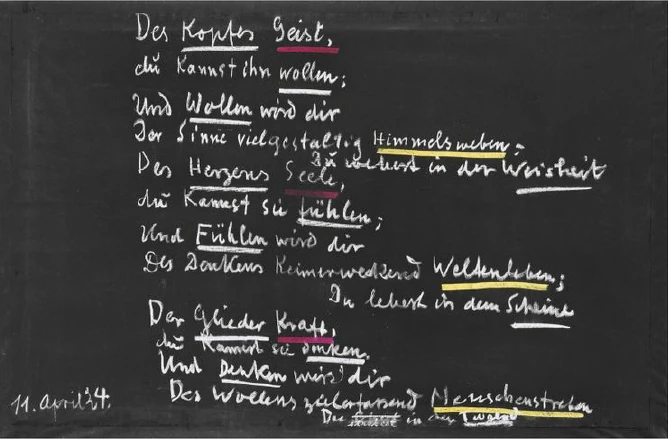
[At the same time the words on the board "head's", "heart's", and limb's" were underlined in white, and the words "spirit", "soul", and "strength" were underlined in red.]
In this way the mantric verse is built. And a person must be aware of the inner congruence, more than aware, for as it floods into him, he must allow the mantric verse to work on him:
heavenly weaving world living human striving
[Forthwith were these three word-groups underlined on the board in yellow.]
These are the words of the Guardian of the Threshold, in which the three, emerging from the one as we cross over into the world on the other side of the Threshold, the three are guided into our mind's eye.
The head's spirit, You can will it; And willing becomes for you Sensing’s many-formed heavenly weaving; You weave in wisdom.
The heart's soul, You can feel it; And feeling becomes for you Thinking’s seed-awakening world living; You live in glory.
The limb's strength, You can think it; And thinking becomes for you Willing’s goal-directed human striving; You strive in virtue.
These are the impressions through which the soul must sift, if real insight, real inward knowing is to be attained, resounding in the admonitions of the Guardian of the Threshold, as he also says to us:
Enter The door is opened 3 You will 4 become A true human being.
[It was written on the board.]
Enter The door is opened You will become A true human being.
And these are the words, that for countless thousands of years, that yawn at all portals to the spiritual world, and at the same time, that resound spiritedly:
Enter The door is opened You will become A true human being.
Imagine, my brothers and sisters, 5 saying to yourselves at once, "I will take these words of the Guardian of the Threshold seriously; I will know that I was not yet human; I will know that I become so through insight into the spiritual world." Imagine, my brothers and sisters, saying to yourselves a second time, "Why, the first time I did not take these words seriously enough; I will tell myself that I need twice as many steps, from my present state of being, not being a true human being, in order to become a true human being." Imagine declaring to yourselves a third time, "I will know that I need three steps, from the spot on which I stand, not being a true human being, in order to become a true human being."
Serious is the first admonition that you give to yourselves. More serious is the second admonition. But the stamp of highest seriousness must be borne by the third admonition. And when you know how to bring this trinity in three-fold seriousness into the depths of your souls, then you will have an inkling of what it means for a person, through insight, through actual inwardly knowing, to become a person. And then you will have come full circle, as we have in this class today, coming full circle to the first admonition, all of which should live in our souls as one self-transmuting verse.
O show the three They are the one, When you bear the stamp of man In existence-awareness upon the earth.
△ Experience the head’s world-gestalt ⧖ Feel the heart’s world-beat ▽ Think the limb’s world-strength
These are the three, The three, that live as one In existence-awareness upon the earth.
Just so, my brothers and sisters, it has sounded just so in the heart, since there has been human existence on the earth, struggling for awareness. There has been a pause in this struggle since the emergence of the fifth post-Atlantean cultural epoch. This pause is at an end, by will of the heavenly, spiritual entities leading mankind. May it once again commence in a worthy manner. In your human hearts may it sound again. So the wise leaders of mankind, ever since there has been human existence upon the earth, have guided human hearts into glimpsing what works as spirit in the world, what works as spirit through the world in human beings, as the crown of the world.
Blackboard (left side)Blackboard (right side)
Blackboard Text for the Seventh Lesson
O schau die Drei Sie sind die Eins, Wenn du die Menschenprägung Im Erdendasein trägst. Erlebe des Kopfes Weltgestalt Empfinde des Herzens Weltenschlag Erdenke der Glieder Weltenkraft Die sind die Drei, Die Drei, die als das Eins Im Erdendasein leben
Des Kopfes Geist, Du kannst ihn wollen; Und Wollen wird dir Der Sinne vielgestaltig Himmelsweben; Du webest in der Weisheit. Des Herzens Seele, Du kannst sie fühlen; Und Fühlen wird dir Des Denkens keimerweckend Weltenleben; Du lebest in dem Scheine. Der Glieder Kraft, Du kannst sie denken; Und Denken wird dir Des Wollens zielerfassend Menschenstreben; Du strebest in der Tugend.
Tritt ein Das Tor ist geöffnet Du wirst Ein wahrer Mensch werden.
O show the three They are the one, When you bear the stamp of man In existence-awareness upon the earth. △ Experience the head’s world-gestalt ⧖ Feel the heart's world-beat ▽ Think the limb’s world-strength These are the three, The three, that live as one In existence-awareness upon the earth.
The head's spirit, You can will it; And willing becomes for you Sensing’s many-formed heavenly weaving; You weave in wisdom. The heart's soul, You can feel it; And feeling becomes for you Thinking’s seed-awakening world living; You live in glory. The limb's strength, You can think it; And thinking becomes for you Willing’s goal-directed human striving; You strive in virtue.
Enter The door is opened You will become A true human being.
Rudolf Steiner: "Apart from all that one can notice externally, these destiny-burdened events constitute a warning sign, a warning sign not to keep to that which the last centuries have brought up as materialism in humankind, a warning sign to turn on the developmental path of humankind. What is experienced in blood and death should be felt as if it was sent from the gods to Earth to teach us how necessary spirituality is for the further development of humankind."
During these last days we have taken leave of a dear friend and loyal collaborator who has left the physical plane, Herman Joachim. He could be seen here in our circle practically every week during the war years. When we contemplate the event of death of someone near to us—filled with sentiments engendered by knowledge which we seek through spiritual science—we may find through this event also our own relation to the spiritual world. We look back on the one hand to the time we were privileged to share with him, but we also look forward into that world which is receiving the soul of the one with whom we were together. We remain united with him, for the bonds that bind us together are spiritual and cannot be severed through the event of physical death.
The name Herman Joachim is like a beacon, throwing its light far and wide, ahead of the one we have lost as far as the physical plane is concerned. It is a name that is very much connected with the development of art in the 19th century; particularly in the sphere of aesthetic interpretation of music. Indeed there is no need for me to explain here what this name stands for in recent cultural achievements. However, if Herman Joachim—who has gone into the spiritual world with all his incomparable and beautiful qualities—had come among us as someone unknown, even then, those whose good fortune it was to know him and share with him their endeavours, would have counted him among the most valuable personalities of their lives. The strength of his personality, the greatness and radiance of his soul would ensure it.
There came to expression in his human relationships with others a cultural artistic quality of a high order, passed on to him from his father. One could say that on the one hand this artistic influence came to expression in everything Herman Joachim thought and did, but it was carried and enhanced by the spirituality of his own will, his own feelings and by his striving for spiritual insight. While his father's great influence held sway in the blood so was there something in Herman Joachim's spiritual makeup which had a beautiful beginning in his life by the fact that Herman Grimm—this distinguished and unique representative of Central European cultural life—held his hand in blessing over him when a child. For Herman Grimm was godfather to Herman Joachim. I was very pleased to learn this as you will understand after the many things I have said, especially in this circle, in appreciation of Herman Grimm's contributions to cultural life in recent times. When a dear friend of his, the unique personality Walter Robert Tornow died, Herman Grimm wrote: “He departs from the society of the living and is received into the society of the dead. One feels one ought to announce to the dead just who it is that joins their ranks.” Herman Grimm did not intend these words to apply only to the one for whom he spoke them. He meant them in the sense that they express a feeling which is present in human beings in general, when someone near departs from the physical into the spiritual world.
When we look back to characteristic experiences which we were privileged to share with someone who has died, then these experiences become windows through which we can follow the further life of a now infinite being. For every human individuality is an infinite being and the experiences we shared can be compared to windows through which we look out on an unlimited landscape. However there are moments in a human life which are of special significance, it is then possible to look deeper into a human individuality. In such moments the secrets of the spiritual world reveal themselves with particular power. It is also in such moments that much of what in ordinary life is the goal of noble, intense striving, is revealed in comprehensive thought pictures permeated with feeling.
I venture to describe a moment of this kind because I consider it symptomatic of Herman Joachim. He had been connected with our movement for years when in Cologne, not long after we had become personally acquainted, we had a conversation. During this conversation it was revealed to me how this man had related his innermost soul to the spiritual powers which live and weave through the cosmos.—Perhaps I can put it in these words: I was able to recognize that he had discovered that there is an important link between responsible human souls and those Divine-spiritual powers whose wisdom governs worlds. In significant moments of his life an individual may come face to face with these powers. In such moments when he puts to himself the question: How do I unite with the world-guiding spiritual powers that are revealed to my inner sight? How can it become possible for me to think of myself as a responsible link in the world's spiritual guidance which, in my innermost self, I know I am meant to be?—Thus it was revealed to me what Herman Joachim consciously felt and experienced with all the deep seriousness of his being in such moments when man's relation to the spiritual world becomes manifest to him.
Herman Joachim had gone through many difficulties. When this endless calamity under which we all suffer broke out* it brought him great hardship. He was in Paris where he had lived for years and where he had found his dear life companion. But now his duty obliged him to return to his former profession as a German officer. Nevertheless it was a duty with which he also had a deep inner connection. He had already fulfilled his task as officer on important occasions, doing his duty not only with expertise but with compassion and self-sacrifice. There are many who have grateful memories because they have benefitted from the true humaneness and social friendliness with which he fulfilled his calling. For myself I often remember the conversations we had during these three years of grief and human suffering, conversations in which he revealed himself as a man who was able to follow with far-reaching understanding the events of our time. There was no question of his objective judgement being clouded by thoughts of either hatred or love for the one or the other side. His intelligent assessment made him fully aware of the gravity of the situation facing us all. Nevertheless, because of his trust in the spiritual guidance of the world he was full of hope and confidence.
Herman Joachim belongs to those who accept spiritual science in a completely matter-of-fact way as something self-evident; while at the same time this matter-of-factness protects them from superficial surrender to anything of a spiritualistic nature. Such souls are not easily led astray into what can be the greatest danger: fanciful illusions and the like. After all, such illusions have their roots in a certain self-indulgent egoism. Herman Joachim had no inclination whatever towards egotistical mysticism but all the more towards great ideals, towards powerful, effective ideas of spiritual science.
He was always concerned about what each individual can do in his own situation in life, to make spiritual science effective. As a member of the Freemasons he had looked carefully into the nature of masonic practices and had resolved to do all he could to bring the life of spiritual knowledge into masonic formalism. His high position within Freemasonry enabled him to make his own, to an exceptional degree, all the profound but now formalized and rigidified knowledge accumulated over centuries. Just because of his high position he saw the possibility to bring the life and spiritual power which can only come from spiritual science into this rigidified knowledge. His aim was to enable it to enter rightly into the stream of human culture. Anyone who is aware how hard he worked towards this goal during these difficult years, how he pursued it with earnestness and integrity; anyone who realizes the strength of his will and the volume of his work in this sphere will also know how much the physical plane has lost with Herman Joachim.—I am often reminded in cases like this of someone, regarded as belonging to the intelligentsia, who is recorded as saying: No man is irreplaceable; if one goes, another steps forward to take his place. It is obvious that such an expression reveals a gross ignorance of real life; for real life shows in fact the opposite. The truth is rather that in regard to what a man accomplishes in life no one can be replaced. This truth strikes us all the more in exceptional cases such as the present one. The death of Herman Joachim strongly reminds us of the working of karma in human life. Only an understanding of human karma, the comprehension of the great karmic questions of destiny, enables us to come to terms with the death of someone, at a comparatively early age, leaving behind an important and necessary life task.
I have followed day by day the soul of our dear friend slowly leaving this realm, in which he was to accomplish so much, and entering another realm where we can find him only through the strength of our spirit, a realm from which he will be an even stronger helper than before. During this time of taking leave I was strongly aware of something else; namely, that human beings themselves demand the necessity of karma; demand it with all their inner courage and strength of spirit. It becomes evident to one's inner sight when experiencing a death of this kind. In these circumstances things must often be spoken of which can be spoken of only in our circles, but then, it is also within our spiritual movement, that human beings can find the great strength which reaches beyond death, the strength that encompasses both life and death.
Herman Joachim's soul stands clearly before me. So it stood clearly before me when, out of his own free will, he took on a spiritual task. And it comes vividly before me how he is taking hold of this task now. His death is revealed to me as something he freely chose because, from that other world his soul is able to work more actively and with stronger forces; forces more appropriate to what is necessary. Under these circumstances one may even speak of the death of an individual as a necessity, as a duty, at a quite specific moment. I know that not everyone will find what I am saying a consoling or a strengthening thought; but I also know that there are souls today to whom these thoughts can be a support when they are faced with the kind of difficulties which in our time must be endured with pain and sorrow, difficulties that one comes up against when trying to solve important and necessary tasks, difficulties that arise from the fact that we are in the physical world, incarnated in physical bodies in a materialistic environment. Yet in all our pain and sorrow we may gradually come to value the thought that death, as far as the physical plane is concerned, was chosen by someone in order to be better able to fulfill his task.
We may balance this thought against the pain which our dear friend, the wife of Herman Joachim, is suffering. We may balance it against the pain we ourselves feel over our dear friend, we may attempt to enoble our pain by thinking of him in the light of a sublime thought such as the one I have just put before you. This thought may not ease or tone down the pain, but its spiritual insight can shine like a sun into the pain and illumine our understanding for the necessity that governs man, the necessity of human destiny. Thus the event of the death of someone near to us can become an experience which brings us into contact with the spiritual world. For if our thoughts about him strengthen our soul's propensity towards the realms in which the departed sojourns then we shall not lose him; we shall remain actively united with him. Furthermore, if we grasp the full implication of the thought that someone who loved his life more than most, nevertheless accepted death because of an iron necessity, then that thought will truly express our spiritual-scientific view of the world. If we honor our friend in this way we shall remain united with him. And his life companion, left here on the physical plane, shall know that we remain united with her in thoughts of the loved one; that we, her friends, remain close to her.
The death of our dear friend Herman Joachim is one of several bereavements suffered within our society during this difficult time, one which was for me especially sad, one I have not yet been able to speak about. The great personal loss and close involvement prevents me from touching on many aspects of this bereavement.
A great many of those present will remember with love a dear and loyal member whom we have also lost from the physical plane in recent months, Olga von Sivers, the sister of Marie Steiner. She was not a personality one would come to know immediately at first encounter; she was a thoroughly modest and unassuming person. But my dear friends, setting aside the pain Marie Steiner and I suffer over this irreplaceable loss I venture to say something else about Olga von Sivers. She belongs to those among us who, from the beginning, went straight to the root of our anthroposophically oriented spiritual science. She took it up with deep understanding and warmth of soul. When Olga von Sivers devoted herself to such matters she did so with her whole being for that was her nature. And she was indeed a human being in the fullest sense as everyone connected with her will know. She strongly rejected everything which nowadays, as a kind of mystical Theosophy, distorts man's inner path and leads spiritual life into wrong channels. She had a keen sense of discernment when it came to distinguishing between those spiritual impulses which belong to our time and advance man's inner progress; and others which arise from quite different impulses. The latter are often disguised as theosophical or other mystical striving. Olga von Sivers is an outstanding example of someone taking hold, in a fundamental way, of the spiritual truths which we in our movement especially strive to attain. Despite her full participation in our work it was not in her nature to neglect or disregard in any way the many and often difficult duties imposed upon her by external life. She absorbed the content of spiritual science from the start with complete understanding and was able to pass it on to others. Whenever this was granted her she undertook the task in exemplary fashion. She knew how to endow the ideas she conveyed to others with the kindness and enormous good will of her nature.
Her work continued also when she was separated from us by the frontiers which today so often and so cruelly come between human beings who are close to one another. But no frontiers prevented her from working for our cause also in regions which are now, in Central Europe, considered to be enemy country. She knew tragic experiences, all the horror of this frightful war in which she carried out truly humanitarian work right up to her last illness. She never thought of herself but was always working for others whom the horrors of war had brought into her care. She carried on this Samaritan work in the noblest sense, permeating all she did with the fruits of what she herself had accomplished within our spiritual movement. Although she is closely related to me I venture to speak with deep feeling about this aspect of Olga von Sivers, who, ever since the founding of our movement was a self-sacrificing member. To Marie Steiner and myself it was a beautiful thought that she should be physically with us once more when better times had replaced our bleak present. But here too iron necessity decided otherwise.
This again is a case when death of someone near can clarify and illumine life if we seek to understand it with spiritual insight. Certainly there are things in our society which are open to criticism, often they are things which the society itself brings to light. But we also see all around us other things which are direct results of the strength that flows through our Anthroposophical Movement, things which belong to our most beautiful, loftiest and significant experiences. Today I venture to speak of examples of this kind.
Many of you will also remember someone who, though she did not belong to this branch, I would nevertheless like to remember today because, together with her sisters she often did appear here and will be known to many of you: our Johanna Arnold who not long ago went from the physical plane into the spiritual world. One of her sisters who was equally a loyal and devoted member of our movement died two years ago.
I have in these days been working on a pamphlet to answer the spiteful attacks on our movement by professor Max Dessoir, and I constantly come across statements to the effect that I know nothing of science and that my supporters have to renounce all thoughts of their own.—Well, a personality like Johanna Arnold is a living proof that such statements coming from this ignorant professor are utter lies. Johanna Arnold's deep devotion to spiritual science contributed to the nobility of her life and also to the nobility with which she died. She is indeed a living proof that the most valuable people are among those who recognize and cultivate spiritual science. Her life brought many trials but it was also a life that developed strength of personality and brought out all the greatness of her soul. During the years in our movement she was a vigorous supporter in her branch and neighbouring circles. She did in fact, together with others, a most valuable work throughout the Rhine region. One of the others was Frau Maud Künstler who also died recently. She too was much appreciated and was also intimately connected with our movement.
Not only in her work within our movement did Johanna Arnold give evidence of her strong vigorous character. At the age of seven she, with great courage, saved her older sister from drowning. Part of her life was spent in England. She gave ample proof that not only is life a great teacher but it can also make a soul strong and powerful. Moreover in her case life revealed to her the divine spiritual for which the human soul longs. Through her inner mobility and strength Johanna Arnold became a benefactress to the Anthroposophists whose leader she was. To us who saw the extent of her commitment to our movement she became a dear friend. During these last years since the beginning of this dreadful war—in her attempt to understand what is happening to mankind—Johanna Arnold would ask me significant questions. She was constantly occupied with the thought as to the real meaning of this most difficult trial of the human race and concerned about what each one of us can do in order to go through it in a positive way. None of the daily occurrences of the war escaped her notice. But she was also able to see them in their wider context, bringing them into relation with mankind's spiritual evolution in general. In her attempt to solve the riddle of mankind she made a close study of Fichte, Schelling, Hegel and Robert Hamerling.
There are indeed many examples in our movement which can show how spiritual science affects man's whole life, his way of working, his inner development. And Johanna Arnold is a living proof, if such is required, that it is a blatant lie to say that individual thought must be renounced in our movement. She was looked up to as an example by those who knew her, not only through her devotion and loyalty to our spiritual-scientific movement but also because she sought through earnest independent thinking, to fathom the secrets of man's existence.—I am personally grateful to all those who so beautifully expressed their appreciation at the funeral of our friend. Her sister who is with us today has witnessed within a short time the death of Johanna Arnold as well as that of another sister; to her we would say that we shall remain united with her in loyal thoughts of those who have gone from her side into the spiritual world. We shall cherish their memory and retain a living connection with them.
These thoughts concerning departed friends, linked as they are with sorrowful experiences, also belong to our studies—using the word here free from all pedantry. We know that for the human soul there is survival and new beginning, but does the same apply to the many hopes and expectations we witness that come to nothing especially in our times? Why is it, we may ask, that even those who have a measure of insight into mankind's evolution nurture unjustified hopes and expectations? The answer is that we must nurture them, for they are forces, effective forces. Any doubt we may have as to whether they will be fulfilled should not prevent us from cherishing them because while we do they act as forces and produce effects whether they are fulfilled or not. We must accept it if, for the time being, they come to nothing. How gladly we set our hopes on many a person when he shows the first signs of warm understanding for the spiritual world. One has such hopes despite the fact that in our materialistic age they are often shattered. In recent lectures I have described deeper reasons as to why such hopes are shattered.
In this connection we must be clear that what we call human courage, which we see today in such abundance in many spheres of external life, is very seldom found in relation to spiritual life. This is why the personalities I spoke of today are really models even in regard to more external aspects of our society and movement. It is dawning on many people today that materialism will not do. But what I have often referred to as man's love of ease prevents them from committing themselves to spiritual science. Yet nothing else can save human civilization from plunging into disaster. There are people who are often quite near the point of crossing the threshold into spiritual science; that they do not is basically due to indolence. It is love of ease that prevents them from making their soul receptive and pliable enough to grasp ideas that quite concretely explain the spiritual world. There are many today who enthuse in general about the mystical unity of worlds, vaguely declaring that science alone does not explain everything; faith must come to its aid. But the courage to penetrate earnestly into the descriptions and explanations of the spiritual world that lies at the foundation of the sense world, that courage is greatly lacking.
Last winter I spoke about Hermann Bahr, about his path of knowledge. His latest books, “Expressionism” and the novel “Ascension,” suggested that he was at the point of becoming conscious of the spiritual world. There is no doubt that despite his vacillations and changes of direction he was at last striving towards the spirit. But his very latest writing which he has just sent me is very curious. Its title is “Reason and Knowledge”* and it deals with the way modern humanity, in contrast to former times, relies more on reason when seeking spiritual insight, when trying to understand the World Order. Hermann Bahr begins by asking what reason has achieved. In the 18th Century, striving to develop reason was synonymous with so-called enlightenment which also played a decisive role in the 19th Century. He begins by saying that: “Before the war the West imagined that its peoples shared a feeling of community. They were cosmopolitans or else ‘good’ Europeans. There was the glittering world of millionaires, there were the dilettante and the aesthetes and also the international set, the uprooted vagabonds, spending their lives in sleeping cars and in grand hotels by the sea. And there were the proud communities of scientists and artists. Furthermore we had people's rights, we had humanitarianism. Internationally we shared the fruits of industry, commerce, money, thoughts, taste, morals and humour. All the nations in the West had aims and goals in common. They even thought they had also a means in common by which to attain these shared goals: the means of human reason! The hope was that, through united effort and human reason, mankind would attain what was perhaps beyond the reach of single individuals: ultimate truth. We have been robbed of all this by the war; it has all vanished.”
Thus Hermann Bahr, looking at the state of the world, concludes that modern man places a one-sided emphasis on reason. He recalls an interesting episode in Goethe's life. In Bohemia Goethe observed a strangely shaped mountain, the Kammerbühl and he concluded that the mountain must be of volcanic origin. He was convinced it had been formed in an ancient volcanic eruption. But others did not share his view; they presumed the mountain had originated through sedimentation which had been driven upwards by the force of water. Goethe was unable to convince these people that his assumption was the right one. He felt an inner impulse which convinced him that the mountain was of volcanic origin. The others were equally certain it had come about through sedimentation. This argument suggested to Hermann Bahr that impulses, quite different from reason, influence man's judgments; he saw them as impulses at work behind reason. Hermann Bahr concedes that not everyone is a Goethe; nevertheless, it seems to him that while people think they are following reason they are in fact determined by impulses. Earlier, in the Middle Ages, people were exhorted to have faith, to base their thoughts about the world on faith. But faith has become a mere phrase, it has lost its influence except in aspects of life in which science plays no role. Thus to Hermann Bahr man seems to be determined by his impulses. He asks: What kind of impulses are at work in modern man? He goes on to enumerate some impulses and emotions which delude people into believing they are following solely their reason. He says that Americans for example have a particularly strong impulse towards pragmatism. They want what is useful and practical, hence the famous pragmatism of William James.14 However Hermann Bahr now asks: What has come of this urge toward the useful? He is of the opinion that: “there are two main urges in Western man.” He then points to the much quoted expression that in the Middle Ages science was the handmaid of Theology; looking at modern culture he concludes that reason is certainly not the handmaid to Theology, rather has it become the handmaid of Greed. He then goes into still deeper problems; the individual, he says, cannot exist by himself, he must live in a community. This community is the State in which the individual has his place. This observation inevitably leads Hermann Bahr to ask if, here again, are not emotions the determining factors within the various States? At this point he attempts to link a spiritual element to the individual human soul. This spiritual element he tries to find first in Goethe and Kant; and he finally comes to the following thought: We see inner impulses at work in our lower life, impulses which draw reason along with them. It is therefore not reason which proves to us whether something is true or untrue. We judge things according to our inner impulses, according to what we want them to be. Thus Goethe wanted the Kammerbühl to be of volcanic origin while his opponents wanted it produced by sedimentation. Hermann Bahr came to the conclusion that there must be impulses in man other than those which stem from the lower nature. This thought brings him to the idea of Genius. What is done by a genius is also done out of impulse, but not a lower one. A genius is someone who is influenced by an element of a cosmic nature. However, the word genius almost makes Hermann Bahr split hairs. He consults Grimm's dictionary to get to the bottom of what the word Genius means; he familiarizes himself with what Goethe, Schiller, the Romantics and others, meant by it. He comes to see that the word genius cannot be applied indiscriminately. For example, if it is used to denote the highest impulse in the pursuit of knowledge then all professors would claim to be geniuses and there would be as many of them to venerate as there were professors. Hermann Bahr had no wish for that, so he looks for another way out. He comes to the conclusion that Goethe was quite right in applying the word genius only to a few special individuals. If applicable only to a few then it cannot be considered as an impulse for scientific endeavour. In short Hermann Bahr reaches a point where he senses that the soul of man has a connection with the spiritual world. He says: “You may tear me to pieces but I cannot explain the logical connection between the impact on the human soul of the hymn: ‘Veni Creator Spiritus’ (‘Come Holy Ghost’) and the meaning of genius in the Goethean sense. The connection is there and is sublime, powerful and real, yet I cannot explain it.”
However, there is one thing that Herman Bahr does want to explain; namely, that relying merely on reason does not help; reason as such, he says, does not lead man to truth. He rejects what in the age of enlightenment had been seen as the supremacy of reason, had been seen as reason's ability to explain everything observed and investigated. He wants to dethrone reason for in his view it has become subservient to external trade and technology and it simply follows man's impulses.
One thing these inner impulses of man do demonstrate is how a man like Hermann Bahr is able to reach the portal of spiritual science and then, because of lack of initiative to get to grips with spiritual science he holds back. He remains at the point of view that reason on its own is helpless, faith must step in to guide it. Thus the impulses that are to guide man must come, not from his lower nature but from God. He must receive them through faith. Knowledge must be guided by faith, reason alone can attain nothing. Hermann Bahr makes great effort to find confirmation of this idea. For example he makes an interesting reference to Friedrich Heinrich Jacobi15 who in a letter once expressed the perceptive idea that when it comes to the human soul's ability to grasp truth it is as if it were capable of elasticity, of expansion. This is a very ingenious idea of Jacobi's. I expressed the same thing somewhat differently in my Philosophy of Freedom where I spoke of an organism of thought, wherein one thought grows out of the preceding one. Whenever one arrives at the "elasticity" of man's inner nature, thinking continues, through its own power, the line of thought. When this happens one is experiencing the power of the spirit in one's own soul. Both Jacobi and Hermann Bahr point to the fact that something of a spiritual nature lives and acts in the human soul. What is so remarkable about Hermann Bahr is that he attempts to find in man the higher, the divine man, by demonstrating that reason is subservient to faith. In so doing he denies validity to the very impulse, i.e., reason that governs modern scientific endeavour.
One impulse Hermann Bahr does not discover: the Christ impulse which lives, or at least can live, in modern man. He points to Christ in only one place—two other places where he mentions Christ have no significance—and what he says there does not come from him but is a quotation from Pascal.16 It comes from Cascali “Pensus” when he says that “we human beings only know ourselves through Jesus Christ; that we know life and death only through Jesus Christ; through ourselves alone we know nothing either of our life or our death; nothing of either God or ourselves.”—Here Pascal is pointing to an impulse that comes from within man yet does not stem from himself; i.e. the Christ impulse. To understand it a sense of history is needed, for it has only been on earth since the Mystery of Golgotha.
Thus Hermann Bahr gets no further than Harnack and others. He comes as far as the idea of a universal God who speaks through nature, but not to a living understanding of Christ. This, once more, is an example of someone who is striving for truth yet cannot find the Christ and is unaware that he does not find Him. Hermann Bahr is at pains to show that throughout the evolution of the world man's striving is in evidence. He says beautiful things about Greek and Roman culture and even about Mohammed. The only thing he leaves out is the Mystery of Golgotha. He speaks of Christianity only in a reference to St. Augustine. But no amount of preoccupation with reason and the like can lead to Christ; it can lead only to a universal God. Christ, the God who descended from cosmic heights into earthly life, lives in us as truly as our own highest being lives in us. As Pascal indicated, we can attain knowledge of life and death; of God and ourselves only through being permeated by Christ. This truth can be recognized and understood only through spiritual science.
Goethe did pave the way to spiritual science. But when Hermann Bahr—in order to justify why he finally turned to faith—tries to explain the value of all kinds of statements by Goethe, all he says is: “It will not be necessary for me to testify that I acknowledge the teaching of the Vatican and the views of Goethe and Kant.” Here we see the influence of an external power which at present clearly indicates its intention to increase that power. Yet people remain deaf and blind to the signs of the times; they let what can explain the signs of the times pass them by. Hermann Bahr in his own way is well able to read these signs. He knows of the many things that induce modern man to say things like: “It will not be necessary for me to testify that I acknowledge the teachings of the Vatican and the views of Goethe and Kant.” It is a supreme example of how indolence can make a man come to a standstill in his endeavour. I love Hermann Bahr and have no wish to say anything against him. I only want to indicate what in such a characteristic way can influence a talented and significant personality of our time.
It is easy enough to blame reason, much can be said against it. It can be accused of not leading man to truth. However, blaming reason simply shows that the matter has not been thought through. Sufficient exploration will reveal that it is only when reason is permeated by Ahriman that it leads away from truth. Similarly if faith is permeated by Lucifer it also leads away from truth. Faith is in danger of being saturated with Lucifer, reason with Ahriman. But neither faith nor reason as such lead to untruth or error. In the religious sense they are gifts of God to man. When they follow their rightful path they will lead to truth, never to either error or untruth. Deeper insight reveals how Ahriman comes to insinuate himself into reason and bring about confusion. This knowledge can be obtained however, only by penetrating into the actual spiritual world. To do this requires one to make the effort to grasp the ideas, the descriptions which depict the spiritual world. If man persists in living in arid abstractions he sins against reason and remains ignorant of the fact that through the development of reason in the fifth post-Atlantean epoch man's ‘I’ is to enter the consciousness soul. People talk about man's relation to the spirit like the blind talk about colors. However, no matter how much the ignorant accuse one of contradictions—when speaking from the point of view of spiritual science—it is essential, as already explained, to stand by the results obtained when the spirit is investigated by spiritual means. One has a personal responsibility for the spirit.
This is the kind of responsibility I was able to speak about earlier in connection with special personalities whose example illustrates man's greatness when he feels responsible, not only for his actions, but also for his thoughts and feelings. By contrast you here have someone with no feeling of responsibility; without trying to discover what the present needs, he links onto influences in man's evolution which belong in the past. Consequently Hermann Bahr can say: “If anyone is interested in the path that led me to God, he may refer to my publication ‘Taking Stock’ and ‘Expressionism’ but I must ask the reader not to generalize my personal experiences; they have helped me but may not necessarily help others” and “Should the reader come upon any passage which deviates from the fundamental issue I must ask him to balance it against my good intentions. Any unfortunate ambiguous phrase caused by negligence is against my will and to my regret.” In other words if one simply accepts whatever decree that goes out from the Vatican there is no need to be personally responsible for one's actions.
It may be a good thing when someone openly and sincerely makes such a confession. However what it implies could not be further from the attitude of anthroposophically orientated spiritual science. What Hermann Bahr is confessing actually expresses a fundamental condition demanded by that spiritual stream which is again trying to assert itself. A condition one could sum up by saying: “The authority of the Vatican decrees what the world in general should believe and profess. And I concede from the start that what as a single individual I hold dear, my belief, my view of things are not the concern of the world in general. I may add my voice but only to the extent it finds approval with the Vatican.”
I do not know to what extent it is still fashionable to make confessions of this kind. What I do know is that spiritual science must rest on its own independent research and take full responsibility for that research. It must also accept disillusions and shattered hopes no matter how often they occur, also when they are, as in the case of Hermann Bahr, completely unexpected.
Washed in the Blood of the Lamb are We Awash in a Sonburst Sea You—Love—and I—Love—and Love Divine: We are the Trinity
You—Love—and I—We are One-Two-Three Twining Eternally Two—Yes—and One—Yes—and also Three: One Dual Trinity Radiant Calvary Ultimate Mystery
Total Pageviews
"Whosover drinketh of the water that I shall give him shall never thirst; but the water that I shall give him shall be in him a well of water springing up into everlasting life." ~John 4:14
In the last day, that great day of the feast, Jesus stood and cried, saying, If any man thirst, let him come unto me, and drink. He that believeth on me, as the scripture hath said, out of his belly shall flow rivers of living water. ~John 7:37-38










 Posts
Posts

