Sunday, May 29, 2022

Piercing Nature's Veil of Maya: Butterflies (Memories), Birds (Thoughts), and Bats (Dreams). Michael and the Dragon


 Diagram 1


Man as Symphony of the Creative Word. Lecture 5 of 12.
Rudolf Steiner, Dornach, Switzerland, October 27, 1923:


These lectures deal with the inner connection between appearance and reality in the world, and you have already seen that there are many things of which those whose vision is limited to the world of appearance have no idea. We have seen how every species of being — this was shown by a number of examples — has its task in the whole nexus of cosmic existence. Now today, as a kind of recapitulation, we will again consider what I said recently about the nature of several beings, and in the first place, the butterfly. In my description of this butterfly nature, as contrasted with that of the plants, we found that the butterfly is essentially a being belonging to the light — to the light in so far as it is modified by the forces of the outer planets: of Mars, of Jupiter, and of Saturn. Hence, if we wish to understand the butterfly in its true nature, we must in fact look up into the higher regions of the cosmos, and must say to ourselves: These higher cosmic regions endow and bless the Earth with the world of the butterflies.
The bestowal of this blessing upon the Earth has an even deeper significance. Let us recall how we had to say that the butterfly does not participate in what is directly connected with earthly existence, but only indirectly, in so far as the Sun, with its power of warmth and light, is active in this earthly existence. Actually a butterfly lays its eggs only where they do not become separated from Sun activity, so that the butterfly does not entrust its egg to the Earth, but only to the Sun. Then out creeps the caterpillar, which is under the influence of Mars-activity, though naturally the Sun influence always remains present. Then the chrysalis is formed, and this is under the influence of Jupiter-activity. Out of the chrysalis emerges the butterfly, which can now in its iridescent colors reproduce in the Earth's environment the luminous Sun-power of the Earth united with the power of Saturn.
Thus in the manifold colors of the butterfly world we see, in the environment of Earth-existence, the direct working of Saturn-activity within the sphere of the earthly. But let us bear in mind that the substances necessary for Earth-existence are in fact of two kinds. We have the purely material substances of the Earth, and we have the spiritual substances; and I told you that the remarkable thing about this is that in the case of man the underlying substance of his metabolic and limb system is spiritual, whereas that of the head is physical. Moreover in man's lower nature spiritual substance is permeated with the activity of physical forces, with the action of gravity, with the action of the other earthly forces. In the head, the earthly substance, conjured up into it by the whole digestive process, the circulation, nerve-activity and the like, is permeated by supersensible spiritual forces, which are reflected in our thinking, in our power of forming mental pictures. Thus in the human head we have spiritualized physical matter, and in the metabolic-limb-system we have earthized — if I may coin a word — earthized spiritual substantiality.
Now, it is this spiritualized matter that we find to the greatest degree in the butterfly. Because a butterfly always remains in the sphere of Sun-existence, it only takes to itself earthly matter — naturally I am still speaking pictorially — as though in the form of the finest dust. It also derives its nourishment from those earthly substances which are worked upon by the Sun. It unites with its own being only what is  Sun-imbued; and it takes from earthly substance only what is finest, and works on it until it is entirely spiritualized. When we look at a butterfly's wing we actually have before us earthly matter in its most spiritualized form. Through the fact that the matter of the butterfly's wing is imbued with color, it is the most spiritualized of all earthly substances.
The butterfly is the creature which lives entirely in spiritualized Earth-matter. And one can even see spiritually how in a certain way a butterfly despises the body which it carries between its colored wings, because its whole attention, its whole group-soul being, is centered on its joyous delight in the colors of its wings.
And just as we marvel at its shimmering colors as we follow it, so also can we marvel at its own fluttering joy in these colors. This is something which it is of fundamental importance to cultivate in children, this joy in the spirituality fluttering about in the air, which is in fact fluttering joy, joy in the play of colors. The nuances of butterfly-nature reflect all this in a wonderful way: and something else lies in the background as well.
We were able to say of the bird — which we regarded as represented by the eagle — that at its death it can carry spiritualized Earth-substance into the spiritual world, and that thereby, as bird, it has the task in cosmic existence of spiritualizing earthly matter, thus being able to accomplish what cannot be done by man. The human being also possesses in his head Earth-matter which has been to a certain degree spiritualized, but he cannot take this earthly matter into the world in which he lives between death and a new birth, for he would continually have to endure unspeakable, unbearable, devastating pain if he were to carry this spiritualized Earth-matter of his head into the spiritual world.
The bird-world, represented by the eagle, can do this, so that thereby a connection is actually created between what is earthly and what is extra-earthly. Earthly matter is, as it were, gradually converted into spirit, and the bird-creation has the task of giving over this spiritualized earthly matter to the universe. One can actually say that, when the Earth has reached the end of its existence, this Earth-matter will have been spiritualized, and that the bird-creation had its place in the whole economy of earthly existence for the purpose of carrying back this spiritualized Earth-matter into spiritland.
It is somewhat different with butterflies. The butterfly spiritualizes earthly matter to an even greater degree than the bird. The bird after all comes into much closer contact with the  Earth than does the butterfly. I will explain this in detail later. Because the butterfly never actually leaves the region of the Sun, it is in a position to spiritualize its matter to such a degree that it does not, like the bird, have to await its death, but already during its life it is continually restoring spiritualized matter to the environment of the Earth, to the cosmic environment of the Earth.
Only think of the magnificence of all this in the whole cosmic economy! Only picture the Earth with the world of the butterflies fluttering around it in its infinite variety, continually sending out into world-space the spiritualized earthly matter which this butterfly-world yields up to the cosmos! Then, with such knowledge, we can contemplate the region of the world of the butterflies encircling the Earth with totally different feelings.

Diagram 1

We can look into this fluttering world and say: From you, O fluttering creatures, there streams out something still better than sunlight: you radiate spirit-light into the cosmos! Our materialistic science pays but little heed to things of the spirit. And so this materialistic science is absolutely unequipped with any means of grasping at these things, which are, nevertheless, part of the whole cosmic economy. They are there, just as the effects of physical activities are there, and they are even more real. For what thus streams out into spirit-land will work on further when the Earth has long passed away, whereas what is taught by the modern chemist and physicist will reach its end with the conclusion of the Earth's existence. So that if some observer or other were to sit outside in the cosmos, with a long period of time for observation, he would see something like a continual outstreaming into spiritland of matter which has become spiritualized, as the Earth radiates its own being out into cosmic space; and he would see — like scintillating sparks, sparks which ever and again flash up into light — what the bird-kingdom, what every bird after its death sends forth as glittering light, streaming out into the universe in the form of rays: a shimmering of the spirit-light of the butterflies, and a sparkling of the spirit-light of the birds.
Such things as these should also make us realize that when we look up to the rest of the starry world we should not think that from there, too, there only streams down what is shown by the spectroscope, or rather what is conjured into the spectroscope by the fantasy of the expert in optics. What streams down to Earth from other worlds of the stars is just as much the product of living beings in other worlds as what streams out from the Earth into world-space is the product of living beings. People look at a star, and with the modern physicist picture it as something in the nature of a kindled inorganic flame or the like. This, of course, is absolute nonsense. For what we behold there is entirely the product of something imbued with life, imbued with soul, imbued with spirit.
And now let us pass inwards from this girdle of butterflies — if I may call it so — which encircles the Earth, and return to the kingdom of the birds. If we call to mind something which is already known to us, we must picture three regions adjoining each other. There are other regions above these, and again other regions below them. We have the light-ether; and we have the warmth-ether — which, however, actually consists of two parts, of two layers, the one being the layer of earthly warmth, the other that of cosmic warmth, and these continually play one into the other. Thus we have not only one but two kinds of warmth, the one which is of earthly, tellurian, origin, and the other of a kind which is of cosmic origin. These are always playing one into the other. Then, bordering on the warmth-ether, there is the air. Below this would come water and earth, and above would come chemical ether and light-ether.
The world of the butterflies belongs more particularly to the light-ether; it is the light-ether itself which is the means whereby the power of the light draws forth the caterpillar from the butterfly's egg. Essentially it is the power of the light which draws the caterpillar forth.
This is not the case with the bird-kingdom. The birds lay their eggs. These must now be hatched out by warmth. The butterfly's egg is simply given over to what is of the nature of the Sun; the bird's egg comes into the region of warmth. It is in the region of the warmth-ether that the bird has its being, and it overcomes what is purely of the air.
The butterfly, too, flies in the air, but fundamentally it is entirely a creature of the light. And in that the air is permeated with light, in this light-air existence, the butterfly chooses not air existence but light existence. For the butterfly the air is only what sustains it — the waves, as it were, upon which it floats; but the butterfly's element is the light. The bird flies in the air, but its element is the warmth, the various differentiations of warmth in the air, and to a certain degree it overcomes the air. Certainly the bird is also an air-being inwardly and to a high degree. The bones of the mammals, the bones of the human being are filled with marrow. (We shall speak later as to why this is the case.) The bones of a bird are hollow and are filled only with air. We consist, in so far as the content of our bones is concerned, of what is of the nature of marrow; a bird consists of air. And what is of the nature of marrow in us for the bird is simply air. If you take the lungs of a bird, you will find a whole quantity of pockets which project from the lungs; these are air-pockets. When the bird inhales it does not only breathe air into its lungs, but it breathes the air into these air-pockets, and from thence it passes into the hollow bones. So that if one could remove from the bird all its flesh and all its feathers and also take away the bones, one would still get a creature composed of air, having the form of what inwardly fills out the lungs, and what inwardly fills out all the bones. Picturing this in accordance with its form, you would really get the form of the bird. Within the eagle of flesh and bone dwells an eagle of air. This is not only because within the eagle there is also an eagle of air. The bird breathes, and through its breathing it produces warmth. This warmth the bird imparts to the air, and draws it into its entire limb system. Thus arises the difference of temperature as compared to its outer environment. The bird has its inner warmth, as against the outer warmth. In this difference of degree between the warmth of the outer air and the warmth which the bird imparts to its own air within itself — it is really in this that the bird lives and has its being. And if you were to ask a bird how matters are with its body — supposing you understood bird language — the bird's reply would make you realize that it regards its solid material bones, and other material adjuncts, rather as you would luggage if you were loaded, left and right, on the back and on the head. You would not call this luggage your body. In the same way the bird, in speaking of itself, would only speak of the warmth-imbued air, and of everything else as the luggage which it bears about with it in earthly existence. These bones, which envelop the real body of the bird, these are its luggage. We are therefore, speaking in an absolute sense when we say that fundamentally the bird lives only and entirely in the element of warmth, and the butterfly in the element of light. For the butterfly everything of the nature of physical substance, which it spiritualizes, is, before this spiritualizing, not even personal luggage but more like furniture. It is even more remote from its real being.
When we thus ascend to the creatures of these regions we come to something which cannot be judged in a physical way. If we do so, it is rather as if we were to draw a person with his hair growing out of the bundle on his head, boxes growing together with his arms, and a rucksack growing out of his back, making him appear a perfect hunch-back. If one were to draw a person in this way, it would actually correspond to the materialist's view of the bird. That is not the bird; it is the bird's luggage. The bird really feels encumbered by having to drag his luggage about, for it would like best to pursue its way through the world free and unencumbered, as a creature of warm air. For the bird all else is a burden. And the bird pays tribute to world-existence by spiritualizing this burden for it, sending it out when it dies into spiritland — a tribute which the butterfly already pays during its lifetime.
You see, the bird breathes, and makes use of the air in the way I told you. It is otherwise with the butterfly. The butterfly does not in any way breathe by means of an apparatus such as the so-called higher animals possess — though these in fact are only the more bulky, not in reality the higher animals. The butterfly breathes in fact only through tubes which proceed inwards from its outer casing, and, these being somewhat dilated, it can accumulate air during flight, so that it is not inconvenienced by always needing to breathe.
The butterfly always breathes through tubes which pass into its interior. Because this is so, it can take up into its whole body, together with the air which it inhales, the light which is in the air. Here, too, a great difference is to be found.
Let us represent this in a diagram. Picture to yourselves one of the higher animals, one with lungs. Into the lungs comes oxygen, and there it unites with the blood in its course through the heart. In the case of these bulky animals, and also with man, the blood must flow into the heart and lungs in order to come into contact with oxygen.
In the case of the butterfly I must draw the diagram quite differently. Here I must draw it in this way: If this is the butterfly, the tubes everywhere pass inwards; they then branch out more widely. And now the oxygen enters in everywhere, and spreads itself out through the tubes; so that the air penetrates into the whole body.
Diagram 2

With us, and with the so-called higher animals, the air comes as far as the lungs as air only; in the case of the butterfly the outer air, with its content of light, is dispersed into the whole interior of the body. The bird diffuses the air right into its hollow bones; the butterfly is not only a creature of light outwardly, but it diffuses the light which is carried by the air into every part of its entire body, so that inwardly too the butterfly is composed of light. Just as I could characterize the bird as warmed air, so in fact is the butterfly composed entirely of light. Its body also consists of light; and for the butterfly warmth is actually a burden, is luggage. It flutters about only and entirely in the light, and it is light only that it builds into its body. When we see the butterflies fluttering in the air, what we must really see is only fluttering beings of light, beings of light rejoicing in their play of colors. All else is garment, is luggage. We must gain an understanding of what the beings around Earth really consist, for outward appearance is deceptive.
Those who today have learned, in some superficial manner, this or that out of Oriental wisdom speak about the world as maya. But to say that the world is maya really implies nothing. One must have insight into the details of why it is maya. We understand  maya when we know that the real nature of the bird in no way accords with what is to be seen outwardly, but that it is a being of warm air. The butterfly is not at all what it appears to be, but what is seen fluttering about is a being of light, a being which actually consists of joy in the play of colors, in that play of colours which arises on the butterfly's wings through the earthly dust-substance being imbued with the element of color, and thus entering on the first stage of its spiritualization on the way out into the spiritual universe, into the spiritual cosmos.
You see, we have here, as it were, two levels: the butterfly, the inhabitant of the light-ether in an Earth environment, and the bird, the inhabitant of the warmth-ether. And now comes the third level. When we descend into the air, we arrive at those beings which, at a certain period of our Earth-evolution, could not yet have been there at all; for instance at the time when the Moon had not yet separated from the Earth but was still with it. Here we come to beings which are certainly also air-beings, living in the air, but which are in fact already strongly influenced by what is peculiar to the Earth: gravity. The butterfly is completely untouched by Earth-gravity. It flutters joyfully in the light-ether, and feels itself to be a creation of that ether. The bird overcomes gravity by imbuing the air within it with warmth, thereby becoming a being of warm air — and warm air is upborne by cold air. Earth-gravity is also overcome by the bird.
Those creatures which by reason of their origin must still live in the air but which are unable to overcome Earth-gravity, because they have not hollow bones but bones filled with marrow, and also because they have not air-sacs like the birds — these creatures are the bats.
The bats are a quite remarkable order of animal-life. In no way do they overcome the gravity of Earth through what is inside their bodies. They do not, like the butterflies, possess the lightness of light, or, like the bird, the lightness of warmth; they are subject to Earth-gravity, and they experience themselves in their flesh and bone. Hence that element of which the butterfly consists, which is its whole sphere of life — the element of light — this is disagreeable to bats. They like the dusk. Bats have to make use of the air, but they like the air best when it is not the bearer of light. They yield themselves up to the dusk. They are veritable creatures of the dusk. And bats can only maintain themselves in the air because they possess their somewhat caricature-like bat-wings, which are not wings at all in the true sense, but stretched membrane, membrane stretched between their elongated fingers, a kind of parachute. By means of these they maintain themselves in the air. They overcome gravity — as a counter-weight — by opposing it with something which itself is related to gravity. Through this, however, they are completely yoked into the domain of Earth-forces. One could never construct the flight of a butterfly solely according to physical, mechanical laws; neither could one the flight of a bird. Things would never come out absolutely right. In their case we must introduce something containing other laws of construction. But the bat's flight: that you can certainly construct according to earthly dynamics and mechanics.
The bat does not like the light, the light-imbued air, but at the most only twilight air. And the bat also differs from the bird through the fact that the bird, when it looks about it, always has in view what is in the air. Even the vulture, when it steals a lamb, perceives it as it sees it from above, as though it were at the end of the light sphere, like something painted onto the Earth. And quite apart from this, it is no mere act of seeing; it is a craving. What you would perceive if you actually saw the flight of the vulture towards the lamb is a veritable dynamic of intention, of volition, of craving.
A butterfly sees what is on the Earth as though in a mirror; for the butterfly the Earth is a mirror. It sees what is in the cosmos. When you see a butterfly fluttering about, you must picture to yourselves that it disregards the Earth, that for it the Earth is just a mirror for what is in the cosmos. A bird does not see what belongs to the Earth, but it sees what is in the air. The bat only perceives what it flies through, or flies past. And because it does not like the light, it is unpleasantly affected by everything it sees. It can certainly be said that the butterfly and the bird see in a very spiritual way. The first creature — descending from above downwards — which must see in an earthly way is disagreeably affected by this seeing. A bat dislikes seeing, and in consequence it has a kind of embodied fear of what it sees, but does not want to see. And so it would like to slip past everything. It is obliged to see, yet is unwilling to do so — and thus it everywhere tries just to skirt past. And it is because it desires just to slip past everything that it is so wonderfully intent on listening. The bat is actually a creature which is continually listening to its own flight, lest this flight should be in any way endangered.
Only look at the bat's ears. You can see from them that they are attuned to world-fear. So they are — these bats' ears. They are quite remarkable structures, attuned to evading the world, to world-fear. All this, you see, is only to be understood when the bat is studied in the framework into which we have just placed it.
Here we must add something further. The butterfly continually imparts spiritualized matter to the cosmos. It is the darling of the Saturn influences. Now call to mind how I described Saturn as the great bearer of the memory of our planetary system. The butterfly is closely connected with what makes provision for memory in our planet. It is memory-thoughts which live in the butterfly. The bird — this, too, I have already described — is entirely a head, and as it flies through the warmth-imbued air in world-space it is actually the living, flying thought. What we have within us as thoughts — and this also is connected with the warmth-ether — is bird-nature, eagle-nature, in us. The bird is the flying thought. But the bat is the flying dream, the flying dream-picture of the cosmos. So we can say: The Earth is surrounded by a web of butterflies — this is cosmic memory; and by the kingdom of the birds — this is cosmic thinking; and by the bats — they are the cosmic dream, cosmic dreaming. It is actually the flying dreams of the cosmos which sough through space as the bats. And as dreams love the twilight, so, too, does the cosmos love the twilight when it sends the bat through space. The enduring thoughts of memory, these we see embodied in the girdle of butterflies encircling the Earth; thoughts of the moment we see in the bird-girdle of the Earth; and dreams in the environment of the Earth fly about embodied as bats. And you will surely feel, if we penetrate deeply into their form, how much affinity there is between this appearance of the bat and dreaming! One simply cannot look at a bat without the thought arising: I must be dreaming; that is really something which should not be there, something which is as much outside the other creations of nature as dreams are outside ordinary physical reality.
To sum up, we can say: The butterfly sends spiritualized substance into spiritland during its lifetime; the bird sends it out after its death. Now what does the bat do? During its lifetime the bat gives off spiritualized substance, especially that spiritualized substance which exists in the stretched membrane between its separate fingers. But it does not give this over to the cosmos; it sheds it into the atmosphere of the Earth. Thereby beads of spirit, so to say, are continually arising in the atmosphere.
Thus we find the Earth to be surrounded by the continual glimmer of outstreaming spirit-matter from the butterflies, and sparkling into this what comes from the dying birds; but also, streaming back towards the Earth, we find peculiar segregations of air where the bats give off what they spiritualize. Those are the spiritual formations which are always to be observed when one sees a bat in flight. In fact a bat always has a kind of tail behind it, like a comet. The bat gives off spirit-matter; but instead of sending it outwards, it thrusts it back into the physical substance of the Earth. It thrusts it back into the air. And just as one sees with the physical eye physical bats fluttering about, one can also see these corresponding spirit-formations which emanate from the bats fluttering through the air; they sough through the spaces of the air. We know that air consists of oxygen, nitrogen, and other constituents — but this is not all: it also consists of the spirit-emanations of bats.
Strange and paradoxical as it may sound, this dream-order of the bats sends little spectres out into the air, which then unite into a general mass. In geology the matter below the earth, which is a rock-mass of a soft consistency like porridge, is called magma. We might also speak of a spirit-magma in the air, which comes from the emanations of bats.
In ancient times when an instinctive clairvoyance prevailed, people were very susceptible to this spirit magma, just as today many people are very susceptible to what is of a material nature, for instance, bad-smelling air. This might certainly be regarded as somewhat vulgar, whereas in the ancient instinctive time of clairvoyance people were susceptible to the bat-residue which is present in the air.
They protected themselves against this. And in many Mysteries there were special formulas whereby people could inwardly arm themselves, so that this bat-residue might have no power over them. For as human beings we do not only inhale oxygen and nitrogen with the air, we also inhale these emanations of the bats. Modern people, however, are not interested in letting themselves be protected against these bat-remains; whereas in certain conditions they are highly sensitive, let us say, to bad smells, they are highly insensitive to the emanations of the bats. It can really be said that they swallow them down without feeling the least trace of repulsion. It is quite extraordinary that people who are otherwise really prudish just swallow down what contains the stuff of which I have spoken. Nevertheless this too enters into the human being. Certainly it does not enter into the physical or etheric body, but it enters into the astral body.
Yes, you see, we here find remarkable connections. Initiation science everywhere leads into the inner aspect of relationships; this bat-residue is the most craved-for nutriment of what I have described in lectures here as the Dragon. But this bat-residue must first be breathed into the human being. The Dragon finds his surest foothold in human nature when man allows his instincts to be imbued with these emanations of the bats. There they seethe. And the Dragon feeds on them and grows — in a spiritual sense, of course — gaining power over people, gaining power in the most manifold ways. This is something against which modern man must again protect himself: and the protection should come from what has been described here as the new form of Michael's fight with the Dragon. The increase in inner strength which man gains when he takes up into himself the Michael impulse as it has been described here, this is his safeguard against the nutriment which the Dragon desires; this is his protection against the unjustified bat-emanations in the atmosphere.
If one has the will to penetrate into these inner world-connections, one must not shrink back from facing the truths contained in them. For today the generally accepted form of the search for truth does not in any way lead to actuality, but at most to something even less actual than a dream: to maya. Reality must of necessity be sought in the domain where all physical existence is regarded as interwoven with spiritual existence. We can only find our way to reality when this reality is studied and observed as has been done here in the present lectures.
In everything good and in everything evil, in some way or other beings are present. Everything in world-connections is so ordered that its relation to other beings can be recognized. For the materialistically minded, butterflies flutter, birds fly, bats flit. But this can really be compared to what often happens with a not very artistic person, who adorns the walls of his room with all manner of pictures which do not belong to each other, which have no inner connection. Thus for the ordinary observer of nature, what flies through the world also has no inner connection; because he sees none. But everything in the cosmos has its own place, because just from this very place it has a relation to the cosmos in its totality. Be it butterfly, bird, or bat, everything has its own meaning within the world-order.
As to those who today wish to scoff, let them scoff. People already have other things to their credit in the sphere of ridicule. Celebrated scholars have declared that meteor-stones cannot exist, because iron cannot fall from heaven, and so on. Why then should people not also scoff at the functions of the bats, about which I have spoken today? Such things, however, should not divert us from the task of imbuing our civilization with a knowledge of spiritual truths.


The Underlying Nonduality of Insects and Plants


Man as Symphony of the Creative Word
Part 2: The Inner Connection of World-Phenomena and World-Being

Lecture 4 of 12. Rudolf Steiner, Dornach, Switzerland, October 26, 1923:


We have studied certain aspects of the connection between Earth-conditions — world-conditions — animals, and man. We shall continue with these studies during the coming days. Today, however, I wish to find the transition to those wider spheres which we shall have to consider later. I should like, in the first place, to draw attention to what has already been described in my Occult Science as the evolution of the Earth in the cosmos — beginning with the primordial Saturn-metamorphosis of the Earth. This Saturn-condition must be thought of as already containing within itself everything belonging to our planetary system. The separate planets of our planetary system, from Saturn onwards to the Moon, were at that time still within old Saturn — which, as you know, consisted only of warmth-ether — as undifferentiated world-bodies. Saturn, which had not even attained to the density of air, but was merely warmth-ether, contained in an undifferentiated etheric condition everything which later took on independent form, becoming individualized in the separate planets.
We then distinguish as the second metamorphosis of Earth-evolution what, in a comprehensive sense, I have called the Sun-condition of the Earth. Here we have to do with the gradual formation — from the fire-globe of Saturn — of the air-globe: the light-permeated, light-irradiated, glittering air-globe, Sun.
Then we have a third metamorphosis, out of which, after the ancient conditions had been recapitulated, there took form on the one hand all that was of a Sun-nature, which at that time still comprised the Earth and Moon — all this is described in Occult Science — and on the other hand all that was already externalized, and to which Saturn in its state of separation belonged.
At the same time, however, during this period of the Moon-metamorphosis, we meet the fact that the Sun separated from what was now a blend of Earth and Moon. I have often described how the kingdoms of nature which we know today did not then exist, how the Earth did not enclose a mineral mass, but was, if I may so express myself, of the nature of horn, so that the solid constituents freed themselves, forming rock-like projections of horny substance, jutting out from the Moon-mass, which was now of the consistency of water. And then there arose the conditions of the fourth metamorphosis, which are the Earth conditions of today.
Now when we depict these four metamorphoses in their sequence, we have first the Saturn-condition, which still contained dissolved within it everything later contained in our planetary system; then we have the Sun-metamorphosis, the Moon-metamorphosis, and the Earth-metamorphosis. These four manifestations fall into pairs.
Just consider how things were during the evolution of Saturn and on into the Sun-epoch, where even then substance had only advanced to a gaseous state! Evolution takes its start from the globe of fire; the fire-globe becomes metamorphosed, densified to a globe of air, which is, however, imbued with light, glittering with light. Here we have the first part of evolution.
Then we have that part of evolution in which the Moon first plays its own role. For it is the role played by the Moon which enables it to fashion those horny rock-formations. And during the Earth-metamorphosis the Moon separates off, becomes a subsidiary planet, leaving behind for the Earth the inner-earth-forces. The forces of gravity, for instance, are essentially forces which, in a physical connection, have remained behind from the Moon. The Earth would never have developed the forces of gravity had not the residue of what was contained in old Moon been left behind; the Moon itself departed. The present Moon is that colony in cosmic space about which I spoke to you from its spiritual aspect only a few days ago. Its substantiality is quite different from that of the Earth, but it left behind in the Earth what, speaking in the widest sense, may be called Earth-magnetism. The forces of the Earth — namely the earthly forces of gravity, the activities described as the effects of weight — these have remained over from the Moon. And thus we can say: on the one hand we have (Saturn-and-Sun-condition) the essentially warm, light-irradiated metamorphosis, when the two conditions are taken together; on the other we have (Moon-and-Earth-condition) the Moon-sustained, watery metamorphosis, the watery condition which evolved during the Moon-metamorphosis, and which then remained during the Earth-metamorphosis; the solid element is called forth by the forces of gravity.
These two pairs of metamorphosis differ from each other to a marked degree, and we must be clear about the fact that everything present in an earlier condition is again inherent in the later one. What constituted the ancient fire-globe of Saturn remained as warmth-substance in all the subsequent metamorphoses; and when today we move about in the regions of the Earth and everywhere encounter warmth, this warmth which is everywhere to be found is the remains of the ancient Saturn condition. Wherever we find air, or gaseous bodies, we have the remains of the ancient Sun-evolution. When, having imbued ourselves with feeling and understanding for this epoch of evolution, we look out into the Sun-irradiated atmosphere, we can say to ourselves with truth: In this Sun-irradiated atmosphere we have remains of the ancient Sun-evolution; for had this ancient Sun-evolution not taken place, the relationship of our air with the rays of the Sun, which are now there outside, would not have existed. Only through the fact that the Sun was once united with the Earth, that the light of the Sun itself shone in the Earth, which was still in a gaseous condition — so that the Earth was an air-globe radiating light into cosmic space — only through this could the later metamorphosis appear, the present Earth-metamorphosis, in which the Earth is enveloped by an atmosphere of air, into which the Sun's rays fall from outside. But these Sun-rays have a deep inner connection with the Earth's atmosphere. They do not, however, behave — as present-day physicists somewhat crudely state — as though projected like small shot through the gaseous atmosphere; but the rays of the Sun have a deep inner relationship with the air. And this relationship is actually the after-effect of their one-time union during the Sun-metamorphosis. Thus everything is mutually interrelated through the fact that the earlier conditions ever and again play into the later conditions in manifold ways. But during the time in which, speaking generally, Earth-evolution took its course — as you find in Occult Science, and as I have briefly sketched it for you here — everything on and around the Earth, everything also within the Earth, has been evolved.
And now we can say: When we contemplate the present-day Earth, we have within it what produces the solid element, the inner Moon, actually anchored in Earth-magnetism; the inner Moon, whose action is such that it is the cause of the solid-element, the cause which produces everything which has weight. And it is the forces of weight which form the solid element out of the fluid. We have next the actual Earth-realm, the watery element which appears in manifold ways — as underground water, for instance, but also in the water which is present in the rising mist-formations, in the descending rain clouds, and so on. And further we have in the circumference what is of the nature of air. Moreover all this is permeated by the element of fire, the remains of old Saturn. So that we also have to ascribe to our present-day Earth what, there above, is Sun-Saturn or Saturn-Sun. We can always say to ourselves: Everything which is present in the warm air, which is irradiated with light, is Saturn-Sun. We look up and actually find our air imbued with what is Saturn-activity, what is Sun-activity, evolving in the course of time into the actual atmosphere of the Earth, which, however, is only an after-effect of the Sun-metamorphosis. Broadly speaking, this is what we find when we direct our gaze upwards.
When we direct our gaze downwards, it is more a question of what arose from the last two metamorphoses. We have what is heavy, the solid element, or better expressed, the working of the forces of weight into what is becoming solid; we have the fluid element, we have the Moon-Earth. These two parts of Earth-existence can be strictly differentiated from each other.
If you read Occult Science again with this in mind, you will see that the whole style alters at the place where the Sun-metamorphosis passes over into the Moon-metamorphosis. Even today there is still a kind of sharp contrast between what is above, what is of the nature of Saturn, and what is below, what is of the nature of Earth-Moon-watery condition.
Thus we can quite well differentiate between the Saturn-Sun-gaseous element and the Moon-Earth fluidic element.
When someone who sees into these things with initiation science contemplates the general course of Earth-evolution — everything also which has developed along with the Earth, which belongs to it — his gaze falls first upon the manifold variety of the insect world. One can well imagine that the very feeling engendered by the fluttering, glittering insect world would bring us into a certain connection with what is above, with what is of the nature of the Saturn-Sun-gaseous condition. And this is indeed the case. When we look at the butterfly with its shimmering colors, we see it fluttering in the air, in the light-flooded, light-irradiated air. It is upborne by the waves of the air. It hardly contacts what is of an Earth-Moon-fluid nature. Its element is in the upper regions. And when one investigates the course of Earth-evolution, it is a remarkable thing that just in the case of the small insect one arrives at very early epochs of Earth-metamorphosis. What today shimmers in the light-irradiated air as the butterfly's wings was first formed in germ during old Saturn, and developed further during the time of old Sun. It was then that there arose what still today makes it possible for the butterfly to be in its very nature a creation of light and air. The Sun owes the gift of diffusing light to itself. The Sun owes the gift that its light can call forth in substances what is fiery, shimmering, to the working-in of Saturn-Jupiter-Mars. The butterfly-nature cannot indeed be understood by one who seeks for it on the Earth.
The forces active in the nature of the butterfly must be sought above, must be sought in Sun, Mars, Jupiter, Saturn. And when we enter more exactly into this wonderful evolution of the butterfly — I have already described it, in its connection with the human being, as what may be called the cosmic embodiment of memory — when we enter into this more exactly, we find in the first place the fluttering butterfly shimmering with light, carried up above the Earth by the air. It then deposits its egg. Yes, the crude materialist says: “The butterfly deposits its egg”, because, under the influence of present-day unscientific science, the things of greatest importance are simply not studied. The question is this: To what does the butterfly entrust its egg when it deposits it?
Investigate any place where the butterfly deposits its egg; everywhere you will find that the egg is deposited in such a way that it cannot be withdrawn from the influence of the Sun. The Sun's influence upon the Earth is in fact not only present when the Sun is shining directly on to the Earth. I have often drawn attention to the fact that in winter peasants put their potatoes into the earth, cover them with earth, because what comes towards the Earth during summer as the Sun's warmth and the power of the sunlight, is, just during winter, within the Earth. On the surface of the Earth potatoes become frosted; they do not become frosted but remain really good potatoes if they are buried in a pit and covered with a layer of Earth, because throughout the winter the activity of the Sun is inside the Earth. Throughout the whole winter we must look for the Sun-activity of summer under the Earth. In December, for example, at a certain depth within the Earth, we have the July-activity of the Sun. In July the Sun radiates its light and warmth on to the surface. The warmth and light gradually penetrate deeper. And if in December we wish to look for what we experience in July on the surface of the Earth, we must dig a pit, and then what was on the surface of the Earth in July will be found in December at a certain depth within it. There the potato is buried in the July Sun. Thus the Sun is not only where crude materialistic understanding looks for it; the Sun is actually present in many spheres. Only this is strictly regulated according to the seasons of the year in the cosmos.
The butterfly never deposits its eggs where they cannot remain in some way or other in connection with the Sun. Consequently one expresses oneself badly when one says that the butterfly lays its eggs in the realm of the Earth. This it does not do at all. It lays its eggs in the realm of the Sun. The butterfly never descends as far down as the Earth. Wherever the Sun is present in what is earthly, there the butterfly seeks out the place to deposit its eggs, so that they remain entirely under the influence of the Sun. In no way do they come under the influence of the Earth.
Then, as you know, out of this butterfly's egg creeps the caterpillar. When it emerges, it remains under the influence of the Sun, but it now comes under another influence as well. The caterpillar would be unable to crawl did it not also come under another influence. And this is the influence of Mars.
If you picture the Earth with Mars circling around it, what emanates from Mars in the upper region pervades everything, and remains everywhere. It is not a question of Mars itself being anywhere in particular, but we have the whole Mars sphere, and when the caterpillar crawls in some direction, it does so in the sense of the Mars sphere. Then the caterpillar becomes a chrysalis, building around itself a cocoon. We get a cocoon. I described to you how this is a sacrifice to the Sun on the part of the caterpillar, how the threads which are spun into it are spun in the direction of the line of light. The caterpillar is exposed to the Sun, follows the rays of light, spins, stops when it is dark, spins on further. The whole cocoon is actually cosmic sunlight, sunlight which is interwoven with matter. Thus when you have the cocoon of the silkworm, for example — which is used to make your silk garments — what is present in the silk is actually sunlight, into which is spun the substance of the silkworm. Out of its own body the silkworm spins its matter in the direction of the Sun's rays, and in this way forms the cocoon around itself. But that this may happen it needs the intervention of the Jupiter activity.
And then, as you know, the butterfly creeps out of the cocoon, out of the chrysalis — the butterfly which is upborne by light, radiant with light. It leaves the dark chamber into which the light only entered as it did into the cromlechs, in the way I described this to you, in the case of the cromlechs of the ancient Druids. The Sun, however, comes under the influence of Saturn, and it is only in conjunction with Saturn that it can send its light into the air in such a way that the butterfly can shine in the radiance of its variegated colors.
And thus, when we behold that wonderful sea of fluttering butterflies in the atmosphere, we must say: That is in truth no earthly creation, but is born into the Earth from above. The butterfly nowhere goes deeper with its egg than to where influences come to the Earth from the Sun. The cosmos bestows on the Earth the sea of butterflies, Saturn bestows their colors. The Sun bestows the power of flight, called forth by the sustaining power of the light, and so on.
Thus I might say that we actually have to see in the butterflies little creatures, strewn down, as it were, upon the Earth by the Sun, and by what is above the Sun in our planetary system. The butterflies, the dragonflies, the insects in general, are actually the gift of Saturn, Jupiter, Mars, and Sun. And not a single insect could be produced by the Earth, not so much as a flea, were it not that the planets beyond the Sun, together with the Sun, bestow upon the Earth the gift of insect life. And we do in truth owe the fact that Saturn, Jupiter, etc. could so generously allow the insect world to flutter in upon us to the first two metamorphoses experienced by Earth-evolution.


And now let us look at the way in which the two last metamorphoses — the Moon-condition and the Earth-condition — have played their part. In view of the fact that the butterfly's egg is never actually entrusted to the Earth, it must be pointed out that at the time when the Moon-metamorphosis, the third condition, was in its beginning, the butterflies were not as yet as they are today. The Earth, too, was not so dependent upon the Sun. At the beginning of the third metamorphosis the Sun was actually still united with the Earth, and only later became separated. The butterfly, therefore, was not so averse to entrusting its germ to the Earth. When it entrusted it to the Earth, it was at the same time entrusting it to the Sun. Thus here there arose a differentiation. In the case of the first two metamorphoses one can only speak of a primal foreshadowing of the insect world. But at that time to entrust something to the outer planets, to the Sun, still signified entrusting it to the Earth. Only when the Earth condensed, when it acquired water, acquired the magnetic forces of the Moon, did matters change, and then it was that a differentiation appeared.
Let us take everything to do with warmth-air as belonging to what is above; and let us take what is below: water-earth. And let us consider those germs whose destiny it was to be entrusted to the Earth, whereas others were held back and not entrusted to the Earth, but only to the Sun within the earthly.
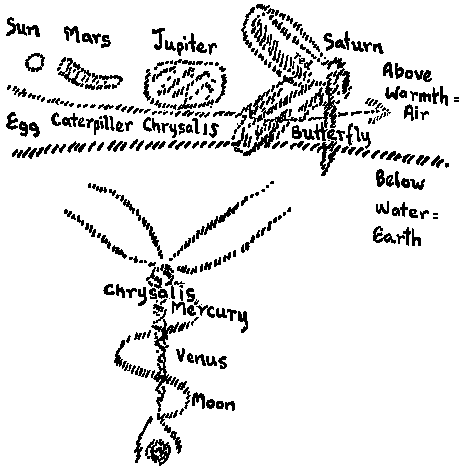
Now let us consider these other germs which were entrusted to the Earth at the time when the third metamorphosis, the Moon-condition, arose. These germs, you see, now came under the influence of Earth-activity — of the watery Earth-Moon activity — just as the insect germs had formerly come under the influence of the Sun activity and of what is beyond the Sun. And through the fact that these germs came under the influence of earth-water activity, they became the plant-germs. And the germs which remained behind in the upper regions, these remained insect-germs. When the third metamorphosis began — through what at the time was of a Sun-nature becoming transformed into what was of the nature of Moon-Earth — the plant-germs came into being, during this third metamorphosis of Earth evolution. And what you now have in the butterfly, under the development of the extraterrestrial cosmos, this whole development from the germ, through the caterpillar, through the chrysalis to the butterfly — this you are now in a position to follow in the plant. In that the seed became earthly it was not the butterfly which developed; but when the seed became earthly, entrusted to the Earth — not now to the Sun — the plant root developed, the first thing to arise out of the germ. And instead of the caterpillar creeping out, under the influence of the forces which proceed from Mars, the leaf arises, creeping upwards in spiral formation. The leaf is the caterpillar which has come under the influence of what is earthly. When you see the creeping caterpillar you have, in the upper regions, what corresponds, below, to the leaf of the plant; the leaf develops out of what became root through the fact that the seed was transplanted from the region of the Sun to the region of the Earth.
Proceeding further upwards, we find contracted to the calyx what is of the nature of the chrysalis. And finally the butterfly develops in the blossom, which is colored, just like the butterfly in the air. The circle is completed. Just as the butterfly lays its egg, so does the blossom develop within itself the new seed for the future. So you see, we look up towards the butterfly, and we understand it to be the plant raised up into the air. What the butterfly becomes from egg to full development under the influence of the Sun with the upper planets, the plant becomes here below under the influence of the Earth. When the plant comes into leaf (see diagram) we have from the Earth aspect the influence of the Moon, then the Venus influence and the Mercury influence. Then there is a return to the Earth influence. The seed is again under Earth influence.
We can, therefore, place before ourselves two verses, which give expression to a great secret of nature:


Behold the plant:
It is the butterfly
Fettered by the Earth.


Behold the butterfly:
It is the plant
Freed by the cosmos.


The plant — the butterfly fettered by the Earth! The butterfly — the plant freed from the Earth by the cosmos!
If one looks at the butterfly, indeed at any insect, from the stage of the egg to when it is fluttering away, it is the plant raised up into the air, fashioned in the air by the cosmos. If one looks at the plant, it is the butterfly fettered to what is below. The egg is claimed by the Earth. The caterpillar is metamorphosed into leaf-formation. In what is contracted in the plant we have the metamorphosis of the chrysalis-formation. And then what unfolds into the butterfly itself, in the plant develops into the blossom. Small wonder that such an intimate relationship exists between the world of the butterflies, the insect-world in general, and the world of the plants. For in truth those spiritual beings which are behind the insects, the butterflies, must say to themselves: There below are our relatives; we must have intercourse with them, unite ourselves with them — unite ourselves with them in the enjoyment of their juices, and so on, for they are our brothers. They are our brothers who have wandered down into the domain of the Earth, who have become fettered to the earthly, who have won another existence.
And again, the spirits who ensoul the plants can look up to the butterflies and say: These are the heavenly relatives of the earthly plants.
You see, one must really say that understanding of the world cannot come about through abstractions, for abstractions do not attain to understanding. Cosmic activity is indeed the greatest of artists. The cosmos fashions everything according to laws which bring the deepest satisfaction to the artistic sense. And no one can understand the butterfly, which has sunk down into the Earth, unless he metamorphoses abstract thoughts into artistic sense. No one can understand the nature of the blossoming plant, which, as the butterfly, has been uplifted into the air by the light and by cosmic forces, unless once again he can bring artistic movement into abstract thoughts. There always remains something immensely uplifting when we turn our minds to the deep, inward connection between the things and beings of nature.
It is a unique experience to see an insect poised on a plant, and at the same time to see how the astrality holds sway above the blossom. Here the plant is striving outwards from the earthly. The plant's longing for the heavenly works and weaves above the iridescent petals of the blossom. The plant cannot of itself satisfy this longing. Thus there radiates towards it from the cosmos what is of the nature of the butterfly. In beholding this the plant realizes the satisfaction of its own desires. And this is the wonderful relationship existing in the environment of the Earth, namely that the longings of the plant-world are assuaged in looking up to the insects, in particular the world of the butterflies. What the blossoming flower longs for as it radiates its color out into world-space becomes for it fulfillment in knowledge when the butterfly approaches it with its shimmer of colors. Outstreaming warmth, outstreaming longing: instreaming satisfaction from the heavens — this is the interplay between the world of the blossoming plants and the world of the butterflies. This is what we should see in the environment of the Earth.
Having thus established the connection with the plant world, I shall now be in the position to extend still further in the near future the studies which lead from the human being to the animals. We can already include the plant world, and thus we shall gradually come to man's connection with the whole Earth. But for this it was necessary to build, as it were, a bridge from the fluttering plant of the air, the butterfly, to the butterfly firmly rooted in the Earth, the plant. The earthly plant is the firmly rooted butterfly. The butterfly is the flying plant. Having recognized this connection between the Earth-bound plant and the heaven-freed butterfly, we have now established the bridge between the animal world and the plant world, and thus we can now look down with a certain unconcern upon all the trivialities which are always saying how spontaneous generation and the like took place. These prosaic concepts will never lead us into those regions of the universe to which we must attain. Those spheres are only reached when prosaic concepts can be led over into artistic concepts, so that we may then arrive at the picture of how, from the heaven-born butterfly which is only entrusted to the Sun, the plant later arose through this butterfly's egg becoming metamorphosed in such a way that, whereas it was formerly entrusted to the Sun, it now became entrusted to the Earth.


Saturday, May 28, 2022

In Memoriam


War: What is it good for?


"Wisdom is crystallized pain."  — Rudolf Steiner


Getting drafted in 1969 forced me to wrestle with the problem of evil — specifically: How could something this bad happen to me?


“War is waged by men; not by beasts, or by gods. It is a peculiarly human activity. To call it a crime against mankind is to miss at least half its significance; it is also the punishment of a crime.” —Frederic Manning


Paul Fussell:


That month away from the line helped me survive for four weeks more but it broke the rhythm and, never badly scared before, when I returned to the line early in March I found for the first time that I was terrified, unwilling to take the chances that before had seemed rather sporting. My month of safety had renewed my interest in survival, and I was psychologically and morally ill prepared to lead my platoon in the great Seventh Army attack of March 15, 1945. But lead it I did, or rather push it, staying as far in the rear as was barely decent. And before the day was over I had been severely rebuked by a sharp-eyed lieutenant-colonel who threatened court martial if I didn’t pull myself together. Before that day was over I was sprayed with the contents of a soldier’s torso when I was lying behind him and he knelt to fire at a machine gun holding us up: he was struck in the heart, and out of the holes in the back of his field jacket flew little clouds of tissue, blood, and powdered cloth. Near him another man raised himself to fire, but the machine gun caught him in the mouth, and as he fell he looked back at me with surprise, blood and teeth dribbling out onto the leaves. He was one to whom early on I had given the Silver Star for heroism, and he didn’t want to let me down.

As if in retribution for my cowardice, in the late afternoon, near Ingwiller, Alsace, clearing a woods full of Germans cleverly dug in, my platoon was raked by shells from an .88, and I was hit in the back and leg by shell fragments. They felt like red-hot knives going in, but I was as interested in the few quiet moans, like those of a hurt child drifting off to sleep, of my thirty-seven-year-old platoon sergeant—we’d been together since Camp Howze—killed instantly by the same shell. We were lying together, and his immediate neighbor on the other side, a lieutenant in charge of a section of heavy machine guns, was killed instantly too. My platoon was virtually wiped away. I was in disgrace, I was hurt, I was clearly expendable—while I lay there the supply sergeant removed my issue wristwatch to pass on to my replacement—and I was twenty years old.
I bore up all right while being removed from “the field” and passed back through the first-aid stations where I was known. I was deeply on morphine, and managed brave smiles as called for. But when I got to the evacuation hospital thirty miles behind the lines and was coming out of the anesthetic from my first operation, all my affectations of control collapsed, and I did what I’d wanted to do for months. I cried, noisily and publicly, and for hours. I was the scandal of the war. 


Here's a salutation to my fellow draftees, all of whom were sacrificed by evil for evil.


A man coerced against his will is of the same opinion still.


Everything the State says is a lie, and everything it has it has stolen.  ~Nietzsche


Yogananda : The Bliss of Yoga


My 75-year-old self and my 12-year-old self
have decided to come together in this guy,
who says "Call me Yogananda"


At-one-ment


Washed in the Blood of the Lamb are We
Awash in a Sonburst Sea
You—Love—and I—Love—and Love Divine:
We are the Trinity

You—Love—and I—We are One-Two-Three
Twining Eternally
Two—Yes—and One—Yes—and also Three:
One Dual Trinity
Radiant Calvary
Ultimate Mystery


Continued: https://martyrion.blogspot.com/2022/05/forever-young-meeting-spirit-of-our.html

The Human Being's Indebtedness to the Earth — the Meaning of the World


Man as Symphony of the Creative Word. Lecture 3 of 12.
Rudolf Steiner, Dornach, Switzerland, October 21, 1923:


We have tried, again from a particular aspect, to place the human being into the universe. Today we wish to put the subject forward in a way which will, as it were, weld everything into a whole. During our physical life we live upon the Earth; we are surrounded by those events and facts which are there because of the physical matter of the Earth. This matter is moulded and shaped in the most varied manner so as to be adapted to the beings of the kingdoms of nature, up to the human form itself. The essential element in all this is the physical matter of the Earth. Today — because we shall immediately have to speak about its opposite — let us call this matter the physical substance of the Earth, comprising all that provides the material basis for the various earthly forms; and then let us differentiate from it everything in the universe which is the opposite of this physical substance, namely spiritual substance. This last is the basis not only of our own soul but also of all those formations in the universe which, as spiritual formations, are connected with physical formations.
It is not right to speak only of physical matter or physical substance. Think only of the fact that we must place into the total picture of the world the beings of the higher hierarchies. These beings of the higher hierarchies have no earthly substance, no physical substance, in what in their case we would call their bodily nature. What they have is spiritual substance. When we look upon what is earthly we become aware of physical substance; when we can look upon what is outside the earthly we become aware of spiritual substance.
Today people know little of spiritual substance. That is why they also speak of that Earth-being who belongs both to the physical and the spiritual — the human being — as though he, too, only possessed physical substance. This, however, is not the case. Man bears both spiritual and physical substance in himself in so remarkable a way as to astonish anyone who is not accustomed to pay heed to such matters. If, for example, we consider that element in man which leads him into movement, namely what is connected with the human limb-system and its continuation inwards as digestive activity, then it is incorrect to speak primarily of physical substance. You will soon understand this still more exactly. We only speak correctly about the human being when we regard the so-called lower part of his nature as having as its basis what is in fact spiritual substance. So that, if we were to represent the human being schematically, we would have to say: The lower man actually shows us a formation in spiritual substance, and the more nearly we approach the human head the more is man formed of physical substance. Basically the head is formed out of physical substance; but of the legs — grotesque though this may sound — it must be said that essentially they are formed of spiritual substance. So that when we approach the head we must represent the human being in such a way that we allow spiritual substance to pass over into physical substance; in the human head in particular, physical substance is contained. Spiritual substance, on the other hand, is diffused in a particularly beautiful way just where — if I may put it so — man stretches out his legs, stretches out his arms, into space. It is really as though the most important matter for arm and leg is precisely this being filled with spiritual substance, as if this is their essence. In the case of arm and leg it is really as though the physical substance were only swimming in the spiritual substance, whereas the head presents a compact formation composed of physical substance. In a form such as man possesses, however, we must differentiate not only the substance, but also the forces. And here again we must distinguish between spiritual forces and earthly, physical forces.
In the case of the forces, things are completely reversed. Whereas for the limb-system and digestion the substance is spiritual, the forces in the limbs — for instance in the legs — are heavy, physical forces. And whereas the substance of the head is physical, the forces active within it are spiritual. Spiritual forces play through the head; physical forces play through the spiritual substance of the limb and metabolic system in man. The human being can only be fully understood when we distinguish in him the upper region — his head and also the upper part of the breast, which are actually physical substance worked through by spiritual forces (I must mention that the lowest spiritual forces are active in the breathing). And we must regard the lower part of man as a formation composed of spiritual substance, within which physical forces are working. Only we must be clear as to how these things are interrelated in man, for the human being also projects his head-nature into his whole organism, so that the head — which is what it is because it is composed of physical substance worked through by spiritual forces — the head also projects its entire nature into the lower part of the human being; and what man is because of his spiritual substance, in which physical forces are at work, this, on the other hand, plays upwards into the upper part of the organism. In these activities in the human being there is mutual interaction. Man can in fact only be understood when he is regarded in this way, as composed of physical-spiritual substantiality and physical-spiritual dynamics, that is to say what is of the nature of forces.
This is something of great significance. For if we look away from external phenomena and enter into the inner being it becomes clear to us, for instance, that no irregularities can be allowed to enter into this apportioning of what is of the nature of substance and of forces in the human being.
If, for example, what should be pure substance, pure spiritual substance in man, is too strongly penetrated by physical matter, by physical substance — if, that is to say, physical substance, which should in fact tend upwards towards the head, makes itself too strongly felt in the metabolism — then digestion becomes too strongly affected by the head-system, and man becomes ill; certain quite definite types of illness then arise. And then the task of healing consists in paralyzing, in driving out, the physical substance-formation which is intruding into the spiritual substantiality. On the other hand, when man's digestive system, in its peculiar manner of being worked through by physical forces in spiritual substance, when this digestive system is sent up towards the head, then the head becomes, as it were, too strongly spiritualized, then there sets in a too strong spiritualization of the head. And now, because this also presents a condition of illness, care must be taken to send enough physical forces of nourishment to the head, so that they reach the head in such a way that they do not become spiritualized.
Anyone who turns his attention to man in health and sickness will very soon be able to perceive the usefulness of this differentiation, if he is really concerned with truth, and not with external illusion. But something essentially different also plays into this matter. What here plays in — the fact that man feels himself as a being constituted in the way I have described — this at first remains for the ordinary consciousness of today below in the unconscious. There, certainly, it is already present; and there it emerges as a kind of mood, a kind of life-mood of man. But it is spiritual vision alone that brings it to full consciousness, and I can only describe this spiritual vision to you thus: The man who knows from present-day initiation-science this secret of the human being — namely that the head is the most important, the most essential organ which needs physical substance with spiritual forces; who knows further that the most essential thing in the system of limbs and metabolism is spiritual substance which needs physical forces — the forces of gravity, of balance, and the other physical forces in order to exist; who can thus penetrate with spiritual vision into this secret of the human being and who then turns his gaze back to this human, earthly existence — this man must acknowledge himself as a tremendous debtor to the world. For he must admit that in order to maintain his human existence he requires certain conditions — but through these very conditions he becomes a debtor to the Earth. He is continually withdrawing something from the Earth. And he finds himself obliged to say that the spiritual substance, which as man he bears within himself during earthly existence, is actually needed by the Earth. When man passes through death, he should in fact leave this spiritual substance behind him for the Earth, for the Earth continually needs spiritual substance for its renewal. But this man cannot do, for he would then be unable to traverse his human path through the period after death. He must take this spiritual substance with him for the life between death and a new birth; he needs it, for he would disappear, so to speak, after death, if he did not take this spiritual substance with him.
Only by carrying this spiritual substance of his limb-metabolic system through the gate of death can man undergo those transformations which he must there undergo. He would be unable to meet his future incarnations if he were to give back to the Earth this spiritual substance which he actually owes to it. He cannot do this. He remains a debtor. And this is something which there is no means of bettering as long as the Earth remains in its middle period. At the end of Earth-existence things will be otherwise.
It is indeed the case, my dear friends, that one who beholds life with spiritual vision has not only those sufferings and sorrows — perhaps also that happiness and joy — which are offered by ordinary life, but — with the beholding of the spiritual — cosmic feelings, cosmic sufferings and joys, make their appearance. And initiation is inseparable from the appearance of such cosmic suffering as, for example, the fact that one has to admit: Simply because I must maintain my humanity I must make of myself a debtor to the Earth. I cannot give to the Earth what I really should give if, in a cosmic sense, I were to act with complete rectitude.
Matters are similar as regards the substance which is present in the head. Because throughout the entire course of Earth-life spiritual forces are working in the physical substance of the head, this head-substance becomes estranged from the Earth. Man must take away from the Earth the substance for his head. But he must also, in order to be man, continually imbue this substance of his head with extra-terrestrial spiritual forces. And when the human being dies, this is something extremely disturbing to the Earth, because it must now take back the substance of the human head which has become so foreign to it. When the human being passes through the gate of death and yields up his head-substance to the Earth, then this head-substance — which is entirely spiritualized, which bears within itself what results from the spiritual — does in fact act as a poison, as a really disturbing element, in the totality of the life of the Earth. When man sees into the truth of these matters, he is obliged to say to himself that the honest thing would be to take this substance with him through the gate of death, for it would in fact be much better suited to the spiritual region which man traverses between death and a new birth. He cannot do this. For if man were to take this spiritualized Earth-substance with him, he would continually create something adverse to all his development between death and a new birth. It would be the most terrible thing that could happen to man if he were to take this spiritualized head-substance with him. It would work incessantly upon the negation of his spiritual development between death and rebirth.
One must therefore acknowledge, when one sees into the truth of these things, that here, too, man becomes a debtor to the Earth; for something for which he is indebted to the Earth but has made useless for it, this he must continually leave behind, he cannot take it with him. What man should leave for the Earth he takes from it; what man should take with him, what he has made useless for it, this man gives over to the Earth with his earthly dust, thus causing the Earth immense suffering in its entire life, in its whole collective being.
It is indeed the case that at first, just through spiritual vision, something weighs heavily upon the human soul, something like a tremendous feeling of tragedy. And only when one surveys wider epochs of time, when one beholds the development of entire systems, only then is the prospect revealed that, when the Earth will have approached its end, in later stages of human evolution — in the Jupiter, Venus, Vulcan stages — will man be able to restore the balance, to annul the debt.
Thus it is not only by passing through the experiences of a single life that man fashions karma, but man creates karma, world karma, cosmic karma, just through the fact that he is an earthly human being, that he is an inhabitant of the Earth, and draws his substance from the Earth.
Here it is possible to look away from man, to look towards the rest of nature and see how — though man must burden himself with the debt of which I have just told you — balance is nevertheless continually restored by cosmic beings. And here one penetrates into wonderful secrets of existence, into secrets which, when taken in conjunction with each other, become something from which one can first gain a conception of the wisdom of the world.
Let us turn our gaze away from man and towards something which has claimed much of our attention during the last few days: let us turn our gaze to the world of the birds, represented for us by the eagle. We spoke of the eagle as the representative of the bird-world, as the creature which synthesizes the characteristics and forces of the bird-kingdom. When we consider the eagle, we are in fact considering, in their cosmic connection, all the attributes which prevail in the bird-world as a whole. In future, therefore, I shall simply speak of “the eagle.”
I have told you how the eagle actually corresponds to the head of man, and how those forces which give rise to thoughts in the human head give rise in the eagle to his plumage. So that the Sun-irradiated forces of the air, the light-imbued forces of the air, are actually working in the eagle's plumage.
This is what shimmers in the eagle's plumage: the light-irradiated power of the air.
Now the eagle — to whom many bad qualities may certainly be ascribed — does nevertheless possess, as regards his cosmic being, the remarkable attribute that outside his skin, in the structure of his plumage, everything is retained which is formed in it by the Sun-irradiated forces of the air. What takes place here is, in fact, only to be noticed when the eagle dies.
For it is only when the eagle dies that one becomes aware of what a remarkable superficial digestion he has compared with the thorough-going digestion of the cow, with its process of chewing the cud. The cow is really the animal of digestion — again as representative of many creatures of the animal kingdom. Here digestion is thoroughly performed. The eagle, like all birds, digests in a superficial way; the business of digestion is only begun. In the eagle, compared with his whole existence, digestion is merely a subsidiary process and is treated as such. On the other hand, everything in the eagle which has to do with plumage proceeds in a thorough way. (In the case of some other birds this is even more so.) Everything to do with the feathers is worked out with immense care. Such a feather is indeed a wonderful structure. Here we find most strongly in evidence what may be called earthly matter, which the eagle has taken from the Earth, spiritualized by the forces of the heights, but in such a way that the eagle does not assimilate it; for the eagle makes no claim to reincarnation. He need not, therefore, be troubled about what is being brought about in the earthly matter of his plumage through the spiritual forces of the heights; he need not be troubled about how this works on in the spiritual world.
Now, when the eagle dies and his feathers fall into decay — as already mentioned this holds good for every bird — the spiritualized earthly matter ascends into spirit-land and becomes changed back into spiritual substance.
You see we have a remarkable relative interplay as regards the relationship of our head to the eagle. What we cannot do, the eagle can; he can continually conjure forth from the Earth what becomes spiritualized in the Earth through spiritual forces working on earthly substance.
This, too, is why we experience such a remarkable sensation when we observe an eagle in its flight. We feel him as something foreign to the Earth, something which has more to do with the heavens than with the Earth, although he draws his substance from the Earth. But how does he do this? He obtains his substance in such a way that, as regards the Earth, he is just a robber. For according to what may be called the ordinary, commonplace law of Earth-existence no provision was made for the eagle to get anything. He becomes a robber; he steals his substance, as is done in all sorts of ways by the bird-kingdom as a whole. But the eagle restores the balance. He steals his material substance, but allows it to be spiritualized by the forces which exist as spiritual forces in the upper regions; and after death he carries off into spirit-land those spiritualized Earth-forces which he has stolen. With the eagles the spiritualized Earth-matter withdraws into spiritland.
Now the life of animals also does not come to an end when they die. They have their significance in the universe. And the eagle in flight is only a symbol of his real being. He flies as physical eagle — Oh, but he flies further after his death! The spiritualized physical matter of the eagle nature flies into the universe in order to unite itself with the spiritual substance of spiritland.
You see what wonderful secrets of the universe one comes upon when one enters into the reality of these things. Only then does one really learn why the various animal and other forms of the Earth are there. They all have their great, their immense, significance in the whole universe.
And now let us turn to the other extreme, to something which we have also studied during these days: let us turn to the cow, so venerated by the Hindu. There we have the opposite extreme. Just as the eagle is very similar to the head, so is the cow very similar to the human digestive system. The cow is the animal of digestion. And, strange as it sounds, this animal of digestion consists essentially of spiritual substance into which the physical matter consumed is merely scattered and diffused. In the cow is the spiritual substance, and everywhere the physical substance penetrates into it, and is absorbed, made use of, by the spiritual substance. It is in order that this may happen in a really thorough way that the process of digestion in the cow is so comprehensive, so fundamental. It is really the most fundamental digestive process that can be conceived, and in this respect — if I may put it so — the cow fosters what is fundamental to animal nature more thoroughly than any other animal in the absolute sense. She actually brings animal-nature — this animal egoism, this animal egoity — out of the universe down on to the Earth, down into the region of Earth-gravity.
No other animal has the same proportion between the blood-weight and the entire body-weight as the cow; other animals have either less or more blood than the cow in proportion to the weight of the body. And weight has to do with gravity, and the blood with egoity — not with the ego, for this is only possessed by man, but with egoity, with separate existence. The blood also makes the animal, animal — the higher animal at least. And I must say that the cow has solved the world-problem as to the right proportion between the weight of the blood and the weight of the whole body — when there is the wish to be as thoroughly animal as possible.
You see, it was not for nothing that the ancients called the zodiac “the animal circle.” The zodiac is twelvefold; it divides its totality into twelve separate parts. Those forces, which come out of the cosmos, from the zodiac, take on form and shape in the animals. But the other animals do not conform to the zodiacal proportion so exactly. The cow has a twelfth part of her body-weight in the weight of her blood. With the cow the blood-weight is a twelfth part of the body-weight; with the donkey only the twenty-third part; with the dog the tenth part. All the other animals have a different proportion. In the case of man the blood is a thirteenth of the body-weight.
You see, the cow has seen to it that, in her weight, she is the expression of animal nature as such, that she is as thoroughly as possible the expression of what is cosmic. A fact I have mentioned repeatedly during these days — namely that one sees from the astral body of the cow that she actually manifests something lofty in physical-material substance — this comes to expression of itself through the fact that the cow maintains the partition into twelve in her own inner relationships of weight. The cosmic in her is at work. Everything to do with the cow is of such a nature that the forces of the Earth are working into spiritual substance. In the cow Earth-heaviness is obliged to distribute itself according to zodiacal proportion. Earth-heaviness must accommodate itself to allow a twelfth part of itself to fall away into egoity. What the cow possesses as spiritual substance has necessarily to enter into earthly conditions.
Thus the cow, lying in the meadow, is in actual fact spiritual substance, which Earth-matter takes up, absorbs, makes similar to itself.
When the cow dies, this spiritual substance which the cow bears within herself can be taken up by the Earth, together with the earthly matter, for the well-being of the life of the whole Earth. And man is right when he feels in regard to the cow: You are the true beast of sacrifice, for you continually give to the Earth what it needs, without which it could not continue to exist, without which it would harden and dry up. You continually give spiritual substance to the Earth, and renew the inner mobility, the inner living activity, of the Earth.
When you behold on the one hand the meadow with its cattle, and on the other hand the eagle in flight, then you have their remarkable contrast: the eagle who, when he dies, carries away into the expanses of spiritland that earth-matter, which — because it is spiritualized — has become useless for the Earth; and the cow, who, when she dies, gives to the Earth heavenly matter and thus renews the Earth. The eagle takes from the Earth what it can no longer use, what must return into spiritland. The cow carries into the Earth what the Earth continually needs as renewing forces from spiritland.
Here you become aware of something like an upsurging of feelings and perceptions from out of initiation-science. It is usually believed about this initiation-science, well, that one certainly studies it, but that it results in nothing but concepts, ideas. One fills one's head with ideas about the supersensible, just as one otherwise fills one's head with ideas about the things of the senses. But this is not how it is. Penetrating ever further into this initiation-science, we reach the point of drawing forth from the depths of the soul feelings and perceptions the existence of which we formerly did not even surmise, but which nevertheless are there unconsciously in every human being; we reach the point of experiencing all existence differently from the way we experienced it before. And so I can describe to you an experience which actually belongs to the living comprehension of spiritual science, of initiation science. It is an experience which would make us acknowledge that if man alone were upon the Earth, we should — if we recognize his true nature — have to despair of the Earth ever receiving what it needs, namely, that at the right time spiritualized matter should be withdrawn and spirit-substance bestowed. We should have to experience an opposition between man and the being of the Earth, which causes great, great pain, and causes that pain because we have to admit that, if man is to be rightly man upon the Earth, the Earth cannot be rightly Earth because of man. Man and Earth have need of each other, but man and Earth cannot mutually support each other. What the being of the one requires is lost to the other; what the other needs is lost to the one. And we should have no security as regards the life-relationship between man and Earth were it not that the surrounding world enables us to say: What the human being is unable to achieve as regards the carrying of spiritualized Earth-substance over into spiritland, this is accomplished by the bird-kingdom; and what man is unable to do as regards giving spiritual substance to the Earth, this is accomplished by the animals which chew the cud, as represented by the cow.
In this way, you see, the world is rounded into a whole. If we look only at man, uncertainty enters our feelings as regards the being of the Earth; if we look at what surrounds man, our feeling of certainty is restored.
And now you will wonder even less that a religious world-conception which penetrates so deeply into the spiritual as does Hinduism venerates the cow, for she is the animal which continually spiritualizes the Earth, which continually gives to the Earth that spiritual substance which she herself takes from the cosmos. And we must learn to accept as actual reality the picture that, beneath a grazing herd of cattle, the Earth below is quickened to joyful, vigorous life, that there below the elemental spirits rejoice, because they are assured of their nourishment from the cosmos through the existence of the creatures grazing above them. And we would have to make another picture of the dancing, rejoicing, airy circle of the elemental spirits hovering around the eagle. Then again one would portray spiritual realities, and in the spiritual realities one would see the physical; one would see the eagle extended outwards in his aura, and playing into the aura the rejoicing of the elemental air-spirits and fire-spirits of the air.
And one would see that remarkable aura of the cow, which so strongly contradicts her earthly nature, because it is entirely cosmic; and one could see the lively merriment in the senses of the elemental Earth-spirits, who are thus able to perceive what has been lost to them because they are sentenced to live out their existence in the darkness of the Earth. For these spirits, what here appears in the cows is Sun. The elemental spirits whose dwelling place is in the Earth cannot rejoice in the physical Sun, but they can rejoice in the astral bodies of the animals which chew the cud.
Yes, my dear friends, there does indeed exist a natural history which is different from what is to be found today in books. What is actually the end and aim of the natural history found today in books?
There has just appeared the sequel to that book by Albert Schweitzer which I discussed some time ago. You may remember my article dealing with this little book on present-day conditions of civilization, which appeared some time back in “The Goetheanum”. [* See Das Goetheanum, No. 47 of 1923.] The preface to this sequel is in fact a somewhat sorry chapter in the spiritual productions of the present day; for whereas the first booklet, which I then discussed, possessed at least a certain force and the insight to admit what our civilization lacks, this preface is a really sorry chapter. For Schweitzer here takes credit to himself for being the first to perceive that, fundamentally speaking, knowledge alone can provide absolutely nothing, and that ethics and a world-conception must be gained from somewhere other than knowledge.
Now in the first place much has been said about the boundaries of knowledge, and it is — how shall I put it? — a trifle short-sighted to believe that one has been the first to speak about the boundaries of knowledge. This has been done by the natural scientists in every possible key. So one has no need to pride oneself upon being the first to discover the colossal error.
Seen apart from this, however, the fact appears that such an excellent thinker as Schweitzer — for he is an excellent thinker, as his first little volume certainly shows — has reached the conclusion that if we wish to have a world-conception, if we wish to have ethics, then we must look right away from science and knowledge, for these in fact give us nothing. Recognized science and knowledge, as put forward today in books, these aspects of science and knowledge do not enable us — as Schweitzer says — to discover meaning in the universe. For, indeed, if one looks upon the world as these personalities do, one cannot avoid the conclusion that eagles in their flight have no purpose, apart from the fact that they can be used in making armorial crests; cows are physically useful because they give milk, and so on. But because man also is regarded only as a physical being, he only possesses physical usefulness; and all this has no meaning for the world as a whole.
If people are unwilling to go further than this, they will certainly not reach the level where a world-meaning can appear; we must pass on to what the spiritual, to what initiation-science, can say to us about the world; then we shall certainly discover the meaning of the world. Then we shall find this meaning of the world as we discover wonderful mysteries in all existence — mysteries such as that which unfolds itself in connection with the dying eagle and the dying cow; and there between them the dying lion, which in his turn so holds spiritual substance and physical substance in balance within himself, through the harmony he establishes in the rhythm of breathing and of blood, that it is he who regulates, through his group-soul, how many eagles are necessary, and how many cows are necessary, to enable the correct process both upwards and downwards to take its course in the way I have described to you.
You see, the three animals — eagle, lion, ox or cow — they were created out of a wonderful intuitive knowledge. Their connection with man is imbued with feeling. For the human being, when he sees into the truth of these things, must really admit: The eagle takes from me the tasks which I myself cannot fulfill through my head; the cow takes from me the tasks which I myself cannot fulfill through my metabolism, through my limb system; the lion takes from me those tasks which I myself cannot fulfill through my rhythmic system. And thus from myself and the three animals something complete is established in the cosmos.
Thus one lives one's way into cosmic relationships. Thus one feels the deep connections in the world, and learns to know how wise are those powers which hold sway in the world of being into which man is woven, and which live and move around him.
In this way you see how we were able to weld together into a whole the divers matters which came to our knowledge when we sought to discover man's connection with the three animal representatives about whom we have spoken in recent weeks.